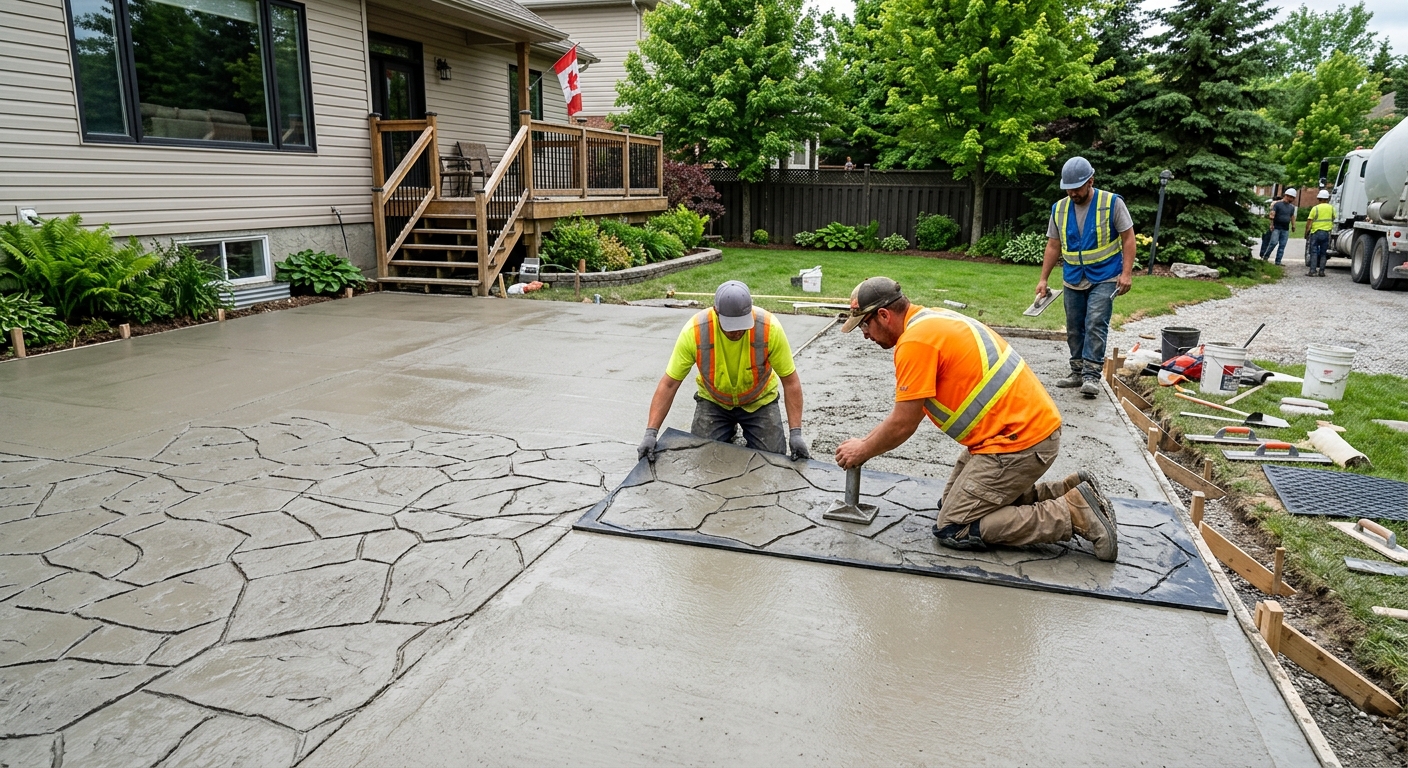
Concrete work options and costs in Spruce Avenue
Spruce Avenue, Alberta has a steady demand for concrete flatwork—especially driveways, patios, and walkways—because this community’s housing stock is largely centred around single-detached neighbourhood living. With a population of 2,120 (Statistics Canada, 2021 Census), you’ll still see frequent replacement projects as homeowners upgrade curb appeal and deal with older slabs. In this Calgary economic region, contractor availability is generally good, but pricing reflects how the cold continental climate forces every pour to be engineered for frost and freeze–thaw. Local engineering practice commonly assumes a design frost depth of about 1.2 m (roughly 4 ft), so footings for houses, garages, and retaining structures must bear on undisturbed soil below that depth to reduce seasonal movement.
That frost-driven excavation and the granular base prep add time and material, which is why foundation/footings pricing often sits higher than in milder provinces. On top of that, exterior slabs need air-entrained concrete mixes and well-spaced control joints to reduce cracking and surface scaling. If you’re working around the shorter exterior pour season, winter-grade placement measures—like insulating blankets and sometimes temporary heating—can also move costs up. You’ll notice this trade being particularly active in family residential pockets where driveways and backyard patios are common upgrade targets.
Below is a homeowner-friendly comparison of typical options, including the finish choices that matter most in a freeze–thaw climate. Use it as a starting point, then match the specs to your site conditions and access constraints.
| Application |
Typical Size |
Key Spec |
Finish Option |
Price Range |
| Concrete driveway (standard broom finish) |
24 ft x 12 ft (288 sq ft) |
Air-entrained exterior mix, compacted base, control joints |
Broom finish, saw-cut joints |
$12,000–$18,000 |
| Exposed aggregate driveway |
24 ft x 12 ft (288 sq ft) |
Air-entrained mix, washed/retarded top, proper curing window |
Exposed aggregate, sealed surface |
$14,500–$20,500 |
| Stamped concrete driveway or patio |
20 ft x 12 ft (240 sq ft) |
Air-entrained exterior mix, integral colouring, curing under protection |
Stamp texture + colour; often sealed after cure |
$15,000–$26,000 |
| Plain concrete patio or walkway |
12 ft x 16 ft (192 sq ft) |
Air-entrained mix, compacted granular base, expansion/control detailing |
Float/smooth or broom; lightly textured to reduce slip |
$5,000–$9,000 |
| Garage floor (interior slab) |
22 ft x 24 ft (528 sq ft) |
Moisture control base layers; mix suited to interior performance |
Plain finish; optional hardener |
$9,500–$16,500 |
| Foundation footings (structural, below frost) |
Typical house/garage perimeter + piers |
Engineered reinforcement; pour depths below design frost |
Structural concrete formwork and finishing minimal/functional |
$28,000–$45,000 |
Prices are estimates only and vary by project scope, site access and material selection.
What affects the price of concrete work in Spruce Avenue
In Spruce Avenue and the broader Calgary area, two quotes for the “same” concrete job can easily differ by 30–50% because the cost is driven less by the concrete itself and more by the engineering, excavation, scheduling, and cold-weather logistics. A driveway isn’t just a slab—it’s frost-protected base prep, reinforcement detailing, and a finish system that can survive Alberta winters and de-icing practices. Calgary’s freeze–thaw cycles dictate that exterior work uses air-entrained concrete and a tight control joint plan. And because the design frost depth is about 1.2 m (roughly 4 ft), footing excavations and form heights are larger here than in regions with shallower frost penetration.
Pricing also shifts with the pour season. Cold-weather placement often requires engineered cold-weather curing precautions—insulating blankets, temperature management, and sometimes supplemental heating—to reach proper strength and prevent early surface scaling. That matters when exterior projects are scheduled late in the year or early spring, when the surface can freeze before the concrete gains strength. De-icing salt further increases risk of spalling if the mix and curing aren’t right, so sealing becomes more than an aesthetic choice.
In practical terms for Spruce Avenue: (1) if your driveway ties into existing paving or needs regrading, the excavation and drainage work can push you toward the higher end of $12,000–$18,000. (2) If you want stamped work, the added labour for forming, colouring, and texture can justify moving toward $15,000–$26,000, but plain broom-finish concrete may still be the better value when your priority is durability over appearance.
| Price Factor |
Why It Matters |
Cost Impact |
| Frost line depth — determines footing depth and form height |
Footings must extend below the design frost depth to reduce frost heave and seasonal movement |
Major cost driver; deeper excavation/longer pump or labour time can add thousands |
| Site preparation — excavation, grading, compacted granular base |
Proper base thickness and compaction prevents settlement and reduces cracking in freeze–thaw |
Can swing 15–30% depending on soil conditions and removal/haul-off needs |
| Reinforcement — rebar or wire mesh requirement |
Controls cracking and improves slab performance under loads and temperature cycling |
Moderate; small changes in layout or steel grade can affect total |
| Mix design — air-entrainment and compressive strength spec |
Exterior air-entrainment and strength targets protect against freeze–thaw damage |
Moderate; “right” mix prevents costly premature repairs |
| Finish type — broom vs. stamped vs. exposed aggregate |
Finish systems require different crews, tooling, and curing attention |
High; decorative systems can add substantial labour and material cost |
| Pour size and concrete truck access to site |
Access determines whether concrete must be wheelbarrowed or pumped, affecting labour time |
Can add materially on tight sites; truck access often decides the schedule |
| Cold-weather curing precautions — heating and blankets |
Ensures strength gain when air temperatures are low and surfaces risk freezing |
Sometimes significant; adds gear, labour supervision, and material layers |
| Control joint pattern and sealing cost |
Joint spacing limits random cracking; sealing helps repel de-icing salt exposure |
Moderate; small line items that strongly affect service life |
Permits & regulations in Alberta
In Alberta, structural concrete work typically requires a building permit and often engineered drawings. That usually includes footings, foundation walls, grade beams, and other elements that carry structural loads. Concrete flatwork—like patios, walkways, and driveways—usually does not require a permit unless it affects lot grading, stormwater drainage, impervious surface coverage limits, or the municipal right-of-way. Because rules can vary by how your project ties into drainage and municipal frontage, confirm with the local authority before breaking ground.
For Spruce Avenue homeowners, the practical checklist is straightforward. First, ask your contractor whether they will obtain the permit (for structural work) and provide the project engineer/permit number information. Second, verify the contractor carries liability insurance and appropriate worker coverage (WSIB/WCB). Then request references that match the same scope and complexity—such as a similar-size footing pour or an exterior slab in a freeze–thaw climate.
Step-by-step verification you can do from home: (1) check the contractor’s Alberta business details and licensing/registration information via the appropriate online registry listings (the contractor should also provide their registration number on proposals); (2) request a certificate of insurance and confirm it covers the work type (concrete/structural construction) with active dates; and (3) ask for a clearance letter or proof of coverage for workers (WSIB/WCB) and check the dates align with your project timeline. If they can’t provide these documents quickly, that’s a red flag.
Getting concrete right in Spruce Avenue's freeze-thaw climate
Concrete fails in Spruce Avenue mainly when the job is treated like “just a slab.” In our freeze–thaw conditions, the most common issues are inadequate base preparation, insufficient air-entrainment, poor curing, and joint detailing that doesn’t control cracking. When water migrates into cracks and pores, freeze–thaw expansion accelerates surface scaling and can lead to spalling—especially where de-icing salt is used on driveways and stairs. The way to avoid this is to spec the work for Calgary’s conditions from the start.
Start with (1) base preparation: excavate and build a compacted granular sub-base to the locally required depth and grade stability for your soil and the engineered frost protection approach. Then (2) mix design: for exterior flatwork, require air-entrainment (target typically 5–7% air for well-detailed exterior concrete) and a minimum 32 MPa compressive strength so it performs through winter cycles. Next (3) control joints: spacing should limit random cracking while keeping joints clean and sealed. (4) Curing matters; plan a minimum 7-day cure under proper conditions, and in cold weather use insulating blankets or temporary heat so the concrete reaches strength before freezing. Finally (5) sealing: apply a penetrating sealer after the full cure window (commonly 28 days post-pour) to repel de-icing salt and reduce surface deterioration.
If you’re comparing options, here’s a real-world value example: choosing standard broom-finish concrete can keep you nearer $12,000–$18,000 for a driveway, while stamped concrete pushes closer to $15,000–$26,000. The additional cost is justified if you want texture/colour, but you should never “buy appearance” by cutting specs like air-entrainment or curing measures—those savings often show up as repair calls 1–3 winters later.
| Spec |
Why It Matters in Spruce Avenue |
What to Ask For |
Impact if Skipped |
| Compacted granular base (depth?) |
Reduces settlement and helps manage freeze–thaw movement through the slab thickness |
Confirm engineered base depth and compaction testing/target |
More cracking, uneven settlement, and faster deterioration |
| Air-entrained concrete mix (target air %?) |
Creates room for freeze–thaw expansion so water doesn’t damage the paste |
Ask for air-entrainment target typically 5–7% for exterior flatwork |
Higher risk of spalling and scaling in Alberta winters |
| Compressive strength (MPa rating) |
Ensures the concrete reaches adequate strength before seasonal stresses |
Minimum 32 MPa specified for the application |
Lower durability, surface wear, and premature failure under loads |
| Control joints (spacing per ACI guidelines) |
Keeps shrinkage cracking controlled and prevents random wide cracks |
Request joint spacing and sealant plan on exterior slabs |
Random cracking, water entry, and freeze–thaw expansion damage |
| Minimum 7-day curing period |
Strength gain depends on time and protection from freezing/cold |
Confirm curing method and temperature management for the pour date |
Scaling, surface dusting, and long-term durability loss |
| Penetrating sealer (when applied after cure) |
Helps reduce chloride/de-icing salt intrusion into the surface |
Apply after cure window (commonly 28 days post-pour) with product specs |
Faster surface deterioration and higher maintenance/replacement risk |
How to choose a concrete work contractor in Spruce Avenue
Start with compliance. In Alberta, you want a contractor who can show current liability insurance and worker coverage (WSIB/WCB). Ask for a certificate of insurance with the work listed on it, then confirm coverage dates span your scheduled pour. For worker protection, request proof/clearance of WSIB/WCB coverage; don’t accept “we’ll figure it out later.” Also request references for projects similar in size and complexity—especially exterior flatwork in a freeze–thaw region like Calgary.
Next, get 2–3 itemised written quotes. The best quotes break out labour and materials (concrete volume, reinforcement, base prep, forming, finishing, saw cutting, sealing) rather than hiding everything in one lump sum. Carefully read the scope: what’s included in excavation, disposal/haul-off, trucking access costs, site protection, and cleanup? Confirm whether permits are included for structural work, and whether the contractor handles any engineering/redline requirements for footings and foundation components.
Warranty is also a real decision factor. Ask for a workmanship warranty length in writing, and whether product/manufacturer warranties apply to sealer or admixtures. Clarify if warranties are transferable to future owners. For payment scheduling, never pay more than 10–15% upfront; hold back a portion until completion and walk-through. Finally, require a start date and completion estimate in writing, with weather contingency language for cold snaps.
- Ask for Alberta insurance certificates and verify coverage dates match your project.
- Confirm WSIB/WCB proof or clearance letter before work starts.
- Require itemised labour/materials quotes (not just total price).
- Check whether excavation, grading, and granular base are included and to what depth.
- Confirm reinforcement plan (rebar/wire mesh) is specified in the quote.
- Ask for the concrete mix requirements: air-entrainment target and minimum compressive strength.
- Verify control joint spacing and whether joints will be sealed.
- Ask what happens in cold weather: blankets/heating, temperature targets, and curing method.
- Confirm finishing specs: broom texture anti-slip for driveways/walkways; decorative process for stamped/exposed work.
- Ensure sealing is scheduled after proper cure (commonly 28 days post-pour for penetrating sealer).
- Ask about disposal/haul-off for excess soil and whether site restoration is included.
- Require a written timeline and weather contingency statement.
Four to five concrete red flags I see in Spruce Avenue: contractors who won’t specify air-entrainment or curing steps, quotes that don’t detail base thickness and reinforcement, a refusal to provide insurance/WSIB documentation, “cheap” decorative work that skips sealing and proper joint layout, and late schedule promises with no weather plan for the short exterior pour season.
Frequently asked questions — concrete work in Spruce Avenue
Can concrete be poured in cold weather in Spruce Avenue?
Yes, concrete can be poured in Spruce Avenue during cold weather, but it must be engineered for it. In the Calgary region’s freeze–thaw climate, the key is controlling curing conditions so the concrete reaches strength before the surface and early-age concrete freeze. Contractors typically use cold-weather curing precautions such as insulated blankets and, when needed, temporary heating. The mix design may also be adjusted for winter placement requirements. Ask your contractor to outline the temperature plan for the pour and curing period, and confirm they’ll protect the slab for the necessary minimum curing time (commonly at least 7 days, with full design considerations after). If a contractor treats winter pours like summer pours, that’s how you end up with scaling and durability problems.
How do I maintain concrete in Spruce Avenue's freeze-thaw climate?
Maintenance in Spruce Avenue is about limiting water and de-icing salt exposure and keeping joints performing. Start by using a penetrating sealer after the slab has properly cured—often around 28 days post-pour for exterior work—because it helps repel chloride and reduces surface damage from road salts. Keep an eye on control joints: if sealant fails or joints open, water can migrate into cracks and accelerate freeze–thaw deterioration. Sweep debris so snowmelt and salt stay on the surface instead of trapped in rough spots. Use de-icers cautiously; they’re needed for safety, but overuse and harsh products can worsen spalling if the slab isn’t properly air-entrained. For replacement planning, a well-detailed broom-finish driveway often sits around $12,000–$18,000, while ignoring maintenance can shorten service life and cost more long-term.
What causes concrete to spall in Spruce Avenue winters?
Spalling is usually a freeze–thaw problem made worse by water and salt. The most common cause I see is inadequate air-entrainment in the concrete mix, which means the paste doesn’t have enough microscopic “space” to accommodate freeze expansion. Once water and brine get into the surface pores or cracks, repeated cycles in a cold continental climate can break down the top layer, producing flaking and spalled edges. Poor curing or early freezing can also lead to weaker surface strength, making scaling more likely. Control joints that are not spaced correctly (or not sealed where needed) let cracks widen and increase water entry. Finally, heavy de-icing salt use without a protective sealer can speed chloride-related surface deterioration. The fix is to ensure the right exterior mix and curing measures from the start—then sealing after cure is a practical step in Alberta.
What is rebar and when is it required in Alberta?
Rebar (reinforcing steel) is used to help control cracking and improve load capacity in structural concrete elements. In Alberta, when reinforcement is required depends on the engineered design for the member. For example, foundation footings and foundation walls are structural components and are typically designed with reinforcement based on loads, soil conditions, and frost-related considerations. That’s why footing and foundation work often sits in the $28,000–$45,000 band—engineering, excavation below design frost, and reinforcement detailing aren’t optional in most structural scopes. For non-structural flatwork like some patios or light walkways, you may see wire mesh or lighter reinforcement, but the spec still should match the slab thickness, soil support, and intended loads. Always rely on the project engineer’s reinforcement schedule (where applicable) and ensure the contractor follows it.
How long does a concrete project take in Spruce Avenue?
Timeline depends on the scope, weather, and site access in Spruce Avenue. For exterior flatwork, the excavation and base prep usually take 1–3 days depending on how much grading is needed and whether haul-off is required. The actual pour day is often a single day, but there’s prep the crew must complete beforehand (forms, reinforcement placement, joint layout, and curing plan). Finishing and saw-cutting are completed immediately after placement. Curing time then affects when you can use the slab: contractors often allow limited traffic after the initial set, but full durability is tied to a longer curing period (commonly a minimum of 7 days under proper conditions). If cold-weather measures like blankets/heating are required, the contractor may extend protection time. For homeowners, decorative work like stamped concrete can add 1–2 extra working days compared with plain broom-finish slabs.
What is a concrete overlay and is it suited to Spruce Avenue?
A concrete overlay is a new top layer placed over an existing slab to improve appearance and restore a worn surface. It can be suited to Spruce Avenue when the existing concrete is structurally sound—meaning there isn’t widespread base failure, significant settlement, or deep structural cracking. Overlays can be a cost-effective refresh compared with full replacement, but freeze–thaw performance depends on proper surface prep (grinding, cleaning, and bonding systems) and on matching the overlay system to exterior Alberta conditions. If the original slab failed due to drainage issues, frost movement, or inadequate base support, an overlay often just hides problems temporarily and can lead to early delamination. Also consider that de-icing salts and freeze–thaw cycles are hard on surfaces—so sealing and proper joint detailing remain important. If your current slab is beyond repair, replacement into a $12,000–$18,000 driveway range may be the more durable option.