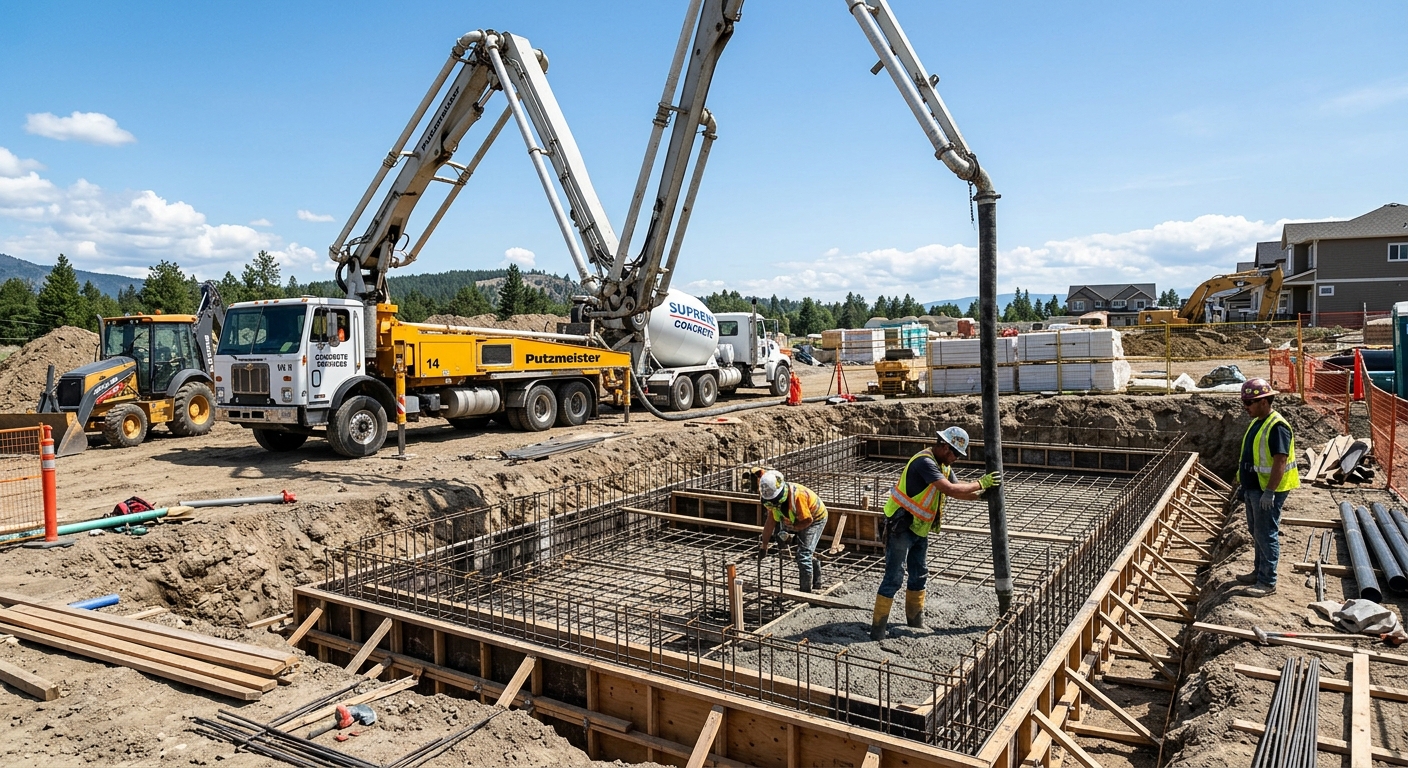
Concrete work options and costs in Bassano
Bassano homeowners typically choose concrete because the town’s housing stock is dominated by single-detached homes—78.7% of dwellings are that type—and because durable flatwork looks good for years on wider lots. With 75.0% of households owning their homes (405 homeowner households, Statistics Canada, 2021 Census), there’s a steady market for driveways, patios, walkways, garage floors, and the structural parts of foundations.
In the Lethbridge–Medicine Hat economic region, pricing is shaped by a deep frost line and aggressive freeze–thaw cycles. That means exterior work has higher base and drainage requirements, and structural pours need to be planned for excavation and forming costs. We also see more project scheduling in the warmer months, and occasional cold-weather pours that require blankets/heaters or accelerators to protect early strength gain. Contractor availability can tighten around peak summer weeks, so if you want a specific start date near irrigation closures and landscaping season, it’s smart to book early.
In Bassano, demand is especially strong around the older core and established neighbourhood blocks near the downtown area, where many homes date back before 1981 (71.3%). Those properties often need driveway replacement, garage slab upgrades, and foundation-related exterior repairs to deal with water management and cracking.
Below are realistic price bands for common concrete options in Bassano—then you can compare specs, not just numbers, against your site conditions.
| Application |
Typical Size |
Key Spec |
Finish Option |
Price Range |
| Concrete driveway (standard broom finish) |
400 sq ft (approx. 20 ft x 20 ft) |
Air-entrained exterior mix, compacted granular base, control joints |
Broom finish |
$5,600 – $8,800 |
| Exposed aggregate driveway |
400 sq ft (approx. 20 ft x 20 ft) |
Air-entrained exterior mix, proper set timing, densified base prep |
Exposed aggregate finish |
$7,200 – $12,000 |
| Stamped concrete driveway or patio |
300 sq ft (approx. 15 ft x 20 ft) |
Air-entrained exterior mix, colour hardener/colouring, sealed surface |
Stamp + colour, optional borders |
$7,000 – $12,500 |
| Plain concrete patio or walkway |
200 sq ft (approx. 10 ft x 20 ft) |
Air-entrained mix, compacted base, edges formed square |
Float/trowel or light broom |
$2,400 – $4,600 |
| Garage floor (interior slab) |
500 sq ft (approx. 20 ft x 25 ft) |
Vapour barrier (if specified), fibre or mesh, smooth flat finish |
Steel trowel finish |
$6,500 – $10,500 |
| Foundation footings (structural, below frost) |
Typical house perimeter (varies by design) |
Excavate below frost, reinforced footing, drainage considerations |
Structural concrete placement |
$18,000 – $35,000 |
Prices are estimates only and vary by project scope, site access and material selection.
What affects the price of concrete work in Bassano
Even when two contractors quote the “same” driveway size in Bassano, bids can differ by 30–50% once you factor in frost depth, base prep, mix design, and the real cost of getting concrete delivered and placed correctly. In southern Alberta, we build for freeze–thaw cycles first: footings must extend below the design frost depth, and exterior slabs need air-entrained mixes so that trapped water inside the concrete has room to expand when it freezes. Those requirements push excavation, forming, and materials above what homeowners may see in milder regions.
The pour season also affects cost. Lethbridge–Medicine Hat conditions cluster exterior work into warmer months, so labour demand rises and scheduling changes can add logistics expenses. Cold-weather curing precautions—like insulation blankets, curing compounds, heaters, and longer cure/protection time—can add meaningful cost if you’re trying to pour near shoulder season.
De-icing salt is another local reality. While Bassano is drier than coastal areas, salts used in winter accelerate surface wear and spalling when the mix isn’t properly air-entrained and when a proper sealer isn’t applied after cure.
Here are practical examples from Bassano projects: (1) a driveway with limited truck access that requires tighter staging and more labour to place and strike forms can move a standard broom option into the upper end of the $14–$22 per sq ft band; (2) a stamped driveway typically costs more, and in one common 300 sq ft layout the stamp/colour plus sealer can justify the difference between a plain patio range and the stamped range—if the base prep and control joints are done right; otherwise, you pay twice due to early cracking.
Housing age matters too. With 71.3% of homes built before 1981 (Statistics Canada, 2021 Census), many lots have older drainage patterns and settled subgrades that require more excavation and re-grading before concrete can be set.
| Price Factor |
Why It Matters |
Cost Impact |
| Frost line depth — determines footing depth and form height |
Below-frost placement prevents frost heave on structural concrete |
High: deeper excavation and more forming |
| Site preparation — excavation, grading, compacted granular base |
Proper base reduces settlement and reduces freeze–thaw pumping |
Medium to high: more haulage/compaction work |
| Reinforcement — rebar or wire mesh requirement |
Controls cracking and supports loads (especially driveways) |
Medium: labour + steel/material cost |
| Mix design — air-entrainment and compressive strength spec |
Air entrainment is critical for freeze–thaw durability outdoors |
Medium: higher-quality mix and tighter spec control |
| Finish type — broom vs. stamped vs. exposed aggregate |
Surface texture affects appearance, slip resistance, and labour |
Varies: stamped/exposed typically higher |
| Pour size and concrete truck access to site |
Access affects placement speed and whether extra equipment is needed |
Low to high: staging, short pours, or pump costs |
| Cold-weather curing precautions — heating and blankets |
Protects early strength gain and reduces cold-related surface defects |
Medium to high during shoulder season |
| Control joint pattern and sealing cost |
Joints guide cracking; sealing helps repel salts and water |
Low to medium: small line items that prevent big failures |
Permits & regulations in Alberta
In Alberta, the permit path depends on what you’re building. Structural concrete work—like foundation footings, foundation walls, and grade beams—usually requires a building permit, and it’s commonly tied to engineered drawings reviewed by the municipality. Concrete flatwork (patios, walkways, driveways) typically does not require a permit unless the work affects lot grading, impervious surface coverage limits, or changes to drainage that could impact neighbouring lots or municipal right-of-way requirements. Even when a permit isn’t typically required for the slab itself, homeowners should confirm with the local authority before breaking ground.
Before you hire a contractor in Bassano, verify three things step-by-step:
- 1) Licence/registration: check the contractor’s business information on the appropriate Alberta consumer/professional registry where applicable to concrete/general contractors, and confirm the legal business name matches the quote and invoice.
- 2) Liability insurance: ask for a current certificate of insurance (COI). The COI should show general liability coverage and project/location details.
- 3) WSIB/WCB coverage: request proof of coverage for workers. Don’t accept “we’re covered” verbally—ask to see the clearance/status documentation.
Finally, ask for references on similar-scale work completed recently in Alberta, and confirm in writing who is pulling any required permits and handling inspections if structural elements are involved.
Getting concrete right in Bassano's freeze-thaw climate
Concrete failures in Bassano usually trace back to water and temperature management. When freeze–thaw cycles act on a slab with inadequate base preparation or the wrong mix, water can work its way in, expand, and cause spalling, scaling, or random cracking. In the Lethbridge–Medicine Hat market, the fix isn’t “more concrete”—it’s the right spec and sequencing.
Start with base preparation: excavate to the required depth and install a compacted granular sub-base suitable for local soil and frost considerations. Next, specify an air-entrained mix designed for exterior exposure; for Bassano flatwork, we typically target 5–7% air content. Also set a minimum 32 MPa compressive strength so the slab reaches design performance even when pours happen during cooler stretches. For cracking control, plan control joints (and keep them clean) so cracking occurs where it’s intended rather than where it’s not.
Curing is another make-or-break step. We budget for a minimum 7-day curing period under proper conditions, and if we’re pouring near shoulder season, curing protection matters—blankets/heaters and limiting freeze damage in early days. Then apply a penetrating sealer after the cure window (commonly around 28 days) to help repel de-icing salts and reduce surface deterioration.
To avoid the most common problem—spalling—ask directly: “What air-entrainment target are you using, and what’s the plan for base drainage and joint spacing?” A good example: if an exposed aggregate driveway quote is lower by a few thousand dollars, but it omits air entrainment, joints, or sealer, you can end up paying for patching and resealing sooner. In many cases, the “savings” don’t survive the first winter—especially on driveways where salt and tire wear are constant.
| Spec |
Why It Matters in Bassano |
What to Ask For |
Impact if Skipped |
| Compacted granular base (depth?) |
Stabilizes the slab and reduces frost-related movement |
Base depth and material type; compaction method and thickness plan |
Settlement, cracking, and accelerated deterioration |
| Air-entrained concrete mix (target air %?) |
Provides space for freeze–thaw expansion in exterior concrete |
Target air content (typically 5–7% for exterior flatwork) and mix design |
Spalling/scaling during winters with de-icing salts |
| Compressive strength (MPa rating) |
Ensures the slab develops enough strength before loading/backfill |
Minimum 32 MPa rating and cold-weather protection plan if needed |
Surface damage, reduced durability, and early failures |
| Control joints (spacing per ACI guidelines) |
Directs cracking and reduces random slab fracture |
Joint spacing and timing; whether saw-cut or formed joints are used |
Random cracking and uneven patching later |
| Minimum 7-day curing period |
Concrete gains strength more slowly in cold conditions |
Curing approach for your expected temperatures; protection duration |
Weak surfaces, higher wear, and failure under early stress |
| Penetrating sealer (when applied after cure) |
Repels water and helps reduce salt-driven surface scaling |
Type of sealer and application timing (commonly around 28 days) |
Faster surface breakdown and increased maintenance |
How to choose a concrete work contractor in Bassano
Choosing the right concrete contractor is mostly about verification and clarity. In Alberta, confirm the contractor carries proper liability insurance and has active worker coverage through WSIB/WCB for their crew. Practically, you should ask for (1) a certificate of liability insurance showing the current dates and the insured parties, and (2) proof of WSIB/WCB coverage or clearance documentation. If they can’t provide these documents quickly, that’s a red flag.
Next, get 2–3 itemised written quotes—not just a lump sum. You want line items for excavation, granular base supply and compaction, vapour barrier (if applicable), reinforcement, concrete supply (with air-entrainment and strength spec), formwork, finishes, saw cutting/control joints, curing/protection, and sealing (if offered). Make sure each quote treats drainage the same way and states whether disposal/haul-off is included.
Warranty matters too. Ask for the workmanship warranty length and what it covers (cracking due to shrinkage vs. workmanship issues), plus whether product/manufacturer warranties apply to sealers or admixtures. Clarify whether warranties are transferable if you sell the home.
For payments, don’t pay more than 10–15% upfront. Hold a reasonable completion holdback until the slab is finished, sealed (when included), and cleaned up.
Finally, request a start date and completion estimate in writing, especially if you’re trying to hit the warm-season pour window in Bassano.
- Ask for COI and confirm project location matches your address
- Request proof of WSIB/WCB coverage in writing
- Compare quotes with the same slab thickness, base depth, and mix spec
- Confirm concrete is air-entrained for exterior work
- Verify reinforcement details (mesh vs. rebar and where it’s placed)
- Make sure control joint spacing and timing are included
- Ask how curing will be protected if temperatures drop
- Confirm whether sealing is included and when it will be applied
- Check whether disposal/haul-away and regrading/restoration are part of the quote
- Get confirmation of truck access plan (staging, pump needs, or short-pour method)
- Ask about the exact finish process (broom, exposed aggregate timing, stamp release)
- Use a payment schedule with a completion holdback
Concrete contractor red flags in Bassano include quotes that omit air-entrainment details for exterior slabs, no mention of control joints or sealing plans, “we’ll figure it out on site” approach to base depth, unclear insurance/WSIB/WCB documentation, and promises of a quick pour without addressing curing protection if temperatures drop.
Frequently asked questions — concrete work in Bassano
What is air-entrained concrete and why does it matter here?
Air-entrained concrete is mixed with microscopic air bubbles that act like pressure relief during freeze–thaw cycles. In Bassano and across southern Alberta’s Lethbridge–Medicine Hat area, water inside concrete can freeze and expand; without the right air content, that expansion can lead to scaling and spalling—especially where de-icing salts are used. That’s why exterior flatwork (driveways, patios, walkways) should be specified with an air-entrainment target (often 5–7%) and a sufficient minimum strength so it performs through winter. When you’re comparing quotes, ask for the mix specification—not just “we use exterior concrete.” If one contractor is cheaper but doesn’t mention air entrainment, that cost difference can look good today and fail after the first harsh season.
How do I prepare the base for a concrete slab?
Base preparation is where most long-term performance is won or lost. In Bassano, you generally need excavation to the required sub-base depth, then placement of compacted granular material in layers. The goal is a stable, well-compacted support that reduces settlement and limits frost movement. Your contractor should describe the material type, compaction approach, and how drainage is handled so water doesn’t pond against the slab. For example, a standard broom-finish driveway (commonly priced in the $14–$22 per sq ft band) can still fail early if the base is under-built or uncompacted. Ask your contractor how they confirm compaction and how thick the base will be for your soil and frost considerations.
How do I compare concrete quotes?
Start by comparing quotes side-by-side on scope and specifications, not just total price. Ask whether the quotes include excavation and granular base prep, reinforcement (mesh or rebar and placement), control joints (spacing and method), air-entrained mix, and curing protection. Also confirm whether sealing is included for exterior slabs and whether disposal/haul-off and site restoration are in the price. In Bassano, the same-size driveway can land anywhere within the regional price bands—like driveway concrete at roughly $14–$22 per sq ft—because one bid may include proper cold-weather considerations and the other may not. Request itemised labour/material breakdowns so you can see what’s truly being delivered. If a quote is much lower, look for what’s missing: air content, base depth, joints, or curing time.
Can concrete be poured in cold weather in Bassano?
Yes, concrete can be poured in cold weather in Bassano, but it must be managed correctly to reach adequate early strength. When temperatures drop, concrete gains strength more slowly, and early freeze damage can occur before curing is established. A responsible crew will use cold-weather procedures such as insulating blankets, heaters, wind protection, and sometimes accelerators depending on mix design. They should also adjust scheduling so protection continues long enough. Ask what temperature thresholds they follow, how they protect the slab during the first critical days, and how long they recommend waiting before backfilling or heavy use. If the job is trying to fit into late-season timing, you may see costs move upward because the curing/protection steps are not optional.
How do I maintain concrete in Bassano's freeze-thaw climate?
Maintenance in Alberta’s freeze–thaw climate is mainly about water control and surface protection. Keep joints and edges free of loose debris so water doesn’t sit against the slab. Use de-icing products carefully—salt is effective, but overuse can accelerate surface wear if the concrete isn’t properly air-entrained and sealed. If your driveway or patio is sealed (typically after the concrete cure window, often around 28 days), the sealer helps repel water and reduces salt-driven surface deterioration. Resealing timing depends on traffic, weather exposure, and product choice, but many homeowners plan for periodic refresh years later. Also watch for early cracking: small, well-formed control-joint cracks are normal, but widening cracks or spalling patches should be addressed promptly to prevent moisture from getting under the surface.
What causes concrete to spall in Bassano winters?
Spalling is usually caused by a combination of freeze–thaw action and salt/water exposure, where the concrete doesn’t have enough protection or the mix isn’t properly designed for exterior conditions. The biggest culprit is inadequate air-entrainment: without sufficient air bubbles, water freezing internally can create pressure that breaks the surface paste. Other contributors include weak early curing (insufficient protection when temperatures drop), poor base drainage (water sitting under or at the edges), and missing or poorly planned control joints that lead to uncontrolled cracking. In Bassano, where de-icing salts are common and older homes (71.3% built before 1981 per Statistics Canada, 2021 Census) often have settled drainage patterns, these issues show up faster. If you’re budgeting for repair or replacement, ask the contractor to explain the air-entrainment target and their base and joint details.