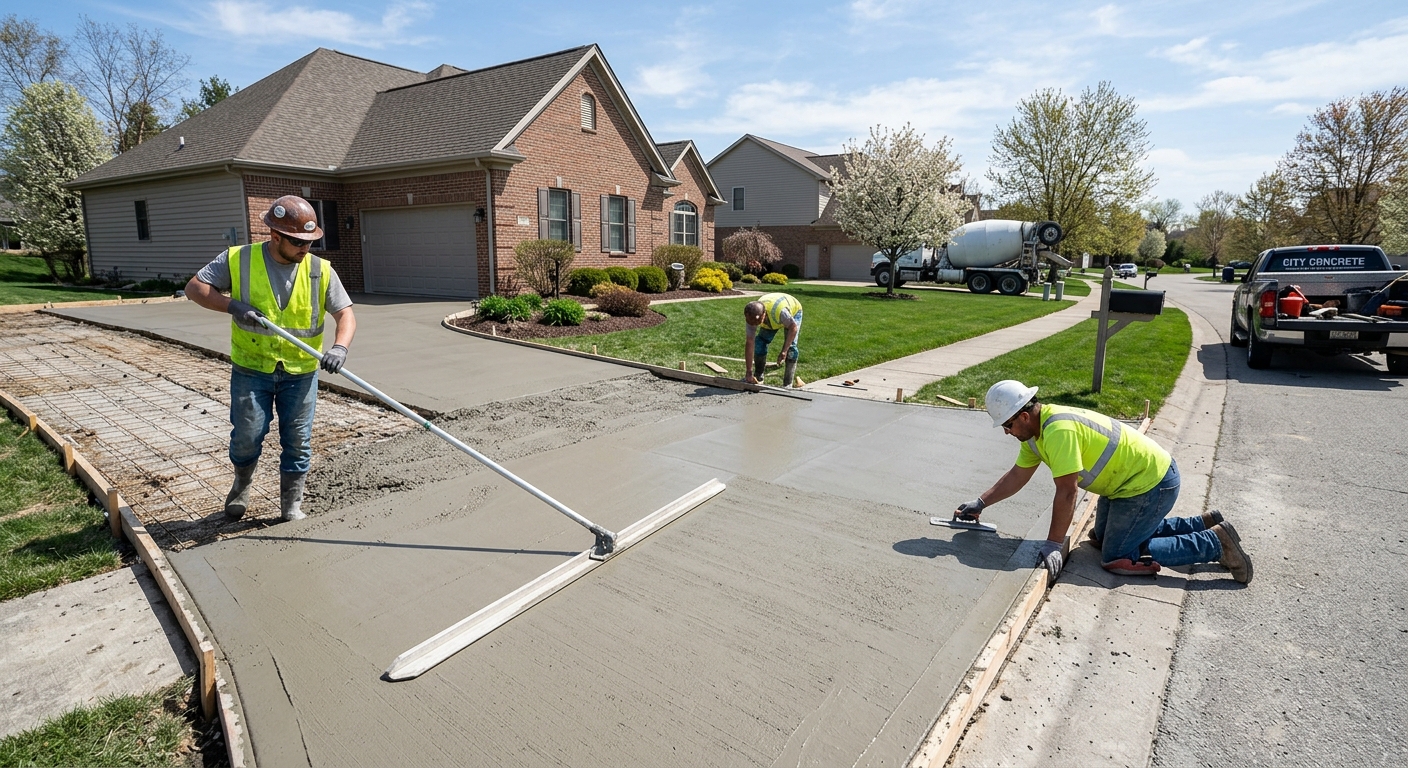
Concrete work options and costs in Lloydminster
Lloydminster is a practical, driveway-and-flatwork kind of town, and most homeowners eventually compare several concrete options before committing. With a population of 31,582 (Statistics Canada, 2021 Census), there’s steady demand for durable exterior slabs—especially around established neighbourhoods where homes are older and lots see frequent re-levels, replacements, and new garage builds. In the Wood Buffalo–Cold Lake economic region, concrete pricing is shaped less by “fancy finishes” and more by how the climate forces the job to be built: deep frost, intense freeze–thaw cycles, and shorter warm-season working windows. Contractors plan for deeper excavations, more base material, air-entrained mixes, and tighter control joint layouts to manage movement and reduce random cracking.
In areas such as the west-end near 9th Avenue and surrounding residential corridors, trades are in particular demand because many streets have mature landscaping and established access routes—so excavation, removal, and re-compaction are common scope items. In Lloydminster’s conditions, even a “simple” driveway can become a more engineered job once we account for compacted granular base depth, proper drainage, and cold-weather protection during the pour window. That’s why you’ll see quotes for the same square footage vary noticeably, and why foundations and exterior flatwork typically land at the higher end of standard provincial price expectations.
Below is a realistic comparison of common applications you can use to benchmark quotes—then we’ll break down what drives price in more detail.
| Application |
Typical Size |
Key Spec |
Finish Option |
Price Range |
| Concrete driveway (standard broom finish) |
24 ft x 12 ft (288 sq ft) |
Air-entrained mix; compacted granular base; control joints |
Broom finish, sealed after cure |
$18,000–$28,000 |
| Exposed aggregate driveway |
24 ft x 12 ft (288 sq ft) |
Air-entrained mix; proper base and drainage |
Exposed aggregate (granolithic style) |
$22,000–$34,000 |
| Stamped concrete driveway or patio |
16 ft x 18 ft (288 sq ft) |
Air-entrained mix; thicker spec as required for stamping; integral color |
Stamp pattern + release + sealer |
$22,000–$35,000 |
| Plain concrete patio or walkway |
12 ft x 14 ft (168 sq ft) |
Air-entrained mix; compacted base; control joints |
Smooth trowel or light broom |
$12,000–$25,000 |
| Garage floor (interior slab) |
22 ft x 22 ft (484 sq ft) |
Vapour barrier as needed; reinforcing; proper finishing |
Float and broom |
$12,500–$22,500 |
| Foundation footings (structural, below frost) |
Typical 24 ft x 40 ft home perimeter |
Engineered reinforcement; excavation to frost; pour below frost line |
Structural concrete footings |
$8,000–$14,000 |
Prices are estimates only and vary by project scope, site access and material selection.
What affects the price of concrete work in Lloydminster
If you’re seeing quotes swing by 30–50% in the Wood Buffalo–Cold Lake region, it usually comes down to how the contractor accounts for Lloydminster’s freeze–thaw reality—not just the finish name. In colder climates, the cost model changes because the exterior work must be built to resist frost heave and surface damage. Footings must be set well below the design frost depth to prevent frost movement, and in Alberta that generally means deeper excavation, higher formwork, and more concrete and rebar than you’d expect in milder areas. Every exterior slab also needs air-entrained concrete to survive repeated freeze–thaw cycles, and that impacts materials and mix design.
Because the warm-season window is shorter, you may also be dealing with cold-weather measures like insulating blankets, heaters, or accelerators to protect curing concrete. Those steps don’t show up in a quick “per square foot” comparison, but they affect labour hours and consumables—so the same 288 sq ft driveway can land near the top end of typical ranges. For context, local backbone pricing for an exterior driveway is roughly $18,000–$28,000, while stamped work often moves into the $22,000–$35,000 bracket because colour, stamping labour, and higher-spec surface preparation are baked into the scope.
Two concrete examples from Lloydminster: (1) A driveway replacement on a lot with soft subgrade often requires extra granular base and re-compaction; that can add cost but prevents voiding and premature cracking. (2) A sealed, broom-finished slab will usually hold up better against de-icing salt than an unsealed surface—skipping sealing can lead to accelerated scaling, and then you pay twice.
| Price Factor |
Why It Matters |
Cost Impact |
| Frost line depth |
Determines footing depth and form height to prevent frost heave |
More excavation and concrete volume; often pushes foundation scopes higher |
| Site preparation |
Excavation, grading, and compacted granular base control settlement and movement |
Soft soils or poor drainage increases hauling and base material cost |
| Reinforcement |
Rebar or mesh improves crack control and structural durability |
Higher material and labour, especially for thicker slabs and footings |
| Mix design |
Air-entrainment and specified compressive strength for freeze–thaw survival |
Better performance concrete costs more than basic mixes |
| Finish type |
Broom vs stamped vs exposed aggregate changes labour and materials |
Stamped/exposed typically land above standard broom driveway pricing |
| Pour size and concrete truck access to site |
Access affects how much time is spent setting up and placing concrete |
Poor access can mean extra labour, wheelbarrowing, and re-plan |
| Cold-weather curing precautions |
Heaters/blankets protect young concrete to reach strength |
Adds consumables and labour during shorter pour windows |
| Control joint pattern and sealing cost |
Joints manage cracking; sealing reduces salt scaling and spalling risk |
Materials + additional scheduling after cure |
Permits & regulations in Alberta
In Alberta, structural concrete work—typically including footings, foundation walls, and grade beams—usually requires a building permit, and you’ll often see engineered drawings reviewed as part of the approval process. Concrete flatwork (driveways, patios, and walkways) often does not require a permit by itself unless the project affects lot grading, stormwater flow, impervious surface coverage limits, or work is near municipal right-of-way areas. In Lloydminster, don’t assume the driveway “just like last time” is permit-free; confirm with the local authority before you break ground, particularly if you’re changing drainage patterns, lowering/raising grade, or tying into existing municipal surfaces.
Step-by-step, here’s how a homeowner can verify a contractor in Alberta:
- Ask for the contractor’s liability insurance certificate (COI) and confirm it covers your work scope.
- Verify workers’ coverage (WSIB/WCB clearance letter or equivalent documentation) before work starts.
- Check the contractor’s Alberta licence/registration status through the appropriate provincial online resources (the contractor should be able to provide the reference details).
- Request references for similar-scale concrete jobs in your area and ask specifically about freeze–thaw durability (sealing, jointing, air-entrainment).
- Ensure the quote includes who pulls permits (if required) and whether inspections are allowed time-wise.
For concrete that becomes part of the building structure (foundations/footings/grade beams), permits and engineered design are the rule. For sidewalks and driveways, most homeowners proceed without permits—but grading and drainage changes are where the paperwork often starts.
Getting concrete right in Lloydminster's freeze-thaw climate
In Lloydminster, concrete failures are usually predictable: frost movement, surface scaling, and uncontrolled cracking. The fix isn’t “more concrete”—it’s building the system correctly for deep frost and intense freeze–thaw cycles. Start with base preparation: a properly compacted granular sub-base at the right depth and profile for local soil and drainage. If the base is underbuilt or drains poorly, the slab can settle or flex, and then cracks open and water gets trapped.
Second, use the right mix. For exterior flatwork, air-entrainment is critical—typically 5–7% air content—and the mix should meet at least 32 MPa compressive strength so the concrete gains durability over the early curing period. Third, specify control joints and spacing to manage shrinkage and thermal movement, rather than hoping random cracking will “behave.” Fourth, curing matters even more than most homeowners expect; in cold snaps you need proper curing protection, and you should plan for a minimum 7-day curing period under suitable conditions to reach adequate strength.
Finally, sealing is what helps with de-icing salts. A penetrating sealer applied after the concrete has cured (commonly around 28 days) helps repel water and reduce scaling that leads to spalling.
Here’s a practical dollar example: upgrading from a basic unsealed exterior slab to sealing is often a comparatively modest add-on (relative to replacing a driveway). If you’re budgeting around the $18,000–$28,000 driveway band, spending for sealing and correct joints is usually justified because the alternative is premature surface breakdown and a redo—far more expensive than doing it right the first time.
| Spec |
Why It Matters in Lloydminster |
What to Ask For |
Impact if Skipped |
| Compacted granular base (depth?) |
Reduces settlement and manages frost-related movement under the slab |
Base depth and compaction method by site conditions |
Early cracking, uneven settling, and water trapping |
| Air-entrained concrete mix (target air %?) |
Protects concrete from freeze–thaw damage and surface scaling |
Target air content typically 5–7% for exterior flatwork |
Spalling risk increases significantly over winter cycles |
| Compressive strength (MPa rating) |
Supports durability and performance during cold curing and service life |
Minimum 32 MPa (or the project-specified rating) |
Reduced strength gain and shorter service life |
| Control joints (spacing per ACI guidelines) |
Controls where cracks form as the slab moves with temperature and moisture |
Joint spacing plan and sealant approach where applicable |
Random cracking and water infiltration along uncontrolled paths |
| Minimum 7-day curing period |
Ensures adequate strength development, especially with cold-weather precautions |
How curing protection is handled during cold nights |
Surface weakness and increased long-term cracking |
| Penetrating sealer (when applied after cure) |
Repels salt and water to reduce scaling and spalling |
Sealer type and timing after cure (commonly around 28 days) |
Faster deterioration in salted exterior conditions |
How to choose a concrete work contractor in Lloydminster
Choosing a contractor in Lloydminster is mostly about verification and clarity. First, confirm Alberta credentials and coverage. Ask for their certificate of insurance (liability/COI) and make sure it matches your project scope (driveway, patio, foundation works, etc.). Then request proof of workers’ coverage through WSIB/WCB clearance documentation. A reputable contractor won’t hesitate—if they can’t provide it promptly, that’s a serious concern. For licence/registration, ask how they are registered in Alberta and request the reference details for you to confirm online.
Next, get 2–3 itemised quotes. Not “one price,” but a breakdown that separates labour, concrete supply, base prep, reinforcement, forming, finishing, sealing, and any cold-weather measures. Also confirm what’s excluded: tree/rock removal, disposal, coring/cutting for tie-ins, permit pulls, drainage work, and saw cutting for joints. In our climate, exclusions around base prep and curing protection often lead to the biggest performance gaps.
Warranty should be in writing: workmanship warranty length, and whether it’s tied to maintenance (like sealing) or excludes salt damage where appropriate. Ask if the product/manufacturer warranty is provided and whether it’s transferable.
Payment matters too. Avoid paying more than 10–15% upfront. Use a holdback until you’ve verified completion details—joints sealed, edges finished, and site cleaned. Finally, lock in a timeline with a start date and completion estimate in writing, since the pour window can tighten quickly during cold snaps.
- Ask for a written scope that names air-entrained mix and curing protection steps.
- Require an itemised quote (base prep, reinforcement, finishing, sealing).
- Confirm disposal/haul-away is included or priced separately.
- Check that liability insurance COI is current and covers your address/job type.
- Request WSIB/WCB clearance documentation before work begins.
- Ask who pulls permits (if needed) and whether inspections are scheduled.
- Confirm reinforcement details (mesh vs rebar, thickness targets).
- Verify control joint plan (spacing and sealing/caulking approach if applicable).
- Ask how cold-weather pouring is handled (blankets/heaters/accelerators).
- Ensure sealing is quoted as a separate line item with timing after cure.
- Agree on a payment schedule with a holdback until completion.
- Get references for freeze–thaw exterior work, not just interior floors.
Concrete red flags in Lloydminster: contractors who won’t discuss air-entrainment or joint spacing, quotes that exclude base preparation/compaction, promises to pour without cold-weather protection during cool evenings, vague warranties (or none in writing), and “cash discount” offers that require large upfront payments without itemised scope.
Frequently asked questions — concrete work in Lloydminster
How much does concrete work cost in Lloydminster?
In Lloydminster, concrete pricing depends heavily on how much excavation and preparation the job needs for deep frost and freeze–thaw durability. As a practical benchmark, many homeowners see exterior concrete driveways land around the $18,000–$28,000 band for standard broom-finish work, while stamped or higher-detail jobs often sit closer to $22,000–$35,000. Plain patios and walkways typically track lower (often in the $15–$25 range per sq ft equivalents depending on scope), but the total cost changes quickly if access is tight, if disposal is required, or if the base needs rebuilding due to soft subgrade. Always compare quotes on the same assumptions: base depth, air-entrained mix, reinforcement, curing protection, and sealing. Those items drive long-term performance in Alberta’s climate.
How deep must footings be for Lloydminster's frost line?
Footing depth is determined by design frost considerations and the specific engineered requirements for your building. In Alberta (including Lloydminster), it’s common that frost depths can be significant—often in the range of up to about 2.4 m in parts of Alberta—so contractors must excavate to the required depth rather than “guessing” based on surface conditions. The key is that footings should be placed below the design frost depth to prevent frost heave and structural movement. For most homeowners, the most reliable path is to review your engineered foundation plan (when applicable) and confirm the contractor is excavating to that depth and recording it during inspection. If you’re doing a renovation or underpinning, verify the existing foundation condition and whether the original depth meets current design expectations for Lloydminster’s climate.
Why does concrete crack in Lloydminster and how is it prevented?
Concrete cracks are often the result of thermal and moisture movement, and in Lloydminster the freeze–thaw cycle makes those movements more aggressive. Even well-made concrete shrinks as it cures and expands/contracts with temperature swings, and if joints aren’t planned properly the slab will crack randomly. Proper prevention starts with a compacted granular base, air-entrained exterior concrete for durability, and a control joint layout designed to “tell” the slab where to crack. Proper curing also matters—cold snaps can slow strength gain if protection isn’t used. Sealing helps by reducing salt-driven water absorption at the surface. When you ask contractors, look for a clear joint spacing plan, confirmation of air-entrainment, and a curing/protection plan for cold nights during the pour window in the Wood Buffalo–Cold Lake region.
Stamped vs broom-finish concrete — cost difference?
Stamped concrete costs more primarily because of the added labour and materials: integral colour or hardener systems, release agents, the stamping process, and more careful surface preparation and curing control. In Lloydminster, that’s why stamped driveway or patio work often lands in the $22,000–$35,000 band, while standard broom-finish driveways are commonly nearer $18,000–$28,000 for similar-size projects. The climate doesn’t eliminate that difference—if anything, it reinforces why contractors must still use air-entrained mixes, correct jointing, and proper curing protection, regardless of the appearance. A good contractor will also explain whether sealing is included and when it will be applied (often after the concrete has cured, around the 28-day mark) to protect against de-icing salt scaling.
When is the best time to pour concrete in Lloydminster?
The best time is when temperatures and conditions allow the concrete to cure safely without excessive cold-weather measures. In the Lloydminster area, the warm-season pour window is shorter, so delays can quickly push a job into nights that require blankets, heaters, or admixtures to protect early-age concrete. That’s why scheduling matters: if your crew can pour during stable daytime temperatures and maintain protection overnight, your final strength and durability are more predictable. Ask your contractor what temperature thresholds they use, how they monitor curing conditions, and what exact protection plan is included. If a quote assumes “normal curing” but the pour dates drift into colder weeks, it’s a cost and performance risk—especially for exterior slabs exposed to repeated freeze–thaw cycles.
How long does concrete take to cure?
Concrete isn’t fully usable at the day it’s poured. For most residential work, you should plan around a minimum 7-day curing period for early strength development, with careful protection during cold weather. After that, concrete continues to gain strength over weeks. Sealing is typically scheduled after cure completion—commonly around 28 days for many penetrating sealers—because sealing too early can reduce performance and increase the chance of trapping moisture in the slab. In Lloydminster’s freeze–thaw environment, curing quality is a big durability factor: poor protection can leave the surface more vulnerable to scaling and spalling when de-icing salt and winter moisture are present. When comparing quotes, ask what curing/protection steps are included and whether sealing timing is stated in the scope.