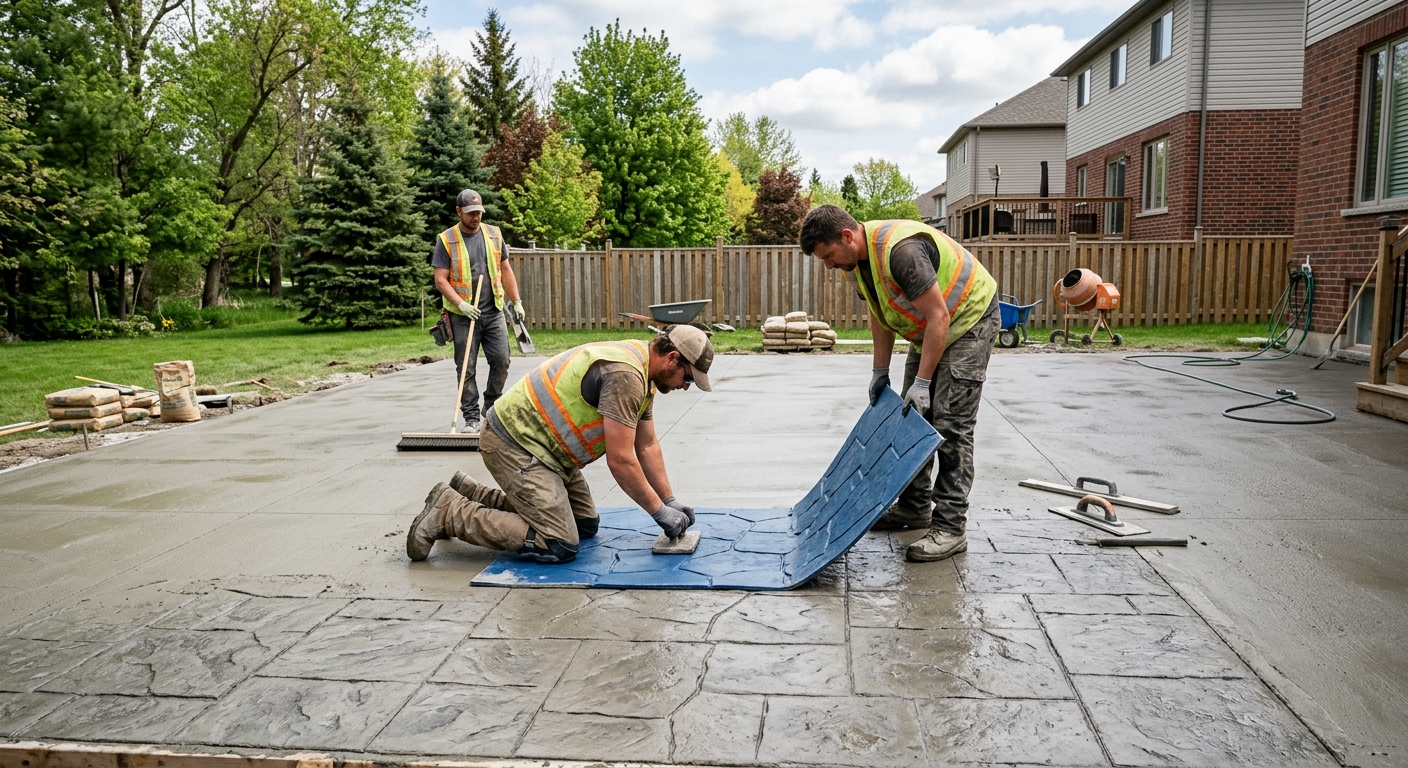
Concrete work options and costs in Innisfail
In Innisfail, concrete work is a practical choice for homeowners because the town sits in the Red Deer economic region where prairie winters and freeze-thaw cycling are hard on exterior surfaces. With single-detached houses making up 61.7% of dwellings (Statistics Canada, 2021 Census), most concrete flatwork demand is driven by driveways, patios, walkways and interior garage slabs. It’s also a common retrofit market: 43.8% of homes were built before 1981 (Statistics Canada, 2021 Census), so upgrades often include replacing older, cracked slabs and improving drainage and base prep around existing foundations.
Compared with milder areas, Red Deer-area pricing is pushed higher by deeper excavation and more material handling, plus tighter scheduling because the pour season is shorter. Innisfail crews also need to use air-entrained concrete and pay close attention to consolidation and control joints to reduce freeze-thaw cracking and surface spalling on driveways and walkways. On top of that, curing in cool, wet stretches requires more protection steps (insulating blankets or controlled warming) so the concrete reaches strength without early freezing.
Within Innisfail, concrete crews often see especially steady demand in established residential pockets near the downtown core and along the main arterial routes where access is manageable and homeowners are frequently updating curb appeal and walkways. If you’re comparing options, the table below gives realistic starting ranges for common jobs in the Innisfail market, reflecting how thickness, base prep, reinforcement and finish level change the final number.
| Application |
Typical Size |
Key Spec |
Finish Option |
Price Range |
| Concrete driveway (standard broom finish) |
24 ft x 10 ft (240 sq ft) |
4 in slab, granular base, air-entrained mix, control joints |
Broom finish |
$3,000–$4,800 |
| Exposed aggregate driveway |
22 ft x 10 ft (220 sq ft) |
4 in slab, air-entrained mix, proper consolidation |
Exposed aggregate (controlled wash) |
$3,600–$6,000 |
| Stamped concrete driveway or patio |
20 ft x 12 ft (240 sq ft) |
4 in slab, air-entrained mix, integral colours |
Stamp pattern + release + sealant |
$4,000–$6,700 |
| Plain concrete patio or walkway |
12 ft x 10 ft (120 sq ft) |
4 in slab, compacted sub-base, air-entrained mix |
Float + light broom |
$1,000–$2,000 |
| Garage floor (interior slab) |
20 ft x 22 ft (440 sq ft) |
4 in slab, vapour barrier, fibre or mesh (per design) |
Light broom/steel trowel finish |
$6,000–$10,500 |
| Foundation footings (structural, below frost) |
Per linear foot (typical 400–700 ft total) |
Below frost depth, engineered rebar, drainage as required |
Formed footings, steel placement |
$35–$65 |
Prices are estimates only and vary by project scope, site access and material selection.
What affects the price of concrete work in Innisfail
In Innisfail and across the Red Deer region, two quotes for the same-looking concrete job can differ by 30–50% because contractors price the “hidden work” differently—excavation depth, drainage provisions, base compaction, reinforcement, and how weather protection is handled during the short season. Your final cost isn’t just square footage; it’s also whether the contractor is building a slab that stays flat and crack-resistant through repeated freeze-thaw cycles.
Here’s the key: frost depth and freeze-thaw exposure dictate every spec. Footings must extend below the design frost depth to prevent frost heave, and exterior slabs need air-entrained concrete to better survive the cycling that causes surface scaling and spalling. In colder stretches, cold-weather curing precautions (insulation blankets, controlled warming, and longer protection) add labour and material costs. De-icing salt in drive-through seasons can also accelerate surface damage if the mix and sealing plan aren’t right—so sealing is commonly included after proper cure.
Local conditions can raise or lower cost in practical ways. If your driveway area requires deeper excavation to reach suitable granular base, expect higher material hauling and formwork time. If there’s poor drainage (low spots near the house), contractors often add sub-drainage or adjust grading—cost up, but it can prevent settling and early cracking. If your site is tight access near existing landscaping, truck placement and concrete pumping may be needed, which affects labour. For perspective, a standard broom-finished driveway often falls in the $10–$18/sq ft band, while stamped options typically price higher (often $16–$28/sq ft) because of extra labour for patterning and finishing, plus sealing.
| Price Factor |
Why It Matters |
Cost Impact |
| Frost line depth — determines footing depth and form height |
More depth means more excavation, rebar, and concrete volume below grade |
Higher form height and material handling can add major cost on foundations |
| Site preparation — excavation, grading, compacted granular base |
Concrete performance depends on a stable, well-compacted base |
Often the biggest swing factor for driveways and slabs |
| Reinforcement — rebar or wire mesh requirement |
Helps control cracking and supports load distribution (especially on wider slabs) |
Cost increases with steel quantity and placement complexity |
| Mix design — air-entrainment and compressive strength spec |
Air-entrainment improves freeze-thaw durability; strength helps resist early damage |
Higher-spec mix can add per-m³ cost, but reduces failures |
| Finish type — broom vs. stamped vs. exposed aggregate |
Finishes require different labour time, materials, and curing/sealing steps |
Stamped and exposed aggregate usually increase cost notably |
| Pour size and concrete truck access to site |
Access affects setup time, travel time, and whether pumping is required |
Poor access can add labour and equipment charges |
| Cold-weather curing precautions — heating and blankets |
Protects early-age strength development in cool, wet Innisfail conditions |
Extra labour and materials; typically more cost in shoulder months |
| Control joint pattern and sealing cost |
Joints manage shrinkage cracking; sealing helps against salt and moisture intrusion |
Can add line items, but helps long-term durability |
Permits & regulations in Alberta
In Alberta, structural concrete work generally requires a building permit, and municipalities may review engineered drawings depending on the design. If you’re dealing with footings, foundation walls, grade beams, or other load-bearing structural elements, assume you’ll need a permit before work starts. Concrete flatwork—like driveways, patios, walkways, and garage slabs—often does not require a permit by itself, but it can trigger requirements if it affects lot grading, alters drainage patterns, or changes impervious surface coverage rules. Innisfail homeowners should confirm with the local authority before breaking ground, especially if the work ties into existing drainage, changes slopes toward the street, or involves any modifications near municipal right-of-way areas.
Before you hire, verify three things: (1) licensing/registration where applicable for the contractor’s scope, (2) liability insurance, and (3) workers’ compensation coverage (WSIB/WCB). A solid contractor can provide certificates without hesitation. Here’s a simple step-by-step approach: request their current certificate of insurance and check that it includes the right project address and coverage limits; ask for proof of WSIB/WCB clearance (or equivalent coverage documentation used for the trade in Alberta); and confirm references for similar Red Deer-area conditions—exterior slabs with air-entrainment, control joints, and cold-weather protection. If they can’t provide documentation quickly, that’s a red flag and often explains why bids come in too low.
Getting concrete right in Innisfail's freeze-thaw climate
Concrete fails most often in Innisfail when the base isn’t prepared correctly, the mix isn’t specified for freeze-thaw durability, or early-age curing is rushed. In our Red Deer-area climate, freeze-thaw cycles pull moisture in and out of the slab. If there isn’t enough air in the concrete, and if joints and sealing aren’t planned, you can get surface scaling (spalling), hidden cracking, and uneven settlement. The cure matters too: in cold, wet stretches, concrete gains strength more slowly, so it needs protection so it doesn’t freeze early or lose too much moisture.
To spec the job correctly, start with base preparation: excavate to the right depth and build a compacted granular sub-base sized for local soil and frost conditions. Second, mix design: for exterior flatwork, air-entrainment is essential (commonly 5–7% air content) and you want at least 32 MPa compressive strength. Third, control joints: plan their location and spacing to keep shrinkage cracking from becoming random. Fourth, curing: minimum 7-day curing under proper conditions, and protect the pour during cold weather. Fifth, sealing: apply a penetrating sealer after the concrete has cured (often around 28 days post-pour) to help repel de-icing salts and moisture.
Here’s where price differences can be justified. If one quote is “cheaper” by skipping air-entrainment or reducing granular base depth, that might save a few dollars per square foot up front, but it can cost far more later when you’re replacing a driveway. Conversely, paying for a properly compacted base and air-entrained mix is usually what keeps a $10–$18/sq ft driveway serviceable through Alberta winters.
| Spec |
Why It Matters in Innisfail |
What to Ask For |
Impact if Skipped |
| Compacted granular base (depth?) |
Improves load support and reduces settlement under freeze-thaw |
Granular base depth and compaction method for your soil/grade |
Uneven sinking, cracking, and early surface failure |
| Air-entrained concrete mix (target air %?) |
Creates freeze-thaw resistance and reduces spalling risk |
Exterior air content target (commonly 5–7% for flatwork) |
Scaling and spalling from trapped moisture/freezing |
| Compressive strength (MPa rating) |
Strength supports durability and wear resistance during early service |
Minimum 32 MPa and mix confirmation from the supplier |
Surface damage and cracking when exposed too soon |
| Control joints (spacing per ACI guidelines) |
Controls shrinkage cracking so cracks don’t become random |
Joint spacing/layout plan and tool-cut timing |
Wider, uneven cracks that let water reach the base |
| Minimum 7-day curing period |
Cold, wet conditions slow strength gain |
Concrete protection plan if temperatures dip (blankets/heating as needed) |
Early freezing or moisture loss leading to weak/unstable slabs |
| Penetrating sealer (when applied after cure) |
Helps repel salt and moisture in Alberta winter cycles |
Penetrating sealer schedule (after full cure; commonly ~28 days) |
Faster salt scaling and surface deterioration |
How to choose a concrete work contractor in Innisfail
Choosing the right contractor in Innisfail starts with verifying Alberta coverage and then matching scope line-by-line. For licensing/registration, ask what permits or registrations apply to their specific work type and confirm they’re allowed to perform it. Next, request proof of liability insurance—ensure it’s current and covers the project location. Finally, ask for WSIB/WCB coverage documentation and a clearance letter (or equivalent proof used in Alberta for the applicable trade). A legitimate contractor should respond quickly and provide documents in writing; if they delay or provide only partial information, don’t assume it’s fine.
Get 2–3 itemised written quotes. You want labour and materials broken out: excavation and hauling, granular base supply and compaction, formwork, reinforcement, concrete mix specification (including air-entrainment), finishing, joints, curing protection, and sealing (where included). Avoid “lump sum” quotes that don’t tell you what’s excluded—especially disposal, site restoration, minor grading, or anything related to drainage adjustments.
Ask about warranty terms: workmanship warranty length, whether it covers cracking/spalling tied to mix/spec compliance, and whether manufacturer product warranties (like sealers) are separate and transferable. For payment, keep it conservative: never pay more than 10–15% upfront, and hold back a portion until the job is complete and cleaned up. Also insist on a written timeline with a start date and completion estimate, since schedule slips in the prairie cold can affect curing and surface durability.
- Confirm the contractor’s proof of insurance (liability) and project address details.
- Request WSIB/WCB clearance documentation for workers performing the concrete work.
- Ask for at least 2–3 local references from the Red Deer area with similar conditions.
- Ensure the quote names the concrete mix specs (air-entrainment and strength) for exterior work.
- Require an itemised breakdown: excavation, granular base, reinforcement, concrete, finishing, curing, sealing.
- Clarify joint pattern and whether joints will be cut/specified and sealed (if included).
- Check whether cold-weather curing protection is included or excluded.
- Confirm thickness (e.g., 4 in typical flatwork) and whether dowels/tying-in are included where needed.
- Ask how drainage/grading will be handled to prevent water pooling.
- Get a written curing/protection plan for the first week, especially in shoulder months.
- Agree on disposal/restoration: topsoil, regrading, and any landscaping protection.
- Review the warranty and exclusions in writing, including what happens if materials or conditions change.
Concrete red flags in Innisfail include: skipping air-entrainment on exterior flatwork, refusing to show mix specs in writing, under-specifying the granular base depth/compaction, starting a pour without a cold-weather curing plan, and demanding large upfront payments (beyond 10–15%) or offering vague timelines.
Frequently asked questions — concrete work in Innisfail
Concrete vs pavers for a patio in Innisfail?
For patios in Innisfail, concrete usually wins on longevity and cost predictability when the base is done properly for freeze-thaw cycles. Pavers can look great and they’re modular for repairs, but they often require meticulous bedding sand, proper edge restraints, and consistent drainage so frost doesn’t heave the panels. If your patio area is near a slope or low spot, concrete with air-entrained mix, correct grading, and control joints is typically a simpler “set it and forget it” solution. Pricing depends heavily on thickness and finish: a plain concrete patio is commonly in the $8–$16/sq ft band, while decorative options like stamped finishes can land closer to $16–$28/sq ft. If you want a uniform look with fewer joints, ask for concrete with air-entrainment, joint layout, and a sealing plan.
How long does a concrete driveway last?
A well-built concrete driveway in Alberta can last many years, often 20+ years, but the real-life outcome depends on what happens at the base and during the freeze-thaw seasons. In Innisfail, durability improves when the contractor uses air-entrained concrete for exterior exposure, consolidates properly, installs control joints on a sensible pattern, and cures the slab with protection if temperatures drop. Base preparation matters too: if excavation and granular compaction are shortcut, you can see settlement and cracking sooner. Many homeowners compare options around the $10–$18/sq ft range for standard broom-finished driveways; paying for correct base prep and mix specs is what separates a driveway that stays serviceable from one that scales or develops wider cracks. A sealer (after full cure) can also help repel de-icing salt—one of the biggest winter stressors.
What is air-entrained concrete and why does it matter here?
Air-entrained concrete is made with tiny, evenly distributed air bubbles that give water somewhere to expand when it freezes. That’s the whole problem in Innisfail’s climate: moisture penetrates the surface and freezes during Alberta winter cycles, and without the right air content the concrete can spall (scale and flake). For exterior flatwork in the Red Deer region, contractors typically target about 5–7% air for the mix and confirm the compressive strength spec—commonly at least 32 MPa. When one quote is significantly cheaper, it’s worth asking whether it includes air-entrainment for exterior exposure and whether it will still use proper consolidation and jointing. If a contractor can’t clearly state the air-entrainment and strength requirements, don’t assume it’s “included.” This is one of the most important technical questions you can ask in Alberta.
How do I prepare the base for a concrete slab?
Base preparation is where most driveway and patio failures are prevented—or caused. In Innisfail, you’ll want excavation down to suitable subgrade, then place a properly sized granular base and compact it in lifts to the right density for the soil and frost conditions. The goal is a stable, well-drained foundation so the slab doesn’t settle or pump water during freeze-thaw. Ask your contractor what granular material they’re using, how deep they’ll excavate, and how compaction will be verified. Also ask about grading so water doesn’t pond near foundations or along the edges. Even a simple plain patio in the $8–$16/sq ft band can perform poorly if the base is too thin or loosely compacted. A good contractor will describe the sequence: excavation, inspection, granular placement/compaction, then reinforcement (if required), and finally an air-entrained mix.
How do I compare concrete quotes?
To compare concrete quotes in Innisfail, don’t rely on the total alone—compare what’s included. Ask for an itemised quote that breaks out excavation and disposal, granular base depth and compaction, reinforcement (rebar/mesh), concrete mix details (especially air-entrainment for exterior), thickness, finishing level, control joint layout, curing protection, and sealing if offered. Confirm whether cold-weather curing blankets/heating are included or excluded, because shoulder-season pours can affect early strength and durability. It’s normal for prices to vary widely across the Red Deer region because one contractor may be building a durable system while another is cutting scope. For reference, standard broom-finished driveways commonly fall in the $10–$18/sq ft range, while stamped/decorative work generally costs more (often $16–$28/sq ft). Quotes that land far outside the expected band are worth questioning for spec gaps.
Can concrete be poured in cold weather in Innisfail?
Yes, concrete can be poured in cold weather in Innisfail, but it requires a cold-weather curing plan. The contractor has to protect the slab so it doesn’t freeze early, because early-age freezing can permanently weaken the concrete. That typically means insulated blankets, heated enclosures (if needed), and careful temperature management. You’ll also want a realistic schedule—concrete gains strength more slowly in cold conditions, so the protection period and when formwork removal or heavier loads are allowed will differ. Ask your contractor what thresholds they use for temperature, how long they’ll protect the pour, and whether they’ll adjust mix timing and curing steps. If someone offers “cold weather pour” without describing blankets/heating and a minimum cure/protection duration, that’s a serious concern for freeze-thaw durability in Alberta.