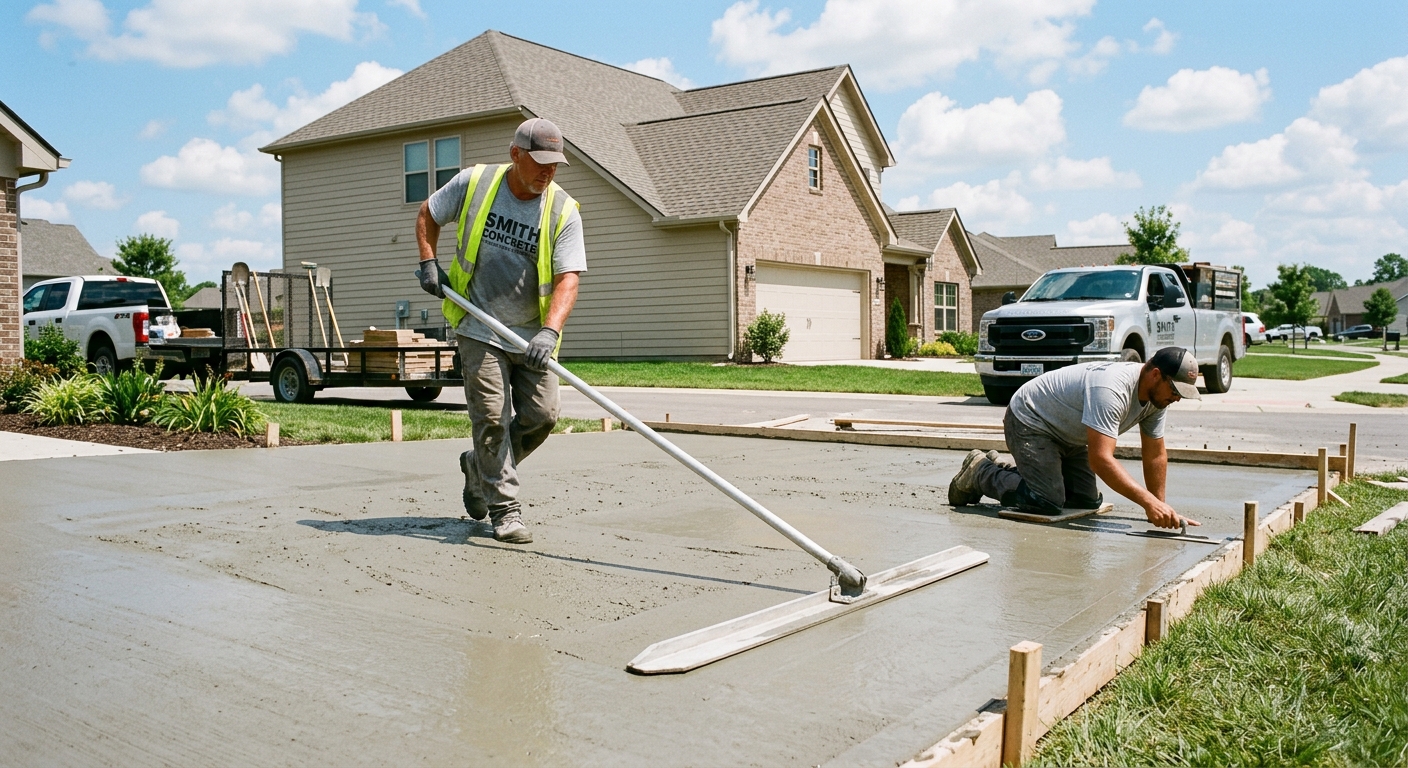
Concrete work options and costs in Lynnwood
Lynnwood, Alberta is a small community (population 3,289 per the Statistics Canada, 2021 Census), but the concrete demand is steady because homeowners need durable flatwork—especially for driveways, patios and walkways that survive Calgary-area freeze–thaw cycles. In many Lynnwood neighbourhoods, single-detached homes dominate the market, and that’s where contractors get busy with repeat services like garage slabs, porch pads, and front-entry walkways.
Because the region’s design frost depth is about 1.2 m (roughly 4 ft), foundation and footing excavation is deeper than in milder areas. That increases labour and material volume and is one reason foundation costs in Alberta often sit at the higher end of typical ranges. For exterior slabs, Calgary’s frequent freeze–thaw events also force stronger attention to air-entrained mixes, granular base prep, and control joints—plus winter-grade curing when you pour late in the season. The practical exterior concrete pour season can be shorter, which concentrates scheduling and can tighten availability among reputable crews.
In Lynnwood, trade demand is especially noticeable around established residential pockets near local service corridors, where homeowners commonly add parking pads and backyard patios alongside ongoing home renovations. If you’re budgeting, it helps to compare the most common options side-by-side before you call for quotes.
| Application |
Typical Size |
Key Spec |
Finish Option |
Price Range |
| Concrete driveway (standard broom finish) |
16 ft x 24 ft (384 sq ft) |
Air-entrained mix, compacted base, wire mesh or rebar as required |
Broom finish with joints and edge protection |
$12,000–$18,000 |
| Exposed aggregate driveway |
16 ft x 24 ft (384 sq ft) |
Air-entrained mix, proper retard/aggregate exposure plan |
Exposed aggregate for improved skid resistance |
$15,500–$22,500 |
| Stamped concrete driveway or patio |
16 ft x 24 ft (384 sq ft) |
Air-entrained mix, integral colour, release agent system |
Stamp pattern + sealant |
$18,000–$26,000 |
| Plain concrete patio or walkway |
12 ft x 16 ft (192 sq ft) or 3 ft x 40 ft walkway |
Compacted granular base, joints, frost-aware detailing |
Broom or smooth trowel edges |
$5,000–$9,000 |
| Garage floor (interior slab) |
24 ft x 24 ft (576 sq ft) |
Vapour barrier where required, fibres or mesh, proper curing |
Smooth or light broom, sawcut control joints |
$10,500–$16,500 |
| Foundation footings (structural, below frost) |
Typical house/extension footing scope (varies by plan) |
Below frost bearing, reinforced concrete, engineered details |
Structural finish (not decorative) |
$28,000–$45,000 |
Prices are estimates only and vary by project scope, site access and material selection.
What affects the price of concrete work in Lynnwood
In Lynnwood and across the Calgary economic region, it’s normal to see quotes for the “same” concrete job land 30–50% apart. The gap usually comes from how contractors engineer for Alberta conditions: excavation and base depth for frost protection, the concrete mix spec (especially air-entrainment), reinforcement choices, finishing system complexity, and how they handle winter curing windows. Even if your driveway footprint looks identical, the hidden work under the slab can change a lot.
First, the design frost depth of about 1.2 m (roughly 4 ft) means footings for houses, garages, decks and retaining structures must bear on undisturbed soil below frost. That directly affects footing volume and formwork height, pushing foundation-related pricing toward the higher band of typical estimates. Second, frequent freeze–thaw cycles drive the need for air-entrained concrete on exterior slabs; rushing the pour or curing—common when crews push late-season—can lead to scaling and early deterioration, and that risk has a cost in rework. Third, de-icing salts accelerate surface spalling on improperly spec’d mixes, so sealing is often part of long-term value.
In practical terms, a plain patio may track the $5,000–$9,000 range, while stamped systems climb toward $15,000–$26,000 because they require integral colour work, a release/texture system and careful sealing schedules. Two examples from Lynnwood: (1) a driveway with limited truck access can add haul and staging time; (2) a backyard patio on marginal drainage can require thicker granular base and improved grading, which adds materials but protects the slab for years.
| Price Factor |
Why It Matters |
Cost Impact |
| Frost line depth — determines footing depth and form height |
Footings must bear below the design frost depth to prevent frost heave. |
Can shift foundation pricing significantly; deeper excavation and more concrete volume. |
| Site preparation — excavation, grading, compacted granular base |
Concrete longevity depends on proper sub-base thickness and compaction. |
Adds labour and granular material; poor prep often leads to early settlement cracking. |
| Reinforcement — rebar or wire mesh requirement |
Controls cracking and supports load distribution for slabs and footings. |
Costs more up front; reduces risk of premature cracking and patchwork. |
| Mix design — air-entrainment and compressive strength spec |
Air-entrainment improves freeze–thaw durability; strength impacts structural performance. |
Higher-spec concrete can cost more, but it’s cheaper than replacing failed slabs. |
| Finish type — broom vs. stamped vs. exposed aggregate |
Complex finishes require extra labour, labour coordination and material systems. |
Stamped/exposed often adds surface materials and longer crew time. |
| Pour size and concrete truck access to site |
Access affects setup time, pumping/placement strategy, and pour efficiency. |
Limited access can increase labour and equipment; can also force smaller pours. |
| Cold-weather curing precautions — heating and blankets |
Proper curing prevents scaling and ensures strength gain in cold snaps. |
Adds equipment and time; typically required for late fall/early spring work. |
| Control joint pattern and sealing cost |
Joints manage shrinkage cracks; sealing helps repel de-icing salt and moisture. |
Sealer and sawcut plan add line items, but reduce long-term surface deterioration. |
Permits & regulations in Alberta
In Alberta, structural concrete work generally needs a building permit and often engineered drawings reviewed through the municipal process. This includes concrete foundation elements such as footings, foundation walls, and grade beams. For many homeowners in Lynnwood, that means your foundation package should be handled through the permit process before any concrete is placed, because the design must show reinforcement and the correct frost-bearing depth.
Concrete flatwork—driveways, patios and walkways—typically does not require a permit by default. However, permits or approvals can become necessary if the work affects lot grading, triggers requirements around impervious surface coverage, or impacts municipal right-of-way considerations. The best approach is to confirm with the local authority before breaking ground, especially if you’re changing drainage patterns or altering how water sheds away from the house.
For contractor due diligence, start with insurance and coverage. Step-by-step: (1) ask for a current certificate of insurance showing liability coverage for concrete construction and confirm the effective dates; (2) verify the contractor has WSIB/WCB clearance (the exact form depends on coverage type, but you should receive a clearance letter or equivalent proof); (3) check for a licence status where applicable to the trade and legal operating name; (4) request references for similar-scale pours in the Calgary area; and (5) ensure the quote clearly names what is included (permit pulling, if any, excavation, disposal, curing protection).
Getting concrete right in Lynnwood's freeze-thaw climate
Concrete fails in Lynnwood when the slab or foundation can’t “move safely” through freeze–thaw cycles or when the surface chemistry and air content aren’t engineered for Alberta winters. The most common problems I see are spalling and surface scaling from inadequate air-entrainment, plus cracking caused by poor base prep or the wrong control-joint plan. If you want the job specified correctly, focus on five areas: (1) base preparation—excavate and place a compacted granular sub-base to the right depth for frost and local soil conditions; (2) mix design—use air-entrained concrete (typical exterior target 5–7% air) with at least 32 MPa compressive strength; (3) control joints—cut and space them to limit random cracking; (4) curing—plan for a minimum 7-day cure under proper conditions, including insulating blankets or temporary heat when temperatures drop; and (5) sealing—apply a penetrating sealer after the concrete has cured, commonly around 28 days, to help resist de-icing salt exposure.
In Calgary’s cold continental climate, it’s not the day of the pour that matters—it’s the weeks after. A late-season patio that’s placed without curing blankets may look fine initially, then flake by the following winter. That’s why a reputable crew might charge more for winter-grade curing precautions; it’s often cheaper than grinding, patching and replacing a failing surface. For example, if stamped concrete is priced in the higher $15,000–$26,000 band, you’re paying for additional finish systems and careful sealing timing—worth it only when the underlying base and air-entrainment spec are done properly.
Use your quote as a technical checklist, not just a number. Ask how they’ll prevent spalling (air content), how they’ll manage shrinkage (joints), and what they’ll do for curing if you’re within a cold-weather window.
| Spec |
Why It Matters in Lynnwood |
What to Ask For |
Impact if Skipped |
| Compacted granular base (depth?) |
Stabilizes the slab and supports frost-aware performance on local soils. |
Base thickness and compaction method; confirm sub-base depth and drainage grade. |
Settlement, uneven cracking, premature edge spalling. |
| Air-entrained concrete mix (target air %?) |
Helps concrete survive freeze–thaw cycles by providing space for ice expansion. |
Document air-entrainment target (commonly 5–7% for exterior flatwork). |
High risk of surface scaling and spalling over 1–3 winters. |
| Compressive strength (MPa rating) |
Controls structural and durability performance for both slabs and foundation elements. |
Minimum 32 MPa at specified testing/age per the mix design. |
Lower strength gain and higher cracking/abrasion risk. |
| Control joints (spacing per ACI guidelines) |
Manages shrinkage so cracking happens in planned locations, not randomly. |
Planned joint spacing, sawcut timing, and joint width plan. |
Random cracks and costly repairs that don’t align with your finish. |
| Minimum 7-day curing period |
Enables strength gain and reduces scaling risk, especially in cold weather. |
How they protect the pour during cold snaps; curing method and duration. |
Surface weakness, scaling, and reduced long-term durability. |
| Penetrating sealer (when applied after cure) |
Repels moisture and de-icing salt intrusion common in Alberta winters. |
Sealer type and application timing (commonly around 28 days post-pour). |
Faster salt wear, staining and spalling acceleration. |
How to choose a concrete work contractor in Lynnwood
Choosing the right concrete contractor in Lynnwood is mostly about verifying coverage and details, not just price. In Alberta, start by confirming licensing status where applicable, then verify insurance: request a current certificate of insurance that includes liability coverage for concrete work and make sure the named insured matches the contractor doing the job. Next, get proof of WSIB/WCB coverage (typically provided as a clearance letter or equivalent documentation). If they can’t produce documentation promptly, that’s a red flag—concrete injuries and site damage are real risks, especially with excavation and concrete trucks.
Then get 2–3 itemised written quotes rather than one lump-sum number. A good quote separates labour, materials, excavation, granular base, reinforcement, concrete supply, finishing, sawcut joints, disposal, and any winter protection. Check the scope for what’s excluded: is rebar included or “as required”? Is permit pulling included where needed? Is concrete disposal (spoils/over-excavation) included?
Warranty matters too. Ask for the workmanship warranty length, whether there’s a manufacturer/product warranty for materials, and if any warranty is transferable to a future buyer. For payment, don’t allow large upfront deposits: keep it to about 10–15% upfront, then hold back funds until substantial completion. Finally, insist on a written timeline with a start date and completion estimate—concrete crews plan around weather, cure times and truck scheduling, and you should too.
- Confirm liability insurance limits and dates on the certificate of insurance.
- Verify WSIB/WCB clearance letter (ask for proof, not just “we’re covered”).
- Get licences/registration confirmation where required for the specific trade activities.
- Use itemised quotes: line items for excavation, base, rebar/mesh, concrete, finishing, and joints.
- Ask for the proposed mix spec (air-entrainment and strength), especially for exterior flatwork.
- Confirm reinforcement plan (wire mesh vs rebar) and where it will sit in the slab.
- Check the joint plan: spacing, sawcut timing, and whether joints will be sealed.
- Ask about cold-weather cure protection if your pour date could slip into colder temperatures.
- Clarify who handles permits (if required) and whether the contractor pulls them.
- Confirm disposal is included or priced separately for over-excavation and debris.
- Review warranty terms in writing, including what triggers warranty coverage.
- Agree to a payment schedule with a holdback until cleanup, sealing and punch-list items are done.
Red flags I see in Lynnwood: quotes that ignore air-entrainment or curing; “lump sum only” proposals with no mix/joint/base details; promises to pour late-season without blankets/heating plans; vague warranty language (“we’ll fix it” with no timeframe); and contractors asking for most payment upfront before any excavation or base work starts.
Frequently asked questions — concrete work in Lynnwood
Stamped vs broom-finish concrete — cost difference?
In Lynnwood and the wider Calgary market, stamped concrete usually costs more than broom-finish because it requires extra steps: colour, release agents, pattern mats, and typically a careful sealing schedule. For budgeting, plain broom-finish concrete flatwork commonly lands around the $12,000–$18,000 driveway band, while stamped driveways and patios often track the higher decorative range around $15,000–$26,000. The important part is that decorative finishing should never replace engineering basics—your base prep, air-entrainment and control joints still need to be right for freeze–thaw durability. If a contractor offers stamped work at a near-plain price but can’t explain mix spec and joint sealing, I’d treat it cautiously.
When is the best time to pour concrete in Lynnwood?
The best timing in Alberta is late spring through summer, when the weather supports curing without heavy cold-weather interventions. In the Calgary region, freeze–thaw cycles mean crews plan around temperature drops, especially for exterior slabs like driveways, patios and walkways. If you’re aiming for a fall pour, insist on a winter-grade curing plan—insulated blankets and sometimes temporary heat—because the minimum curing window is critical to avoid scaling and surface weakness. For foundation footings, timing also matters for excavation and formwork efficiency. A realistic approach is to schedule ahead, confirm daily temperature targets in the contract, and avoid last-minute pours when frost nights are likely.
How long does concrete take to cure?
Concrete curing is a process, not a single day. As a homeowner rule of thumb for Lynnwood: most exterior work needs at least a 7-day curing period under proper conditions for early strength and durability, and sealing is commonly done after full cure—often around 28 days—to better resist de-icing salt and moisture. If the temperature is cold, contractors may extend protection time using blankets or heat so the concrete can gain strength. You may be able to walk on it sooner, but don’t treat “walkable” as “safe for loads.” For driveways and garage floors, keep vehicles off until the contractor’s strength targets are met, and follow the curing plan in your scope.
Do I need a permit for concrete work in Alberta?
In Alberta, concrete that’s part of a structure—like footings, foundation walls, and grade beams—typically requires a building permit and often engineered drawings that get reviewed through the municipal process. Concrete flatwork like driveways, patios and walkways usually doesn’t require a permit by default, unless it affects lot grading, impacts impervious surface limits, or relates to municipal right-of-way considerations. For Lynnwood homeowners, the safest approach is to confirm with the local authority before you start, especially when water drainage changes. Also, ask your contractor whether they pull permits (if required) and whether it’s included in the quote.
Concrete vs pavers for a patio in Lynnwood?
Concrete and pavers both work well in Lynnwood, but each has trade-offs. Concrete patio slabs are often a better value when you want a uniform surface, simple edging, and predictable maintenance—plain patios commonly fall in the $5,000–$9,000 band depending on size and prep. Pavers cost more in many cases due to material variety, labour-intensive layout, and edging details, but they can be easier to spot-repair if a section shifts. In freeze–thaw climates, the biggest determinant is still the base: compacted granular sub-base, drainage grade, and proper jointing/edges. If you expect drainage issues or you want easy replacement of a single area, pavers can be attractive. If you want long-term durability with fewer visible joints, concrete often wins—when engineered correctly.
How long does a concrete driveway last?
A properly built concrete driveway in the Calgary/Lynnwood climate can last many years—often decades—because it’s designed around frost depth and freeze–thaw durability. Longevity depends on the details: a compacted granular base, air-entrained concrete for exterior exposure, correctly spaced control joints, and a curing plan that protects the pour, especially during temperature swings. Sealing is also important because de-icing salts accelerate surface wear and can contribute to spalling when the concrete isn’t protected. When homeowners compare quotes, a bargain price that cuts corners on air content, base depth or curing usually shows problems earlier (surface scaling, joint deterioration, random cracking). If a contractor can’t explain how they’ll spec those items, it’s a sign to ask more questions before you commit.