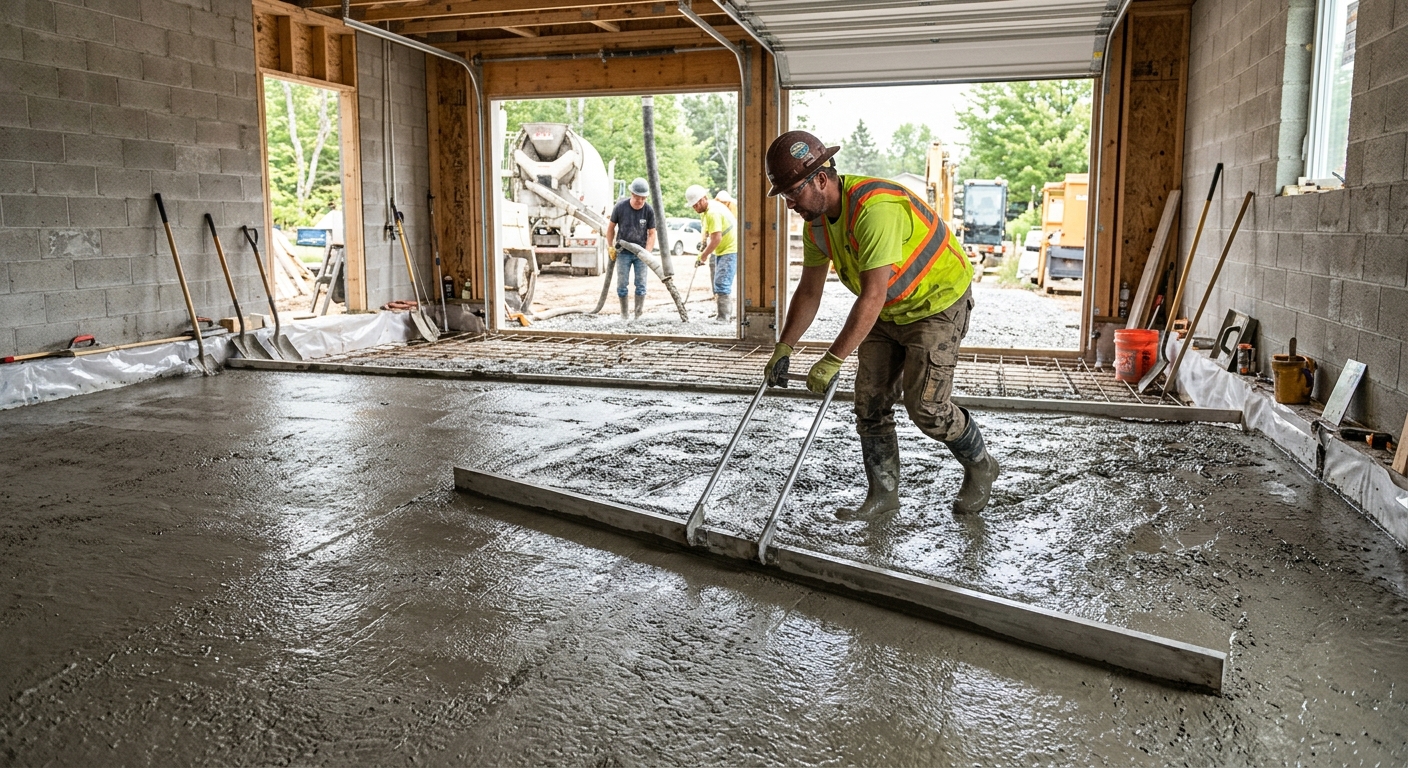
Concrete work options and costs in Cranston
Cranston, Alberta is a great place for durable concrete flatwork, but the pricing reflects the realities of building in a Calgary-region freeze–thaw climate. With a 2021 population of 20,850 in the area and a housing mix that heavily favours single-detached homes (the primary market for driveways, patios and walkways), you’ll see consistent demand for quality workmanship around neighbourhoods like Walden-style-style lake-adjacent communities and newer subdivisions near the southeast Calgary corridor where residents upgrade curb appeal and backyard systems.
In this region, concrete costs aren’t just about “square footage.” Contractors must account for a deeper frost design (about 1.2 m here) so footings and structural slabs bear below undisturbed soil. Frequent freeze–thaw cycles also push specs toward air-entrained mixes, properly graded granular base prep, and well-spaced control joints to reduce cracking and surface deterioration. On top of that, the practical exterior pour season is shorter than in milder provinces—so cold-weather curing precautions (insulation blankets, temporary heat, and winter-grade placement procedures) can become part of the quote, especially for late fall and early spring.
Availability of skilled crews can tighten near peak season, and that labour component is one reason you may see swings within the same application type. Use the following comparison table as a realistic baseline for Cranston, then we can fine-tune it based on site access, base conditions, reinforcement, and finish selection.
| Application |
Typical Size |
Key Spec |
Finish Option |
Price Range |
| Concrete driveway (standard broom finish) |
400 sq. ft. (e.g., 20' x 20') |
Air-entrained mix, compacted granular base, joints |
Broom finish |
$12,000–$18,000 |
| Exposed aggregate driveway |
400 sq. ft. (e.g., 20' x 20') |
Proper mix + finishing/curing to support chip exposure, joints |
Exposed aggregate |
$15,000–$21,000 |
| Stamped concrete driveway or patio |
300 sq. ft. (e.g., driveway apron or 15' x 20') |
Air-entrained mix, reinforcement as needed, colour + sealer-ready curing |
Stamped + integral colour |
$15,000–$26,000 |
| Plain concrete patio or walkway |
200 sq. ft. (e.g., 10' x 20') |
Compacted base, joints, air-entrained mix |
Plain (trowel + light broom texture) |
$5,000–$9,000 |
| Garage floor (interior slab) |
480 sq. ft. (e.g., 20' x 24') |
Vapour barrier (if required), fibre or mesh, standard interior curing |
Steel-trowel finish + perimeter joints |
$10,000–$16,000 |
| Foundation footings (structural, below frost) |
Typical house/garage footing run |
Engineered design; footings below design frost depth (~1.2 m), rebar per engineer |
Structural concrete only (no decorative finishes) |
$28,000–$45,000 |
Prices are estimates only and vary by project scope, site access and material selection.
What affects the price of concrete work in Cranston
In Calgary and the broader Alberta market, two quotes for the same “driveway size” can differ by 30–50% because concrete pricing is driven by engineering assumptions, excavation realities, and how carefully a contractor protects the slab during cure—not just by the volume of concrete poured. Frost depth requirements and freeze–thaw cycles dictate every spec: footings must extend below the local design frost depth (about 1.2 m in this region) to reduce frost heave and seasonal movement, while exterior slabs need air-entrained concrete mixes to survive repeated temperature swings. Cold-weather placement also matters—when the pour season tightens, winter-grade mixes, insulating blankets and sometimes temporary heat can add cost.
De-icing salt usage in winters across the Calgary region adds another pricing driver: the better contractors plan for sealing and surface durability so your slab resists spalling and scaling over time. In practical terms, you’ll often see these cost differences reflected in the same categories: more excavation and thicker granular base increase foundation and slab costs; reinforcement (rebar versus wire mesh, or extra steel where loads demand it) increases labour and materials; and finishing upgrades move pricing quickly.
For example, a standard broom-finish driveway is typically aligned with the $12,000–$18,000 band, while stamped work can land closer to the $15,000–$26,000 band once colouring, stamping labour, and higher finishing consistency are included. On newer Cranston builds, site preparation is often cleaner, which can keep driveway pricing closer to the lower end of the band; on retrofit jobs with trees, slope, or poor soil, excavation and base replacement can push you higher—sometimes enough to justify upgrading from plain concrete to a more durable finishing strategy (like exposed aggregate for traction), if you want longevity.
| Price Factor |
Why It Matters |
Cost Impact |
| Frost line depth |
Determines footing depth and form height |
Deeper excavation increases concrete volume and labour; can be a major driver for foundations/footings |
| Site preparation |
Excavation, grading, compacted granular base |
Poor subgrade or extra base replacement raises equipment time and granular material costs |
| Reinforcement |
Rebar or wire mesh requirement |
More steel (and proper spacing) increases material and placement labour |
| Mix design |
Air-entrainment and compressive strength spec |
Winter-grade and correctly specified air content can cost more but reduces scaling/spalling risk |
| Finish type |
Broom vs. stamped vs. exposed aggregate |
Stamped/exposed finishes add labour time, tooling, and colour/sealer system consistency |
| Pour size and concrete truck access to site |
How far and how efficiently concrete can be delivered/placed |
Long carries or limited access can add manpower and planning time |
| Cold-weather curing precautions |
Heating and blankets |
Temporary protection increases labour and materials; it’s critical in late fall/early spring |
| Control joint pattern and sealing cost |
Manages cracking and protects against de-icing salts |
Proper jointing and sealing add line items but reduce long-term repair and aesthetic failure |
Permits & regulations in Alberta
In Alberta, structural concrete work—such as building footings, foundation walls, and grade beams—typically requires a building permit, and you’ll often see engineered drawings reviewed as part of that process. Concrete flatwork (driveways, patios, and walkways) usually does not require a permit, unless the work affects lot grading, meets specific impervious-surface or drainage expectations, or ties into municipal right-of-way considerations. Because requirements can vary by how the slab connects to site drainage or by project type, confirm with the local authority before any excavation.
Before you sign with a contractor in Cranston, verify three basics: permit handling (if applicable), liability coverage, and worker coverage. Step-by-step, you can do this quickly. First, ask the contractor for a certificate of insurance showing general liability; ensure it includes the correct legal business name and active coverage dates. Second, ask for proof of worker coverage under Alberta’s system (commonly referred to as WCB—Workers’ Compensation Board). A credible contractor can provide a clearance letter or proof of coverage on request.
Third, confirm the contractor is legitimate for the scope: look for their business registration and any applicable trades or concrete-related registration information available through provincial or business registries. Finally, ask for references on similar-scale work in the Calgary region, and—if structural concrete is involved—request that they coordinate with the engineer and permit process. If they’re vague about insurance or schedule coordination, that’s a red flag.
Getting concrete right in Cranston's freeze-thaw climate
In Cranston, concrete most often fails for one reason: moisture plus freeze–thaw, working together when the mix and detailing aren’t matched to winter conditions. The biggest avoidable failure is spalling from inadequate air-entrainment, especially where de-icing salts and surface water concentrate near driveway edges, steps, and joints. To spec the job correctly, start with base preparation: a properly compacted granular sub-base to the right depth for local soil and frost conditions provides stability so the slab doesn’t flex and crack. Next, demand a mix design that includes air-entrainment (commonly 5–7% for exterior flatwork) and a minimum 32 MPa compressive strength so the concrete is strong and resilient.
Then control cracking using joints: control joints should be planned and spaced so random cracking is reduced, and edges should be properly detailed. Curing is equally important in Calgary’s climate. Even with great concrete, rushing cure in cold weather increases risk. A minimum 7-day curing period under correct conditions helps the concrete develop strength and durability. Finally, apply a penetrating sealer about 28 days after the pour to help repel de-icing salts and reduce surface water absorption.
Here’s a realistic dollar example: if you’re deciding between broom-finish and stamped concrete, stamped may come closer to the $15,000–$26,000 band because of added labour and finishing consistency. In many Cranston driveways, the best “value for durability” is actually making sure the base, air-entrainment and joints are right—those elements matter as much for a standard driveway as they do for stamped work. If a quote is cheaper but skips air-entrainment or doesn’t discuss sealing timing, you’ll often pay later with spalling and patch repairs.
| Spec |
Why It Matters in Cranston |
What to Ask For |
Impact if Skipped |
| Compacted granular base (depth?) |
Prevents settlement and cracking during freeze–thaw and frost movement |
State the granular depth and compaction requirements based on your soil and frost design |
Premature cracking, uneven slabs, and joint failure |
| Air-entrained concrete mix (target air %?) |
Provides freeze–thaw resistance to reduce scaling and spalling |
Confirm exterior air content target (typically 5–7% for flatwork) |
Surface scaling and spalling, especially with de-icing salts |
| Compressive strength (MPa rating) |
Ensures adequate structural performance and durability |
Confirm minimum 32 MPa rating for the specified application |
Lower strength and faster deterioration under winter stress |
| Control joints (spacing per ACI guidelines) |
Controls where cracking occurs rather than letting it happen randomly |
Ask for the joint spacing plan and joint type (saw-cut/timing) |
Random cracks that can widen and let water into the slab |
| Minimum 7-day curing period |
Cold-season placement needs time to gain strength safely |
Confirm curing protection plan if temperatures are low |
Surface scaling, reduced durability, and weaker slab |
| Penetrating sealer (when applied after cure) |
Helps repel salt and water so freeze–thaw is less damaging |
Confirm application timing (often ~28 days after pour) and sealer type |
Faster salt-related wear and more frequent patching |
How to choose a concrete work contractor in Cranston
Choosing the right contractor in Cranston comes down to proof and process. Start by verifying Alberta coverage and compliance. Ask for a current certificate of general liability insurance (with the correct insured business name and dates). Request proof of Alberta worker coverage (often provided as a WCB clearance letter or confirmation of coverage) before work begins. Then confirm they’re a legitimate business with references you can contact, ideally for similar driveway/patio/footing scopes in the Calgary region.
Next, get 2–3 written quotes that are itemised—not just a lump sum. A good quote breaks down labour and materials: excavation/haul, granular base, vapour barrier (when applicable), reinforcement, concrete supply specs (air-entrainment and strength), formwork, finishing, joints, curing protection, and sealing (if included). Read the exclusions carefully: is permit handling included where required for structural work? Is disposal/rock hauling included? What happens if unsuitable soil is discovered—do they provide a base replacement allowance or a change-order trigger?
Warranty matters, but make it concrete-specific. Ask for a workmanship warranty length and whether product/manufacturer coverage applies to admixtures or sealers. Confirm if the warranty transfers to a new owner if you sell. For payment, avoid paying more than 10–15% upfront; keep a holdback until the job is complete and final finishing/clean-up is done. Finally, insist on a written timeline with a start date and estimated completion window, especially if cold weather might affect curing and surface quality.
- Provide certificate of general liability with coverage dates and limits
- Provide WCB proof/clearance letter on request (no vague “we’re covered” statements)
- Show at least 3 references from comparable concrete scopes in the Calgary area
- Quote includes base prep details (excavation scope and granular depth/compaction expectation)
- Quote states concrete mix requirements (air-entrainment and minimum strength)
- Specifies reinforcement approach (mesh vs rebar) and where it’s placed
- Includes joint plan: spacing, saw-cut/timing method, and any sealing of joints if used
- Lists curing protection for cold weather (blankets/heating plan where needed)
- Clarifies sealing inclusion and timing (often ~28 days post-pour)
- Breaks down disposal/haul and protection of landscaping and driveway approaches
- Uses a written change-order process for unexpected soil or access issues
- Includes warranty terms for workmanship and how defects are corrected
Concrete red flags in Cranston include: a quote that won’t discuss air-entrainment and joints, pricing that seems too low for proper base prep, crews that can’t explain curing/blanket plans in shoulder seasons, reluctance to provide insurance/WCB documentation, and vague warranties that don’t specify the scope of repair.
Frequently asked questions — concrete work in Cranston
Why does concrete crack in Cranston and how is it prevented?
Concrete in Cranston typically cracks because of shrinkage and expansion, then the freeze–thaw cycle turns those small movements into visible defects—especially when water gets into the slab edges or joints. Prevention starts with a stable base (compacted granular sub-base sized to local frost conditions, about 1.2 m design frost depth for foundation bearing). The second key is jointing: control joints should be planned and placed so cracking happens where you intend. Third, make sure the mix is air-entrained for exterior durability and that curing isn’t rushed in cold weather. A properly sealed and correctly jointed driveway can stay serviceable much longer. If you’re budgeting, remember even a standard driveway priced around $12,000–$18,000 can fail early if the base and air-entrainment aren’t done properly—so always ask what’s included, not just the final number.
Stamped vs broom-finish concrete — cost difference?
Stamped concrete costs more because it requires additional labour, careful finishing timing, and consistent curing so the imprinting and colour work stays crisp in winter conditions. In Calgary-area pricing, stamped driveways and patios often align with the $15,000–$26,000 band, while a standard broom-finish driveway commonly sits closer to $12,000–$18,000 depending on size and site access. That difference is typically justified by colour material, tooling labour, and a higher standard of prep and finishing consistency. However, durability still depends on the fundamentals: proper base prep, air-entrainment, joint planning, and curing protection. If a contractor is willing to stamp but can’t clearly explain those specs, the cheaper broom-finish approach may be the better long-term bet.
When is the best time to pour concrete in Cranston?
For Cranston exterior flatwork, the best time is late spring through summer when air temperatures support normal curing and you can avoid aggressive cold-weather measures. In practice, late fall and early spring are “possible but engineered”: crews often need insulated blankets, heating, and tighter protection schedules to meet curing requirements and reduce surface scaling risk. Timing also affects scheduling—Calgary-region projects can fill quickly when conditions are ideal, especially for driveways and patios. If you’re aiming for a schedule-friendly pour, plan around stable temperatures rather than just thaw dates. Ask your contractor how they handle curing protection if temperatures drop overnight, and confirm that they’ll meet the minimum curing expectations (typically at least 7 days under proper conditions). That’s often where the real cost and risk differences show up in quotes.
How long does concrete take to cure?
Concrete “sets” quickly, but curing is about gaining strength and durability. For most residential work in Alberta, you should plan for a minimum 7-day curing period under proper conditions before treating the slab as fully durable. In freezing conditions, the curing window must be protected with proper insulation/blankets and, in some cases, temporary heat so the slab can achieve strength development and resist early surface damage. Don’t confuse “walk on it” with full curing. Also consider sealing timelines: for exterior flatwork where de-icing salts are used, penetrating sealer is commonly applied about 28 days after the pour (after adequate cure) to repel moisture. If your contractor can’t explain their curing plan for your pour date, that’s a quality risk—especially in Cranston’s freeze–thaw climate.
Do I need a permit for concrete work in Alberta?
In Alberta, structural concrete work such as footings, foundation walls, and grade beams generally requires a building permit and often engineered drawings reviewed through the municipal process. For concrete flatwork like driveways, patios, and walkways, a permit is often not required—unless the work changes lot grading, involves drainage considerations, or connects to right-of-way or impervious-surface constraints. The safest approach is to confirm with the local authority before excavation so you don’t run into delays. When you get quotes for Cranston projects, ask whether permit handling (if applicable) is included. Also verify the contractor carries liability insurance and has Alberta worker coverage (WCB proof). A credible contractor will help you understand what needs permitting rather than guessing.
Concrete vs pavers for a patio in Cranston?
Concrete and pavers both work in Cranston, but they perform differently under freeze–thaw. Plain concrete patios (often around $5,000–$9,000 depending on size and prep) typically offer a faster, more uniform finish with fewer individual joint components to shift. Pavers give design flexibility and easier spot repair in some cases, but they still rely on proper base construction and jointing details to prevent settling and weed growth. In a Calgary-region winter climate, what matters most is base prep and drainage: both systems can fail if the sub-base isn’t properly compacted. If you want the best “set it and forget it” durability, well-specified concrete with proper joints and optional sealing is a strong choice. If aesthetics and easy individual replacement are your priority, pavers can be worth it—just ensure the contractor’s approach to base depth and compaction matches local frost realities.