Concrete work options and costs in Falconridge
Concrete work is a big part of life in Falconridge, Alberta—driveways, patios, walkways and foundation work have to be built for long, cold winters and rapid freeze–thaw cycles. With a population of 10,325 (Statistics Canada, 2021 Census), there’s steady demand from homeowners maintaining established properties and from new builds. In this Calgary region, most concrete flatwork is tied to single-detached and townhouse lots, so you’ll commonly see new driveway pours, replacement slabs, and grade-related repairs around mature neighbourhood pockets where landscaping and re-sodding happen often—one reason the trade is especially busy along residential corridors near major access routes into Falconridge.
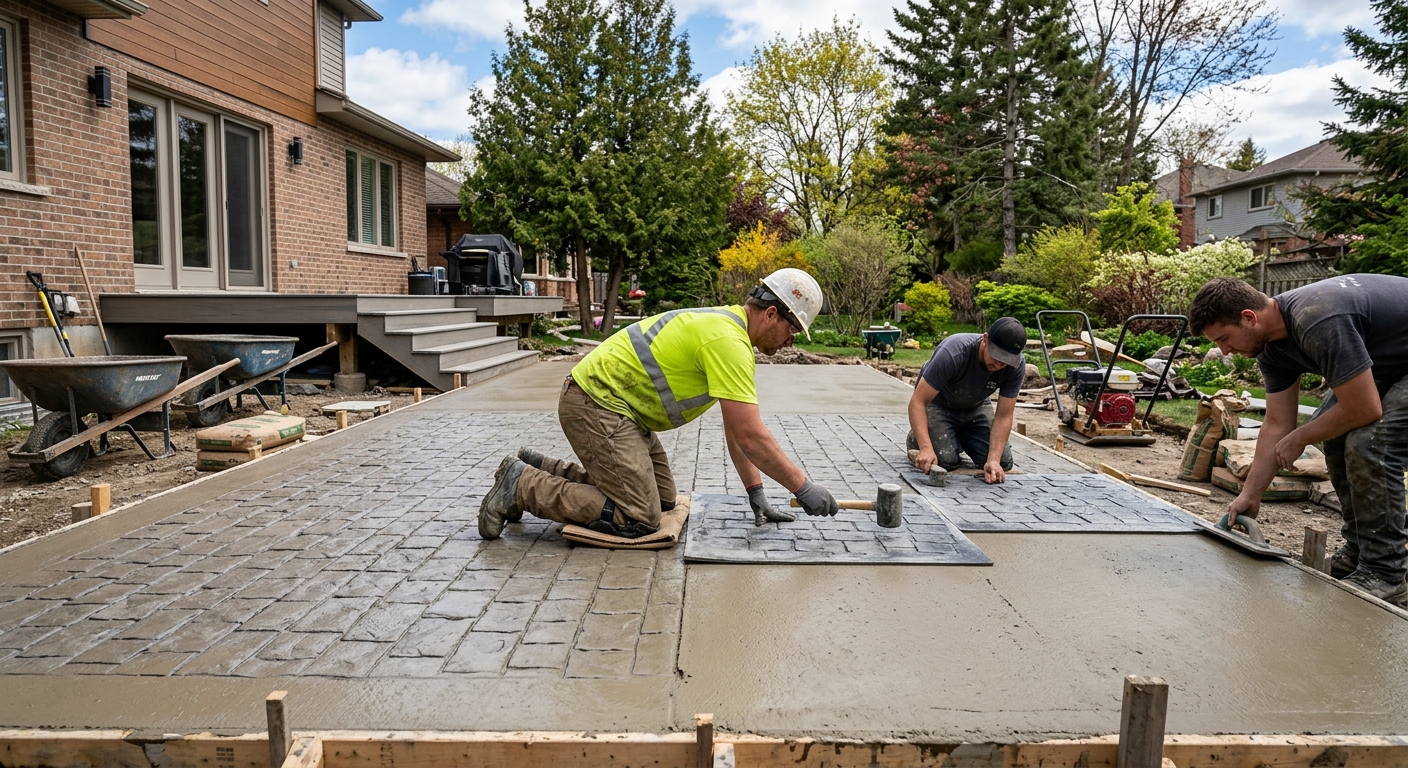
Prices can swing from one quote to the next because frost depth and curing conditions directly affect excavation, footing size, and mix selection. Calgary’s design frost depth is about 1.2 m (roughly 4 ft), so exterior footings and any structural support must typically bear below that zone to reduce frost heave. For exterior slabs, air-entrained concrete and a proper base prep aren’t optional—these specs protect against scaling and spalling when temperatures jump around above and below freezing. On top of that, the practical pour season is shorter, so contractors plan trucking, finishing, and curing protection more carefully. In real terms, that’s why a standard broom-finished driveway can land on the low end of the regional $12,000–$18,000 band, while decorative work like stamping usually pushes higher due to labour intensity and additional surface prep.
Below is a practical comparison of common options so you can match scope to budget before you request itemised quotes.
| Application |
Typical Size |
Key Spec |
Finish Option |
Price Range |
| Concrete driveway (standard broom finish) |
10 m x 3 m (approx. 30 m²) |
Air-entrained mix; compacted granular base; control joints |
Broom finish |
$12,000–$18,000 |
| Exposed aggregate driveway |
10 m x 3 m (approx. 30 m²) |
Air-entrained mix; proper retarder/curing plan; sealed surface options |
Exposed aggregate |
$15,000–$22,000 |
| Stamped concrete driveway or patio |
40 m² (typical driveway/patio area blend) |
Air-entrained mix; upgraded release/curing; crack control plan |
Stamp + colour hardener/release |
$15,000–$26,000 |
| Plain concrete patio or walkway |
30 m² walkway/patio area |
Air-entrained mix; proper slope; joint spacing |
Float + broom or smooth finish |
$5,000–$9,000 |
| Garage floor (interior slab) |
6 m x 3.5 m (approx. 21 m²) |
Vapour barrier/insulation if required; control joints |
Steel trowel finish or broom (per use) |
$6,500–$12,000 |
| Foundation footings (structural, below frost) |
Typical house footings/partial rebuild |
Below design frost depth bearing; engineered rebar layout |
Structural concrete forming/pouring |
$28,000–$45,000 |
Prices are estimates only and vary by project scope, site access and material selection.
What affects the price of concrete work in Falconridge
In Falconridge and the wider Calgary market, it’s common to see two quotes for the “same” concrete job come in 30–50% apart. The big reason isn’t profit—it’s engineered differences: how deep the excavation goes, how much base prep is required, whether the contractor is actually pricing air-entrained mix for exterior work, and how they handle curing when the temperature drops. When frost depth drives footing depth, your form height, rebar quantities, and concrete volume increase. Local conditions also affect labour productivity, especially around tighter residential driveways where a pump may or may not be required.
Every exterior slab is engineered around Calgary’s freeze–thaw reality. With a design frost depth of about 1.2 m (roughly 4 ft), footings for houses, garages, decks and retaining structures must bear on undisturbed soil below that depth to help prevent frost heave and seasonal movement. On top of that, frequent freeze–thaw cycles require air-entrained concrete mixes and properly spaced control joints to reduce cracking and spalling on driveways, patios and walkways. In cold months, the practical pour season narrows and contractors may need winter-grade practices—insulated blankets, managed curing temperatures, and sometimes temporary heat—so concrete reaches adequate strength without scaling.
Two practical examples in Falconridge: (1) replacing a driveway on top of soft fill is rarely “just new concrete.” If the contractor finds unsuitable subgrade and has to excavate deeper and rebuild with compacted granular base, the driveway cost can shift toward the upper end of the $12,000–$18,000 band. (2) A stamped patio may look similar on paper to a plain patio, but stamping adds labour and surface prep; if your site needs extra base correction to avoid uneven stamping, the project often lands closer to the $15,000–$26,000 decorative range.
As a homeowner, the most important step is matching your quote to the engineering reality—especially the frost depth bearing and exterior air-entrainment—rather than comparing only the final line total.
| Price Factor |
Why It Matters |
Cost Impact |
| Frost line depth — determines footing depth and form height |
Footings must bear below design frost depth to prevent frost heave |
Major cost driver when excavation/formwork increases |
| Site preparation — excavation, grading, compacted granular base |
Correct base reduces settlement and protects the slab during freeze–thaw |
Can move a flatwork job 10–25% depending on subgrade |
| Reinforcement — rebar or wire mesh requirement |
Controls cracking for driveways, thicker slabs, and structural work |
Moderate increase, especially for thicker or higher-load areas |
| Mix design — air-entrainment and compressive strength spec |
Exterior durability depends on air-entrainment in freeze–thaw climates |
Moderate to high if upgraded specs are truly included |
| Finish type — broom vs. stamped vs. exposed aggregate |
Labour, tooling, and curing/release steps affect durability and appearance |
Stamped/exposed usually add significant labour time |
| Pour size and concrete truck access to site |
Short access can require extra handling, smaller pours, or pumps |
High impact when access is tight or multiple mobilizations are needed |
| Cold-weather curing precautions — heating and blankets |
Ensures proper strength gain and reduces surface scaling |
Can add meaningful cost near shoulder seasons |
| Control joint pattern and sealing cost |
Jointing and sealing reduce random cracking and protect from de-icing salts |
Moderate; often overlooked in cheaper bids |
Permits & regulations in Alberta
In Alberta, the rules are straightforward: structural concrete work needs a building permit and often engineered drawings. That means foundation footings, foundation walls, grade beams, and other structural elements typically require a permit. For many flatwork projects—patios, walkways, and standard driveways—a permit is often not required unless your work changes lot grading, affects impervious surface coverage limits, or involves municipal right-of-way or drainage changes. Even when a permit may not be required, you should still confirm with the local authority before breaking ground, particularly if your work could redirect water toward neighbouring property or public areas.
Before hiring in Falconridge, verify three things: (1) the contractor can legally operate for the type of work offered, (2) they carry liability insurance, and (3) they have the appropriate workers’ compensation coverage (WSIB/WCB as applicable in Alberta). The step-by-step homeowner checks are:
- Check online for the contractor’s licensing/registration details relevant to their trade/contracting category in Alberta.
- Ask for a Certificate of Insurance (COI) showing general liability; review the coverage limits and confirm Falconridge/Calgary-area projects are covered.
- Ask for workers’ compensation clearance documentation and ensure it’s active.
- Request references for similar foundation or flatwork scopes (not just decorative patios).
- Confirm permit responsibility in writing: who pulls permits (if required) and what inspections are expected.
If a bid suggests structural concrete can be done “permit-free” without any engineered drawing involvement, treat it as a red flag and ask how they’re handling regulatory steps.
Getting concrete right in Falconridge's freeze-thaw climate
Concrete failures in Falconridge usually come down to three things: poor base support, incorrect mix design for exterior exposure, and rushing curing. Freeze–thaw cycles expand water in pores and widen microcracks; if the concrete isn’t air-entrained or if the base isn’t properly compacted, you’ll see scaling, surface deterioration, and sometimes spalling after a few winters. The fix is to spec the job correctly and demand proof of process—especially because Calgary-area pours often happen during colder shoulder months.
Here’s how to spec concrete for this climate. (1) Base preparation: require a compacted granular sub-base to the correct depth for your local soil and frost considerations. If the contractor can’t clearly explain excavation, subgrade assessment, and granular compaction, your slab may settle and crack. (2) Mix design: for exterior flatwork, air-entrainment is critical; target about 5–7% air content and require a minimum 32 MPa compressive strength specification. (3) Control joints: spacing should be planned to limit random cracking; joints aren’t just cosmetic—they’re engineered crack control. (4) Curing: insist on minimum 7 days of proper curing, with insulated blankets or winter-curing precautions when temperatures drop. (5) Sealing: use a penetrating sealer applied 28 days after the pour to repel de-icing salts.
For budgeting, understand where the price difference makes sense. For example, upgrading from a basic broom-finish patio to a stamped or decorative system can cost more, but if the quote also includes better base correction and proper curing protection, that extra spend is justified. If it’s just adding pattern and colour with no reinforcement of air content, jointing, and curing, you’re paying for looks while risking durability.
| Spec |
Why It Matters in Falconridge |
What to Ask For |
Impact if Skipped |
| Compacted granular base (depth?) |
In Falconridge’s freeze–thaw cycles, the base prevents settlement and movement under the slab |
State excavation depth and granular type; confirm compaction method |
Cracking, uneven surface, and premature deterioration |
| Air-entrained concrete mix (target air %?) |
Air pockets help concrete handle freeze–thaw without scaling and spalling |
Confirm target air content around 5–7% for exterior flatwork |
Surface scaling and spalling after winter seasons |
| Compressive strength (MPa rating) |
Strength gain supports durability and load capacity during and after freezing conditions |
Require minimum 32 MPa |
Lower durability and higher risk of cracking or surface breakdown |
| Control joints (spacing per ACI guidelines) |
Joints control where cracks form as temperatures cycle |
Ask for joint layout plan and spacing consistent with ACI practice |
Random cracking and loss of surface integrity |
| Minimum 7-day curing period |
Proper curing is essential when placing near cold weather to reach strength safely |
Confirm curing protection plan for cold days |
Weak surface, increased scaling risk, and reduced long-term performance |
| Penetrating sealer (when applied after cure) |
De-icing salts accelerate spalling if concrete is left unprotected |
Penetrating sealer applied after 28 days cure (or per manufacturer timing) |
Salt intrusion and faster surface deterioration |
How to choose a concrete work contractor in Falconridge
Choosing the right concrete contractor in Falconridge is less about “who’s cheapest” and more about who can prove they build for frost, curing, and longevity. Start with Alberta compliance checks. Ask for a current Certificate of Insurance (general liability) and confirm the coverage limit is appropriate for the scale of your project. Next, request their workers’ compensation clearance documentation (WSIB/WCB as applicable in Alberta) and make sure it’s active for the duration of the job. For structural scopes (footings and foundation walls), ensure they can provide references on similar engineered work.
Then get 2–3 itemised written quotes. You want a breakdown that separates labour, concrete volume, reinforcement, excavation/base prep, finishing, joints, and sealing—rather than one lump number. Carefully read what’s excluded: disposal of surplus soil, permit fees (if any), protection of landscaping, truck/pump access allowances, and whether rebar is included where required. If your bid is missing an element like air-entrainment specification for an exterior slab, it often underprices the material itself and shows up as cracking or spalling later.
Review warranty terms. Ask for the workmanship warranty length, whether it covers cracks/spalling, and what’s excluded. Confirm the product/manufacturer warranty if admixtures, sealers, or special membranes are used, and whether any warranty is transferable. For payment, keep it controlled: never pay more than 10–15% upfront, and hold back a portion until the project is complete and deficiencies are corrected. Finally, get a start date and a completion window in writing, because cold-weather scheduling affects curing performance in this region.
- Ask for proof of insurance (COI) and verify dates/coverage limits.
- Confirm active workers’ compensation clearance documentation.
- Request references for similar Falconridge/Calgary flatwork and any structural pours.
- Insist on an itemised quote: base prep, reinforcement, concrete supply, finishing, joints, sealing.
- Check whether air-entrainment and minimum strength (e.g., 32 MPa) are stated.
- Clarify joint layout and sealing plan (when sealer is applied after curing).
- Confirm cold-weather curing procedures (blankets/heating) if the schedule risks late-season pours.
- Ask who handles excavation depth and disposal, and what’s included in site clean-up.
- Verify equipment/access: truck reach, staging area, and whether a pump is included.
- Review warranty length and exactly what it covers for the freeze–thaw environment.
- Keep payment terms conservative: 10–15% upfront max; retain holdback until completion.
- Get start date and finish date estimates in writing.
Concrete red flags in Falconridge include: quotes that don’t specify air-entrainment or minimum strength, skipping winter curing protection when temperatures are likely to drop, vague “we’ll figure it out” plans for base depth and compaction, refusal to put curing/joint/sealing details in the scope, and payment requests that exceed 10–15% upfront without clear milestones.
Frequently asked questions — concrete work in Falconridge
How do I maintain concrete in Falconridge's freeze-thaw climate?
In Falconridge, maintenance is about protecting the surface from water and de-icing salts that accelerate freeze–thaw damage. Start by using de-icing products carefully—avoid over-salting, and use plastic shovels when possible to prevent surface abrasion. Keep an eye on joints: if joint filler is missing or spalling begins around joints, address it early so water doesn’t migrate underneath. For exterior driveways and patios, plan for penetrating sealer after curing; a common approach is applying sealer at about 28 days post-pour. If you’re budgeting, sealing is usually far less than replacing a failed slab—replacing exterior flatwork often fits into the $12,000–$18,000 driveway band depending on size and prep, while maintenance can be a fraction of that.
What causes concrete to spall in Falconridge winters?
Spalling in Falconridge is typically driven by freeze–thaw expansion of moisture inside concrete pores, and it’s most common when the concrete mix isn’t properly air-entrained for exterior exposure. If contractors skip or under-specify air content, the concrete doesn’t tolerate freezing expansion well, so you get scaling and then flakes/spalls. Another contributor is inadequate base prep or poor drainage: water can pool, freeze, and create internal stress. De-icing salts worsen this by increasing deterioration at the surface, which is why sealing matters after the slab cures. Finally, cold-weather placement without proper curing protection can leave the surface weaker. Even if a driveway is within the $12,000–$18,000 range, the true durability depends on specs and curing—not just the final price.
What is rebar and when is it required in Alberta?
Rebar (reinforcing steel) is used in concrete to control cracking and improve structural capacity. In Alberta, whether rebar is required depends on the application and engineering design: structural elements like foundation footings, grade beams, and foundation walls are typically engineered and require reinforcement layouts. For flatwork, rebar or welded wire mesh may be used depending on slab thickness, intended loads (for example, heavier vehicle traffic on driveways), soil support, and whether the contractor is following the engineered spec for your thickness. In colder climates like Falconridge where freeze–thaw stresses are higher, reinforcement and proper joint spacing work together to limit random cracking. If you’re comparing quotes, ask whether reinforcement is included and what it is (rebar vs. mesh), and ensure thickness and base prep match the spec—not just a “best guess.”
How long does a concrete project take in Falconridge?
Timelines vary based on scope, weather, and curing needs, especially in Falconridge where winter conditions can limit exterior pours. Typical durations: a small patio or walkway might take about 1–2 days on site for prep and pour, with curing continuing afterward; you’ll usually want at least 7 days of proper curing before normal use, depending on traffic. A driveway often takes longer due to excavation, base prep, rebar/mesh (if needed), finishing, and jointing—commonly around several working days before the concrete is ready for full load, again with curing time. If cold-weather precautions are required, schedule can stretch. Foundation footings are more involved (excavation, formwork, inspections, and engineered rebar placement), so the overall project often takes longer and may include municipal inspection steps.
What is a concrete overlay and is it suited to Falconridge?
A concrete overlay is a new concrete layer placed over an existing slab to improve appearance and function, typically requiring careful surface preparation—usually grinding/scarifying, cleaning, and sometimes bonding systems depending on the condition of the original concrete. In Falconridge, an overlay can be suitable when the existing slab is structurally sound (no major base failure, deep voiding, or widespread movement), because freeze–thaw damage will still be present if water management and base support are failing. If the original slab has significant cracking with settlement, overlays often just hide the symptoms temporarily and can lead to another round of deterioration. If your quote lands near the decorative bands like $15,000–$26,000 for stamped work, ask whether the scope truly includes bonding prep and whether control joint strategy addresses the original movement. If you’re unsure, get a contractor to assess for differential settlement and drainage before committing.
How do I seal concrete to protect it in Falconridge?
Sealing helps slow down salt and water penetration, which is important in Alberta winters when de-icing accelerates surface breakdown. The key rule in Falconridge is timing: wait until the concrete has cured sufficiently—commonly around 28 days after the pour—unless your sealer manufacturer specifies otherwise. A penetrating sealer is typically applied after the surface is clean and dry, and the contractor should address stains or contaminants before application. Don’t seal over standing moisture or fresh laitance. For outdoor flatwork, sealing works best when paired with proper drainage, air-entrained concrete, and correctly placed control joints. If you’re budgeting, compare sealing costs against the cost of failure—driveway replacements often fall in the $12,000–$18,000 range depending on site prep and finish, so preventative protection usually costs less.