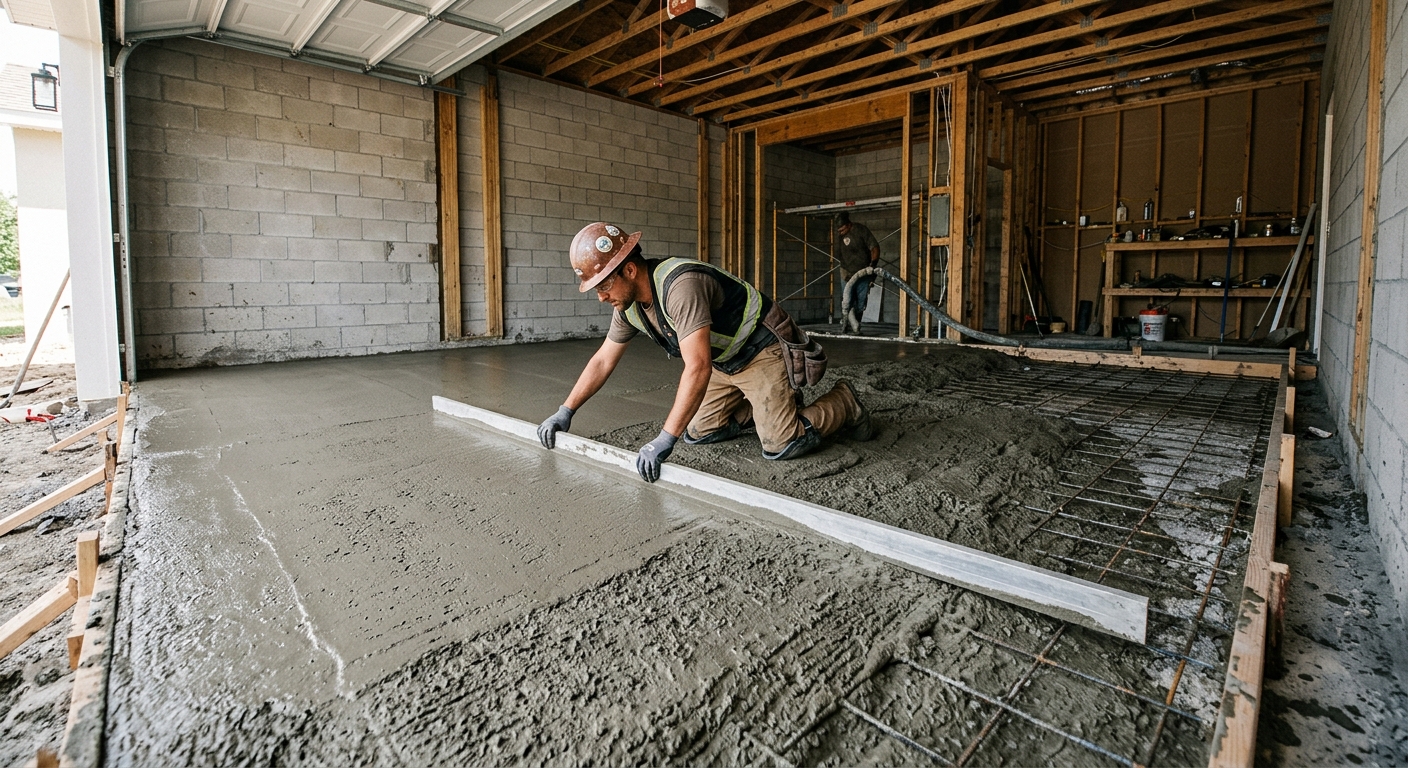
Concrete work options and costs in Sundance
Sundance, Alberta is a growing community (population 9,590 as of the 2021 Census: Statistics Canada), and a lot of homeowners are investing in driveways, patios, walkways, and foundations that can handle Calgary’s deep-frost, freeze–thaw winters. In this area, the most common concrete flatwork demand typically tracks the way families build and update single-detached homes—more than just curb appeal, these slabs need to perform through seasonal movement. Calgary’s broader market also affects availability: when weather forces crews to pause exterior pours, scheduling compresses, and that can move pricing up or down depending on how far your project falls into the pour season.
In Sundance (and around Calgary, including Airdrie/Rocky View), concrete pricing is engineered around frost depth of about 1.2 m for typical house/supporting elements. That means more excavation and higher foundation/footing volumes than in milder regions. For driveways and patios, Calgary’s frequent freeze–thaw cycles demand air-entrained mixes, properly graded granular bases, and well-planned control joints to reduce cracking and spalling. If you’re comparing options late in fall or early spring, winter-grade placement procedures—insulation blankets, temporary heat, and careful curing—are often built into the cost to protect the concrete while it gains strength.
Below are realistic budget ranges for Sundance homeowners, then we’ll break down the factors that swing quotes and how to spec your project correctly.
| Application |
Typical Size |
Key Spec |
Finish Option |
Price Range |
| Concrete driveway (standard broom finish) |
20 ft x 9 ft (180 sq. ft.) |
Frost-aware base prep, air-entrained mix, control joints |
Broom finish, standard saw cuts |
$12,000 – $18,000 |
| Exposed aggregate driveway |
20 ft x 9 ft (180 sq. ft.) |
Frost-aware base prep, air-entrained mix, retarder/exposure process |
Exposed aggregate (salt-scaling resistant finish choice) |
$15,000 – $22,000 |
| Stamped concrete driveway or patio |
18 ft x 10 ft (180 sq. ft.) or 200 sq. ft. patio |
Reinforced slab, air-entrained mix, integral colouring |
Stamp + colour release (pattern selection) |
$15,000 – $26,000 |
| Plain concrete patio or walkway |
200 sq. ft. patio or 4 ft x 30 ft walkway (120 sq. ft.) |
Compacted granular base, air-entrained mix, joints |
Float + light broom, clean saw-cut joints |
$5,000 – $9,000 |
| Garage floor (interior slab) |
20 ft x 22 ft (440 sq. ft.) |
Vapour barrier (where required), reinforcement, proper curing |
Standard trowel or broom finish |
$10,500 – $16,500 |
| Foundation footings (structural, below frost) |
Typical single-detached footing footprint (engineered) |
Excavation to undisturbed soil below design frost depth, rebar, formwork |
Structural concrete (no cosmetic finish) |
$28,000 – $45,000 |
Prices are estimates only and vary by project scope, site access and material selection.
What affects the price of concrete work in Sundance
It’s common to see quotes for the “same” concrete job vary by 30–50% across the Calgary region and Alberta because the real drivers aren’t just the square footage—they’re the engineered specs and how hard the site is to build on. Two driveways can both be 180 sq. ft., yet one may require deeper excavation, more rebar, or winter protection because of timing and soil conditions. In Sundance, crews also balance demand during a shorter effective exterior pour window, so scheduling and truck access can impact labour productivity.
First, frost depth is the anchor: local practice targets footings and supporting elements below the design frost depth (about 1.2 m). Excavation and form height follow that depth, and they increase labour time and concrete volume. Second, freeze–thaw cycles dictate air-entrained concrete mixes for exterior flatwork; that material spec is part of what protects your slab from scaling and spalling. Third, colder placement seasons can require cold-weather curing precautions—insulated blankets and sometimes temporary heat—to keep curing on track. That curing window is a cost add, but it’s cheaper than premature repairs. Fourth, de-icing salt in winter accelerates surface wear, so sealing is often recommended for driveways and patios.
Here are a few Sundance-specific examples of what raises or lowers cost: if your driveway is on heavier clay or needs over-excavation and replacement, base prep can push you toward the higher end of concrete driveway budgets (for many homeowners, that’s closer to the upper part of $12,000 – $18,000). If you choose stamped or exposed aggregate, the labour and materials jump into the higher band (often near $15,000 – $26,000) because stamping/finishing is slower and requires tighter batching control. Finally, older neighbourhood lots with limited truck access can add costs simply because staging and rework time go up.
| Price Factor |
Why It Matters |
Cost Impact |
| Frost line depth |
Determines footing depth and the amount of excavation and formwork |
Often the biggest swing for foundations/footings; deeper/engineered depth increases labour and material |
| Site preparation |
Grading and compacted granular base prevents settlement and controls water |
Extra excavation, disposal, and granular replacement can add significant hours and trucking |
| Reinforcement |
Rebar or wire mesh helps control cracking under load and temperature change |
Higher reinforcement requirements can add material and placement time |
| Mix design |
Air-entrainment and strength rating affect durability through freeze–thaw |
Air-entrained and winter-grade mixes typically cost more, especially for cold-weather pours |
| Finish type |
Broom is faster; stamped/exposed are more labour-intensive and process-sensitive |
Stamped/exposed options commonly move you into the upper price bands |
| Pour size and concrete truck access to site |
Truck placement and pumping/handling affect production and labour effort |
Restricted access can require smaller pours, more labour, and additional staging |
| Cold-weather curing precautions |
Insulation blankets/heating protect strength gain when temperatures drop |
Can add day-of labour plus equipment time, raising exterior slab costs |
| Control joint pattern and sealing cost |
Joints limit random cracking; sealing helps resist de-icing salt damage |
Skipping/weak jointing increases repair risk; sealing adds a material and crew step |
Permits & regulations in Alberta
In Alberta, structural concrete work generally needs a building permit and, in many cases, engineered drawings reviewed through the municipal process. That includes concrete used for foundations and structural systems such as footings, foundation walls, and grade beams. For concrete flatwork—driveways, patios, and walkways—the work often does not require a permit, unless it affects lot grading, stormwater handling, impervious surface coverage limits, or the municipal right-of-way. In Sundance, always confirm with the local authority before excavation, especially if you’re changing drainage patterns or working near service connections.
Here’s a homeowner-friendly, step-by-step way to verify a contractor in Alberta before work starts:
- Ask for the contractor’s Alberta business licence/registration details and confirm they are in good standing (where applicable through provincial online resources).
- Request a current certificate of liability insurance—verify the coverage amount is appropriate for the project and that it’s not expired.
- Ask for proof of WSIB/WCB coverage for worker protection; if the contractor is subbing out trades, ask who holds the coverage.
- Collect references from projects of similar scope (size, winter pour experience, and slab type).
- Confirm who pulls any permits and whether engineering is included where structural work is involved.
- Get everything in writing: scope, curing approach, disposal, and any exclusions.
If a contractor won’t provide documentation up front, treat that as a red flag and keep shopping.
Getting concrete right in Sundance's freeze-thaw climate
Concrete fails in Sundance’s winters primarily because water gets into the slab system, then freezes and expands—creating pressure that cracks paste, pops surface layers, and leads to spalling. The fix is less about “stronger concrete” alone and more about matching the slab design to local conditions: (1) base preparation—your compacted granular sub-base must be built to the right depth for local soil and frost considerations so the slab doesn’t heave or settle; (2) mix design—exterior concrete should be air-entrained (commonly 5%–7% air content for freeze–thaw durability) with a minimum compressive strength of 32 MPa; (3) control joints—planned joints manage shrinkage and thermal movement so cracking happens where it’s intended; (4) curing—aim for a minimum 7-day curing period under proper conditions, and in cold weather, protection (insulated blankets and/or heat) is what keeps early strength on track; (5) sealing—apply a penetrating sealer about 28 days after placement to help repel melt water and de-icing salts.
When you spec these items clearly, your slab is built for the Calgary market’s reality: deep frost depth (about 1.2 m) and frequent freeze–thaw cycles. A practical cost example: upgrading a standard broom-finished driveway to stamped can add roughly the difference between the driveway band ($12,000 – $18,000) and the stamped band ($15,000 – $26,000). That premium is justified when the base, reinforcement, and curing are still done to spec—otherwise you’re paying more for a decorative finish on a system that may still fail.
Use the checklist below as your technical “question list” so you don’t end up with air-entrainment shortcuts or poor joint/cure practices—two common causes of spalling in this climate.
| Spec |
Why It Matters in Sundance |
What to Ask For |
Impact if Skipped |
| Compacted granular base (depth?) |
Reduces settlement and helps manage frost-related movement |
Granular base thickness and compaction proof (and any over-excavation plan) |
Cracking, uneven settlement, and accelerated wear under traffic |
| Air-entrained concrete mix (target air %?) |
Protects against freeze–thaw scaling and spalling from water in the paste |
Target air content (typically 5%–7% for exterior flatwork) and mix design sheet |
More surface scaling and spalling over winters |
| Compressive strength (MPa rating) |
Ensures durability and strength gain for freeze–thaw exposure |
Minimum 32 MPa and confirmation of cold-weather placement plan |
Lower long-term performance and higher risk of premature damage |
| Control joints (spacing per ACI guidelines) |
Controls where cracking occurs as concrete shrinks and moves with temperature |
Planned joint spacing and saw-cut timing details |
Random cracking that can open pathways for water and salts |
| Minimum 7-day curing period |
Strength development improves resistance to early freeze and scaling |
How curing will be maintained (blankets/heat when needed) |
Surface scaling, reduced strength, and potential long-term structural issues |
| Penetrating sealer (when applied after cure) |
Helps repel de-icing salts and meltwater that drive spalling |
Penetrating sealer and timing (commonly after ~28 days) |
Faster deterioration and more frequent maintenance/replacement risk |
How to choose a concrete work contractor in Sundance
Start by verifying Alberta coverage and real capacity. Ask for a copy of the contractor’s liability insurance certificate (confirm it’s active and that the coverage limits fit the project scope). Next, request proof they (or their subcontractors) carry WSIB/WCB coverage for workers—this matters for jobsite safety and liability if an accident occurs. If a contractor won’t provide current documents, don’t “figure it out later.”
Then get 2–3 itemised written quotes. The best quotes separate labour and materials (concrete supply, reinforcement, base/grading, forming, finishing, sealing, and any winter protection). Be wary of lump sums that don’t state key specs like air-entrainment, reinforcement requirements, and jointing timing. Review the scope line by line: is permit pulling included where required (structural work), is disposal of excavated material included, and what’s excluded (pumping, rock removal, stairs/levels, saw-cutting tie-ins)?
Warranty matters too. Ask for a workmanship warranty (how long, and what it covers), plus manufacturer/product warranty details. Confirm whether the warranty transfers if you sell your home. For payment, keep it fair: never pay more than 10%–15% upfront; hold back a portion until completion and final walkthrough. Finally, ask for a start date and completion estimate in writing—Sundance exterior pours are weather-dependent, and a firm plan reduces schedule-driven quality shortcuts.
- Confirm liability insurance is current and covers concrete work scope.
- Verify WSIB/WCB clearance for all workers performing the work.
- Request mix specs: air-entrainment and minimum strength (not “general concrete”).
- Ask about base depth, granular type, and compaction expectations.
- Confirm reinforcement plans (wire mesh vs rebar, and slab areas).
- Require control joint spacing details and saw-cut timing.
- Ask how they handle cold weather curing (blankets/heat plan).
- Clarify what sealing includes and when it will be applied (after cure).
- Get disposal/trucking details in the quote (excavated soil—where does it go?).
- Ask for truck access/pour staging plan so you don’t get cold joints.
- Check references for similar Sundance/Calgary winters and slab types.
- Ensure warranty terms and warranty transfer are written clearly.
Concrete contractor red flags in Sundance: vague mix language (“it’ll be fine”), no discussion of air-entrainment or curing; missing or expired insurance/WSIB/WCB proof; quotes that exclude disposal while assuming “easy access”; and promises to pour right at freezing without winter protection or a curing plan.
Frequently asked questions — concrete work in Sundance
What is air-entrained concrete and why does it matter here?
Air-entrained concrete is standard for exterior work in Alberta because it includes tiny, evenly spaced air bubbles in the mix. Those bubbles give expanding ice somewhere to go inside the concrete paste, which reduces scaling and spalling when Sundance and the Calgary region swing through freeze–thaw cycles. Without air-entrainment, water that enters the slab system can freeze and expand, breaking the surface layers over time. When you’re budgeting, make sure your contractor’s quote reflects a true exterior mix spec—this is one reason concrete driveway pricing in the region often lands around the driveway band of $12,000 – $18,000 for standard work, and rises for stamped/exposed finishes because finishing requires careful placement and durability planning.
How do I prepare the base for a concrete slab?
Base prep is where performance starts. For Sundance, your slab needs a compacted granular base built to the right depth and over the right material for your soil conditions. The goal is stable support and good drainage so the slab doesn’t move with frost and moisture. Your contractor should outline excavation (including any over-excavation if soft soils are found), granular type, grading, and compaction requirements, plus any proof method (testing or documentation). Because the design frost depth is about 1.2 m in this Calgary-area practice, proper excavation and base build are critical. If site prep is skipped or rushed, you’ll often see settlement cracks or uneven slabs—problems that cost more later than doing it right upfront.
How do I compare concrete quotes?
Compare quotes like-for-like. First, verify they’re quoting the same thickness, reinforcement approach (mesh vs rebar), and base construction. Next, check the mix details: exterior work should be air-entrained and have a stated minimum strength (commonly 32 MPa). Make sure the finish scope matches—broom finish vs stamped vs exposed aggregate can change labour time and curing logistics. Also compare schedule and site handling: cold-weather curing precautions (insulation blankets/heating) and truck access can add real cost. If one quote is much lower than the others, it may be omitting air-entrainment, reinforcement, or proper jointing. Use the bands as a sanity check—standard driveway budgets often fall within $12,000 – $18,000, while stamped projects commonly reach $15,000 – $26,000.
Can concrete be poured in cold weather in Sundance?
Yes, concrete can be placed in cold weather in Sundance, but it has to be engineered for it. The key is curing: if early strength development is slowed by freezing temperatures, the slab can scale, weaken at the surface, and lose long-term durability. In Calgary’s freeze–thaw environment, reputable crews use cold-weather placement procedures such as insulated blankets and, when required, temporary heat to protect the slab until it reaches adequate strength. Your contractor should also address curing timing and temperature monitoring rather than just “pouring and hoping.” If a quote doesn’t mention winter protection, it’s worth asking directly—especially for exterior work during late fall or early spring when the pour season is tight and scheduling pressure can tempt shortcuts.
How do I maintain concrete in Sundance's freeze-thaw climate?
Maintenance is about limiting water and salt exposure. For driveways, patios, and walkways, apply a penetrating sealer after the concrete fully cures (often around 28 days) so meltwater and de-icing salts don’t soak into the surface. Use de-icing products wisely—avoid dumping high-concentration salts directly on fresh or already-damaged areas. Keep an eye on joints: control joints are designed to manage cracking, but they need to stay clear and properly sealed if you used a joint sealing system. For winter, plough/shovel gently to prevent surface chips. If you see small spalls early, address them promptly to stop water ingress. When you build the right specs up front—air-entrainment, base prep, joints, and cure—maintenance becomes much simpler.
What causes concrete to spall in Sundance winters?
Spalling usually comes from water getting into the concrete (through surface pores, cracks, or around poorly detailed joints), then freezing and expanding. In Sundance and the Calgary region, frequent freeze–thaw cycles make this process repeatable across the season. The most common root causes are insufficient air-entrainment, rushed curing, inadequate base drainage, or joints that aren’t spaced and timed correctly—so cracks form randomly and become pathways for water and de-icing salt. Sealing helps, but it can’t fix a weak mix design or missing durability controls. That’s why it’s worth paying for the right exterior specs rather than trying to choose the lowest price. A properly built exterior driveway in this market often reflects that durability budget—standard work commonly sits around $12,000 – $18,000, while decorative options cost more because finishing adds process sensitivity.