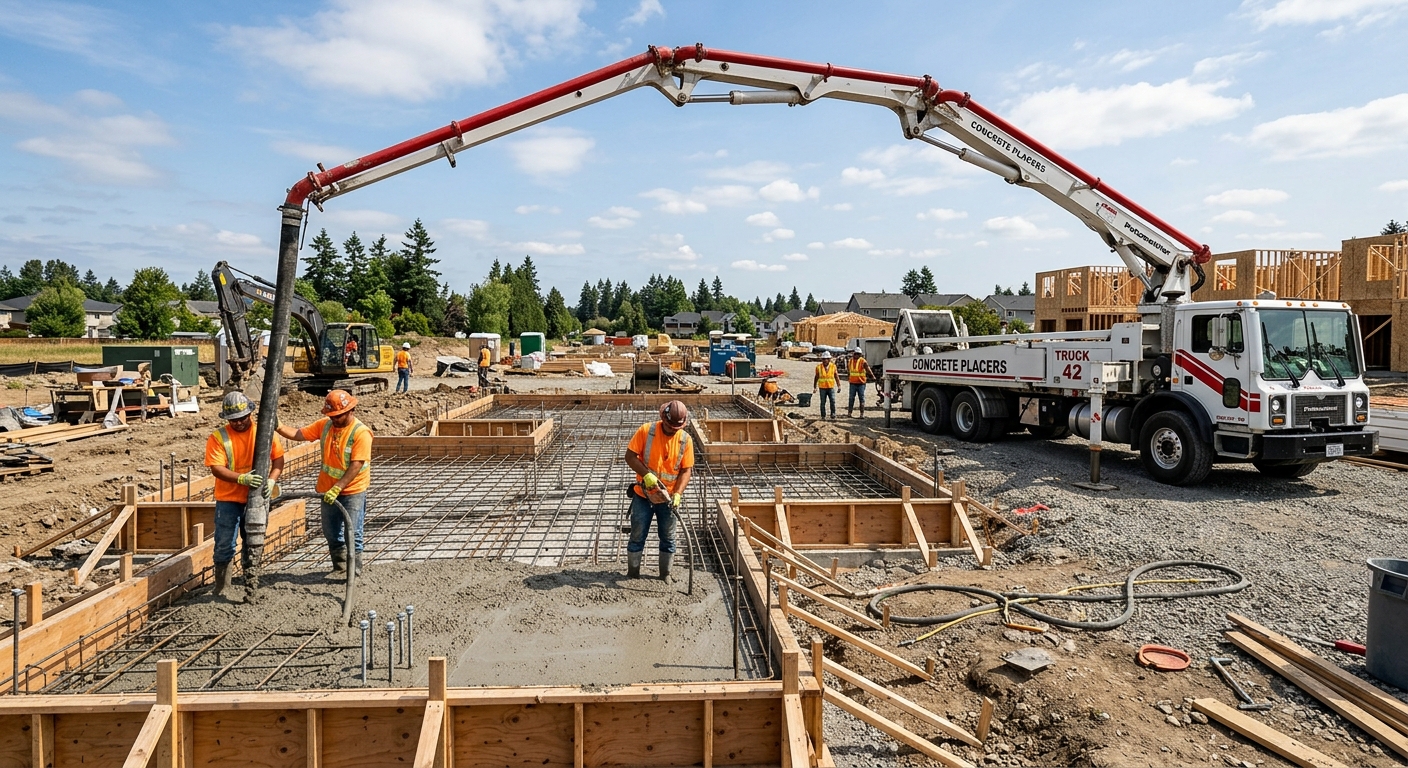
Concrete work options and costs in Tamarack
Tamarack, Alberta is a small community (population 2,348 per Statistics Canada, 2021 Census), but the concrete demand is steady because most homeowners eventually need practical exterior surfaces—especially driveways, patios and walkways that can handle Calgary’s freeze–thaw seasons. In a typical Tamarack housing pattern dominated by single-detached homes (Statistics Canada, 2021 Census), concrete flatwork is a go-to upgrade for durability and low maintenance, and it’s also a common “finish” to landscaping and foundation projects.
In the Calgary economic region, concrete costs tend to run higher than you might expect from milder provinces because the engineered frost depth and winter curing requirements affect almost everything: how deep you excavate, how much granular base you build, the height and bracing of forms, and how long contractors must protect and cure the slab. Frequent freeze–thaw cycling also makes air-entrainment and proper jointing non-negotiable, which can narrow the pool of crews willing to do the work correctly within the shorter exterior pour season.
Where in Tamarack is it especially in demand? You’ll notice more work around established family areas near local schools and busy residential lanes—anywhere with heavy foot traffic, frequent ploughing and ongoing landscaping phases—because driveways and front walkways see repeated loading and de-icing use. From there, homeowners usually want to compare finish types and structural scopes side-by-side, so the table below lines up typical applications and realistic cost bands.
| Application |
Typical Size |
Key Spec |
Finish Option |
Price Range |
| Concrete driveway (standard broom finish) |
20 ft x 10 ft (400 sq. ft.) |
4 in slab, air-entrained, rebar or mesh, control joints |
Broom finish, edges sealed |
$12,000–$18,000 |
| Exposed aggregate driveway |
20 ft x 10 ft (400 sq. ft.) |
Air-entrained, proper mix design, delayed exposure |
Exposed aggregate (light wash/exposure) |
$15,500–$22,500 |
| Stamped concrete driveway or patio |
20 ft x 10 ft (400 sq. ft.) driveway or 16 ft x 12 ft patio |
Air-entrained, integral color or densifier, joints |
Stamped patterns, sealer topcoat |
$15,000–$26,000 |
| Plain concrete patio or walkway |
12 ft x 12 ft patio (144 sq. ft.) or 4 ft x 30 ft walkway (120 sq. ft.) |
4 in slab, air-entrained, compacted base, joints |
Float/screed + light broom finish |
$5,000–$9,000 |
| Garage floor (interior slab) |
22 ft x 20 ft (440 sq. ft.) |
Vapour barrier, air-entrained or garage mix, joints as needed |
Steel trowel or broom depending on use |
$10,000–$16,000 |
| Foundation footings (structural, below frost) |
Typical single-detached build footing mass (varies by plan) |
Excavation to design frost, engineered rebar, proper formwork |
Structural concrete, no decorative finish |
$28,000–$45,000 |
Prices are estimates only and vary by project scope, site access and material selection.
What affects the price of concrete work in Tamarack
In Tamarack and across the Calgary region, it’s common to see quote swings of 30–50% for the “same” concrete work because contractors price the unseen parts: excavation and hauling, how deep they must go for frost, the granular base thickness and compaction, reinforcement detailing, and cold-weather curing logistics. Even the finish choice can change labour hours—stamped work includes additional colour/texture steps and more setup time. On top of that, the region’s colder continental climate shortens the practical exterior pour window and pushes crews to use winter-grade protection so the concrete actually hydrates properly.
The frost line depth dictates every footing and foundation decision. In Alberta, that means exterior work often needs deeper excavation and undisturbed soil below the design frost depth (up to about 2.4 m), so foundation and footing volumes run higher than in warmer areas. For exterior slabs—driveways and patios—air-entrained concrete is essential to survive repeated freeze–thaw cycling and to reduce spalling. When homeowners choose winter scheduling, contractors may add insulated blankets, heat, and extra labour to protect the pour long enough to cure.
Here are a few practical examples that show up in Tamarack pricing. A driveway tied to a new build can cost more if the contractor must excavate around existing services and then rebuild a thicker base to match frost protection requirements. A plain patio may fall near the $5,000–$9,000 band, but switching to stamped concrete often moves you toward $15,000–$26,000 because of integral colour, texture mats, and finishing time. If a yard has clay pockets that hold water, expect more base replacement and drainage work—often a bigger cost driver than the concrete itself.
| Price Factor |
Why It Matters |
Cost Impact |
| Frost line depth |
Determines footing depth and required formwork height to reach undisturbed soil |
Higher excavation and concrete volume; can add substantial cost on footings and slab edges |
| Site preparation |
Excavation, grading, and compacted granular base prevent settlement and moisture movement |
More haul-off/replace materials increases labour and equipment time |
| Reinforcement |
Rebar or mesh controls cracking and helps slabs resist loads in freeze–thaw conditions |
Material + placement labour; cost rises with structural requirements |
| Mix design |
Air-entrainment and strength spec (for exterior exposure and durability) affect material class and cost |
Air-entrained exterior mixes and winter-grade protection can increase concrete delivery cost |
| Finish type |
Broom vs. stamped vs. exposed aggregate changes labour steps, tools and curing/sealer plan |
Stamped/exposed finishes typically cost more due to added labour and materials |
| Pour size and concrete truck access to site |
Large pours need efficient placement; tight access can increase pump/hand-carry time |
Pumping/extra labour can push pricing upward quickly |
| Cold-weather curing precautions |
Heating and insulated blankets protect hydration and prevent early freeze |
Adds daily setup/removal labour and equipment rentals |
| Control joint pattern and sealing cost |
Correct joint spacing reduces random cracking; sealing helps resist de-icing salt damage |
More saw-cutting/extra material time can add a meaningful line item |
Permits & regulations in Alberta
In Alberta, structural concrete work typically needs municipal review because it can affect the building’s safety and load paths. For most homeowner projects in Tamarack, the work that usually does require a permit includes: foundation footings, foundation walls, grade beams, and other structural elements tied to the engineered foundation plan. Many new-build or major-renovation projects also require engineered drawings and municipality review before the concrete is placed.
Concrete flatwork like patios, walkways and driveways usually does not require a permit by default, unless it changes lot grading, impacts impervious surface coverage limits, affects municipal right-of-way conditions, or is part of a broader development approval. Even then, you may be asked for documentation related to drainage or setbacks.
Step-by-step, here’s how a Tamarack homeowner can verify contractor compliance in Alberta:
- Ask for the contractor’s liability insurance certificate of insurance (COI) and confirm it names you as an additional insured if required by your contract.
- Request proof of Alberta coverage for workers (WSIB is used in Ontario; in Alberta look for the applicable workers’ compensation coverage/clearance documentation).
- Confirm they can provide references for similar-scale exterior flatwork in the Calgary region (cold-weather curing experience matters).
- Verify any permit responsibility in writing: who pulls it, who pays fees, and what documentation they provide you.
- Before breaking ground, confirm with the municipality’s development/building department whether your specific scope needs a permit or a grading/drainage approval.
With concrete, the “permit vs no permit” question isn’t just paperwork—it determines how the foundation and drainage are verified, which directly affects long-term performance in Alberta’s freeze–thaw climate.
Getting concrete right in Tamarack's freeze-thaw climate
Concrete fails in Tamarack primarily due to moisture and freeze–thaw action. If water gets into the slab and the freeze cycle expands it, you can see scaling, pop-outs, and eventually spalling—especially on driveways and walkways where de-icing salts accelerate surface deterioration. The fix is to spec the job so the slab is built for frost and drainage, not just poured and left to cure. The right approach starts with (1) compacted granular base prep to the correct depth for local soils and frost protection, and it includes proper subgrade compaction so the slab doesn’t move with the seasons.
Next is (2) mix design. For exterior flatwork, air-entrainment is critical, typically targeting about 5–7% air content, and using a minimum 32 MPa compressive strength spec for durability. Then (3) control joints must be planned so cracking happens where it’s least visually disruptive and least structurally harmful. After that comes (4) curing: minimum 7 days under proper conditions, with extra protection for cold snaps. Finally, (5) sealing—ideally a penetrating sealer applied 28 days after the pour—helps repel de-icing salts and reduces moisture movement into the surface.
To help you budget wisely, note that choosing standard broom-finish concrete can keep you closer to the $12,000–$18,000 driveway band, while stamped work pushes toward the $15,000–$26,000 band. That price difference is justified when the crew has proper bases, correct joints, and a sealer plan—because the durability failures are prevented by the same specs you’re paying for in both options.
| Spec |
Why It Matters in Tamarack |
What to Ask For |
Impact if Skipped |
| Compacted granular base (depth?) |
Correct base depth and compaction control settlement and frost-related movement |
“What base depth are you placing, and what compaction test method do you use?” |
Cracking, uneven slab movement, and accelerated deterioration |
| Air-entrained concrete mix (target air %?) |
Freeze–thaw cycles require air pockets to resist internal ice expansion |
“Confirm air-entrainment target (about 5–7% for exterior flatwork) and exterior exposure class.” |
High risk of scaling and spalling within a few seasons |
| Compressive strength (MPa rating) |
Adequate strength supports durability and load capacity in harsh winters |
“What minimum compressive strength are you specifying—at least 32 MPa?” |
Surface wear and reduced long-term performance |
| Control joints (spacing per ACI guidelines) |
Joints manage where cracks form as the slab shrinks and moves |
“What joint spacing are you using and when will you saw-cut?” |
Random cracking patterns and wider, more unsightly defects |
| Minimum 7-day curing period |
Proper curing lets cement hydrate; freezing early can damage surface and strength |
“How do you protect the slab if temperatures drop—blankets/heating and curing plan?” |
Weak surface layer, scaling, and reduced strength development |
| Penetrating sealer (when applied after cure) |
Salt and water exposure are common on Tamarack drives/walks |
“Will you apply a penetrating sealer about 28 days after pour, and what product?” |
More moisture ingress and faster surface damage from de-icing |
How to choose a concrete work contractor in Tamarack
Start by verifying Alberta compliance and real insurance coverage—this is where many homeowners save time later. Ask for three documents: (1) their liability insurance certificate (COI) and confirm limits are appropriate for your scope, (2) proof of workers’ compensation coverage/clearance for their Alberta operations, and (3) any specific permit responsibility written into your contract. In Tamarack (Alberta’s cold-weather environment), the “best” contractor is often the one who can show they’ve done winter-grade placement and curing protection—not just the lowest per-square-foot bid.
Next, request 2–3 itemised written quotes rather than lump sums. A good quote breaks down labour and materials: excavation and disposal, granular base supply/compaction, reinforcement, concrete supply and any cold-weather protection, forming, finishing, saw-cut joints and sealing. Make sure you know what’s excluded: site repair after removal, does the price include asphalt tie-ins or approach cuts, and is permit pulling included if required for structural work?
Warranty and payment schedule matter. Look for a workmanship warranty length in writing, plus whether the concrete product/manufacturer warranty applies and is transferable. Payment should be conservative: never pay more than 10–15% upfront. Hold back the remainder until the slab is complete, cured as specified, and any sealer or touch-ups are done. Finally, get a written start date and completion estimate; in Calgary-area exterior work, delays from weather protection can affect curing timelines.
- Ask for proof of liability insurance COI before signing.
- Verify workers’ compensation coverage/clearance for their Alberta work.
- Confirm who pulls required permits and who pays fees for structural scopes.
- Require itemised quotes (labour, materials, disposal, curing protection, sealing).
- Check base prep spec: excavation depth and compacted granular plan.
- Ensure the mix is described as air-entrained for exterior flatwork.
- Ask about reinforcement type (mesh vs rebar) and placement method.
- Confirm control joint plan (spacing and saw-cut timing).
- Require a curing plan for cold snaps (blankets/heating if needed).
- Confirm sealing details: type and approximate timing after cure.
- Review warranty terms (workmanship, limits, and what’s covered).
- Use a payment schedule with a holdback until completion and clean-up.
Concrete red flags in Tamarack: vague “we’ll pour it and it’ll be fine” curing promises, no mention of air-entrainment or jointing, unrealistic schedules that skip cold-weather protection, quotes that lump excavation/disposal without details, and contractors who won’t put permit responsibility and warranty terms in writing.
Frequently asked questions — concrete work in Tamarack
Concrete vs pavers for a patio in Tamarack?
In Tamarack (Alberta’s freeze–thaw climate), both concrete and pavers can work well, but they fail differently. Concrete patio slabs rely on correct base compaction, air-entrained mix, control joints and curing; when those specs are met, a plain patio typically lands around $5,000–$9,000. Pavers can be easier to “repair one section at a time,” but they require excellent bedding sand, edge restraint and proper drainage to avoid heaving. If your patio gets frequent de-icing and is near a downspout discharge path, concrete with a penetrating sealer plan (often about 28 days after pour) tends to hold up well. If you want maximum repair flexibility later, pavers can be attractive—but ensure the contractor details the base and compaction, not just the surface.
How long does a concrete driveway last?
A well-built concrete driveway in the Calgary region often lasts decades, but “how long” depends heavily on specs and winter exposure. The biggest durability drivers are air-entrainment for freeze–thaw resistance, correct joint spacing, good curing, and sealing to slow moisture and de-icing salt effects. If contractors rush curing or skip air-entrainment, scaling and spalling can show up far earlier. A standard broom-finish driveway in Tamarack commonly fits within $12,000–$18,000—and the quality of base prep and reinforcement within that budget matters as much as the concrete thickness. With proper installation and maintenance (especially periodic cleaning and sealing when appropriate), many homeowners see strong service life well beyond the first 10–15 years.
What is air-entrained concrete and why does it matter here?
Air-entrained concrete is mixed with microscopic air bubbles that give expanding ice somewhere to expand internally during freeze–thaw cycles. In Tamarack and across the Calgary area, that matters because repeated temperature swings pull moisture in and out of the slab and can quickly damage surfaces without the right air system. That’s why reputable contractors specify exterior air-entrainment (commonly targeting about 5–7% air for exterior flatwork) and pair it with control joints and proper curing. Homeowners sometimes focus on appearance and finish, but air-entrainment is one of the main reasons properly built driveways and patios don’t spall early. If you’re comparing quotes, ask whether the concrete mix is explicitly described as air-entrained for exterior exposure and what protection they use if weather turns cold during the pour.
How do I prepare the base for a concrete slab?
Base preparation is where most concrete longevity is won or lost. For Tamarack’s freeze–thaw environment, the slab must sit on properly excavated and graded material with a compacted granular sub-base to the required depth for your soil and frost protection needs. You should expect the contractor to remove topsoil/soft material, build in layers, compact each lift, and confirm the grade is right before any formwork and steel go in. A common mistake is cutting corners on excavation depth or compaction, which can lead to settlement cracks and uneven surfaces. When you ask for quotes, request details: what base depth is included, whether they test compaction, and how they handle moisture-prone soil. Even if the finish is broom or stamped, the base prep determines whether the slab survives Alberta winters.
How do I compare concrete quotes?
When comparing quotes in Tamarack, don’t compare just the bottom line—compare what’s included. Ask for itemised pricing that separates excavation and disposal, granular base and compaction, reinforcement (rebar vs mesh), concrete mix spec (especially air-entrainment for exterior), forming, finishing steps, saw-cut joints, cold-weather curing precautions, and sealing. For example, a standard driveway quote may land within $12,000–$18,000, while stamped projects often rise toward $15,000–$26,000 because labour and materials are different. If one contractor is cheaper, it’s usually because they’ve omitted something critical—like specifying air-entrainment, detailing joints, or including curing protection. Make sure permit responsibility and warranty terms are written into the contract before you sign.
Can concrete be poured in cold weather in Tamarack?
Yes, concrete can be poured in cold weather in Tamarack, but it’s not “same-day, same process.” Alberta cold snaps can freeze concrete too early and stop proper hydration, which increases the risk of weak surfaces and scaling. The contractor should use cold-weather procedures such as winter-grade mixes and protection methods like insulating blankets and/or controlled heating, plus strict curing timing. Ask how they’ll monitor temperatures during and after the pour and what minimum curing period they’ll protect (often minimum 7 days, with extra measures if temperatures drop). If a quote doesn’t mention cold-weather curing protection, that’s a major red flag in the Calgary area where freeze–thaw can start early. Proper cold-weather placement is one reason realistic quotes can differ—done correctly, it’s worth the cost.