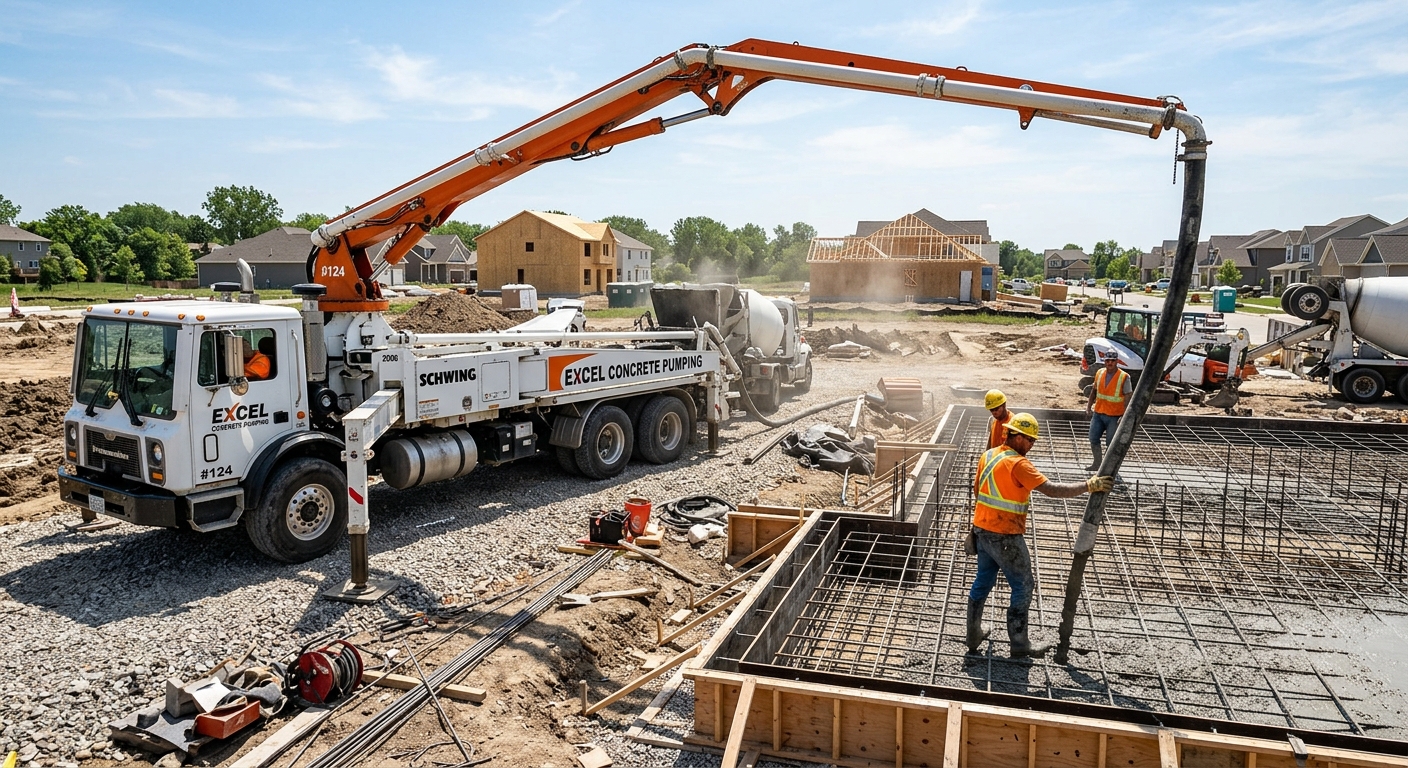
Concrete work options and costs in Erlton
Erlton, Alberta is a small community (population 1,280 as of the 2021 Census) where most concrete flatwork serves the same core needs: driveways, patios, walkways, and garage floors that handle winter snow, traffic, and de-icing salt. In practice, many homeowners are upgrading or building around existing single-detached housing patterns common to Calgary’s surrounding areas (Statistics Canada, 2021 Census). That matters because the concrete you see most often—driveways and exterior slabs—has to survive Calgary’s deep frost demands and frequent freeze–thaw cycles.
In the Calgary region, engineered footing and flatwork specs are driven by frost movement. Local engineering practice is built around a design frost depth of about 1.2 m (roughly 4 ft), meaning footings for houses, garages, decks, and retaining structures must bear on undisturbed soil below that depth to reduce frost heave. Exterior slabs also require air-entrained concrete and properly spaced control joints to limit cracking and surface scaling. On top of that, Alberta winter placement is more expensive: crews may need cold-weather curing precautions such as insulating blankets and, in some cases, temporary heating to protect early strength gain.
Because of this, contractors who focus on cold-weather scheduling and granular base preparation tend to be in higher demand in established pockets like the Erlton area near local main routes, where accessibility affects excavation and truck access. Use the table below to compare typical options, finishes, and realistic price bands for an Erlton homeowner.
| Application |
Typical Size |
Key Spec |
Finish Option |
Price Range |
| Concrete driveway (standard broom finish) |
24 ft x 10 ft (240 sq ft) |
Air-entrained exterior mix, control joints, compacted granular base |
Broomed surface |
$12,000–$18,000 |
| Exposed aggregate driveway |
24 ft x 10 ft (240 sq ft) |
Air-entrained mix, proper curing, often thicker slab for durability |
Exposed aggregate finish |
$15,000–$21,000 |
| Stamped concrete driveway or patio |
20 ft x 10 ft (200 sq ft) driveway pad or 15 ft x 12 ft (180 sq ft) patio |
Air-entrained mix, reinforcement for loads, cold-weather curing plan |
Stamped pattern (varies: slate/stone looks) |
$15,000–$26,000 |
| Plain concrete patio or walkway |
12 ft x 12 ft (144 sq ft) patio or 4 ft x 25 ft (100 sq ft) walkway |
Air-entrained exterior mix, compacted base, joints where needed |
Broom or smooth finish |
$5,000–$9,000 |
| Garage floor (interior slab) |
22 ft x 22 ft (484 sq ft) |
6–7 in slab typical, reinforcement based on subgrade, sawcut joints |
Steel-trowel (smooth) or broom finish |
$10,000–$16,000 |
| Foundation footings (structural, below frost) |
Typical house perimeter (engineered quantities) |
Footings designed to sit below frost depth (~1.2 m), forms/placement for walls |
Structural plain concrete |
$28,000–$45,000 |
Prices are estimates only and vary by project scope, site access and material selection.
What affects the price of concrete work in Erlton
In Erlton and the wider Calgary market, you can see bids for what looks like the “same” concrete project vary by 30–50%. That’s because the real drivers aren’t just the volume of concrete—they’re the specs and labour needed to make it perform in Alberta’s freeze–thaw climate. Two contractors might both quote a driveway, but one may plan for deeper excavation, better granular base prep, engineered joint layout, and cold-weather curing if the schedule slips into shoulder season. The other may price faster production with fewer protective steps, which can lead to premature scaling and cracking.
Frost line depth and freeze–thaw cycles dictate every step. Footings must extend below the design frost depth (about 1.2 m in Calgary practice) to prevent frost heave and seasonal movement. Exterior slabs also need air-entrained mixes designed to survive freeze–thaw, with the right curing window. Colder placement seasons are shorter, so achieving proper strength gain can require insulating blankets and, sometimes, temporary heat—especially when crews pour in late fall or early spring. On top of that, de-icing salts accelerate surface spalling; sealing done at the correct time helps, but it’s an extra line item.
Here are a few examples of how local conditions change cost in Erlton: (1) a driveway on clay or disturbed soil usually needs more excavation and granular replacement, which pushes pricing toward the higher end of the $12,000–$18,000 band; (2) tight truck access on older lots can increase labour and staging time—often making “standard” driveway jobs feel closer to the upper range; (3) decorative upgrades like stamped work can be worth it, but the stamp, re-mixing, and surface detailing typically move projects into the $15,000–$26,000 range.
Also, many homes around Calgary’s periphery were built and first improved decades ago; as those driveways and steps settle, the base can become uneven. When removal and rebase are extensive, you’ll feel it immediately in the total cost.
| Price Factor |
Why It Matters |
Cost Impact |
| Frost line depth |
Determines footing depth and form height |
More excavation and concrete volume; can shift foundation/footings pricing within the $28,000–$45,000 band |
| Site preparation |
Excavation, grading, compacted granular base |
Removes weak soils; increases labour/haul costs, especially on disturbed or clayey sites |
| Reinforcement |
Rebar or wire mesh requirement |
Additional material and tie-in labour; required when engineered drawings call for it or where loads demand it |
| Mix design |
Air-entrainment and compressive strength spec |
Proper air reduces scaling/spalling risk; higher spec can raise material cost but prevents failure |
| Finish type |
Broom vs. stamped vs. exposed aggregate |
Decorative finishes add labour, set-up, and detailing time; stamped work commonly moves toward the $15,000–$26,000 band |
| Pour size and concrete truck access to site |
Placement speed and method depend on access |
Tighter access can require pumps/hoses or more team members; larger pours may need additional trucks |
| Cold-weather curing precautions |
Heating and blankets |
Adds equipment and labour; critical to achieve proper strength gain when temps drop |
| Control joint pattern and sealing cost |
Limits random cracking; protects against salt scaling |
Joints require layout and sawcut timing; sealing adds material and labour but can extend service life |
Permits & regulations in Alberta
In Alberta, structural concrete work—such as foundation footings, foundation walls, grade beams, and other load-bearing elements—typically requires a building permit, and engineered drawings are often reviewed as part of the permit process. Concrete flatwork (driveways, patios, and walkways) usually does not require a permit by itself unless it changes lot grading, affects stormwater flow, increases impervious surface beyond local requirements, or touches municipal right-of-way considerations. Because Erlton projects are tied into Calgary-area permitting expectations, you should confirm with the local authority before breaking ground—even for “just a slab.”
Before signing, verify your contractor carries liability insurance and the proper workplace coverage (WSIB/WCB). Then ask for references on similar-scale jobs: a reputable concrete contractor will show completed driveways and foundations built for freeze–thaw conditions, not only interior slabs.
Step-by-step, here’s how a homeowner in Erlton can verify coverage and credentials: (1) Request the contractor’s certificate of insurance and confirm it is current (and that the policy includes general liability for concrete work). (2) Ask for proof of workplace coverage (WSIB/WCB clearance letter or current account status, depending on how the contractor carries coverage). (3) Check contractor licensing/registration where applicable through Alberta’s public-facing registries; if they can’t tell you what registry they’re in, ask why. (4) Confirm the job scope matches any drawings you have—especially footing size and reinforcement. (5) Get everything in writing: schedule, site protection, disposal, and the permit responsibility (who pulls it, if required).
Getting concrete right in Erlton's freeze-thaw climate
Concrete failures in Erlton are rarely “mystery problems.” They’re usually predictable results of base issues, mix problems, or curing shortcuts that don’t match Calgary-area freeze–thaw conditions. The top failure mode is spalling and scaling, often caused by inadequate air-entrainment, poor surface curing, or salt exposure before the concrete has developed sufficient strength. To spec the job correctly, you want a tight package covering base preparation, mix design, joints, curing, and sealing.
1) Base preparation: Require compacted granular sub-base to the right depth for local soil and frost performance. If the base isn’t built and compacted properly, the slab settles and cracks, and joints can’t do their job. 2) Mix design: Ask for air-entrainment—commonly 5–7% air content for exterior flatwork—and a minimum 32 MPa compressive strength. 3) Control joints: Spacing should limit random cracking, with sawcut timing planned so joints control shrinkage cracking. 4) Curing: Plan for at least 7 days of proper curing conditions. In cold weather, curing may require insulated blankets and/or temporary heating so early strength gain isn’t interrupted. 5) Sealing: For salt protection, request a penetrating sealer applied after the concrete has cured sufficiently—typically 28 days post-pour—so it can repel moisture and de-icing brine.
Asking these questions protects your wallet. For example, a broom-finished exterior slab might land near the $5,000–$9,000 band for patios/walkways, while stamped work can move up to the $15,000–$26,000 range depending on size and detailing. The decorative portion pays for labour and finishing time—but the performance specs (air, base, joints, curing) are what keep the stamped surface from deteriorating.
| Spec |
Why It Matters in Erlton |
What to Ask For |
Impact if Skipped |
| Compacted granular base (depth?) |
Controls settlement and supports slab through freeze–thaw |
Base depth and compaction method; confirm excavation to stable subgrade |
Uneven support leads to cracking, trip hazards, and accelerated spalling |
| Air-entrained concrete mix (target air %?) |
Improves freeze–thaw durability in Alberta winters |
Target 5–7% air content for exterior flatwork; confirm it’s air-entrained |
High risk of scaling/spalling once salts and moisture get into pores |
| Compressive strength (MPa rating) |
Ensures adequate strength gain and structural durability |
Minimum 32 MPa for exterior flatwork (as per your contractor’s mix design) |
Surface damage and reduced long-term performance |
| Control joints (spacing per ACI guidelines) |
Manages shrinkage cracking under Edmonton/Calgary-like temp swings |
Joint layout and sawcut timing plan; spacing consistent with specs |
Random cracking across the slab, often widening with freeze cycles |
| Minimum 7-day curing period |
Strength and durability depend on curing under proper conditions |
Minimum curing plan; ask how they protect in cold weather (blankets/heating) |
Surface scaling, dusting, and reduced freeze–thaw resistance |
| Penetrating sealer (when applied after cure) |
Repels moisture and helps limit salt-driven deterioration |
Confirm seal type and application timing—commonly around 28 days post-pour |
Faster moisture ingress and spalling risk during winter salting |
How to choose a concrete work contractor in Erlton
Start with Alberta compliance and coverage. Ask the contractor for (1) proof of liability insurance (certificate of insurance showing current coverage and appropriate limits), (2) workplace coverage proof (WSIB/WCB clearance letter or account status document), and (3) the correct licensing/registration details for the type of work they’re doing. In Alberta, structural concrete is closely tied to permitting and engineered expectations, so a contractor who’s comfortable coordinating drawings, inspections, and concrete scheduling is usually the safer choice.
Next, get 2–3 itemised written quotes. You want labour and materials separated (demo/removal, excavation, granular base, reinforcement, concrete supply, finishing, curing protection, sealing, and disposal). Avoid lump sums without a clear breakdown—especially in Calgary-area winters where “cold-weather protection” can be either included or treated as an extra.
Read the scope carefully: what’s excluded? Is permit pulling included if needed? Is hauling/disposal included for excess soil and old concrete? If reinforcement or base depth changes after excavation reveals weak subgrade, how is that handled—by change order or predetermined allowance?
Warranty matters too. Ask for workmanship warranty length and confirm whether any manufacturer warranty (for curing aids or decorative systems) is provided and whether it’s transferable. Finally, payment schedule: never pay more than 10–15% upfront, and use a holdback until the job is complete and properly cleaned/finished.
Get a written start date and estimated completion date. In Erlton, weather windows change quickly, so a contractor should plan around curing time and temperature protection—not just pour day.
- Request current certificates: liability insurance + WSIB/WCB proof.
- Confirm who pulls any permits if structural concrete is involved.
- Ask for a site plan for truck access, staging, and protection of landscaping.
- Require an itemised quote (labour, materials, base prep, disposal, finishing).
- Confirm the concrete is air-entrained for exterior work in Calgary’s freeze–thaw cycle.
- Ask for reinforcement details: mesh vs. rebar, and whether engineered drawings specify it.
- Verify control joint layout and sawcut timing.
- Ask how they handle cold-weather curing (blankets/heating plan if needed).
- Confirm curing duration and protection method for at least 7 days.
- Ask about sealing: which sealer, prep requirements, and timing (commonly ~28 days).
- Review warranty terms in writing (workmanship and any material/manufacturer coverage).
- Use a payment schedule with a holdback until punch-list completion.
Concrete red flags in Erlton: crews who won’t discuss air content or curing protection, quotes that ignore base depth/compaction, vague “we’ll see” answers on reinforcement and joint spacing, promises to pour and finish without a plan for cold weather, and contractors who want large upfront payments before any materials are confirmed.
Frequently asked questions — concrete work in Erlton
How do I maintain concrete in Erlton's freeze-thaw climate?
In Erlton and the Calgary region, maintenance is about reducing moisture and salt exposure. After your slab cures, keep it clean—wash off winter grit and de-icing brine as soon as practical to reduce salt-driven deterioration. If you had exterior concrete sealed, re-check it periodically and reapply penetrating sealer when water stops beading/saturating as expected (typically years later, depending on traffic and winter use). For small cracks, don’t ignore them: routing and proper crack sealing helps prevent water from getting under slabs where freeze–thaw can lift edges. Avoid using sandpaper-style de-icing methods that chew the surface. If you’re sealing a driveway, plan the coating timing carefully; applying sealer too early can trap moisture and reduce performance.
What causes concrete to spall in Erlton winters?
Spalling is usually a combination of water entry, freeze–thaw expansion, and salt exposure. The most common technical cause is inadequate air-entrainment or air that doesn’t match the exterior exposure requirements—when water freezes in pores, it disrupts the surface and leads to scaling and spalling. Another frequent contributor is rushing curing or not protecting the pour in cold weather, which can weaken early surface strength. Base and drainage issues also matter: if a slab settles or has poor slope, water pools and increases freeze damage. Finally, de-icing salts accelerate the process, so sealed concrete typically holds up better when applied at the right time. If you’re replacing a driveway budgeted around $12,000–$18,000, it’s worth paying for the air, joints, and curing plan—not just the finish.
What is rebar and when is it required in Alberta?
Rebar (reinforcing steel) is used to control cracking and add tensile strength where concrete is expected to carry bending stresses or where the slab/foundation design calls for it. In Alberta, whether you need rebar isn’t usually a “best guess”—it’s driven by engineered drawings, structural requirements, slab thickness, and subgrade conditions. For foundation footings and walls, reinforcement is typically specified as part of the structural design and permitting package, especially since frost movement and load-bearing capacity are critical in Calgary’s freeze–thaw environment. For garage floors and exterior slabs, reinforcement may be required when loads demand it or where the base conditions warrant it. The safest approach in Erlton is to ask your contractor to confirm reinforcement type and spacing (mesh vs. rebar) and show how it matches the drawings for structural work.
How long does a concrete project take in Erlton?
Timelines depend on size, access, and whether conditions require cold-weather precautions. A typical exterior slab like a driveway (with demo/haul and base prep) often spans about 1–3 weeks from site prep through finishing and curing protection, though the actual pour day is only a single day. Patios and walkways are usually faster—often closer to 1–2 weeks total. Interior garage floors can be similar to patios but may take additional time if there’s surface prep and curing coordination. In late fall or early spring, cold-weather curing can add time because crews must maintain safe curing temperatures and insulation blankets for proper strength gain. Always ask for a written schedule with weather contingencies and a defined curing/protection period of at least 7 days where applicable.
What is a concrete overlay and is it suited to Erlton?
A concrete overlay is a new concrete layer placed over an existing slab (after preparation), designed to improve appearance and level minor surface deterioration. In Erlton’s freeze–thaw climate, overlays can be suitable when the existing slab is structurally sound—no major settlement, no widespread spalling, and good adhesion conditions after grinding and preparation. However, if the original base has failed or the slab is moving, an overlay may crack or delaminate because the movement is still there. That’s why contractors should evaluate the slab: check for hollows, drainage issues, and crack patterns. If your existing driveway is heavily salt-damaged, a full replacement may be the better long-term solution. If you’re comparing options, factor in realistic pricing: exterior upgrades like stamped concrete can land around $15,000–$26,000, while overlays can be less expensive initially—but may cost more later if the underlying issues aren’t corrected.
How do I seal concrete to protect it in Erlton?
Sealing helps protect concrete from moisture and de-icing salt exposure, which is important in Alberta winters. The key is timing and surface prep. For most exterior concrete, request a penetrating sealer applied after the slab has cured adequately—commonly around 28 days post-pour—so the concrete isn’t still off-gassing moisture. Before sealing, the surface must be clean and dry; wash off dirt, remove any contaminants, and let it dry fully. If there are active cracks or scaling already present, they should be addressed before sealing so moisture isn’t trapped. Ask your contractor what sealer type they use (penetrating vs. film-forming), since penetrating sealers generally align better with freeze–thaw performance because they reduce water uptake. If you opted for decorative finishes, make sure the sealer is compatible with that finish.