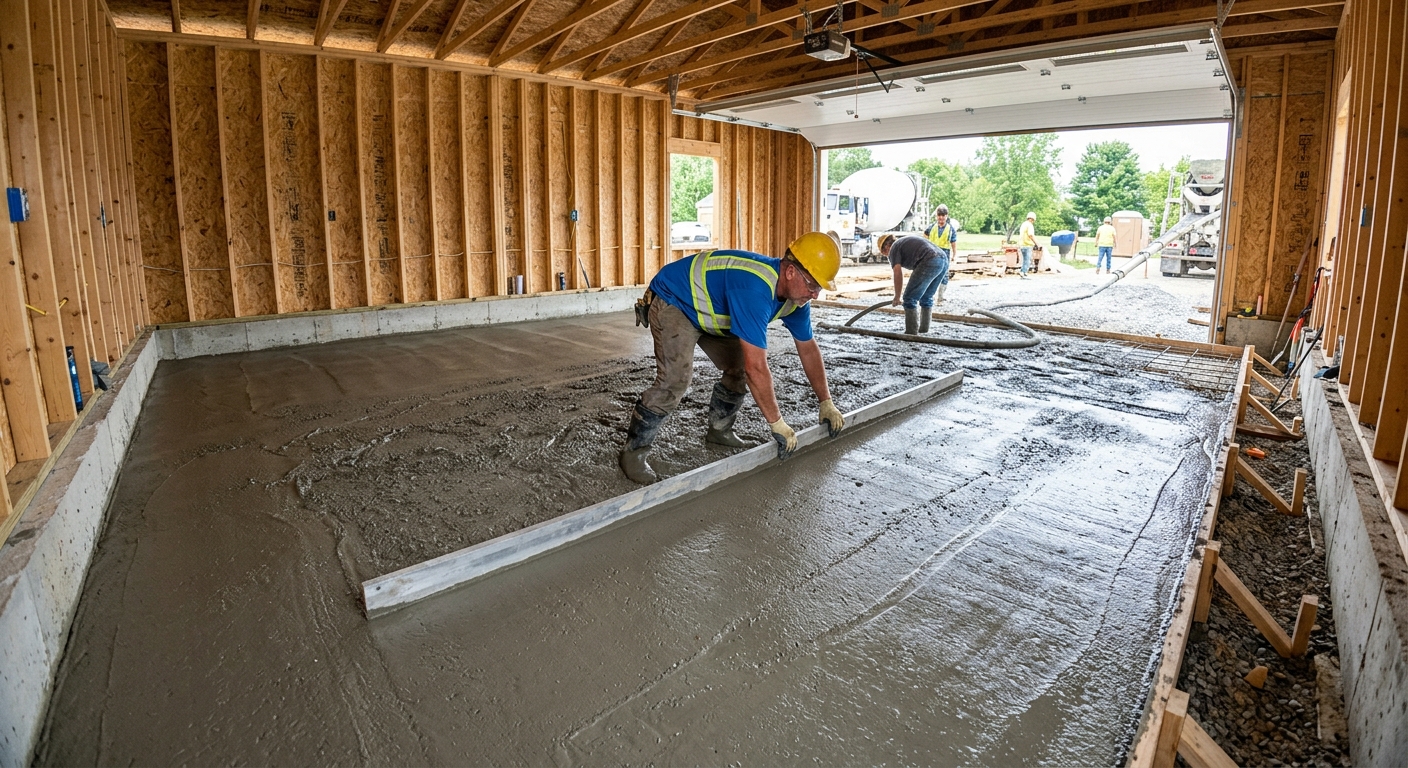
Concrete work options and costs in Applewood Park
Concrete work in Applewood Park is mostly about durable flatwork and foundations that can handle Calgary-area winter swings, spring thaw, and years of snowplough traffic. In Applewood Park’s housing market—where single-detached homes make up a large share of the local demand (Statistics Canada, 2021 Census)—you’ll commonly see concrete driveways, patios, walkways, and attached-structure slabs. The same homeowners who plan basements, garages, and retaining walls also typically plan upgrades to existing concrete, which keeps contractor availability steady in neighbourhood pockets like the newer pockets around 90th Ave and the surrounding residential streets where lots are often being developed.
Cost is shaped by the cold continental climate. Calgary’s freeze–thaw cycles drive tighter engineering and stricter materials specs: footings generally need to extend below the regional design frost depth (about 1.2 m), and exterior slabs should use air-entrained mixes to reduce scaling and spalling. Local crews also price in a shorter practical exterior pour season and the extra steps needed for cold-weather curing (insulated blankets, sometimes heat), especially for patios, walkways, and driveway approaches. That’s why two “similar” jobs can land far apart—one site might be all clear access on compacted ground, while another needs heavier excavation, thicker granular base, and more reinforcement.
Below are practical cost bands for common options you’ll be comparing as a homeowner in Applewood Park, Alberta—then you can line those up against the specs in your proposal.
| Application |
Typical Size |
Key Spec |
Finish Option |
Price Range |
| Concrete driveway (standard broom finish) |
400–500 sq ft |
Air-entrained mix, thickened edges, control joints |
Broom finish |
$12,000–$18,000 |
| Exposed aggregate driveway |
400–500 sq ft |
Air-entrained mix, properly cured, accent aggregate exposure |
Exposed aggregate (light wash/salt technique) |
$14,500–$20,500 |
| Stamped concrete driveway or patio |
300–500 sq ft |
Air-entrained mix, integral colour, release/cure plan |
Stamped pattern + seal |
$15,000–$26,000 |
| Plain concrete patio or walkway |
200–350 sq ft |
Air-entrained mix, compacted base, joints as required |
Float/ broom or light broom |
$5,000–$9,000 |
| Garage floor (interior slab) |
400–600 sq ft |
16–20 MPa typical interior spec, vapour considerations as needed |
Light broom finish |
$6,500–$12,500 |
| Foundation footings (structural, below frost) |
Typical house/garage footing package |
Engineered rebar, depth below design frost, proper concrete quality |
Structural (no cosmetic finish) |
$28,000–$45,000 |
Prices are estimates only and vary by project scope, site access and material selection.
What affects the price of concrete work in Applewood Park
In Applewood Park and the wider Calgary region, it’s common to see quote differences of 30–50% for the “same” concrete work. The big reason isn’t just labour—it’s the spec behind the pour. A driveway that looks identical on a photo can require very different excavation, granular base thickness, reinforcement density, and cold-weather curing planning depending on the soil, slope, and access to your yard. Local contractors also manage scheduling around the practical pour season; when the window tightens, demand rises and crews protect production time by tightening how much they need to do on-site.
Frost line depth and freeze–thaw cycles dictate everything here. In Alberta, footings need to extend below the design frost depth (roughly 1.2 m in this region) to prevent frost heave and seasonal movement. Exterior slabs and walkways should use air-entrained concrete so the mix survives repeated freeze–thaw cycles without surface scaling or spalling. Because the season is shorter, cold-weather placement often requires insulated blankets and/or temporary heat to keep curing on track; that can add material and labour on top of the normal driveway or patio pricing. Also, de-icing salt is hard on concrete—proper sealing and joint detailing help reduce early surface deterioration.
Two real examples from Applewood Park: (1) If your driveway ties into an approach with poor drainage or saturated subgrade, excavation and base prep cost more, pushing you toward the higher end of the driveway band (for example, closer to $12,000–$18,000 rather than the low end). (2) A stamped patio typically costs more (often landing within $15,000–$26,000) because it adds colour systems, moulding, and careful curing/sealing—yet it’s not “better concrete,” just better appearance and higher finish labour.
| Price Factor |
Why It Matters |
Cost Impact |
| Frost line depth — determines footing depth and form height |
Footings must sit below design frost to avoid heave and seasonal movement |
Major cost driver for foundations; thickened depth increases concrete and excavation |
| Site preparation — excavation, grading, compacted granular base |
Weak or wet subgrade fails early and increases settlement/cracking risk |
Can swing pricing dramatically if regrading/removal is required |
| Reinforcement — rebar or wire mesh requirement |
Controls crack width and improves load performance, especially on driveways |
Moderate-to-large impact depending on thickness and engineering |
| Mix design — air-entrainment and compressive strength spec |
Air-entrainment is crucial for freeze–thaw durability and spalling resistance |
Higher spec increases material cost and can limit substitution |
| Finish type — broom vs. stamped vs. exposed aggregate |
Finish complexity drives labour time, materials, and sealing steps |
Stamped/exposed can add a premium vs plain broom-finish |
| Pour size and concrete truck access to site |
Smaller pours and difficult access increase labour and pump/handwork time |
Can add mobilization/pumping costs and reduce crew efficiency |
| Cold-weather curing precautions — heating and blankets |
Proper curing prevents surface scaling and strength loss in cold snaps |
Season-dependent cost increase, especially in late fall/early spring |
| Control joint pattern and sealing cost |
Joints guide cracking; sealing helps repel de-icing salts and water |
Minor materials cost but can add labour and scheduling for correct timing |
Permits & regulations in Alberta
In Alberta, structural concrete work typically requires a building permit because the foundation elements influence structural safety. For Applewood Park homeowners, that generally includes footings, foundation walls, grade beams, and any structural foundation modifications that affect load paths. Municipal review may also require engineered drawings before the work starts. By contrast, concrete flatwork such as patios, walkways, and most driveways often does not require a permit—unless your project affects lot grading, changes stormwater flow, or hits impervious surface/lot coverage requirements, or involves municipal right-of-way considerations.
A practical way to avoid surprises is to confirm what your lot plan allows before excavation. Step-by-step, here’s how to verify a contractor’s credentials in Alberta. First, confirm the contractor is properly registered/licensed for the scope they’re doing—use the Alberta government licensing registry search (or ask for their business number and registration details). Second, request a current Certificate of Insurance showing general liability coverage (and name the correct legal business entity on your project). Third, verify WSIB/WCB coverage: ask for a clearance letter or proof showing their account status is active for the trades involved. Finally, ask for references on similar-scale Applewood Park jobs (driveway/patio thicknesses and joint detailing, not just “a basement”).
If you’re expanding foundation work or changing drainage patterns, treat permits as part of the schedule, not an afterthought. A contractor who won’t talk permits and insurance upfront is a red flag.
Getting concrete right in Applewood Park's freeze-thaw climate
Concrete fails in Applewood Park mainly when the mix, base, joints, or curing aren’t engineered for repeated freeze–thaw cycles and salt exposure. The right approach is to build in durability from the ground up: start with base preparation, use an air-entrained mix, control cracking with properly spaced joints, cure correctly in cold conditions, and seal once the concrete has fully developed strength. Because this area’s design frost depth is about 1.2 m, exterior and structural elements that sit on or near grade need special attention to how they’re supported and protected. Poor base compaction or shallow support can translate to settled edges and random cracking, while inadequate air-entrainment is one of the fastest routes to spalling.
Spec your job with these elements. (1) Base preparation: use a compacted granular sub-base to the required depth based on soil conditions and frost considerations, not just “whatever fits.” (2) Mix design: for exterior flatwork, use air-entrainment targeting about 5–7% air content and set a minimum strength requirement—commonly at least 32 MPa for exterior structural performance. (3) Control joints: plan joint spacing so cracks form where you intended instead of migrating through the slab. (4) Curing: allow a minimum 7-day curing period under proper conditions; in cold weather, curing may need blankets or heat to keep temperatures stable and strength development on track. (5) Sealing: apply a penetrating sealer about 28 days after the pour to help repel de-icing salts.
Where the price difference is justified: upgrading from plain broom-finish to stamped concrete often costs more because it includes colour systems and extra finishing labour. If you’re choosing between a plain patio ($5,000–$9,000) and a stamped option (often $15,000–$26,000), the spend is mainly about appearance and finish detail—not structural strength—so make sure the base, air-entrainment, and joints are still spec’d correctly regardless of finish.
| Spec |
Why It Matters in Applewood Park |
What to Ask For |
Impact if Skipped |
| Compacted granular base (depth?) |
Stabilizes the slab against freeze–thaw movement and settlement in Calgary-area winters |
State required excavation depth and granular type; confirm compaction testing approach |
Uneven settling, edge spalling, and premature cracking |
| Air-entrained concrete mix (target air %?) |
Air bubbles provide space for freeze–thaw expansion to reduce surface scaling |
Ask for air content target (typically 5–7% for exterior flatwork) |
Higher risk of spalling and scaling within a few winters |
| Compressive strength (MPa rating) |
Ensures durability and strength gain needed for winter loading and de-icing abrasion |
Confirm minimum strength (commonly 32 MPa for exterior work) |
Lower durability and faster surface wear |
| Control joints (spacing per ACI guidelines) |
Guides cracking patterns to reduce random cracking through the slab |
Ask for the planned joint layout and saw-cut timing |
Random cracks that can admit water and accelerate deterioration |
| Minimum 7-day curing period |
Strength develops over time; cold temps slow curing and can weaken the surface |
Ask how they’ll protect curing in cold weather (blankets/heat) |
Surface scaling, weaker slab edges, and reduced long-term performance |
| Penetrating sealer (when applied after cure) |
Helps reduce water and salt intrusion from winter driving and foot traffic |
Confirm sealer type and timing (often around 28 days post-pour) |
Faster salt damage and more visible spalling over time |
How to choose a concrete work contractor in Applewood Park
Choosing the right concrete contractor in Applewood Park starts with verifying Alberta credentials and coverage, then locking scope details in writing. First, confirm licensing/registration appropriate to the work they’re selling you (structural foundation vs flatwork), and ask for their Alberta business details. Next, verify liability insurance: request a Certificate of Insurance and ensure the policy is active for the project period. For worker coverage, ask for proof of WSIB/WCB coverage—either a clearance letter or current documentation—so you’re not left holding risk if a worker is injured on-site.
Then get 2–3 itemised written quotes. You want a breakdown that separates labour and materials and reflects key line items like excavation, granular base, reinforcement, concrete supply, finishing, joints, and sealing. Avoid quotes that lump everything into one number without explaining thickness, reinforcing, and joint pattern. Read the scope carefully for exclusions: is disposal of removed material included? Is permit pulling included if it’s required for structural work? Is saw-cutting and sealing included, or is that an add-on later? Warranty matters too—ask for the workmanship warranty length and whether it’s tied to their crew versus the manufacturer. Also ask if warranties are transferable if you sell the home.
Payment schedule: never pay more than 10–15% upfront. Hold back the remainder until the job is complete and site clean-up is finished. Finally, get a start date and completion estimate in writing; in Calgary-area weather, crews plan mobilization around the cure and the pour window.
- Ask for insurance COI with correct legal name and project dates
- Confirm active WSIB/WCB coverage (clearance letter preferred)
- Match quotes to the same slab thickness and base depth
- Require air-entrained mix confirmation for exterior flatwork
- Confirm reinforcement type (rebar vs mesh) and placement if needed
- Check joint layout: where they’ll saw-cut and expected spacing
- Ask about sealing type and exact timing (commonly ~28 days post-pour)
- Clarify cold-weather curing plan (blankets/heat if needed)
- Ensure material delivery assumptions match your access constraints
- Get a disposal/removal line item (excavated soil and concrete debris)
- Confirm warranty terms: workmanship duration and what’s covered
- Agree on a payment schedule that protects you at each stage
Concrete red flags I see in Applewood Park: contractors who won’t discuss frost-depth implications, quotes that omit granular base thickness and reinforcement, vague curing promises in shoulder seasons, refusal to provide insurance/WSIB documentation, and “lowest price only” bids that don’t explain joint layout or sealing timing.
Frequently asked questions — concrete work in Applewood Park
How deep must footings be for Applewood Park's frost line?
For Applewood Park (Calgary region), footings are typically designed to extend below the design frost depth—about 1.2 m (roughly 4 ft) for this area. The exact footing depth should come from your engineered drawings for the house or foundation plan, because local soil conditions and building layout can affect the final recommendation. In practice, if a contractor sets footings too shallow, the freeze–thaw cycle can lift or move the foundation over time, leading to cracks and sticking doors. When you review a foundation quote in Alberta, ask for the footing depth shown on the drawings and whether the excavation is taken down to undisturbed soil. If you’re comparing foundation packages, pricing often lands in the $28,000–$45,000 band, and the depth/engineering details are part of what you’re paying for.
Why does concrete crack in Applewood Park and how is it prevented?
Concrete cracks in Applewood Park mainly because it shrinks as it cures, then expands and contracts with temperature swings and freeze–thaw cycles. When moisture gets into uncontrolled cracks, you can also see faster surface deterioration. Prevention is about controlling where the cracks form and ensuring the slab is supported correctly. That means a proper compacted granular base, the right air-entrained mix for exterior work, and a control joint pattern designed for the slab size. Joint spacing and saw-cut timing are especially important for driveways and patios exposed to snowmelt and de-icing salts. Sealing helps slow down salt and water intrusion. If you’re budgeting for a driveway, remember that a quality driveway spec within $12,000–$18,000 should include joints and air-entrainment—finish alone won’t stop cracking.
Stamped vs broom-finish concrete — cost difference?
Stamped concrete costs more than broom-finish because it includes additional materials and labour: integral colour or colouring methods, stamp mats, release agents, and careful finishing so the pattern stays crisp after curing. In Alberta’s freeze–thaw climate, the underlying spec still matters—air-entrainment, proper base, and correct curing steps must be the same foundation of quality regardless of finish. The price difference you’ll see in Applewood Park typically follows local banding: plain driveways with a standard broom finish are commonly in the $12,000–$18,000 range, while stamped concrete projects often land higher, frequently within $15,000–$26,000, depending on size and complexity. If a quote for stamped concrete doesn’t clearly describe joint layout, curing protection, and sealing, ask questions—appearance upgrades should not weaken the durability spec.
When is the best time to pour concrete in Applewood Park?
In Applewood Park and the Calgary area, the best time to pour concrete is typically during the warmer, more stable part of the season when temperatures support curing without extra intervention. That said, it’s not “only summer”—good contractors can pour in colder periods using winter-grade concrete, insulated blankets, and temperature monitoring so curing continues long enough to reach the required strength. The real risk window is late fall and early spring: if you rush curing, surface scaling and long-term durability issues become much more likely, particularly for exterior slabs exposed to freeze–thaw and de-icing salt. Ask your contractor to specify how they’ll handle cold-weather curing and protection. For exterior work like patios and walkways, the typical $5,000–$9,000 band assumes correct curing planning; it shouldn’t be cut corners just because the calendar is tight.
How long does concrete take to cure?
Concrete curing is more than “waiting for it to dry.” In Applewood Park, you should plan around a minimum 7-day curing period under proper conditions for many exterior flatwork applications, with protection in place during cold weather. Early strength gain is critical for resisting surface damage from temperature cycles. Full long-term performance continues developing over weeks, and that’s why sealing schedules matter. For example, penetrating sealers are commonly applied after the concrete has cured sufficiently—often around 28 days post-pour—to repel water and de-icing salts effectively. If you’re preparing for traffic or furniture placement, ask how they’ll manage load timing (construction loads can be different from vehicle loads). When you get quotes, confirm the curing plan, especially in shoulder season. Cutting curing time is one of the most common ways homeowners end up redoing work too soon.
Do I need a permit for concrete work in Alberta?
In Alberta, permits are often required for structural concrete work such as footings, foundation walls, and grade beams—these affect load-bearing capacity and usually need municipal review and sometimes engineered drawings. For concrete flatwork like patios, walkways, and most driveways, a permit often is not required unless the work impacts lot grading, impervious surface limits, stormwater drainage requirements, or involves municipal right-of-way considerations. In Applewood Park, always confirm with the local authority before breaking ground, particularly if you’re changing drainage patterns or upgrading a foundation element. When hiring a contractor, verify they understand permit requirements for the scope you’re doing, and ensure you receive the written scope clearly stating whether permit work is included. If you’re comparing foundation budgets within the $28,000–$45,000 range, permit/engineering steps are part of the overall compliance picture, not optional add-ons.