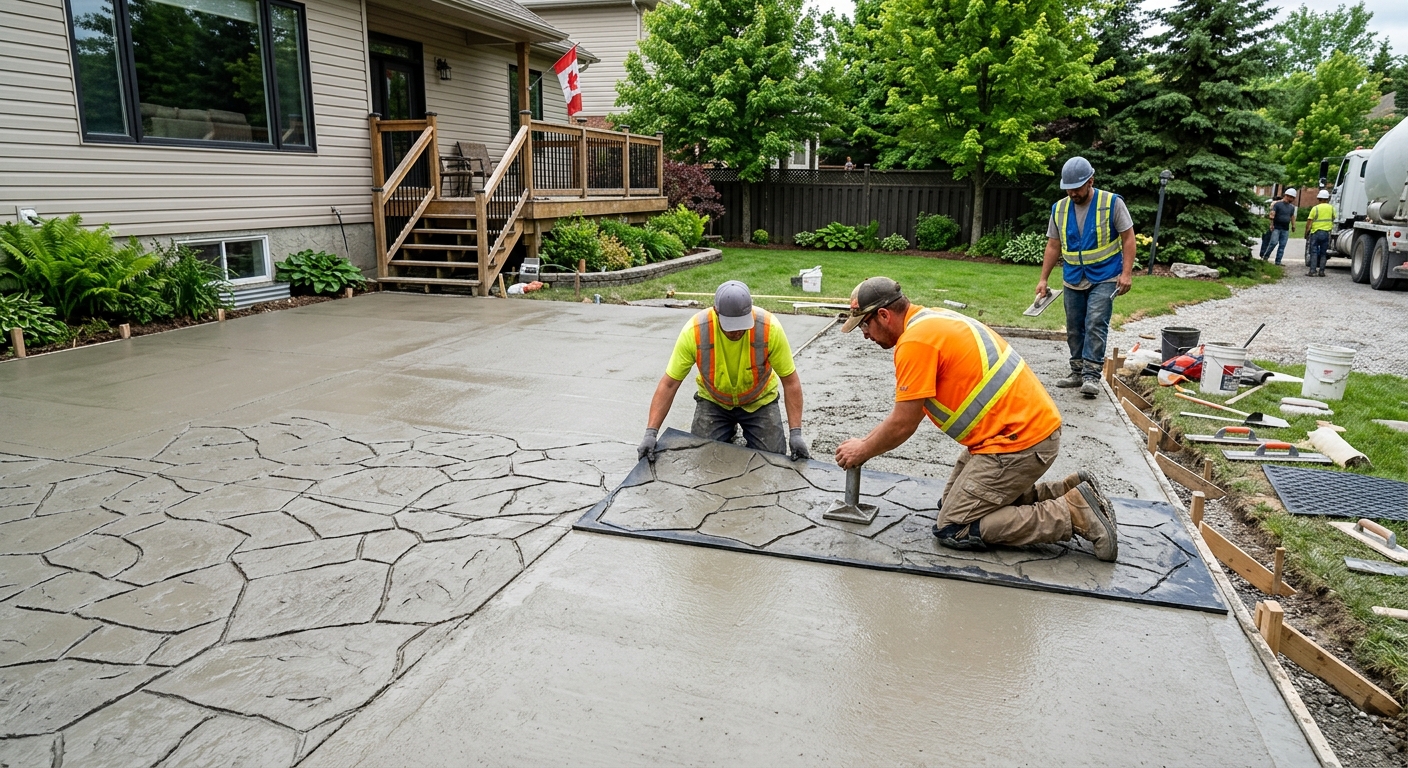
Concrete work options and costs in Mayerthorpe
Mayerthorpe homeowners typically choose concrete for driveways, patios and walkways because the town’s housing stock and weather patterns suit it. With single-detached houses making up about 69.6% of dwellings and homeowner households at 81.4% (Statistics Canada, 2021 Census), there’s steady demand for durable exterior flatwork—especially on properties with long, winter-exposed drive lanes. In the Edmonton economic region, pricing is shaped by a cold continental climate and frost-aware construction: footings must be placed below the design frost depth (commonly 1.5 m or more in this part of Alberta), and exterior slabs need well-compacted bases, good drainage and air-entrained mixes to handle freeze–thaw cycles.
That climate reality also affects scheduling. The flatwork pour season is more compressed into late spring through early fall, so labour can book up faster and cold-weather protection (heated enclosures or insulated curing blankets) may be required for late or early pours. In older neighbourhoods and established pockets with mature landscaping—where excavation and access take longer—contractors often charge more for sawcutting, hauling, and re-grading.
In Mayerthorpe, demand is often especially visible in the more established residential areas near the main road corridors (where driveways are frequently wider and tied into older approaches). If you’re comparing options, it’s easiest to start with the typical application sizes below and then tailor specs to your soil, frost depth, reinforcement plan, and finish.
| Application |
Typical Size |
Key Spec |
Finish Option |
Price Range |
| Concrete driveway (standard broom finish) |
20 ft x 10 ft (2 lanes/approach as applicable) |
Air-entrained mix, compacted granular base, control joints |
Broom finish, stamped border optional |
$9,000–$18,000 |
| Exposed aggregate driveway |
20 ft x 10 ft |
Proper curing, consistent aggregate exposure, jointing plan |
Exposed aggregate (trowel-wash style) |
$12,000–$22,000 |
| Stamped concrete driveway or patio |
16 ft x 12 ft patio or 20 ft x 10 ft driveway (varies) |
Reinforcement as needed, air-entrained mix, curing and sealing |
Stamped pattern + release + colour hardener |
$12,000–$26,000 |
| Plain concrete patio or walkway |
12 ft x 10 ft patio or 40 ft x 4 ft walkway |
Air-entrained mix, compacted base, sawcut joints |
Plain float + light broom finish |
$3,500–$9,000 |
| Garage floor (interior slab) |
24 ft x 24 ft |
Vapour management as needed, fibres or mesh, proper thickness |
Steel-trowel finish + cure/compound |
$7,500–$16,000 |
| Foundation footings (structural, below frost) |
Perimeter foundation on typical house footprint |
Excavation to frost depth, rebar, engineered dimensions |
Reinforced structural concrete (no decorative finish) |
$25,000–$60,000 |
Prices are estimates only and vary by project scope, site access and material selection.
What affects the price of concrete work in Mayerthorpe
In Edmonton and the surrounding region, two quotes for the “same” concrete job can differ by 30–50% because the real cost drivers aren’t just the volume of concrete—they’re what it takes to get it to perform through Alberta winters. Frost depth, freeze–thaw cycles, soil conditions, haul distance, and how much premium labour time is needed to meet cold-weather curing requirements can swing pricing quickly.
For Mayerthorpe specifically, frost-aware design is non-negotiable: exterior footings and foundations must extend below the design frost depth (often up to 2.4 m in Alberta), otherwise frost heave can lift the structure or crack slabs. Exterior flatwork also needs air-entrained concrete mixes to survive repeated freeze–thaw cycles; without adequate air entrainment, spalling and scaling show up sooner—especially with de-icing salts. Add that the pour season can be shorter in colder months, and concrete crews may rely on insulated blankets or heated enclosures to cure properly, which increases material and fuel costs.
Local job realities also matter. For example, if your driveway ties into an older culvert or you have soft spots that require thicker base or sub-excavation, the job can climb toward the upper end of the driveway band. Likewise, a larger stamped layout can justify higher labour because finishing, formwork for edges, and pattern work are slower; it’s one reason stamped driveway or patio pricing often sits near the top of the $12,000–$26,000 band. Conversely, a simple plain patio on stable, well-drained ground may land nearer the $3,500–$9,000 range—if base preparation and jointing are done right.
| Price Factor |
Why It Matters |
Cost Impact |
| Frost line depth — determines footing depth and form height |
Deeper placement increases excavation, rebar, forming and concrete volume. |
Can push foundation/footings toward the higher end (e.g., $25,000–$60,000 range) depending on engineered dimensions. |
| Site preparation — excavation, grading, compacted granular base |
Compaction and drainage prevent settlement and surface failure during freeze–thaw. |
Often adds a major share of cost when soil is wet/unstable or base must be thicker. |
| Reinforcement — rebar or wire mesh requirement |
Controls cracking and improves load performance (especially driveways and slabs on grade). |
Small material cost, but can increase labour for placement, chairs, and overlap. |
| Mix design — air-entrainment and compressive strength spec |
Air entrainment is critical for scaling resistance in Alberta freeze–thaw. |
Higher-spec mix typically adds cost; it protects against early spalling and rework. |
| Finish type — broom vs. stamped vs. exposed aggregate |
Labour intensity and curing/sealing steps vary by finish. |
Stamped/exposed often moves jobs toward the upper ends of driveway/patio bands. |
| Pour size and concrete truck access to site |
Long walks, tight turns, or limited access increase labour and could require smaller loads. |
Access issues can add hauling and placement time. |
| Cold-weather curing precautions — heating and blankets |
Concrete needs stable curing conditions; cold snaps slow strength gain. |
Can add material + equipment premiums in shoulder-season pours. |
| Control joint pattern and sealing cost |
Jointing limits random cracking; sealing helps repel de-icing salts. |
Proper jointing adds sawcut/placement labour; sealing is an extra scheduled step (often after 28 days). |
Permits & regulations in Alberta
In Alberta, the permitting rules depend on whether the work is structural or simply exterior flatwork. Structural concrete work—such as footings, foundation walls, grade beams, and other load-bearing components—generally requires a building permit and often engineered drawings that get reviewed by the municipality. If you’re extending a foundation, changing foundation type, or building anything that supports loads, treat it as permit-required.
Concrete flatwork like patios, walkways, and driveways typically does not require a permit, but there are common exceptions: if the work alters lot grading, affects drainage patterns, changes stormwater flow, or impacts impervious surface coverage or municipal right-of-way areas, the municipality may get involved. Always confirm before you break ground—especially if you’re reworking slopes or tying new concrete into existing drainage infrastructure.
For homeowners in Mayerthorpe, verifying a contractor is step-by-step. First, ask for their Alberta business details and confirm they are properly registered through the appropriate online registry options available to the public (your contractor should be able to provide their legal business name and permit/registration references if applicable). Next, request a Certificate of Insurance for liability coverage—your contractor should clearly list coverage limits and the project address. Also ask for WSIB/WCB clearance documentation (or proof of coverage). Finally, get references for similar jobs (driveways/patios and, if relevant, structural foundation work) so you can judge the quality and finish consistency in an Alberta climate.
Getting concrete right in Mayerthorpe's freeze-thaw climate
Concrete fails in Mayerthorpe when the job is designed for “temperate weather” rather than Alberta freeze–thaw. The most common failures are spalling and scaling from inadequate air-entrainment, cracking from weak or poorly prepared bases, and heaving when frost protection is wrong or drainage is poor. To spec the job correctly, focus on five things: base preparation, mix design, control joints, curing, and sealing.
Start with base preparation: excavate to the correct depth for your soil and frost considerations, then place and compact a granular sub-base so it stays stable through spring thaw. Next, specify air-entrained concrete—typically 5–7% air content for exterior flatwork exposed to freeze–thaw—and minimum 32 MPa compressive strength (or a higher spec when required by the design). Then control cracking with a joint plan: add control joints early enough and at sensible spacing so cracks form where you want them. Curing matters just as much: concrete should cure for a minimum of 7 days under proper conditions, and in colder shoulder-season windows you may need insulated blankets or an enclosure so early strength gain isn’t delayed. Finally, sealing is your protection against de-icing salts—use a penetrating sealer applied 28 days after the pour.
A dollar example helps: homeowners often choose stamped concrete at the higher end of the market (for example, around the $12,000–$26,000 band) expecting aesthetics—but the “value” is only real if air-entrainment, base prep and jointing are still treated as essentials. Skimping on those items to save a few thousand can lead to early repairs that erase the benefit.
| Spec |
Why It Matters in Mayerthorpe |
What to Ask For |
Impact if Skipped |
| Compacted granular base (depth?) |
Stable support prevents settlement and cracking during spring freeze–thaw. |
Granular sub-base type, lift thickness, compaction method, and target thickness for your soil. |
More cracking, uneven surface, and premature edge breakdown. |
| Air-entrained concrete mix (target air %?) |
Air voids allow freeze–thaw expansion without damaging the paste. |
5–7% air content specified for exterior flatwork exposed to Alberta winters. |
Spalling/scaling (especially around edges and where salts accumulate). |
| Compressive strength (MPa rating) |
Strength gain supports load capacity and durability in a cold region. |
Minimum 32 MPa (or higher per engineer spec for foundations). |
Surface wear, scaling, and reduced structural performance. |
| Control joints (spacing per ACI guidelines) |
Joints direct shrinkage/thermal movement to predictable locations. |
Joint spacing plan and sawcut timing that matches the slab size. |
Random cracking across the slab field. |
| Minimum 7-day curing period |
Proper curing strengthens concrete before traffic and seasonal temperature swings. |
Protection plan, curing duration, and cold-weather procedures when needed. |
Reduced strength, higher permeability, and early surface deterioration. |
| Penetrating sealer (when applied after cure) |
Helps repel meltwater and reduces salt-driven deterioration. |
Penetrating sealer applied after 28 days curing (or per product directions). |
Faster scaling and staining, more frequent maintenance. |
How to choose a concrete work contractor in Mayerthorpe
Choosing the right concrete contractor in Mayerthorpe starts with proof and process. For Alberta projects, verify three things: (1) licensing/registration where applicable to the contractor’s trade and business activity, (2) liability insurance, and (3) WSIB/WCB coverage. You can check licensing/registration using the public-facing online registry options available to Albertans and confirm the contractor’s legal business name matches their paperwork. For insurance, request a Certificate of Insurance showing liability coverage limits and the job address or project description. For WSIB/WCB, ask for clearance/coverage documentation—reputable crews can provide this without delays.
Next, require 2–3 itemised written quotes. The best quotes break labour and materials separately (excavation, base, rebar/mesh, concrete supply, forming, finishing, sawcutting, disposal, and sealing/schedule), rather than only giving a single lump sum. Read the scope carefully: what’s excluded (topsoil removal, hauling, drainage adjustments), is permit work included (when required for foundations), and is disposal included for excess material?
Warranty matters too: ask for a workmanship warranty length and whether the manufacturer’s warranty (for sealers/chemicals, where relevant) is included and transferable to future owners. For payment, avoid large deposits—never more than 10–15% upfront—and hold back funds until the job is complete and deficiencies are corrected. Finally, insist on a written timeline with a start date and completion estimate; in the Edmonton region, weather windows can shift, so the schedule should account for curing and protection time.
- Request their latest Certificate of Liability Insurance and confirm coverage is active.
- Confirm WSIB/WCB clearance/coverage documentation before work begins.
- Ensure quotes list excavation and disposal/hauling separately.
- Ask for the concrete mix spec: air-entrainment target and compressive strength (MPa).
- Confirm base thickness and compaction method/lift requirements.
- Verify reinforcement plan (mesh vs rebar, and slab/foundation requirements).
- Ask when control joints will be installed and the intended spacing.
- Require details for curing protection in shoulder-season temperatures (blankets/enclosures).
- Get a sealing schedule (if included) noting 28 days curing for penetrating sealer.
- Ensure the quote states who handles sawcut timing and joint sealing material.
- Set payment terms in writing: 10–15% max deposit; holdback until acceptance.
- Ask for a warranty statement in the contract, including how defects are handled.
Concrete red flags in Mayerthorpe include: vague “concrete mix” wording with no air-entrainment target, skipping a granular base thickness or compaction description, no clear joint layout (or “we’ll add joints later”), offering sealing immediately “right after the pour” instead of after cure, and quoting a foundation/footing without engineered dimensions and frost-depth excavation details.
Frequently asked questions — concrete work in Mayerthorpe
How do I seal concrete to protect it in Mayerthorpe?
In Mayerthorpe and across Alberta, sealing is about repelling meltwater and reducing salt-driven surface damage. For exterior slabs (driveways, patios, and walkways), use a penetrating sealer rather than only relying on surface coatings. Plan sealing for after the concrete has cured properly—commonly 28 days after the pour—so the sealer can do its job without trapping moisture. Before sealing, the surface should be cleaned and fully dry; pressure washing is often used, but you want the concrete to be given time to dry thoroughly. If you’re comparing options, a plain patio typically lands in the $3,500–$9,000 band, and sealing may be a separate line item—worth it because freeze–thaw cycles and de-icing salt can accelerate scaling.
What is the difference between concrete and cement?
Homeowners in Mayerthorpe often use “cement” and “concrete” interchangeably, but they aren’t the same. Cement is one ingredient—usually Portland cement—that acts as the binder. Concrete is the finished building material made from cement plus water, aggregates (sand and gravel/crushed stone), and often additives like air-entrainment (critical for Alberta freeze–thaw durability). When you request a mix for exterior work, the practical spec to look for is air-entrainment and compressive strength (for example, a typical exterior target is minimum 32 MPa with air around 5–7%). That mix spec is what drives performance more than the word “cement” on a quote.
How much does concrete work cost in Mayerthorpe?
Costs in Mayerthorpe generally track the broader Edmonton economic region, with premiums for frost-aware specs and weather scheduling. For flatwork, a concrete driveway commonly ranges from $9,000–$18,000 depending on size, base work, reinforcement, access and jointing. Patios and walkways are often more modest—commonly $3,500–$9,000 for typical residential sizes—while stamped concrete may run higher (commonly within $12,000–$26,000) due to labour intensity and finishing steps. Foundation/footings are the biggest swing factor because excavation can reach below frost depth; typical budgeting is often $25,000–$60,000. Exact numbers vary based on your site prep needs and whether cold-weather curing precautions are required.
How deep must footings be for Mayerthorpe's frost line?
For Mayerthorpe, footing depth is determined by the design frost depth for Alberta, not a one-size rule. In this region, frost depths are commonly designed around 1.5 m or more, and Alberta designs can reach up to about 2.4 m depending on soil and local engineering assumptions. Practically, that means contractors typically excavate below that frost depth so the footing stays unaffected by seasonal heave. Because foundation specs are structural, you should expect engineered dimensions and a permit process for foundation work. If someone proposes a shallow depth “to save money,” that’s a major durability red flag in an Edmonton-area freeze–thaw climate—especially given older housing stock where drainage and settlement issues can already exist.
Why does concrete crack in Mayerthorpe and how is it prevented?
Concrete can crack in Mayerthorpe because it naturally shrinks as it cures and it expands/contracts with temperature changes—then freeze–thaw cycles and de-icing salts intensify the stress. Cracking is also more likely if the base isn’t properly excavated, graded, and compacted. The main prevention steps are: correct granular base preparation, a durable air-entrained mix for exterior exposure, and a control joint plan with proper spacing and sawcut timing. Joints are designed to “tell” the slab where to crack so you don’t get random fractures. If you seal (after proper cure), you also help protect the surface from meltwater and salt intrusion. Done properly, these measures reduce cosmetic cracking and help prevent early spalling.
Stamped vs broom-finish concrete — cost difference?
Stamped concrete costs more than broom-finish for two reasons: it’s more labour-intensive and it requires additional materials and workflow (releases, colour hardeners/integral colouring, and careful finishing). In the Edmonton region, that’s why stamped driveway or patio budgets often fall in the $12,000–$26,000 band, while standard broom-finish driveways commonly sit around $9,000–$18,000 depending on size and base requirements. If you have a large exposed area or you want a higher-end look, the price can be justified—provided the contractor still meets cold-weather durability fundamentals (air-entrainment, base prep, and a joint pattern). Skipping those fundamentals to save on stamping costs is where homeowners get disappointed later.