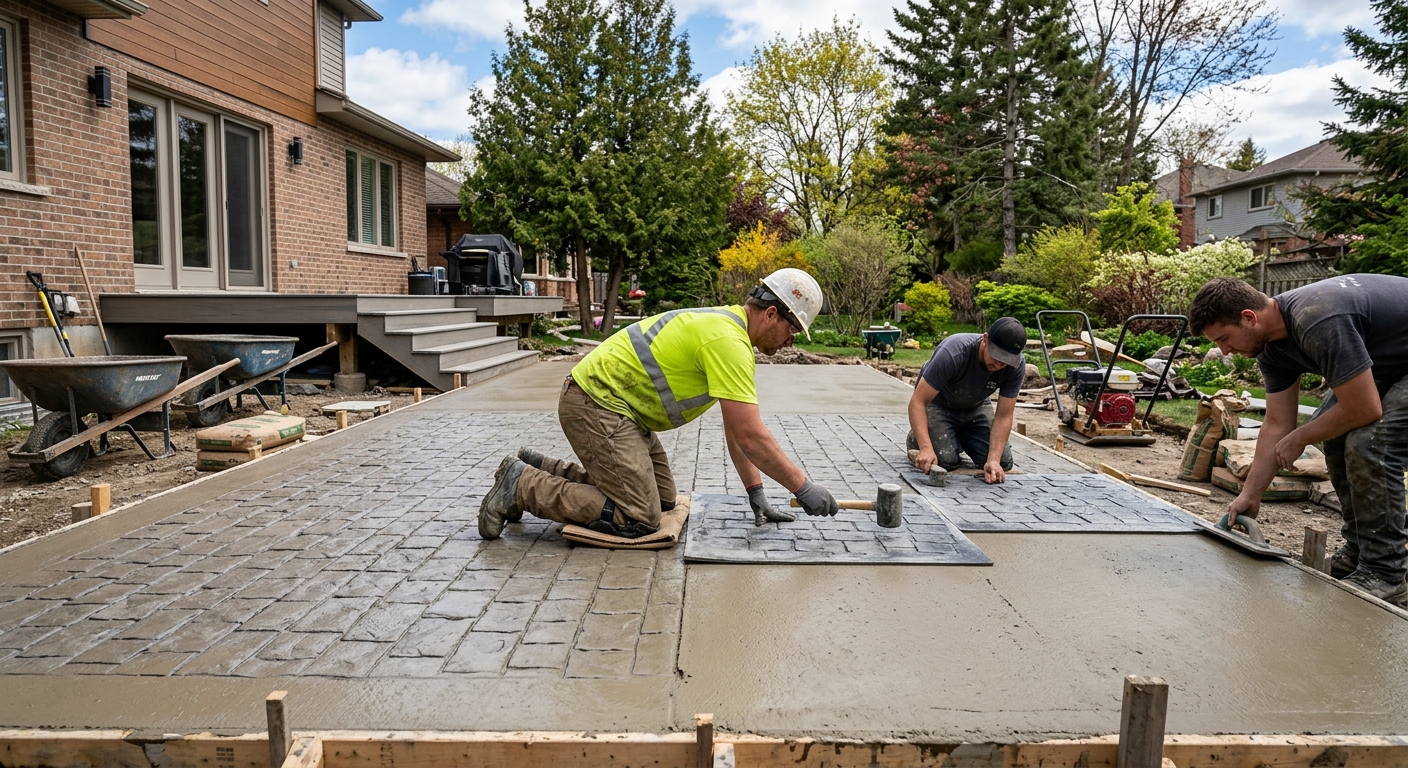
Concrete work options and costs in Capilano
In Capilano, Alberta, most homeowners start thinking about concrete because it’s practical for driveways, patios, walkways, and—when you’re building or upgrading—structural foundations. Capilano’s housing stock is small but steady for new flatwork: in the broader Calgary economic region, single-detached homes make up a large share of dwellings that typically need driveway and slab upgrades (Statistics Canada, 2021 Census). With a 2021 population of 2,683 in Capilano itself (Statistics Canada, 2021 Census), demand is concentrated around established neighbourhood pockets where access, soil conditions, and aging surfaces all drive repeat work.
Calgary’s cold continental climate is the main reason concrete pricing here can differ from milder parts of the province. Concrete in Capilano is engineered around frost and freeze–thaw, with a design frost depth of about 1.2 m (roughly 4 ft) for footing support decisions. Exterior slabs also need air-entrained mixes and careful curing—especially when pours are scheduled near the shoulder seasons. Add in that truck access, excavation depth, and granular base prep are often more intensive in Alberta than you’d expect, and you’ll see why local contractors may price similar projects differently.
In Capilano, trades are especially busy around established residential areas where driveways and patios are commonly near mature landscaping and overhead utility lines, which can increase labour time for forms, demolition, and disposal. Below is a practical side-by-side comparison of common concrete options and typical pricing, so you can compare quotes apples-to-apples.
| Application |
Typical Size |
Key Spec |
Finish Option |
Price Range |
| Concrete driveway (standard broom finish) |
24 ft x 10 ft (240 sq. ft.) |
Air-entrained mix for exterior, compacted granular base, joints |
Broom finish |
$12,000–$18,000 |
| Exposed aggregate driveway |
24 ft x 10 ft (240 sq. ft.) |
Air-entrained mix, proper curing to develop surface, sealed joints |
Exposed aggregate (sprayed retarder or wash) |
$14,500–$22,500 |
| Stamped concrete driveway or patio |
300 sq. ft. (typical patio/run) |
Engineered base, air-entrained mix, integral colour or stain, release agent |
Stamped pattern + seal |
$15,000–$26,000 |
| Plain concrete patio or walkway |
200 sq. ft. patio or 4 ft x 30 ft walkway |
Air-entrained mix, compacted granular sub-base, light saw cuts |
Broom finish or floated trowel edge |
$5,000–$9,000 |
| Garage floor (interior slab) |
24 ft x 22 ft (528 sq. ft.) |
Vapour barrier as needed, fibre or rebar depending on design, ground preparation |
Steel trowel or broom/texture |
$10,000–$16,500 |
| Foundation footings (structural, below frost) |
Typical house footing scope (engineered) |
Concrete placement below design frost depth, reinforcement, inspection holds |
Structural grade placement (formwork + rebar) |
$28,000–$45,000 |
Prices are estimates only and vary by project scope, site access and material selection.
What affects the price of concrete work in Capilano
In Capilano, you can see quotes for the “same” concrete job swing by 30–50% across Calgary and the surrounding area because the scope details rarely match. Two contractors may both say “240 sq. ft. driveway,” but one includes deeper excavation, geotextile and thicker granular base, while the other assumes thinner base and standard access. Labour rates, the crew’s scheduling window, and how they protect the pour during cold weather also change costs quickly.
Calgary’s freeze–thaw cycle dictates the technical specs. With a design frost depth of about 1.2 m (roughly 4 ft) for footings, exterior concrete assemblies often need excavation and foundation-bearing volumes that are more intensive than in warmer regions. That same climate also requires air-entrained concrete for exterior slabs to reduce freeze–thaw damage and surface scaling. In practical terms, colder placement periods have a shorter pour season and may require winter-grade measures—insulated blankets, monitored curing temperatures, and sometimes temporary heat—so concrete reaches the required strength before exposure. That curing window is a major cost driver when projects land late fall or early spring.
Local conditions can raise or lower costs. For example, a driveway near mature trees may require extra demolition care and disposal, while a flat, accessible lot with stable soil can reduce excavation time. If your slab connects to an existing garage floor or needs dowels and reinforcement tie-ins, expect higher structural labour. Finish choice matters too: a standard broom driveway usually lands within the $12,000–$18,000 band, while stamped & decorative work commonly tracks the $15,000–$26,000 range because of added finishing labour, colour systems, and sealing.
| Price Factor |
Why It Matters |
Cost Impact |
| Frost line depth — determines footing depth and form height |
Footings must bear on undisturbed soil below the design frost depth to prevent frost heave |
Major cost driver on foundations/footings; deeper excavation increases concrete and labour |
| Site preparation — excavation, grading, compacted granular base |
Proper base reduces settlement and helps drainage under the slab |
Can swing total price by 10–25% depending on soil and access |
| Reinforcement — rebar or wire mesh requirement |
Crack control and load capacity for garage slabs, driveways and foundation elements |
Medium-to-high; impacts material and labour time |
| Mix design — air-entrainment and compressive strength spec |
Freeze–thaw survival and structural performance in Alberta winters |
Moderate; required specs raise material cost versus basic mixes |
| Finish type — broom vs. stamped vs. exposed aggregate |
Decorative finishes add time, tools, curing discipline and sealing steps |
High for stamped/exposed; often shifts you into decorative bands |
| Pour size and concrete truck access to site |
Small pours still require forms and crews; access limits chute length and staging |
Medium; poor access increases labour and can require additional equipment |
| Cold-weather curing precautions — heating and blankets |
Concrete must achieve strength under freezing risk; cold slows hydration |
Medium-to-high; can add days and specialized materials |
| Control joint pattern and sealing cost |
Joints guide cracking and sealing helps protect against de-icing salt exposure |
Low-to-medium, but skipped items can lead to early surface failure |
Permits & regulations in Alberta
In Alberta, many homeowners in Capilano assume “it’s just concrete,” but the permit need depends on structural impact and grading. Structural concrete work—such as footings, foundation walls and grade beams—typically requires a building permit and is often tied to engineered drawings that the municipality reviews. For concrete flatwork like driveways, patios, and walkways, a permit often isn’t required on its own, unless the work affects lot grading, changes drainage, or relates to impervious surface coverage or work that encroaches toward a municipal right-of-way. Because exact requirements can vary by situation, confirm with the local authority before excavation.
Before signing, verify your contractor is set up properly. Step-by-step, you can do this from your computer:
- Check contractor licensing/registration: use Alberta’s relevant online registry for the business or trades as applicable to the scope.
- Request a certificate of insurance: look for active liability insurance (and confirm limits). Your contractor should list you/your property where required by contract.
- Confirm workers’ coverage: ask for proof of WSIB/WCB coverage (depending on the contractor’s classification and coverage structure).
- Ask for documentation: request clearance letters or equivalent proof if the registry requires it.
- Verify references: specifically ask for similar-scale concrete projects around Calgary where freeze–thaw performance matters.
Doing these checks early protects you from schedule delays, uncovered liability, and rework—especially when excavation and curing constraints are involved in Alberta’s seasonally cold conditions.
Getting concrete right in Capilano's freeze-thaw climate
Concrete fails in Capilano’s climate when the slab is built like it’s in a milder region: inadequate base preparation, poor drainage, incorrect mix design, weak curing, and missing protection after the pour. The big performance issue homeowners notice over time is spalling—surface scaling and small flakes—usually tied to freeze–thaw damage and, most importantly, insufficient air-entrainment. Calgary’s cold continental winters and freeze–thaw cycles stress every exterior slab, so the job spec has to be precise.
To get it right, start with five fundamentals. (1) Base preparation: excavate to a compactable depth and build a properly graded, compacted granular sub-base that matches local soil and frost considerations. (2) Mix design: for exterior flatwork, specify air-entrainment (commonly 5–7% air content) and a minimum 32 MPa compressive strength. (3) Control joints: plan saw cuts to limit random cracking; then seal where the system requires it. (4) Curing: allow at least 7 days of proper curing conditions; cold-weather placement may require insulated blankets or monitored heat so hydration isn’t compromised. (5) Sealing: apply a penetrating sealer after curing—often around 28 days—to help repel de-icing salts.
Here’s where pricing is justified. If a plain patio in the $5,000–$9,000 range is quoted with a non-air-entrained mix or shallow base, you may save up front but pay later for surface repairs and potential replacement. A stamped patio can land closer to the $15,000–$26,000 band, and that premium is often real—extra finishing steps plus colour materials and sealing—yet the freeze–thaw specs should remain non-negotiable either way.
When you ask technical questions, anchor them to your climate: “What air content are you targeting?”, “How deep are we excavating and how thick is the compacted base?”, and “What cold-weather curing plan is included if temperatures drop?” That’s how you avoid the most common failure in this market.
| Spec |
Why It Matters in Capilano |
What to Ask For |
Impact if Skipped |
| Compacted granular base (depth?) |
Reduces settlement and supports slab through frost-season moisture movement |
Confirm excavation depth, granular layer thickness, compaction testing/verification, and drainage grade |
Uneven settling, cracking, and accelerated surface failure |
| Air-entrained concrete mix (target air %?) |
Protects against freeze–thaw damage common in Calgary-area winters |
Target air content for exterior flatwork (commonly 5–7%) and batch/mix documentation |
Spalling, scaling, and early deterioration from trapped water |
| Compressive strength (MPa rating) |
Ensures durability and capacity under load and temperature cycling |
Minimum 32 MPa (or engineered requirement for structural work) |
Higher risk of cracking and reduced long-term durability |
| Control joints (spacing per ACI guidelines) |
Limits random cracking and reduces water intrusion at stress points |
Joint spacing plan and whether joints are saw-cut and sealed as applicable |
Wider random cracks and increased freeze–thaw penetration |
| Minimum 7-day curing period |
Hydration must continue long enough to reach adequate strength before exposure |
Minimum 7 days under proper conditions; included cold-weather curing measures if needed |
Weaker surface, higher scaling/spalling risk |
| Penetrating sealer (when applied after cure) |
Helps repel de-icing salt and water intrusion during freeze–thaw seasons |
Confirm sealer type and timing (often after cure, around 28 days) |
Faster surface wear and more salt-driven deterioration |
How to choose a concrete work contractor in Capilano
Start by verifying Alberta coverage and accountability. Ask for their current insurance certificate and confirm it has active liability coverage for concrete work risks (site damage and third-party injury). Next, confirm they carry WSIB/WCB coverage for workers involved in the pour, excavation and formwork. If you’re hiring a subcontractor crew, don’t assume coverage—request proof for the parties actually on-site. Finally, ensure their business is properly registered/licensed for the scope you’re buying.
Then get 2–3 itemised written quotes instead of a single lump sum. A strong quote breaks down labour and materials (demo, excavation, granular base, rebar/wire mesh, concrete supply, finishing, sealing, and any required curing blankets/heating). Read the exclusions carefully: disposal included or not, permit pull responsibility, what happens if conditions differ once excavation starts, and whether the price includes any required dowels/tie-ins to existing concrete.
Pay attention to warranty terms. Look for a workmanship warranty length that matches the risk profile of exterior concrete in Alberta (freeze–thaw, de-icing exposure), and ask whether product warranties are provided by the manufacturer and if they’re transferable to you. For payment, use a schedule that protects you: typically no more than 10–15% upfront, then hold back until key milestones are complete (base inspection, forms/rebar ready, final finishing and curing steps).
Insist on timeline clarity: ask for a written start date and a completion estimate that accounts for weather and curing requirements in Capilano’s winter risk window.
- Request proof of liability insurance and review the certificate for current dates and limits.
- Verify WSIB/WCB coverage for the exact crew doing the work.
- Ask for the Alberta registry/registration information relevant to their contracting activity.
- Get itemised quotes: demolition, excavation, base, reinforcement, concrete, finishing, sealing, curing measures.
- Confirm disposal: dump fees and hauling included or extra.
- Confirm permit responsibility (who pulls it, if required) and whether the cost is included.
- Ask for the mix design spec: air-entrainment and target compressive strength.
- Ask about base depth and compaction verification method.
- Confirm rebar/wire mesh and jointing plan (spacing) before you approve price.
- Require cold-weather curing plan in writing if temperatures may drop during placement.
- Set a milestone-based payment schedule with a holdback until curing/sealing steps are complete.
- Demand a written timeline with weather contingencies and who decides to reschedule.
Concrete contractor red flags in Capilano include quoting a “standard mix” for exterior without air-entrainment details, skipping a base build-up/compaction explanation, offering decorative work that isn’t paired with sealing plans, refusing to put curing and cold-weather procedures in writing, or asking for large upfront deposits before any site inspection or foundation/base layout is done.
Frequently asked questions — concrete work in Capilano
How long does concrete take to cure?
In Capilano, curing time matters because Alberta’s freeze–thaw cycle punishes weak early strength. For most flatwork, crews plan for at least 7 days of proper curing conditions before you treat the surface as fully reliable, though it won’t reach full long-term durability overnight. If temperatures are cold, contractors often use insulated blankets and sometimes temporary heat so hydration continues and the concrete gains strength properly. Even after the slab is “walkable,” you should avoid heavy loads and construction impacts early in the schedule. Sealing is also typically timed after cure—often around 28 days—to help repel moisture and de-icing salt. Your contractor should confirm the curing method in the scope, not just the pour date.
Do I need a permit for concrete work in Alberta?
In Alberta (including Capilano), structural concrete like footings, foundation walls, and grade beams generally requires a building permit and usually engineered drawings reviewed through the municipal process. Concrete flatwork such as driveways, patios, and walkways often does not require a permit by itself, unless the work changes lot grading, affects drainage, increases impervious surface coverage constraints, or involves an area that ties into municipal right-of-way rules. Because details can change with site conditions, it’s smart to ask your contractor whether a permit is required for your specific scope before excavation starts. Also confirm the contractor’s approach to drainage and transitions at the house and property lines, since these are common reasons flatwork scopes trigger additional requirements in practice.
Concrete vs pavers for a patio in Capilano?
Concrete and pavers both work well in Alberta, but they fail differently in freeze–thaw climates. A plain concrete patio (often in the $5,000–$9,000 band depending on size and prep) typically gives a more rigid, uniform surface if the base is built correctly and joints are cut/managed. Pavers can look great and are easier to replace locally if a section settles, but they rely on a carefully drained and compacted base and a consistent jointing system to prevent frost-related movement and weed growth. In Capilano, the deciding factors are your base/soil conditions, your desired maintenance level, and whether you’re using de-icing near the patio area. If you want the most predictable “clean and continuous” surface with fewer joint lines, concrete is often the simpler long-term choice—provided you specify air-entrainment and proper curing.
How long does a concrete driveway last?
A well-built concrete driveway in Capilano commonly lasts 20–30 years or more, but the exact life depends on how it’s engineered for Calgary-area freeze–thaw and de-icing salt. The biggest early-life risks are inadequate air-entrainment, poor base compaction, weak curing in cold weather, and missing or improperly placed control joints. If those are handled, surface scaling is usually reduced and the driveway holds up through winters. Pricing reflects durability choices: a standard broom-finished driveway often lands in the $12,000–$18,000 range, while decorative options can be higher (for example, stamped work frequently falls into the $15,000–$26,000 band). If you plan for sealing after cure and avoid aggressive de-icers, you extend the driveway’s usable life.
What is air-entrained concrete and why does it matter here?
Air-entrained concrete is mixed with microscopic air bubbles that give freezing water somewhere to expand without damaging the paste. In Capilano and the Calgary region, freeze–thaw cycles are frequent, so exterior slabs without proper air content are much more likely to develop scaling and spalling over time. That’s why reputable Alberta contractors specify an air-entrained mix for driveways, patios, and walkways, typically targeting about 5–7% air for exterior flatwork. It’s also tied to curing: if hydration is rushed due to cold placement without blankets or heat, even a correctly designed mix can underperform early. When you’re comparing quotes, ask your contractor to confirm the air-entrainment target and the compressive strength spec, not just the finish (broom vs stamped).
How do I prepare the base for a concrete slab?
Base preparation in Capilano is where longevity is decided. Your concrete contractor should excavate to the planned depth and build a compacted granular sub-base that matches site soil and local frost considerations. In this Calgary-area market, proper drainage and compaction are critical because moisture movement and freeze–thaw can lead to settlement and cracking if the base isn’t uniform. In your quote, look for details on excavation, granular layer thickness, and whether the crew compact-checks the material before placing reinforcement and concrete. For exterior slabs like patios and driveways, the contractor should also confirm the mix is air-entrained and that joints are planned to limit random cracking. If you’re in the middle of a late-fall or early-spring schedule, ask how they’ll maintain curing conditions—heating and insulated blankets can be part of the base-to-durability plan.