Concrete work options and costs in Leger
Concrete work in Leger, Alberta is all about getting the mix, base, and curing right for Calgary-area freeze–thaw cycles. With a 2021 population of 2,559 in Leger (Statistics Canada, 2021 Census), the local contractor pool is smaller than in bigger Calgary communities, so availability can affect schedule—and pricing when trades are booked into spring and early summer. Most homeowners here are planning concrete flatwork for single-detached lifestyles, and concrete is typically the durable choice for driveways, patios, walkway slabs, and even basement-related foundation pours.
In the Calgary region, the design frost depth is about 1.2 m (roughly 4 ft). That matters for anything supported by soil—especially garage slabs tied to footing support, retaining walls, and structural foundation work where footings must bear below frost to prevent movement. Exterior slabs also need air-entrained mixes and well-spaced control joints, because repeated freeze–thaw can drive scaling and cracking if the spec is rushed. And because the exterior pour season can be shorter, late-fall or early-spring work sometimes requires insulated blankets or temporary heat, which adds labour and materials cost.
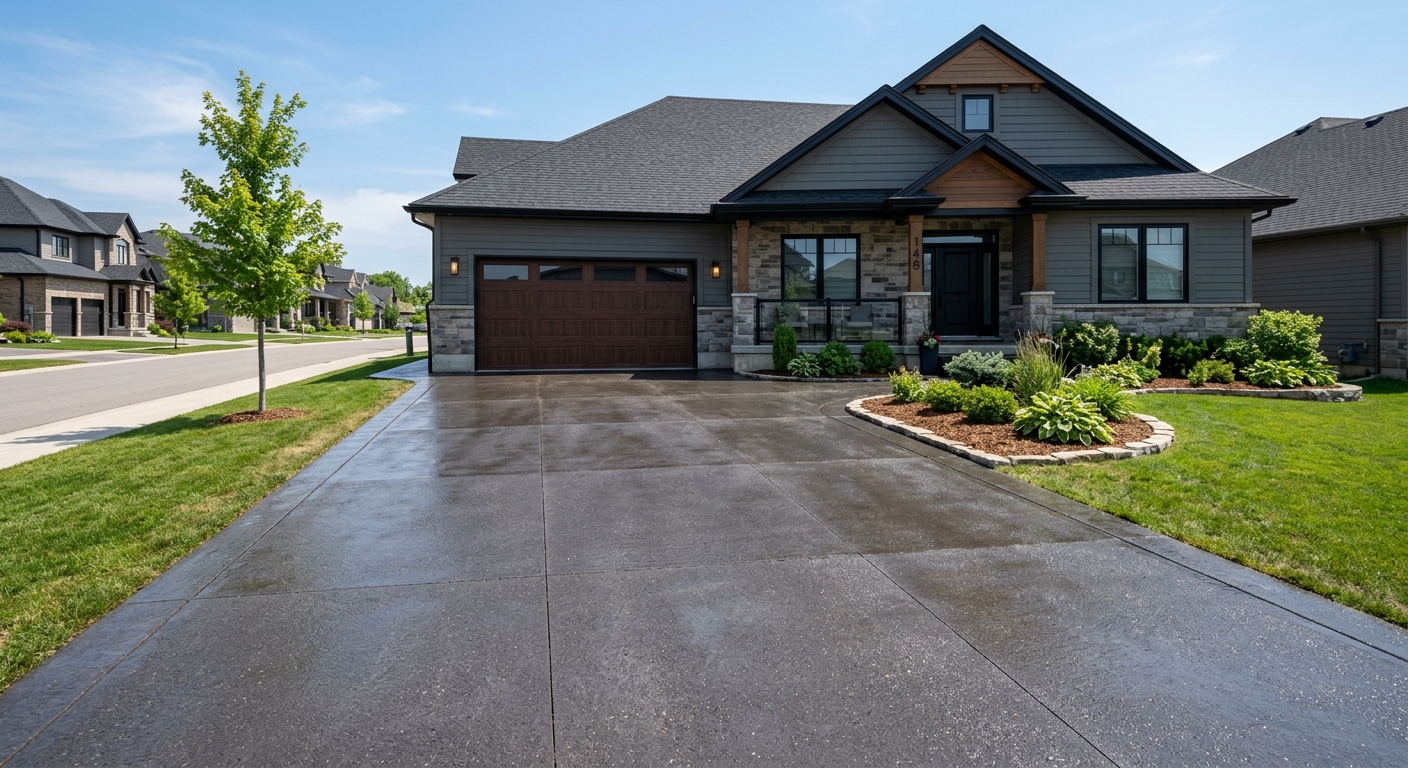
In Leger proper, demand is often especially high around family-focused streets near local school and park corridors—areas where homeowners commonly upgrade driveways, add rear patios, or replace older slabs before thaw season. If you’re weighing options, the table below compares typical scope, finishes, and realistic price bands for this tier in Leger.
| Application |
Typical Size |
Key Spec |
Finish Option |
Price Range |
| Concrete driveway (standard broom finish) |
10 m x 3 m (about 30 m²) |
Air-entrained exterior mix, control joints, compacted granular base |
Broom finish with edges and expansion allowance |
$12,000–$18,000 |
| Exposed aggregate driveway |
10 m x 3 m (about 30 m²) |
Air-entrained mix, proper curing, joint layout to control cracking |
Exposed aggregate (surface wash/delamination process) |
$14,000–$20,500 |
| Stamped concrete driveway or patio |
8 m x 3 m (about 24 m²) |
Air-entrained exterior mix, integral colour, release agent and seal |
Stamped pattern (e.g., ashlar/stone) with protective sealer |
$15,000–$26,000 |
| Plain concrete patio or walkway |
6 m x 3 m (about 18 m²) |
Air-entrained mix, compacted base, control joints as required |
Float/straightedge with light broom or scored lines |
$5,000–$9,000 |
| Garage floor (interior slab) |
7 m x 6 m (about 42 m²) |
Vapour barrier where required, reinforcement/wire mesh depending on design |
Broom finish or light trowel (durable for light storage) |
$9,000–$15,500 |
| Foundation footings (structural, below frost) |
Typical house perimeter (engineered) |
Excavation to frost depth (~1.2 m), rebar cage, engineered concrete |
Structural finish (not decorative) |
$28,000–$45,000 |
Prices are estimates only and vary by project scope, site access and material selection.
What affects the price of concrete work in Leger
In Leger and across the Calgary economic region, the same “driveway replacement” can land anywhere from a solid baseline to a noticeably higher total—often 30–50%—because the cost is driven less by concrete alone and more by excavation depth, base preparation, engineering details, and how the contractor protects curing. In cold continental winters, your contractor isn’t guessing; they’re following a frost-depth-driven design mindset. For the area, design frost depth is about 1.2 m (roughly 4 ft). That means footings for structures bearing on soil must extend below that depth to avoid frost heave and seasonal movement. Exterior slabs also need air-entrained concrete mixes to survive repeated freeze–thaw cycles, with fewer shortcuts possible without risking scaling and spalling.
Labour availability can also sway pricing. When the pour season tightens, crews that can reliably place and cure cold-weather concrete (blankets, heat, and scheduling discipline) are booked. That’s why a standard broom-finished driveway often fits the $12,000–$18,000 tier, while stamped or decorative work jumps into the $15,000–$26,000 band—not just because of stamp labour, but because colour, release systems, and sealing steps require consistent execution and extra time.
Two or three Leger-specific examples: if your site has heavy clay or is close to existing landscaping, excavation and granular base replacement can add days. If de-icing salt exposure is high (common on front entrances and sloped approaches), sealing becomes more critical, and skipping it leads to faster surface deterioration. If you need footings below frost or additional reinforcement, foundation work aligns to the $28,000–$45,000 footing band, not the flatterwork pricing.
| Price Factor |
Why It Matters |
Cost Impact |
| Frost line depth — determines footing depth and form height |
Footings must bear below about 1.2 m to reduce frost heave risk |
Higher excavation and formwork; can materially push foundation/footing totals |
| Site preparation — excavation, grading, compacted granular base |
Base thickness and compaction control settlement and cracking |
Extra trucking, equipment time, and labour if soils are unsuitable or access is tight |
| Reinforcement — rebar or wire mesh requirement |
Controls cracking and supports loads; depends on design and thickness |
Material and placement labour; underestimated reinforcement is a common failure point |
| Mix design — air-entrainment and compressive strength spec |
Air entrainment improves freeze–thaw durability; strength supports structural performance |
“Cheaper mix” can reduce upfront cost but increases long-term scaling/spalling risk |
| Finish type — broom vs. stamped vs. exposed aggregate |
Complex finishes require more steps, tools, and curing discipline |
Decorative pours commonly move you from ~$12,000–$18,000 into ~$15,000–$26,000 territory |
| Pour size and concrete truck access to site |
Access affects pumping/telebelt needs and pour sequencing |
Long carries or limited access increase labour and equipment costs |
| Cold-weather curing precautions — heating and blankets |
Maintains curing conditions during Alberta temperature swings |
Adds temporary heat/blankets and monitoring; can be significant outside peak season |
| Control joint pattern and sealing cost |
Joints limit random cracking; sealers reduce salt-driven surface damage |
More saw-cutting labour and product cost; worth it on exterior salt exposure |
Permits & regulations in Alberta
In Alberta, structural concrete work is typically not “DIY permit-free.” For Leger homeowners, any concrete involved in supporting the building—such as foundation footings, foundation walls, grade beams, and other structural elements—usually requires a building permit and often engineered drawings that the municipality reviews as part of the permitting process. Concrete flatwork (patios, walkways, driveways) typically does not require a permit by default, unless it affects lot grading, impervious surface coverage limits, or the municipal right-of-way. The safest approach is to confirm before excavation, especially if you’re changing drainage patterns or tying into existing curbs/sidewalks.
Here’s a practical step-by-step way to verify your contractor in Alberta:
- Ask for their business licence number and confirm they operate in Alberta (many contractors share this on estimates and invoices).
- Request proof of liability insurance (certificate of insurance). Make sure the coverage amount is high enough for the job size.
- Confirm worker coverage for site labour through WSIB/WCB documentation (they should be able to provide current proof).
- Request a clearance letter if you’re told they’re “registered” but the proof hasn’t been recently updated.
- Check references on comparable-scale projects in the Calgary area—especially exterior flatwork exposed to de-icing salts.
Also, verify who is responsible for permitting and inspections if any structural permit is required. A professional quote should clearly state what’s included versus excluded.
Getting concrete right in Leger's freeze-thaw climate
Concrete failures in Leger are usually predictable: inadequate base preparation, missing air-entrainment, poor jointing, and rushed curing. In Calgary’s cold continental climate, freeze–thaw cycles can pull moisture into the slab, then expand it as temperatures drop—leading to scaling, spalling, and widening cracks. The spec should start with base preparation: compacted granular sub-base to the proper depth for local soil and frost performance. Next, the mix design must include air-entrainment—typically 5–7% air content for exterior flatwork—and it should meet a minimum compressive strength target such as 32 MPa (per typical exterior performance specs). Third, control joints must be cut/placed to limit random cracking; they’re not cosmetic—they’re a cracking strategy.
Curing is where many problems are born in late-season work. In Alberta, a minimum 7-day curing period under appropriate conditions is key, and when it’s cold you may need insulated blankets or temporary heat so the concrete gains strength without surface damage. Finally, sealing matters: apply a penetrating sealer after the cure period (commonly around 28 days post-pour) to reduce de-icing salt-driven surface wear.
When you ask the right questions, you prevent the most common Leger issue: spalling caused by inadequate air-entrainment or weak curing. For example, if two driveway quotes differ by only a few thousand dollars but one includes air entrainment documentation and cold-weather curing precautions while the other doesn’t, the “cheaper” option often costs more later—repairs and rework are rarely priced lower than the original driveway tier of $12,000–$18,000.
| Spec |
Why It Matters in Leger |
What to Ask For |
Impact if Skipped |
| Compacted granular base (depth?) |
Controls settlement and provides frost-resistant support |
Confirm the base depth and compaction standard for your soil conditions |
Cracking, uneven settlement, and early slab failure |
| Air-entrained concrete mix (target air %?) |
Improves freeze–thaw durability in Alberta winters |
Ask for target air content (typically 5–7% for exterior flatwork) |
Surface scaling/spalling; faster deterioration under salt |
| Compressive strength (MPa rating) |
Ensures durability and load capacity |
Confirm minimum 32 MPa for exterior applications (as specified) |
Reduced performance and premature wear or cracking |
| Control joints (spacing per ACI guidelines) |
Controls crack locations during freeze–thaw movement |
Ask for joint spacing plan and saw-cut timing approach |
Random cracking and wider defects that invite moisture |
| Minimum 7-day curing period |
Curing strength gain reduces surface and structural issues |
Ask how cold weather affects curing and what protection is used |
Surface damage, scaling, and long-term strength issues |
| Penetrating sealer (when applied after cure) |
Helps repel salt and moisture from freeze–thaw exposure |
Confirm application timing (commonly ~28 days post-pour) and product type |
Faster surface breakdown and more visible spalling over time |
How to choose a concrete work contractor in Leger
Choosing the right contractor matters a lot in Leger because cold-weather placement and freeze–thaw durability are spec-driven. Start by verifying Alberta coverage: request their liability insurance certificate and confirm current WSIB/WCB coverage for workers. If the contractor says they’re “covered,” ask to see the certificate or clearance letter—don’t rely on verbal assurance. Then confirm licensing/business standing details they provide for work in Alberta.
Next, get 2–3 itemised written quotes. You want labour and materials broken down (excavation, granular base, rebar/wire mesh, concrete supply, finishing, saw-cutting, sealing, disposal). A quote should clearly list exclusions such as: removal and disposal of old concrete, grading/draintie-in scope, permit handling (if any), and whether snow/overburden cleanup is included.
Pay attention to warranty and documentation. A workmanship warranty should be in writing (and ideally specify what’s covered and for how long). Ask about product/manufacturer warranty too—and whether any parts of it are transferable if you sell your home. For payment scheduling, avoid large up-front payments: commonly, never more than 10–15% upfront, and hold back a portion until the work is complete and any finish/sealing is delivered. Finally, request a written start date and completion estimate so you can see if weather protection plan exists for cold pours.
- Ask what air content and curing protection they plan for (blankets/heat if needed).
- Require a base preparation description (depth and compaction approach).
- Confirm whether joints are included (and who performs saw cuts).
- Get reinforcement details (wire mesh vs. rebar, thickness assumptions).
- Ensure sealing is clearly listed for exterior slabs (product and timing).
- Check whether old concrete demo and disposal are included.
- Verify access plan for concrete trucks (pumping/telebelt, if required).
- Confirm who handles permits and inspections if structural concrete is involved.
- Request proof of liability insurance and WSIB/WCB before the first deposit.
- Use an itemised quote, not just a single lump-sum number.
- Confirm warranty terms in writing and what triggers a warranty call-back.
- Review payment milestones tied to completed stages—not just “start/end.”
Concrete red flags I see in Leger include: quotes that don’t mention air-entrainment or curing for exterior slabs, vague base specifications (“we’ll prep it properly” without depth/compaction), missing joint plans or no commitment to saw-cut timing, skipping sealer where salt exposure is unavoidable, and refusing to provide insurance/WSIB/WCB proof or clear warranty terms.
Frequently asked questions — concrete work in Leger
What causes concrete to spall in Leger winters?
Spalling in Leger winters is usually tied to moisture getting into the concrete and then expanding during freeze–thaw cycles. The big driver is often inadequate air-entrainment (or air-entrainment that isn’t actually targeted), which prevents the concrete from handling internal freezing pressure. Salt exposure from de-icing worsens the problem by accelerating surface breakdown, especially on driveways and steps where meltwater sits. Another common cause is weak curing in cold snaps—if the concrete doesn’t gain strength properly, the surface can scale and later flake. Finally, poor base prep and inconsistent control joints allow cracks to form randomly, giving water a pathway. If your slab is already failing, a good contractor will assess mix history, jointing pattern, and whether sealing was ever applied after cure (often around 28 days).
What is rebar and when is it required in Alberta?
Rebar is steel reinforcing bar used inside concrete to control cracking and improve load capacity. In Alberta, whether rebar is required depends on the structural design, slab thickness, soil conditions, and the loads the concrete will carry. For foundation footings, foundation walls, and grade beams, rebar is commonly used because those elements must meet structural performance requirements below frost depth (about 1.2 m in this region). For interior slabs and some flatwork, reinforcement may be specified by engineering or by the contractor’s design assumptions. A proper quote should state the thickness, reinforcement type (wire mesh versus rebar), spacing, and cover. If the quote is silent on reinforcement for a higher-load slab (or for exterior slabs in a harsh freeze–thaw environment), ask directly—skipping reinforcement or cover can reduce durability and increase crack risk.
How long does a concrete project take in Leger?
The total timeline in Leger depends on the scope and weather. For a typical exterior flatwork project, the “active work” (demo, excavation, base, pour, finishing, and early curing) might take a few days, but the full service life depends on proper curing. Many crews plan around the minimum 7-day curing requirement, and they schedule sealing only after the cure period (commonly around 28 days post-pour). Cold-weather conditions can extend schedules because blankets/heating and protected curing are needed to reach strength safely. If your driveway is in the higher-demand portion of the season, you might also wait for crew availability. As a budgeting anchor, a standard driveway often sits in the $12,000–$18,000 tier, but the timeline can still vary widely based on truck access, excavation depth, and whether control joints and sealing are included.
What is a concrete overlay and is it suited to Leger?
A concrete overlay is a new concrete layer placed over an existing slab after surface prep. It can be suited to Leger when the existing concrete is structurally sound (not heavily cracked through, not lifting due to frost, and with a surface that can be properly bonded). However, overlay works best when the base has been stable—if the original slab is failing due to frost heave, inadequate base, or widespread moisture entry, an overlay may only delay the inevitable. In Calgary-area freeze–thaw, the overlay still needs the right mix design, air entrainment, and joint strategy to reduce cracking and spalling. If de-icing salts are heavily used, sealing is also important. Before choosing overlay, ask for an assessment of subgrade conditions, drainage, and crack movement—then confirm whether the contractor is specifying a cold-weather and curing plan appropriate for Alberta winters.
How do I seal concrete to protect it in Leger?
Sealing in Leger should be planned after the concrete has cured. A common approach is to apply a penetrating sealer about 28 days after the pour (timing can vary with product and conditions). Penetrating sealers help repel water and reduce salt-driven surface damage by limiting moisture movement into the slab. Before sealing, the surface should be clean and fully cured; applying too early or over dirty surfaces reduces performance. In freeze–thaw climates, sealing complements—rather than replaces—proper air-entrained mix, control joints, and cold-weather curing. For driveway and walkway projects, ask your contractor to include sealing in the scope and specify the product type. If your quote is only focused on the pour and finishing, you may want to confirm whether sealing is actually included, especially if you regularly use de-icing salt.
What is the difference between concrete and cement?
Concrete is the final building material you see in the slab—cement plus water plus aggregates (sand and gravel), and often admixtures like air-entrainment for freeze–thaw durability. Cement is one ingredient inside concrete: it’s the powder that reacts with water to form the binding paste that holds everything together. In Alberta, the concrete performance you care about—like freeze–thaw resistance—comes from the whole mix design, not just the cement type. That’s why your contractor should talk about air entrainment (often 5–7% for exterior flatwork), strength targets (commonly a minimum around 32 MPa for exterior applications), and curing methods for the Calgary winter environment. When quotes only mention “cement” without discussing the full concrete mix and curing plan, that’s a sign to ask more questions—because the spec is what keeps driveways and patios from spalling over time.