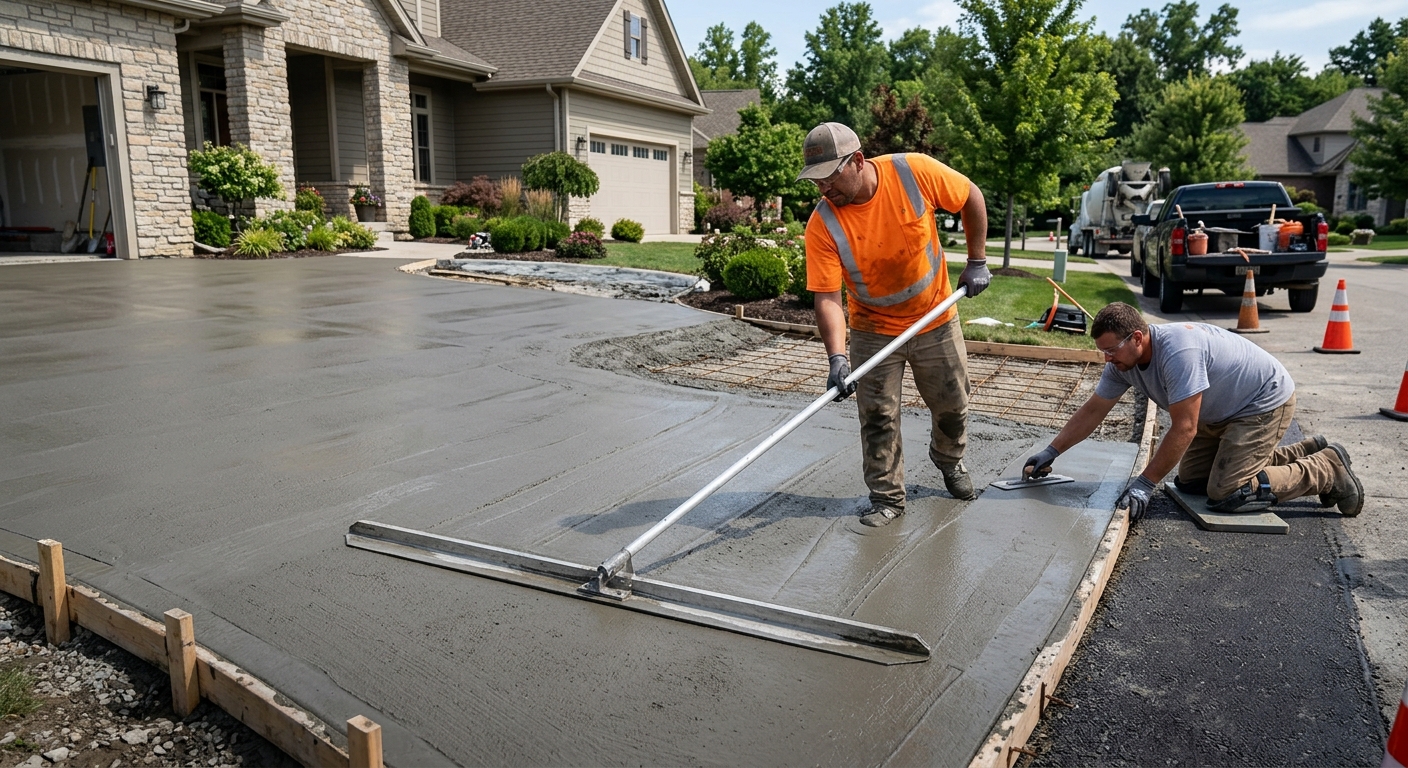
Concrete work options and costs in Westgate
Westgate, Alberta has a steady demand for concrete flatwork because most homes in the area are single-detached, and that drives regular projects like driveways, patios, and walkways. In the Calgary economic region, Westgate’s population was 3,225 in the 2021 Census (Statistics Canada, 2021 Census). That household mix and the pace of development mean contractors are busy—especially when weather allows exterior pours. Costs in this neighbourhood are also shaped by Calgary’s cold continental winters: concrete is engineered around deep frost depth, freeze–thaw cycling, and the need for reliable curing. In practice, that means more excavation, properly compacted granular base, air-entrained mixes, and tighter sequencing on site so the slab stays workable, placed correctly, and cured long enough to resist scaling.
In Westgate, demand is especially strong near established residential pockets along local frontage where homeowners are upgrading older driveways and front steps ahead of winter. You’ll usually see the biggest pricing differences between standard broom-finished concrete and premium options like exposed aggregate or stamped work, because those finishes require denser surface prep, specialized mixes and finishing crews. Foundation work is priced higher than flatwork for one simple reason: footings must bear on undisturbed soil below the design frost depth to limit seasonal movement. With engineered frost depth practices in Alberta (often up to around 2.4 m), foundation scopes are labour- and excavation-intensive—so they cost more than in regions with shallower frost penetration.
The table below compares common concrete options and realistic price bands you can expect when booking work in Westgate, including what typically changes the number from one quote to another.
| Application |
Typical Size |
Key Spec |
Finish Option |
Price Range |
| Concrete driveway (standard broom finish) |
400–500 sq. ft. |
Air-entrained mix, compacted granular base |
Broom finish, control joints |
$12,000–$18,000 |
| Exposed aggregate driveway |
400–500 sq. ft. |
Air-entrained mix, colour/aggregate selection |
Exposed aggregate with sealer |
$15,000–$22,000 |
| Stamped concrete driveway or patio |
300–450 sq. ft. |
Air-entrained mix, reinforced slab as needed |
Stamped pattern with release + sealing |
$15,000–$26,000 |
| Plain concrete patio or walkway |
200–350 sq. ft. |
Air-entrained mix, compacted base, slope |
Float + light broom or trowel-broom |
$5,000–$9,000 |
| Garage floor (interior slab) |
500–650 sq. ft. |
Vapour barrier (if required), reinforced slab |
Standard finish, saw-cut joints |
$9,500–$15,500 |
| Foundation footings (structural, below frost) |
Per engineered house footprint |
Excavation + reinforced footings to frost depth |
Structural concrete (engineered spec) |
$28,000–$45,000 |
Prices are estimates only and vary by project scope, site access and material selection.
What affects the price of concrete work in Westgate
In Westgate and across Calgary, quotes for the “same” concrete job can swing by 30–50% because the concrete price is only part of the total scope. Excavation depth, how much granular base is required, how much reinforcement is specified, and whether winter curing measures are needed can change labour and material costs fast. In colder markets like Calgary, the design frost depth is engineered around frost and freeze–thaw more than in milder provinces—so footings often must extend below the design frost depth (up to around 2.4 m in Alberta) to prevent frost heave. On top of that, exterior slabs generally require air-entrained concrete to survive repeated freeze–thaw cycles, and joints must be spaced and sealed to control cracking and spalling. The pour season is also tighter: if crews are forced into late fall or early spring work, you may see add-ons for cold-weather curing like insulated blankets or temporary heat to keep curing reliable.
De-icing salts accelerate surface breakdown, so sealing becomes more than an aesthetic decision; it can protect your driveway or patio from roughening and scaling. For a homeowner, that protection has a direct cost: a standard broom-finish driveway is typically within the $12,000–$18,000 band, while premium stamped or exposed aggregate options often move into the $15,000–$26,000 range because finishing labour and materials are higher. For example, a typical 400–500 sq. ft. driveway may look similar on paper, but if one contractor prices a properly deep, well-compacted granular base and includes air-entrainment and sealing, that quote is usually the one that holds up through Westgate winters.
Cost can also go down when the site is straightforward: clean access for a concrete truck, minimal tree/root conflicts, and stable soil conditions. Conversely, if foundation work requires deeper excavation than expected or if granular base is increased to reach proper compaction, the project can climb quickly—especially when the frost line pushes footing depth upward, increasing both formwork height and concrete volume.
| Price Factor |
Why It Matters |
Cost Impact |
| Frost line depth — determines footing depth and form height |
Footings must bear below design frost to limit heave |
Major increase to excavation + concrete volume |
| Site preparation — excavation, grading, compacted granular base |
Proper base reduces settlement and voids under slabs |
Moderate-to-major variation depending on soil/access |
| Reinforcement — rebar or wire mesh requirement |
Controls cracking and supports loads for exterior use |
Materials + labour increase for heavier reinforcement |
| Mix design — air-entrainment and compressive strength spec |
Air-entrainment reduces freeze–thaw damage |
Higher-spec mix can raise costs, usually worth it |
| Finish type — broom vs. stamped vs. exposed aggregate |
Finishing steps and specialty materials differ |
Premium finishes typically cost more per square foot |
| Pour size and concrete truck access to site |
Smaller access limits can require pumping/extra labour |
Can add labour costs and extend crew time |
| Cold-weather curing precautions — heating and blankets |
Reliable curing prevents scaling and strength loss |
Can add day-rate and material rental costs |
| Control joint pattern and sealing cost |
Joints manage cracking; sealing protects from salts |
Small line items that prevent costly failures later |
Permits & regulations in Alberta
In Alberta, structural concrete work—like foundation footings, foundation walls, and grade beams—typically requires a building permit and, in many cases, engineered drawings that the municipality reviews as part of the permitting process. Concrete flatwork (driveways, patios, and walkways) usually does not need a permit by itself, but it can trigger requirements if it affects lot grading, drainage, or impervious surface coverage limits, or if work touches municipal right-of-way considerations. The safest approach in Westgate is to confirm with the local authority before breaking ground, particularly when you’re changing slopes near the foundation or altering how water drains off the property.
Before you hire anyone, verify your contractor’s coverage and professionalism. Step one: ask for their certificate of insurance and confirm liability coverage is current and matches the project scope. Step two: request proof of WSIB/WCB coverage (as applicable to the contractor’s operating setup) so you’re not exposed to uninsured injuries or workplace claims. Step three: check references for similar-scale projects in the Calgary area—especially jobs that involve exterior slabs exposed to de-icing salts and freeze–thaw. Step four: confirm the contractor provides itemized scope details (base prep, reinforcement, mix design, finishing, sealing, and winter curing measures when needed).
For licensing, use Alberta’s online registry resources and look for the specific trade/contracting authorization that applies to their work, then match the company name on their insurance certificate to what you see online. Clearance letters (where used for certain records) should align with the contractor’s legal entity name.
Getting concrete right in Westgate's freeze-thaw climate
Concrete failures in Westgate usually come down to one thing: water and freeze–thaw acting on weak points—poor base preparation, inadequate air-entrainment, missing or poorly spaced control joints, or rushing curing. Calgary’s deep frost environment (with design frost depth practices often around the 1.2 m range conceptually, and higher practical excavation depths in Alberta) means footings and exterior slab systems have to be built to perform through seasonal movement. For flatwork like driveways and patios, the spec starts with the base: compacted granular sub-base at the correct depth for local soil and frost performance, with proper grading so water drains away from the foundation.
Next is the mix. Exterior slabs should use air-entrained concrete (often 5–7% air content for exposure conditions) and a minimum compressive strength commonly around 32 MPa so the concrete can tolerate thermal cycling and de-icing salt exposure. Control joints are not optional “extras”; they’re how you limit random cracking by giving the slab planned locations to crack. Curing matters even more in this region: plan for minimum 7-day curing under proper conditions, and if conditions are cold, curing may require insulation blankets and sometimes temporary heat to keep temperatures in the acceptable range for strength gain. Finally, apply a penetrating sealer 28 days after the pour to repel de-icing salts and reduce surface scaling.
Here’s where price differences make sense. A broom-finish patio might fall in the $5,000–$9,000 band, but if a contractor cuts corners on base compaction or air-entrainment, you can end up paying twice—repairs and patching usually start appearing within a couple winters. Spending for correct base, proper mix, and sealing is the “insurance” that protects your investment.
| Spec |
Why It Matters in Westgate |
What to Ask For |
Impact if Skipped |
| Compacted granular base (depth?) |
Reduces settlement and frost-related movement under slabs |
Granular base type and target compaction; confirmed depth on your slope/soil |
Cracking, unevenness, and premature spalling |
| Air-entrained concrete mix (target air %?) |
Helps concrete resist freeze–thaw damage |
Specified air content (typical 5–7% for exterior flatwork) |
Higher risk of surface scaling and long-term deterioration |
| Compressive strength (MPa rating) |
Strength supports loads and improves durability |
Minimum 32 MPa at specified test age |
Reduced performance and possible early surface failure |
| Control joints (spacing per ACI guidelines) |
Controls where cracks occur under thermal movement |
Planned joint layout and saw-cut timing; confirm spacing target |
Random cracking, wider cracks, water intrusion |
| Minimum 7-day curing period |
Strength gain requires consistent curing conditions |
Curing plan for your pour weather (cold-weather blankets/heating if required) |
Weak surface, scaling, reduced durability in Westgate winters |
| Penetrating sealer (when applied after cure) |
Reduces salt and moisture penetration from winter maintenance |
Confirm sealer type and schedule (applied after cure, typically 28 days post-pour) |
Faster roughening, patching, and need for earlier maintenance |
How to choose a concrete work contractor in Westgate
Choosing the right contractor in Westgate is mostly about verification and clarity. Start with Alberta licensing: use the relevant online registry and confirm the contractor’s legal entity matches the company on the quote. Next, verify liability insurance—ask for a certificate of insurance showing coverage limits and the project address or project type. Then check WSIB/WCB coverage: request proof appropriate to their work arrangements so you’re not exposed if an incident happens on your site. If anything doesn’t line up (company name mismatch, expired documents, or unclear coverage), treat it as a red flag and request corrections before work begins.
Then get 2–3 itemised written quotes. A good concrete quote breaks out labour and materials and clearly lists what’s included: excavation and disposal, compacted granular base, reinforcement (if needed), concrete mix design, finishing method, curing approach, sealing, and joint layout. Avoid comparing only the “bottom line” number—compare the inclusions. Confirm whether a permit pull (for the structural scope) is handled and what the contractor expects from you. Ask if subgrade testing or additional excavation is allowed for contingency, rather than surprises later.
Warranty should be in writing: a workmanship warranty length, product/manufacturer warranty terms, and whether the warranty is transferable if you sell the home. Payment scheduling should be conservative—never more than about 10–15% upfront—and use a holdback until key items are complete. Finally, insist on a written timeline with start date and completion estimate so you’re not left waiting through freeze–thaw delays.
- Confirm Alberta trade/contracting authorization matches the quote and the insurance certificate.
- Verify liability insurance is current and appropriately limits risk for your project.
- Request WSIB/WCB proof suitable to their operational structure.
- Ask for references from similar Calgary-area freeze–thaw exterior pours.
- Require an itemised quote (base prep, reinforcement, mix, finishing, sealing, disposal).
- Confirm whether site access affects truck placement or requires pumping.
- Check if the quote includes winter-grade curing measures when applicable.
- Ask for joint layout details: spacing and whether joints are saw-cut or formed.
- Confirm concrete mix spec: air-entrainment and minimum strength rating.
- Clarify curing plan and the minimum 7-day curing expectation.
- Review warranty terms for workmanship and product coverage, including transferability.
- Use a payment schedule with a holdback until completion and cleanup.
In Westgate, common contractor red flags include: vague scopes that don’t mention air-entrainment or curing; quotes that exclude sealing despite de-icing salt exposure; pushing you into a late-season pour with no cold-weather plan; and refusing to provide proof of insurance/WSIB/WCB or written start/completion dates.
Frequently asked questions — concrete work in Westgate
How deep must footings be for Westgate's frost line?
For Westgate, footing depth is determined by design frost depth requirements and your specific site conditions, so it’s not a single “one size fits all” number. In Alberta practice, the design frost depth is deeper than in many warmer regions, which is why footing excavations are often more intensive and foundation costs higher than you might see elsewhere. Contractors and engineers typically base footing elevations on the design frost depth concept and local geotechnical recommendations, then set the bottom of footings on undisturbed soil below that requirement to prevent frost heave and seasonal movement. In practical terms, you should expect significant excavation and form height when frost depth requirements govern the foundation. If someone quotes foundation work without clearly referencing how frost depth and soil bearing are handled, ask for the engineered specification and footing elevation details before signing.
Why does concrete crack in Westgate and how is it prevented?
Concrete cracks in Westgate largely because it’s exposed to repeated freeze–thaw cycles, temperature swings, and seasonal movement—plus normal shrinkage as concrete cures. Cracking doesn’t always mean failure, but it becomes a durability problem when cracks are uncontrolled and allow water to get in, which then contributes to spalling. Prevention starts with correct base preparation and compaction, using the right air-entrained concrete mix for freeze–thaw exposure, and installing control joints at a planned pattern so the slab cracks where you intend. Curing quality also matters: rushing curing in cold weather raises the risk of surface scaling. Finally, sealing helps protect the surface from de-icing salt. When you compare quotes for driveways in the $12,000–$18,000 range, ensure they both include air-entrainment, joint layout, and proper curing—those are the items that reduce ugly, early cracking.
Stamped vs broom-finish concrete — cost difference?
Stamped concrete costs more than broom-finish because it requires additional finishing steps and specialized materials. A broom-finished exterior driveway typically lands in the $12,000–$18,000 band, assuming a typical size and proper base prep for Calgary-area freeze–thaw performance. Stamped concrete driveway or patio work usually falls higher—often in the $15,000–$26,000 range—because crews need to place and stamp in tight timing, manage release materials and pattern alignment, and then seal correctly for durability in Alberta winters. The best value choice depends on how you’ll use the space and how much you care about appearance. If your goal is long-term performance with simple maintenance, broom finish can be a strong choice. If you want curb appeal, stamped can be justified, but only when the base compaction, air-entrainment, joint spacing, and curing plan are treated as non-negotiables.
When is the best time to pour concrete in Westgate?
The best time to pour concrete in Westgate is when temperatures stay within a range that allows the concrete to be placed and cured reliably—because curing quality drives durability through winter. In Calgary-area winters, the risk isn’t just the pour day; it’s whether the concrete stays warm enough for proper strength gain in the first days. Late fall and early spring can still work, but only if cold-weather curing is planned: insulated blankets and, in some cases, temporary heating. Otherwise, you increase the chance of surface scaling and long-term problems like roughening and reduced strength. Your contractor should talk about curing protection and the expected minimum 7-day curing period, not just the calendar date. If your schedule lands in colder weeks, ask how they’ll maintain curing conditions and what products they use.
How long does concrete take to cure?
Concrete generally needs at least 7 days to cure properly for many performance milestones, but “cure time” isn’t just one number—it depends on temperature, mix design, and whether cold-weather protection is used. For Westgate exterior flatwork, the critical window is the first week because freeze–thaw exposure can begin quickly once temperatures drop, especially if curing is insufficient. Many contractors follow a minimum 7-day curing expectation under proper conditions to ensure strength gain. Then, for sealing, penetrating sealers are typically applied after the concrete has cured fully enough—often around 28 days post-pour—so the surface can accept the sealer and perform well against de-icing salts. If you’re comparing options, make sure quotes don’t treat curing as optional. A driveway in the $12,000–$18,000 band can fail early if the curing plan is weak, so ask what will be done to keep the slab curing reliably.
Do I need a permit for concrete work in Alberta?
In Alberta, structural concrete work—like foundation footings, foundation walls, and grade beams—usually requires a building permit and often engineered drawings reviewed by the municipality. Concrete flatwork such as patios, walkways, and driveways often does not need a permit by itself, but it can if your work affects lot grading, drainage, impervious surface limits, or touches municipal right-of-way considerations. In Westgate, that means the “need” can depend on what you’re changing around the house and how water will drain after the pour. Before you dig, confirm the requirement with the local authority and ask your contractor how permits are handled for the structural scope. Also verify the contractor has liability insurance and WSIB/WCB coverage and that their scope clearly states what’s included (including excavation/disposal and any permit-related steps where applicable).