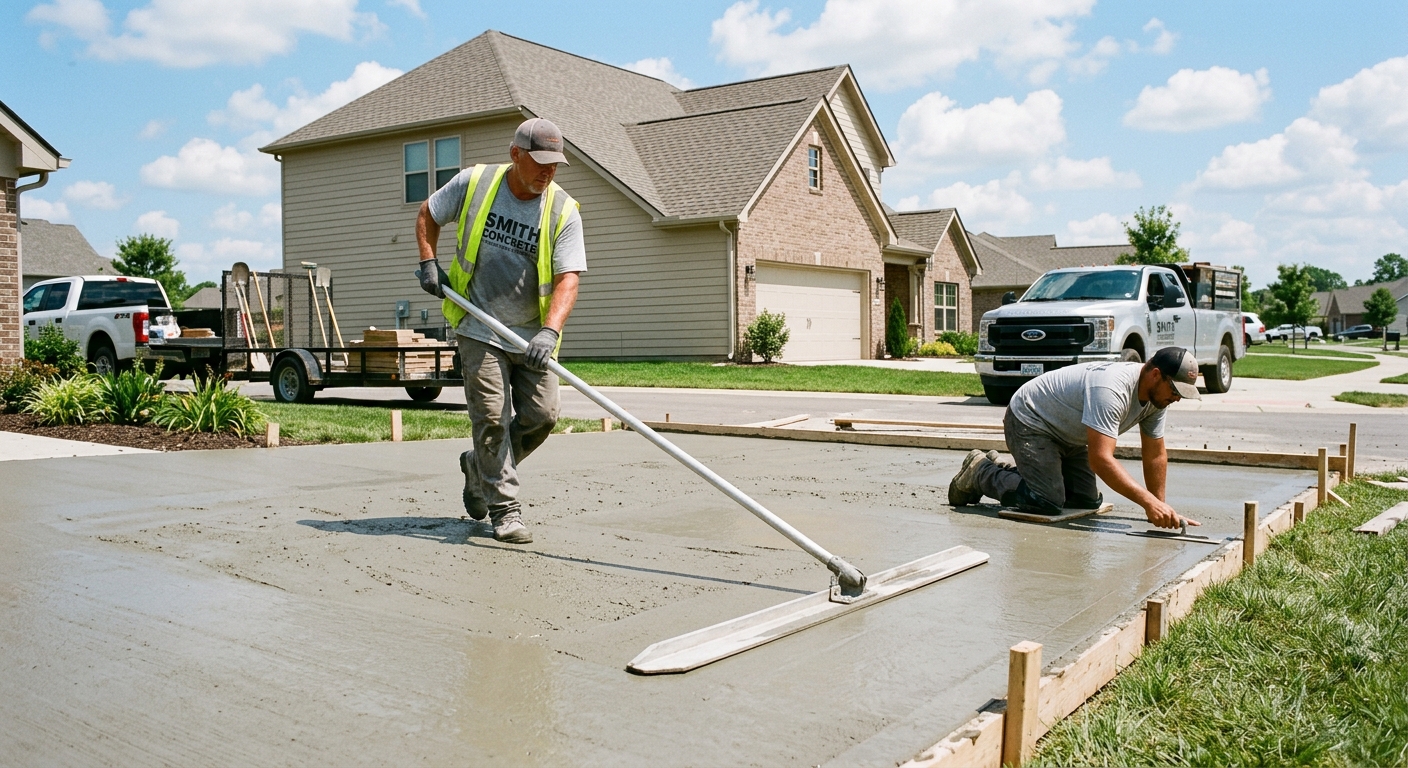
Concrete work options and costs in Midnapore
Midnapore, Alberta is a great place for long-lasting concrete flatwork, but it’s also a place where the climate drives the details. With a Midnapore population of 6,480 (Statistics Canada, 2021 Census), there’s steady demand from homeowners and builders for driveways, patios and walkways—especially in newer pockets where lots are still being finalized. In the Calgary area, most concrete flatwork is built for typical family lots, commonly alongside single-detached homes, garages, and rear-yard access that needs a durable surface. That means contractors are busy around landscaping season, and pricing reflects both labour availability and the engineering demands of a cold continental freeze–thaw cycle.
Calgary’s conditions are different from milder provinces: the design frost depth is about 1.2 m (roughly 4 ft), so exterior footings and any frost-sensitive elements must bear on undisturbed soil below that depth. Freeze–thaw also pushes the mix design toward air-entrained concrete, and Calgary crews plan for control joints and proper curing because late-fall and early-spring pours can increase the chance of scaling. On top of that, de-icing salts and snow-clearing add wear—so sealing often becomes part of a sensible long-term plan for driveways and patios.
If you’re seeing widely varying numbers on your quote, you’re not imagining it. A standard broom-finished driveway and a stamped or exposed aggregate job can sit in different labour and material bands. Below is a practical comparison of typical Midnapore scopes and budgets to help you line up apples-to-apples with any contractor you’re considering—starting with a driveway comparison.
| Application |
Typical Size |
Key Spec |
Finish Option |
Price Range |
| Concrete driveway (standard broom finish) |
20 ft x 10 ft (200 sq. ft.) |
Air-entrained, typical 4 in slab, fibreglass/some rebar depending on base |
Broom finish, control joints, edge forms |
$12,000–$18,000 |
| Exposed aggregate driveway |
20 ft x 10 ft (200 sq. ft.) |
Air-entrained mix, exposed surface selection and curing controls |
Exposed aggregate with sealer |
$14,500–$22,000 |
| Stamped concrete driveway or patio |
16 ft x 12 ft (192 sq. ft.) |
Air-entrained mix, stamped system, release agent |
Stamped pattern (field + border options) |
$15,000–$26,000 |
| Plain concrete patio or walkway |
12 ft x 12 ft (144 sq. ft.) |
Air-entrained, proper slope, jointing |
Broom or smooth float finish |
$5,000–$9,000 |
| Garage floor (interior slab) |
20 ft x 22 ft (440 sq. ft.) |
Typically 4 in slab, vapour management as needed |
Broom finish or smooth trowel top |
$7,500–$14,000 |
| Foundation footings (structural, below frost) |
House/garage footprint varies |
Designed frost depth bearing (~1.2 m), rebar cage, engineered sections |
Structural concrete only (no cosmetic finish) |
$28,000–$45,000 |
Prices are estimates only and vary by project scope, site access and material selection.
What affects the price of concrete work in Midnapore
In Midnapore and across the Calgary economic region, two contractors can quote the same general project and still be 30–50% apart. The reason is usually not “who’s more expensive”—it’s what they include. One crew may price only concrete and place time, while the other factors in deeper excavation to reach undisturbed soil below the design frost depth, more granular base, engineered reinforcement, and winter-grade curing precautions. Labour cost also swings because freeze–thaw seasons shorten the window for exterior work and crews get booked earlier.
In Calgary’s cold continental climate, footings and frost-sensitive elements must be placed to bear below the design frost depth (about 1.2 m). That extra depth drives higher foundation volumes and more formwork, which is why foundation/footings often land in the $28,000–$45,000 band. Exterior slabs and flatwork also need air-entrained concrete to manage freeze–thaw cycling, plus a joint layout that reduces random cracking. When pours happen in colder periods, contractors may add insulated blankets, curing compounds, and sometimes temporary heating—costs that aren’t visible when you only compare slab square footage.
De-icing salt is another Calgary reality. It can accelerate surface spalling if the finish quality and curing are rushed, so sealing is commonly recommended after the correct cure period. In a typical Midnapore driveway job (often budgeted around the $12,000–$18,000 range for standard broom finish), the biggest cost drivers are excavation depth, base thickness, drainage prep, and reinforcement decisions based on soil conditions and load requirements.
| Price Factor |
Why It Matters |
Cost Impact |
| Frost line depth — determines footing depth and form height |
Footings must bear below design frost depth to prevent frost heave |
Often increases excavation and concrete volume materially |
| Site preparation — excavation, grading, compacted granular base |
Proper base reduces settlement and supports slab uniformity |
More hauling/compaction can add significant labour |
| Reinforcement — rebar or wire mesh requirement |
Controls cracking and improves load performance |
Material + labour for tying/spacers varies by design |
| Mix design — air-entrainment and compressive strength spec |
Air entrainment supports freeze–thaw resistance |
Higher-spec mix and testing can add per-yard cost |
| Finish type — broom vs. stamped vs. exposed aggregate |
Finishes change labour time, materials and curing/handling |
Stamped/exposed systems typically raise total cost |
| Pour size and concrete truck access to site |
Smaller pours can still require full crew mobilization |
Access constraints can increase labour and wait time |
| Cold-weather curing precautions — heating and blankets |
Achieves proper early strength in freeze conditions |
Special equipment and slower progress can add cost |
| Control joint pattern and sealing cost |
Joints manage shrinkage and sealing reduces salt damage |
Skipping or under-spec’ing can reduce upfront cost, but increases failure risk |
Permits & regulations in Alberta
In Alberta, it’s common for homeowners to ask whether concrete needs a permit—and the answer depends on what you’re building. In most cases in Midnapore, concrete work that changes the structure or supports a structure does require a building permit. That typically includes foundation footings, foundation walls, grade beams, and any structural concrete intended to carry loads. For those jobs, engineered drawings are often reviewed as part of the permit process, and municipalities may require specific inspections at key stages (for example, after excavation and before pour, and sometimes after rebar placement).
Conversely, standard concrete flatwork—patios, walkways, driveways—typically does not require a permit unless it affects lot grading, stormwater/lot drainage patterns, impervious surface coverage limits, or ties into municipal right-of-way requirements. Even when a permit isn’t usually required, it’s still smart to confirm with your local authority before breaking ground, especially if you’re altering drainage slopes or working near property line boundaries.
Before work starts, verify your contractor is properly covered. Ask for a liability insurance certificate showing your name/job address as applicable, and confirm they have Alberta workplace coverage (commonly WSIB/WCB as applicable to their trade and payroll). Also request clearance letters or proof of active account standing if they can provide it. Then, check their business credentials using online registries where available, and request references for similar Midnapore projects—driveway and footing jobs with the same frost-depth realities and winter placement constraints.
Getting concrete right in Midnapore's freeze-thaw climate
Concrete in Midnapore faces one main enemy: freeze–thaw plus salts. When water gets under or into a slab and then freezes, expansion pries at the surface and can lead to scaling and spalling. In a Calgary-area cold continental climate with a design frost depth around 1.2 m, failures often trace back to base preparation shortcuts, incorrect mix design, or rushed curing. If you want durability, you spec the system as a whole: base, mix, joints, curing and (later) sealing.
Start with base preparation. Exterior slabs need a compacted granular sub-base placed to the right depth and shape for your site conditions, with drainage slopes correct so surface water doesn’t pond. Next is mix design: for exterior flatwork, require air-entrainment (typically 5–7% air content) and a minimum 32 MPa compressive strength spec, tailored for freeze–thaw exposure. Control joints are not optional—spacing needs to limit random cracking, and joints should be cut/installed at the right time. Then curing matters: you need a minimum 7-day curing period under proper conditions. If you’re pouring near cold weather, you should plan insulated blankets or heat as required so the concrete reaches early strength without damage. Finally, plan sealing: a penetrating sealer is typically applied 28 days after the pour to help repel de-icing salts and reduce moisture intrusion.
Here’s a practical price example. A standard broom driveway might target the $12,000–$18,000 band. Switching to stamped concrete is often the $15,000–$26,000 band, but the biggest difference in longevity usually isn’t the pattern—it’s whether the contractor installed the correct base, used the right air content, cured properly, and sealed when appropriate. A “cheap” stamped job that skips air entrainment or rushes curing can cost more later due to surface breakdown and patch repairs.
| Spec |
Why It Matters in Midnapore |
What to Ask For |
Impact if Skipped |
| Compacted granular base (depth?) |
Prevents settlement and water pumping under slabs in freeze–thaw |
Granular base depth and compaction method per site conditions |
Cracks, rocking, and uneven slab movement |
| Air-entrained concrete mix (target air %?) |
Manages expansion during freezing for exterior durability |
Air-entrained mix with target 5–7% air content for exterior flatwork |
Higher risk of spalling/scaling on driveways and patios |
| Compressive strength (MPa rating) |
Early and long-term strength affects resistance and performance |
Minimum 32 MPa compressive strength (as specified) |
Surface damage, reduced durability and performance under traffic |
| Control joints (spacing per ACI guidelines) |
Controls shrinkage cracking to predictable lines |
Planned joint spacing and method (saw-cut timing or formed joints) |
Random cracking and water paths that accelerate deterioration |
| Minimum 7-day curing period |
Correct early strength development is critical with cold weather |
Minimum 7-day curing with cold-weather protection if needed |
Scaling, surface weakness and long-term cracking |
| Penetrating sealer (when applied after cure) |
Helps reduce moisture/salt penetration in Calgary-area winters |
Penetrating sealer applied about 28 days post-pour |
Faster salt damage and spalling risk |
How to choose a concrete work contractor in Midnapore
Choosing the right contractor for concrete in Midnapore is about proof, not promises—because a freeze–thaw-ready job depends on the details. Start with verification. In Alberta, confirm the contractor’s licensing status where applicable for their trade, and request a certificate of liability insurance for your specific project. Also ask for WSIB/WCB clearance and proof they carry the appropriate workplace coverage for their workers. Don’t accept “we’re covered” without documentation; call the insurer number on the certificate if needed.
Next, get 2–3 itemised written quotes rather than one lump sum. Ask for a labour + materials breakdown: excavation/base prep, concrete supply, reinforcement, forming, finishing labour, any saw-cut jointing, sealing, and disposal/hauling. Confirm whether permits are included when required (not typically for a simple patio, but often for structural foundation work). Clarify what’s excluded: tree/root removal, trucking distance, snow removal during pours, underground drainage adjustments, or any required temporary heating for cold-weather placement.
Warranty should be in writing, with workmanship warranty length and whether it covers cracking, spalling, and joint-related issues. Separate product/manufacturer warranties from labour workmanship. On payment schedule, never pay more than 10–15% upfront; hold back until the job is complete and you’ve confirmed proper curing and finishing. Finally, require a timeline: start date, pour date (or weather contingency), and completion estimate.
- Ask for at least two recent references in the Calgary-area cold climate (driveways/patios and one frost-depth foundation job if available).
- Request a detailed scope: slab thickness, base depth, compaction approach and drainage slope notes.
- Confirm mix design is air-entrained for exterior use and aligned with freeze–thaw requirements.
- Get the reinforcement plan in writing (rebar or mesh type, grade, placement and cover).
- Ask about cold-weather curing: insulated blankets/heating plan if temps drop.
- Require control joint spacing and who is responsible for proper timing (saw-cut vs. formed joints).
- Confirm sealing: whether it’s included, which sealer type, and when it will be applied (commonly after the full cure period).
- Check cleanup and disposal: haul-away of unsuitable soil/old concrete included or not.
- Review site-access constraints: how they handle tight turns, side access and concrete truck placement.
- Ask how they protect neighbouring landscaping and property lines during excavation and curing.
- Insist on a written warranty that distinguishes workmanship vs product claims.
- Set a payment holdback (10–20%) until final inspection and documentation (including curing/record notes if provided).
Concrete contractor red flags in Midnapore: they won’t provide itemised pricing for base prep and reinforcement; they suggest skipping air entrainment to “save money”; they won’t commit to a curing plan or warn you about late-fall/early-spring pour risk; they ask for large upfront payments (well beyond 10–15%); or their warranty is vague and doesn’t address cold-weather performance issues like scaling and cracking control.
Frequently asked questions — concrete work in Midnapore
Do I need a permit for concrete work in Alberta?
In Alberta, structural concrete work typically needs a building permit. That includes foundation footings, foundation walls, and grade beams—anything engineered to carry loads. For Midnapore homeowners, the key is whether the concrete is structural or whether it changes lot grading/drainage. A patio, walkway, or driveway often doesn’t require a permit, unless it affects impervious surface limits, drainage flow, or ties into right-of-way rules. Because requirements can vary with the scope and impact on lot grading, confirm with your local authority before excavation. Also verify your contractor is insured and covered for their workforce, and ask for references on similar jobs done in the Calgary freeze–thaw climate to ensure they spec air-entrainment and curing correctly.
Concrete vs pavers for a patio in Midnapore?
Concrete and pavers both work well in Midnapore, but the trade-offs come down to maintenance and performance in freeze–thaw. Concrete is typically a smooth, monolithic slab that—when built with proper base prep, air-entrained mix, and well-planned control joints—can handle Calgary-area winter cycling reliably. Pavers can be easier to repair one section at a time, but they rely heavily on a well-drained granular base and correct jointing to avoid shifting. In budget terms, a plain concrete patio or walkway usually falls around $5,000–$9,000, while pavers often cost more once you factor in excavation, base materials, and labour. If you expect frequent salt exposure and want fewer joint lines, sealed concrete often wins; if you value modular repairs, pavers may be better.
How long does a concrete driveway last?
A properly built driveway in Midnapore can last decades, but service life depends on the details that fight winter damage. The big factors are base preparation, air-entrained concrete, correct slope and drainage, control joints, and cold-weather curing. If those are done well, a driveway can perform for a long time even with Alberta winters and regular de-icing. If they’re skipped—especially air entrainment or curing—surface scaling and spalling can show up sooner. Budget projects usually cluster around $12,000–$18,000 for standard broom-finish driveways, and higher finishes like stamped concrete are commonly in the $15,000–$26,000 range. Remember: paying more for a finish won’t save a driveway if the mix, base, and curing aren’t built for freeze–thaw.
What is air-entrained concrete and why does it matter here?
Air-entrained concrete is designed with tiny air bubbles in the mix so that when water inside the concrete freezes, there’s space for expansion. In Midnapore and the wider Calgary region, freeze–thaw cycles are frequent, and de-icing salts increase surface wear. Without correct air entrainment, water/ice expansion can break down the surface and lead to spalling and scaling—especially on exterior slabs like driveways and patios. When you’re comparing quotes in Alberta, ask directly: is the concrete air-entrained for exterior use, and what target air content is planned (commonly 5–7% for exterior flatwork)? Ask also about curing. Even air-entrained concrete can underperform if the contractor rushes curing during cold periods.
How do I prepare the base for a concrete slab?
Base prep is where concrete projects are won or lost in Alberta’s freeze–thaw climate. For Midnapore slab work, the contractor should remove unsuitable soil, then place a compacted granular sub-base to the correct depth for the site. The depth and thickness depend on frost considerations and local soil conditions, but the goal is uniform support and drainage so water doesn’t pump under the slab. Proper compaction is essential—loose base leads to settlement and cracking. Ask for clarity in the quote: base material type, compaction method, and whether drainage slopes are being set. For driveways and walkways, you should also confirm air-entrainment and reinforcement decisions, because the best base still needs a freeze–thaw-ready mix design.
How do I compare concrete quotes?
Comparing concrete quotes in Midnapore is easiest when you force apples-to-apples. First, compare scope line-by-line: excavation depth, base thickness and compacted granular base, reinforcement (rebar or mesh type and placement), slab thickness, joint layout, finishing method, and sealing. Second, ask how each quote handles freeze–thaw realities and cold-weather curing—especially if work is planned in late fall or early spring. Third, request itemised pricing for labour and materials rather than a single number. One contractor’s “$12,000” may include only concrete and placement, while another’s may include deeper prep that protects against frost-related movement. Finally, confirm warranty terms and payment schedule (never more than 10–15% upfront). For a standard driveway, expect many realistic bids to land near the $12,000–$18,000 range unless the site and specs push costs higher.