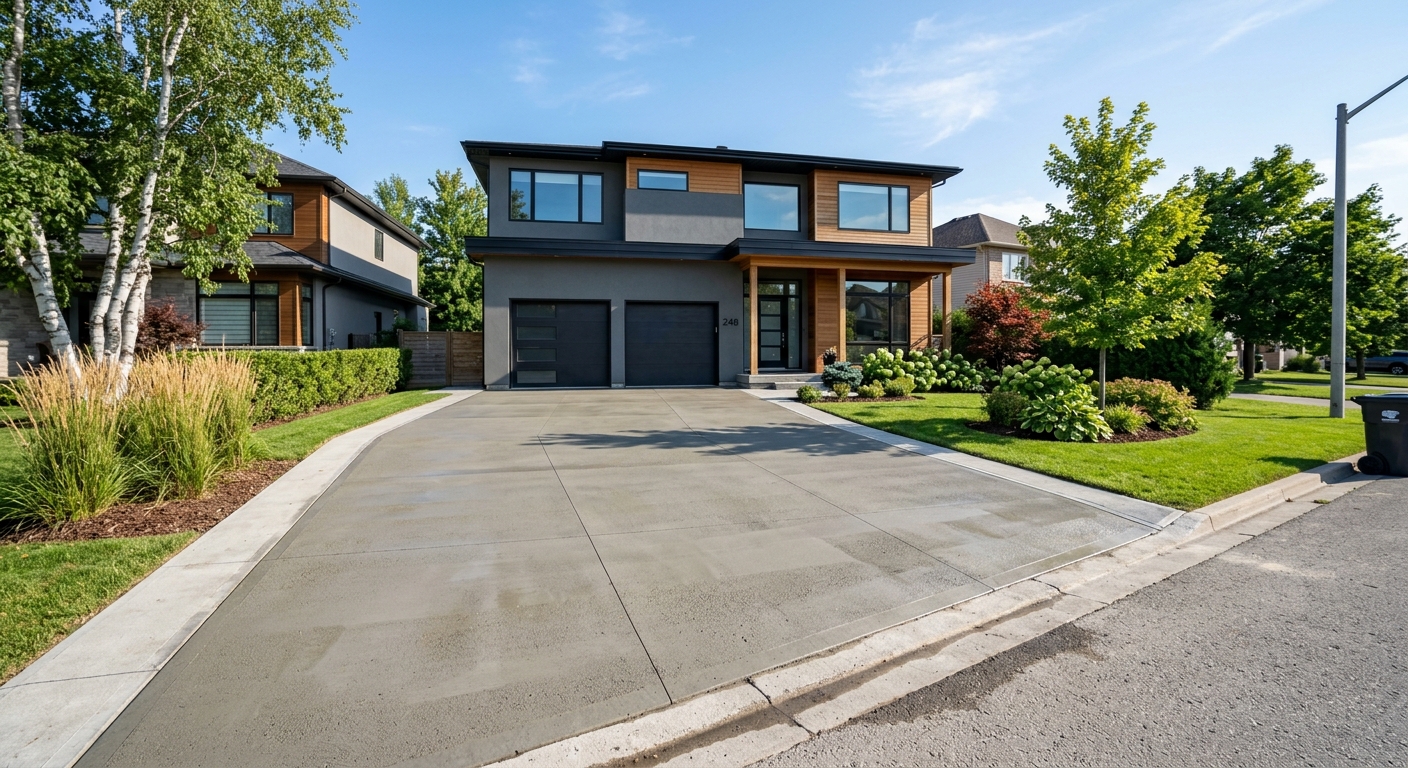
Concrete work options and costs in West Springs
West Springs is a fast-growing community in Calgary, and with its mix of established streets and newer builds, concrete flatwork is one of those projects homeowners notice right away. With a population of 11,560 (Statistics Canada, 2021 Census), there’s steady demand for driveways, patios and walkways from the area’s primarily single-detached households—exactly the kind of projects that get engineered around heavy freeze–thaw cycles. In Calgary, the cold continental climate means concrete pricing is driven less by “finish look” alone and more by how the base, mix and curing are protected against winter conditions. Local crews also plan around logistics and the pour season: exterior work in late fall or early spring often requires heated enclosures or insulated blankets to keep curing on track.
In West Springs, I see especially frequent concrete calls for the newer infill pockets along the west and northwest portions of the neighbourhood, where lot grading and access can be tighter. Those site realities affect excavation, disposal, rebar placement and how long it takes a crew to stage forms and concrete trucks safely. That’s why two homes can land at different totals even when the “size” sounds similar—foundation depth for frost and the granular base spec change the scope early, and that flows into labour and material usage.
Below are realistic starting points for the most common West Springs concrete options, so you can compare quotes apples-to-apples before you ask for line items.
| Application |
Typical Size |
Key Spec |
Finish Option |
Price Range |
| Concrete driveway (standard broom finish) |
24 ft x 10 ft (240 sq ft) |
Air-entrained mix; compacted base; control joints |
Broom finish |
$12,000–$18,000 |
| Exposed aggregate driveway |
24 ft x 10 ft (240 sq ft) |
Air-entrained mix; consistent bond/texture; sealer recommended |
Exposed aggregate |
$14,000–$20,500 |
| Stamped concrete driveway or patio |
20 ft x 12 ft (240 sq ft) |
Air-entrained mix; base prep; release agent; control joints |
Stamped pattern |
$15,000–$26,000 |
| Plain concrete patio or walkway |
12 ft x 10 ft (120 sq ft) |
Air-entrained mix; compacted base; edging |
Float-and-trowel with light broom |
$5,000–$9,000 |
| Garage floor (interior slab) |
22 ft x 20 ft (440 sq ft) |
Vapour barrier (if specified); fibre or mesh; flatness |
Standard power float |
$11,000–$17,500 |
| Foundation footings (structural, below frost) |
Typical 2-storey house |
Engineered reinforcement; excavation to design frost depth |
Concrete below grade (no decorative finish) |
$28,000–$45,000 |
Prices are estimates only and vary by project scope, site access and material selection.
What affects the price of concrete work in West Springs
In West Springs and across the Calgary region, it’s common to see concrete quotes for the “same” job land 30–50% apart. That gap usually comes from engineering and site prep differences that don’t show up in marketing photos: footing depth decisions, base thickness and compaction, reinforcement approach, and whether cold-weather curing steps are included. In Alberta’s freeze–thaw climate, contractors also have to plan around a design frost depth of about 1.2 m (roughly 4 ft) and ensure exterior slabs and supporting soils perform for years, not weeks.
Every frost season forces specs that are more intensive than in milder areas. Footings must bear below the design frost depth to reduce frost heave and seasonal movement. Exterior slabs require air-entrained concrete to survive freeze–thaw cycling, and crews often add control joints and sealing to manage cracking and spalling risk when homeowners de-ice in winter. Because the pour season is shorter, cold-weather concrete placement may require winter-grade mixes, insulated blankets and controlled curing—those items add both labour hours and material cost.
Two West Springs examples that commonly move the total: (1) a driveway with soft or poorly draining soil typically needs more excavation and granular base replacement, which pushes the job toward the higher end of the $12,000–$18,000 driveway band; (2) a stamped patio is often quoted near $15,000–$26,000 when the base and curing plan are upgraded to keep the stamp crisp and the surface durable in salt exposure. If you want to keep costs down without sacrificing performance, ask for the same air-entrainment and curing standards across all quotes—those are the foundations of long-term value.
| Price Factor |
Why It Matters |
Cost Impact |
| Frost line depth — determines footing depth and form height |
Footings must extend below design frost depth to prevent frost heave |
Higher excavation and concrete volume can add significant cost (often a major driver) |
| Site preparation — excavation, grading, compacted granular base |
Compaction and base thickness determine stability and long-term settlement resistance |
More hauling/disposal and granular material increases labour + materials |
| Reinforcement — rebar or wire mesh requirement |
Controls cracking and improves structural capacity under loads |
Material plus labour for tying/positioning can raise costs |
| Mix design — air-entrainment and compressive strength spec |
Air-entrainment protects against freeze–thaw damage; strength supports load and durability |
Upgraded mix typically costs more but reduces warranty issues |
| Finish type — broom vs. stamped vs. exposed aggregate |
Finish methods change labour, timing, and sometimes additional materials (e.g., release agents) |
Stamped/exposed finishes usually cost more than broom-finished flatwork |
| Pour size and concrete truck access to site |
Longer carries or multiple loads require planning and can slow production |
Access constraints can add equipment time and additional mobilizations |
| Cold-weather curing precautions — heating and blankets |
Proper curing avoids scaling and surface deterioration in winter conditions |
Can add a meaningful labour/material line item during shoulder seasons |
| Control joint pattern and sealing cost |
Joints direct cracking; sealing helps repel de-icing salt and water |
Proper jointing and sealers add cost but extend service life |
Permits & regulations in Alberta
In Alberta, structural concrete work—think foundation footings, foundation walls, grade beams and other engineered structural elements—typically requires a building permit and often engineered drawings reviewed through the municipal process. Concrete flatwork such as patios, walkways and driveways usually does not require a permit by default, unless it affects lot grading, creates an impervious surface over certain municipal thresholds, or ties into municipal right-of-way requirements. When in doubt, confirm with the local authority before you break ground.
For homeowners in West Springs, the safest approach is to verify your contractor in three steps before work starts. First, ask what permits are needed for your specific scope (structural foundation elements vs. non-structural slab work). Second, request a current certificate of liability insurance naming you/your property as appropriate, and confirm the insurer’s coverage is active on the date of the pour. Third, confirm worker coverage under WSIB/WCB (depending on the contractor’s situation) and keep a copy of any clearance documentation they provide.
To check credentials, start with the contractor’s own registration/licence information (as applicable to the scope), then verify insurance directly from the certificate and—when offered—clearance letters. If you’re hiring for foundation work, ensure the project is designed to meet frost-related requirements for Calgary-area freeze–thaw exposure. Finally, ask for references on similar-scale builds in the Calgary region so you can confirm the contractor has managed excavation depth and curing in Alberta’s colder seasons.
Getting concrete right in West Springs's freeze-thaw climate
Concrete failures in West Springs almost always trace back to water management, inadequate base preparation, or a mix that isn’t designed for freeze–thaw. The biggest enemy is spalling: when water gets into the concrete and the freeze–thaw cycle expands it, the surface can flake and deteriorate—especially when de-icing salts are involved. To avoid this, you need the right construction sequence and specs, not just the right finish.
(1) Base preparation comes first. Exterior slabs perform only as well as the compacted granular sub-base beneath them, placed to the correct depth and compacted for stability against frost movement. (2) Mix design matters. For exterior flatwork, specify air-entrained concrete with about 5%–7% air content and a minimum 32 MPa compressive strength so the concrete can tolerate repeated freezing and thawing. (3) Control joints should be installed to limit random cracking—joints are a planned weak point, and they give cracks somewhere predictable to go. (4) Curing is non-negotiable. Plan for a minimum 7-day curing period under proper temperature and protection conditions; in cold weather, heating or insulated blankets are often required to protect surface and early-age strength development. (5) Sealing: apply a penetrating sealer after the cure (commonly around 28 days post-pour) to help repel water and de-icing salt.
When you’re comparing options, don’t automatically assume stamped is “better value.” For example, a broom-finished driveway in the $12,000–$18,000 range is often the most cost-effective if your goal is durability. You pay extra—sometimes pushing toward the $15,000–$26,000 band for stamped—for aesthetics and additional labour/time. The key is to make sure the durability specs (air content, base, joints, curing) are held constant across both choices.
| Spec |
Why It Matters in West Springs |
What to Ask For |
Impact if Skipped |
| Compacted granular base (depth?) |
Reduces settlement and limits frost-related movement |
Granular type and compacted depth based on site conditions and slab thickness |
Uneven settling, premature cracking, water ponding |
| Air-entrained concrete mix (target air %?) |
Protects concrete from freeze–thaw damage and surface scaling |
Specify air content in the 5%–7% range for exterior flatwork |
Higher risk of spalling and scaling after winter cycles |
| Compressive strength (MPa rating) |
Ensures structural capacity and improved durability under loads |
Minimum 32 MPa compressive strength |
Reduced performance, potential for early surface deterioration |
| Control joints (spacing per ACI guidelines) |
Controls where cracks form and helps manage water intrusion |
Joint spacing based on slab design and ACI guidance (site-specific layout) |
Random cracking, more frequent maintenance and patching |
| Minimum 7-day curing period |
Lets early strength develop for cold-weather resilience |
Protection plan during cold conditions; curing method described in writing |
Scaling, weak surface, and shortened service life |
| Penetrating sealer (when applied after cure) |
Helps resist de-icing salt and water penetration in Alberta winters |
Penetrating sealer applied after cure (commonly around 28 days) |
Faster salt/water ingress and earlier deterioration |
How to choose a concrete work contractor in West Springs
Choosing a concrete contractor in West Springs is about more than price—it’s about whether they build for Alberta’s frost and freeze–thaw reality. Start by verifying they carry the right coverage: ask for a current certificate of liability insurance and confirm WSIB/WCB coverage for their workers (or whatever applies to their situation). A real certificate should show active dates, the correct legal name of the business and coverage terms. Then request clearance documentation if they provide it, and keep copies with your contract.
Next, collect 2–3 itemised written quotes that break out labour, concrete materials, forms/rebar, excavation/granular base, finishing, disposal and any cold-weather curing allowances. Avoid “lump sum” quotes that don’t say what mix spec they’re using or whether they’ll include air-entrainment and curing protection. Read exclusions carefully: is permit pulling included where required, is hauling/disposal included, and are removals (old slab/curb cuts) priced separately?
Warranty matters too. Ask for the workmanship warranty length, what it covers (cracking vs. spalling vs. replacement) and whether it’s tied to completion requirements like sealing and maintenance. Confirm if product/manufacturer warranties apply and if they transfer to you if you sell the home. For payment, use a schedule that doesn’t front-load risk: never pay more than 10–15% upfront, and hold back until the full punch list and sealing (where included) are completed.
Finally, get timelines in writing: proposed start date, expected pour day(s), finishing schedule and completion estimate—especially important in Calgary’s shorter exterior pour windows.
- Provide a written scope with dimensions, thickness assumptions and excavation/base plan
- Confirm air-entrainment and minimum strength in the quote (not just “winter mix” wording)
- Ask for joint layout and sealing plan in writing
- Verify liability insurance is current and list coverage dates
- Confirm WSIB/WCB clearance or worker coverage documentation
- Request proof of past work specifically in Calgary-area freeze–thaw conditions
- Ensure quotes include disposal/haul-off if excavation is required
- Clarify whether permit pulling is included for structural work
- Get an explicit cold-weather curing allowance (blankets/heating) if work falls in shoulder season
- Use a payment schedule with limited upfront payment (10–15%) and holdback to completion
- Get a warranty document and confirm what triggers a claim
- Confirm truck access plan and whether concrete carries/extra mobilizations are priced
Concrete red flags I watch for in West Springs: contractors who won’t commit to air-entrainment or curing protection in cold weather; quotes that don’t list base prep or joint spacing; “lowest price” bids that include no rebar/mesh when they should; vague warranties that exclude spalling and cracking; and requests for large upfront deposits with no written schedule.
Frequently asked questions — concrete work in West Springs
Why does concrete crack in West Springs and how is it prevented?
Cracking in West Springs is usually a mix of shrinkage, temperature movement and how water interacts with the slab. Alberta’s freeze–thaw cycle can worsen small cracks by letting water in, then expanding as it freezes—especially where salt exposure and poor drainage occur. The prevention strategy is technical: proper compacted granular base, correctly specified air-entrained concrete for freeze–thaw durability, and a control joint pattern designed to “tell” the concrete where to crack. Curing is also critical; if the slab surface dries too fast in cold weather, you can get early weakness and more surface distress. When you compare quotes, ask that they include control joints and curing protection—not just the finish. For driveway and patio projects, this typically keeps long-term repairs down, even when the upfront cost sits in ranges like $12,000–$18,000 for a standard broom-finish driveway.
Stamped vs broom-finish concrete — cost difference?
The cost difference is mainly labour and process complexity. Broom-finish concrete is straightforward: place, level, finish and broom-texture for traction, then cut joints and cure correctly. Stamped concrete adds extra steps—release agents, stamping mats, careful timing and sometimes colour hardeners—plus more attention to consistency so the pattern doesn’t look “wavy” as it settles. In Calgary’s climate, both options still need the same durability specs (air-entrainment, base prep, joints, curing) to reduce freeze–thaw spalling risk, which is why you should compare quotes on technical inclusions, not just appearance. In West Springs, it’s common to see broom-finish driveways in the $12,000–$18,000 band, while stamped driveway or patio projects often land higher—commonly within $15,000–$26,000 depending on size, pattern and site access.
When is the best time to pour concrete in West Springs?
For West Springs, the best window is when temperatures support proper curing without expensive add-ons. Contractors typically prefer late spring through early fall, when the slab can cure in more stable conditions. Calgary’s cold continental weather means pour timing matters: in late fall or early spring, you may need winter-grade mixes, insulated blankets and sometimes heat to keep curing on track for at least the first week. If a contractor promises an exterior pour during cold weather but doesn’t describe a protection plan, that’s a concern. If you’re aiming for a driveway or patio, plan early enough to schedule excavation, base prep and the pour when temperatures are workable. It’s also why the same project can price higher near the shoulder season—curing protection and scheduling labour increase. For homeowners, ask your contractor how they handle curing if temperatures drop overnight, and whether that cost is included in the quote.
How long does concrete take to cure?
Concrete curing has two timelines: initial strength gain and longer-term strength. For most residential exterior flatwork in Alberta, you should plan on a minimum 7-day curing period under proper conditions so the slab reaches a level of early strength that supports performance through daily use and freeze–thaw exposure. Then, for sealing and durability, many contractors target around 28 days post-pour before applying a penetrating sealer. The key is temperature and protection—if you’re pouring in colder conditions around West Springs, curing can slow down and you may need insulated blankets or heating to maintain the right environment. When reviewing quotes, ask for a written curing plan, especially if your pour date is close to seasonal cold snaps. This is also tied to warranties: workmanship warranties are usually stronger when the contractor can show they followed curing requirements for Alberta’s climate.
Do I need a permit for concrete work in Alberta?
In Alberta, it depends on what you’re building. Structural concrete work—such as footings, foundation walls and grade beams—typically requires a building permit and often engineered drawings reviewed through the municipal process. Non-structural concrete flatwork like patios, walkways and most driveways usually doesn’t require a permit unless it affects lot grading, impervious surface coverage limits, or connects into municipal right-of-way rules. For homeowners in West Springs, the practical step is to ask your contractor to specify whether a permit is required for your scope and to confirm who is responsible for pulling it. Also verify your contractor carries liability insurance and worker coverage (WSIB/WCB as applicable). If the contractor starts excavation without answering permit questions, pause and confirm the requirements with the local authority before proceeding.
Concrete vs pavers for a patio in West Springs?
Concrete is often the better choice when you want a durable, seamless surface with fewer joints to trap debris—provided it’s built for Alberta’s freeze–thaw conditions. Pavers can look great and offer easier section repairs if a small area fails, but they still rely on excellent base preparation and proper jointing for drainage. In West Springs, the decision usually comes down to your priorities: concrete typically offers lower maintenance and a more uniform surface, while pavers can be more forgiving aesthetically if you want a patterned look. Pricing depends on size and site access. Plain concrete patios commonly start around $5,000–$9,000, while stamped concrete usually costs more (often $15,000–$26,000 depending on scope). If you choose pavers, make sure the quote includes the same level of granular base prep and drainage detailing you’d expect for concrete durability.