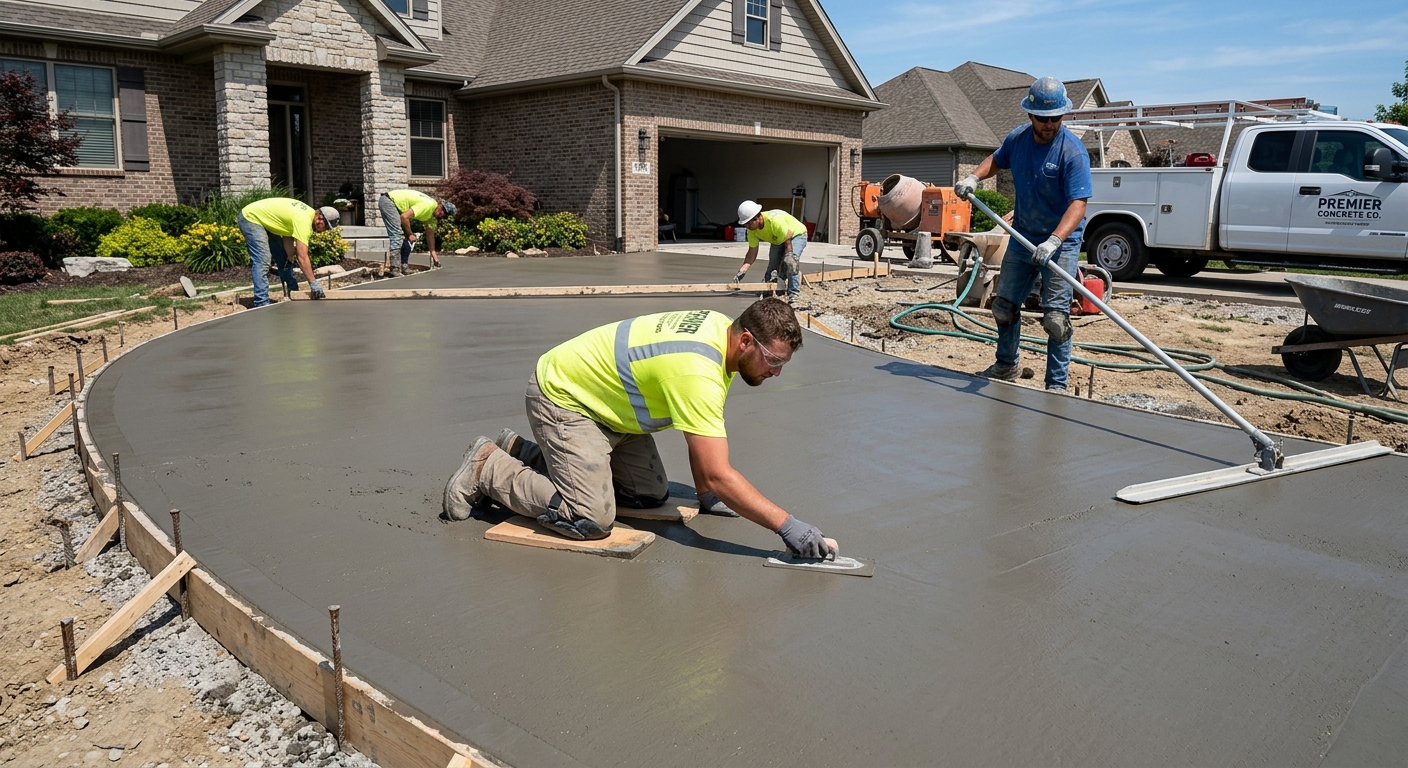
Concrete work options and costs in Garrison Green
Garrison Green, Alberta is a great place for durable concrete flatwork, but the cost is never “one-size-fits-all.” First, it helps to know the local housing profile: the Calgary region is dominated by single-detached homes, and concrete driveways, patios and walkways are a common upgrade for that buyer pool. In the 2021 Census, Garrison Green’s population was 1,680 (Statistics Canada, 2021 Census), which keeps work fairly neighbourhood-driven—when crews are already booked for nearby communities, mobilization and scheduling can affect your final price.
Calgary’s cold continental climate is the real driver. Exterior concrete has to be engineered around frost depth and frequent freeze–thaw cycles. That means deeper excavation for footings (with bearing on undisturbed soil below the local design frost depth) and air-entrained mixes for slabs that will face wetting, thawing and refreezing. It also shortens the exterior pour season, so contractors may schedule cold-weather placements using insulated blankets and sometimes supplemental heat to protect curing.
In Garrison Green, trades are especially busy during improvement seasons in areas with active infill and new builds near established collector roads and busier local corridors, where access and parking constraints can slow down concrete placement and finishing. If your project is in that demand zone, it’s even more important to compare scope—not just the number.
Use the table below to benchmark typical costs for the most requested concrete jobs, then tailor it with your site conditions and finish choice.
| Application |
Typical Size |
Key Spec |
Finish Option |
Price Range |
| Concrete driveway (standard broom finish) |
24 ft x 10 ft (240 sq ft) |
Air-entrained mix; control joints |
Broom finish |
$12,000–$18,000 |
| Exposed aggregate driveway |
24 ft x 10 ft (240 sq ft) |
Air-entrained mix; specialty aggregate wash |
Exposed aggregate |
$14,500–$21,500 |
| Stamped concrete driveway or patio |
20 ft x 14 ft (280 sq ft) |
Air-entrained mix; colour hardener |
Stamped pattern |
$15,000–$26,000 |
| Plain concrete patio or walkway |
12 ft x 12 ft (144 sq ft) |
Air-entrained mix; jointing plan |
Float and broom/wood finish |
$5,000–$9,000 |
| Garage floor (interior slab) |
24 ft x 22 ft (528 sq ft) |
Vapour barrier; rebar or mesh as required |
Light broom or smooth trowel |
$7,500–$13,500 |
| Foundation footings (structural, below frost) |
Typical 2,000–2,800 sq ft house footprint area |
Engineered design; excavation to frost depth; rebar |
Structural concrete (no surface finish) |
$28,000–$45,000 |
Prices are estimates only and vary by project scope, site access and material selection.
What affects the price of concrete work in Garrison Green
In and around Calgary, it’s common to see quotes for the “same” concrete job swing by 30–50%. The sticker shock usually isn’t the concrete itself—it’s the engineered requirements that protect your slab or foundation in a cold freeze–thaw climate, plus how difficult the site is to build on. When one contractor designs for frost and drainage and another “value engineers” around it, the numbers can look close on paper but behave very differently over the next 5–15 years.
Here’s how the climate changes the spec. In Alberta, footings must extend below the local design frost depth (often up to 2.4 m), so excavation is deeper and footing volumes are higher. For exterior slabs like driveways and patios, concrete must be air-entrained to survive repeated freeze–thaw cycling and reduce surface scaling and spalling. Calgary also has a shorter practical pour season for exterior work, which pushes up cost when winter-grade mixes, insulated blankets, and curing protection are required. On top of that, de-icing salt accelerates surface deterioration; sealing and proper jointing are part of the long-term plan.
Two quick Garrison Green examples. If your driveway grade requires additional removal and replacement of unsuitable subgrade, that preparation work adds cost before the first truck arrives. If you choose stamped or exposed finishes, labour time increases (forms, pattern stamping, detailing edges), so you may move from the standard driveway band toward the $15,000–$26,000 range for decorative work depending on area and complexity. Conversely, a simple plain walkway in a straightforward backyard can stay closer to $5,000–$9,000 because the finishing and joint layout are less labour-intensive.
Home age matters too: older lots often have unknown backfill or prior subgrade disturbance, which can increase excavation and compaction requirements—sometimes by thousands of dollars—especially where drainage is marginal in freeze–thaw conditions.
| Price Factor |
Why It Matters |
Cost Impact |
| Frost line depth |
Determines footing depth and form height |
Higher excavation and concrete volume; usually a major cost driver for foundations |
| Site preparation |
Excavation, grading, compacted granular base |
Unsuitable soil removal and extra base layers can add thousands in big swings between quotes |
| Reinforcement |
Rebar or wire mesh requirement |
Material and labour increase; required specs reduce long-term cracking risk |
| Mix design |
Air-entrainment and compressive strength spec |
Cold-weather performance and durability can cost more up front but protects the slab |
| Finish type |
Broom vs. stamped vs. exposed aggregate |
Decorative options add labour time, tools and careful timing |
| Pour size and concrete truck access to site |
Placement rate and whether pumping is needed |
Limited access, long carries or pumping can increase labour and equipment costs |
| Cold-weather curing precautions |
Heating and blankets |
Extra materials and labour during the short exterior pour season |
| Control joint pattern and sealing cost |
Controls cracking; sealers resist de-icing salt damage |
Better detailing and sealing adds cost but reduces spalling risk on flatwork |
Permits & regulations in Alberta
In Alberta, the boundary between “structural” and “simple flatwork” matters for permits. Structural concrete work—such as foundation footings, foundation walls, grade beams, and other load-bearing elements—typically requires a building permit and, in many cases, engineered drawings reviewed through the municipality’s process. Concrete flatwork like patios, walkways and most driveways usually does not require a permit unless it affects lot grading, drains toward neighbouring areas in a way that changes water management, triggers impervious surface coverage limits, or impacts municipal right-of-way/sidewalk interfaces. Even when a permit isn’t required, your contractor should still follow the local drainage and set-back expectations for your lot.
Before breaking ground in Garrison Green, verify these three items step-by-step. First, confirm the contractor’s Alberta licence (ask for their business profile and any relevant trade registration details) and cross-check their credentials using publicly available listings. Second, ask for a certificate of insurance showing liability coverage and ensure the policy includes your project address. Third, confirm Workers’ Compensation coverage: request the contractor’s WSIB/WCB clearance/coverage proof (the exact format varies by employer category, but the documentation should be current and specific). Then ask for references on similar-scale jobs (for example, exterior slabs with air-entrained mixes in Calgary’s climate).
If a contractor can’t provide clear documentation quickly, that’s usually a red flag for scheduling, labour quality, and accountability later on.
Getting concrete right in Garrison Green's freeze-thaw climate
Concrete fails in Garrison Green when it’s treated like a “set it and forget it” material instead of a system engineered for frost and freeze–thaw. The most common failures I see are spalling and surface scaling on driveways and walkways—often caused by inadequate air-entrainment, poor base compaction, or rushing curing in cold snaps. The fix starts long before the pour.
1) Base preparation: excavate to the design frost strategy and build a compacted granular sub-base to the proper depth for your soil and drainage conditions. If the base isn’t compacted and drained correctly, the slab can move and crack even if the finish looks good.
2) Mix design: require air-entrainment for exterior slabs (commonly 5–7% air content depending on the mix and exposure), and specify a minimum 32 MPa compressive strength for typical residential exterior flatwork. That air is what helps concrete withstand freeze–thaw cycling.
3) Control joints: plan joint spacing so shrinkage and temperature movement cracks in the right places. Random cracking isn’t a “defect” you can hide—it’s movement without a guide.
4) Curing: you should plan on a minimum 7-day cure under proper conditions. In Calgary shoulder seasons, cold weather curing precautions can be the difference between surface scaling and a solid long-term finish.
5) Sealing: penetrating sealer applied after the cure (often 28 days post-pour for best results) helps repel de-icing salts and reduces surface deterioration.
When you compare options, the cost difference is sometimes justified. For example, moving from standard broom-finished driveway work toward decorative stamping can place you in the $15,000–$26,000 range, but that premium is about labour time and finishing control. If your base and mix are under-specified, paying for a premium finish won’t save the concrete—fix the engineering first.
| Spec |
Why It Matters in Garrison Green |
What to Ask For |
Impact if Skipped |
| Compacted granular base (depth?) |
Provides the stiffness and drainage needed against frost movement |
Confirm excavation depth and granular layers; request compaction method/requirements |
Settling, unevenness, cracking and shortened service life |
| Air-entrained concrete mix (target air %?) |
Reduces freeze–thaw damage and scaling in Calgary winters |
Specify air content target (commonly 5–7% for exterior flatwork) |
Higher risk of spalling and surface deterioration |
| Compressive strength (MPa rating) |
Ensures the mix can resist stresses and abrasion over time |
Minimum 32 MPa for typical exterior flatwork (per scope) |
Wear, cracking, and reduced long-term durability |
| Control joints (spacing per ACI guidelines) |
Controls where shrinkage and temperature cracks occur |
Ask for joint layout/spacing plan and finish details |
Random cracking; water infiltration through cracks |
| Minimum 7-day curing period |
Critical for achieving strength and surface stability in cold weather |
Confirm curing plan and cold-weather protections if temps drop |
Surface scaling and weaker concrete at early age |
| Penetrating sealer (when applied after cure) |
Helps resist de-icing salt damage and moisture ingress |
Confirm sealer type and that it’s applied after the recommended cure (often ~28 days) |
Faster spalling and colour/finish degradation |
How to choose a concrete work contractor in Garrison Green
Choosing the right contractor in Alberta is mostly about proof and process—especially in Garrison Green, where freeze–thaw and shorter pour seasons demand careful specs. Start by verifying licensing and coverage. Ask for (1) their Alberta business/trade registration details, (2) a current certificate of liability insurance naming you (or showing the project address), and (3) WSIB/WCB coverage documentation. If they can’t provide these before you sign, pause. Then confirm the coverage is active and that the certificate isn’t expired.
Next, get 2–3 itemised written quotes. A fair quote breaks down labour and materials (excavation, granular base, reinforcement, concrete supply, finishing and sealing), and it clearly states inclusions and exclusions: permit pull (if applicable), disposal/haul-away of excess soil, protection of landscaping, and whether you’re getting saw-cut control joints vs. scoring only. Avoid “lump sum” quotes that don’t show what’s under-specified.
Warranty should be specific. Ask for the workmanship warranty length and what it covers (for example, replacement of failed sections) and whether product/manufacturer warranties apply to admixtures or sealers. Also ask if the warranty is transferable to future owners.
For payment, don’t put yourself at risk. A common best practice is keeping upfront payments around 10–15%, then holding back the remainder until the work is complete and cleaned up. Finally, demand a written timeline: start date, pour date (weather-dependent), and an estimated completion date in case cold snaps extend cure times.
- Request air-entrainment and curing specifications in writing for exterior slabs.
- Confirm frost-depth excavation approach for foundations/footings (engineered as required).
- Ask whether they’ll supply and place compacted granular base and how thickness is determined.
- Verify reinforcement details (rebar/mesh) match your load and slab type.
- Ensure control joints are planned and executed (not just “we’ll score it”).
- Confirm whether cold-weather curing measures are included if temps dip.
- Get a clear joint sealing plan for driveways/walkways exposed to de-icing salt.
- Ask about concrete truck access and whether pumping/carts are included if needed.
- Make sure debris disposal and haul-away are included (not “by client”).
- Confirm who is responsible for any lot grading and drainage corrections.
- Review their warranty in plain language and get it on the contract.
- Require a written payment schedule with a holdback until final inspection.
Concrete contractor red flags in Garrison Green: they won’t discuss air-entrainment or joint spacing; they quote exterior work without acknowledging cold-weather curing needs; they provide insurance documents after you ask repeatedly (or with expired dates); they refuse to itemize scope (no base prep or reinforcement line items); or they want a large upfront payment beyond 10–15%.
Frequently asked questions — concrete work in Garrison Green
Concrete vs pavers for a patio in Garrison Green?
In Garrison Green and across the Calgary area, both concrete and pavers can perform well, but they fail differently. Concrete patios are often better for a “one surface, easy maintenance” approach: you get consistent jointing and an air-entrained mix can be specified for freeze–thaw. Pavers can be more forgiving on appearance if you get minor settlement, but joints still need proper bedding and edging to prevent weed growth and shifting during thaw cycles. Cost-wise, plain concrete patio work typically lines up with $5,000–$9,000 depending on size and site access. Pavers can start similar but often climb when you add proper base depth, edge restraints and re-sanding joint material. If your goal is maximum durability with minimal ongoing upkeep, ask contractors to show their patio base build-up and joint plan for the winter climate.
How long does a concrete driveway last?
A properly designed and placed concrete driveway in Alberta can last decades, but “how long” depends on the spec details. Freeze–thaw means air-entrainment is crucial, and the base must be compacted correctly to the right depth for frost strategy—otherwise the slab moves and cracks. Control joints must be laid out to guide shrinkage cracking, and sealing helps protect the surface from de-icing salts that accelerate spalling. In Garrison Green, a standard broom-finished driveway is commonly priced in the $12,000–$18,000 band, and the durability difference between a good and a poor job is often in base prep, mix design and curing, not just the finish. If you’re offered a “quick pour” late in the season with no cold-weather curing plan, that’s where long-term lifespan usually takes a hit.
What is air-entrained concrete and why does it matter here?
Air-entrained concrete is mixed with tiny, evenly distributed air bubbles that give freezing water space to expand without breaking the paste. In Calgary’s cold continental climate, that’s not optional for exterior flatwork—freeze–thaw cycles drive a lot of surface scaling and spalling risk when air content is too low. For patios, walkways and driveways in Alberta, contractors typically aim for about 5–7% air for exterior exposure (confirm for your specific mix and slump requirements). Without it, even a driveway that looks fine at first can start flaking or scaling after a few winters, especially where de-icing salts are used. In Garrison Green, ask your contractor to explicitly state air-entrainment in the written quote and confirm their cold-weather placement and curing precautions are included.
How do I prepare the base for a concrete slab?
Base preparation is where concrete projects are won or lost in Garrison Green. A good base starts with proper excavation to the required depth for your soil and frost strategy, then grading to the correct elevation and slope for drainage. Next comes placing and compacting a granular sub-base in layers (not just dumping material and hoping it settles). Compaction method and test expectations should be discussed—especially if you have older fill or any soft spots. After base prep, reinforcement is placed as specified (rebar/mesh depending on slab type and design). Finally, the contractor pour-matches the plan with joint spacing and finishing timing. If a quote doesn’t include granular base build-up details, you can end up paying later for corrective work.
How do I compare concrete quotes?
Compare quotes like an engineer, not like a shopper. For each bid, check whether it includes the same scope: excavation depth and granular base thickness, reinforcement type, concrete mix specs (including air-entrainment for exterior), control joint layout and finishing method. Also look for cold-weather curing measures in Alberta—if the pour date might fall in shoulder season, ask what heating/blanket plan is included. Make sure disposal/haul-away is specified and confirm concrete truck access details (and whether pumping is included if they need it). A meaningful quote will often show labour and material components rather than a single lump sum. For price anchors, standard driveway work frequently sits in the $12,000–$18,000 band, while decorative stamped concrete can move into the $15,000–$26,000 range. If one contractor is far below those while omitting key specs, that’s usually where corners are being cut.
Can concrete be poured in cold weather in Garrison Green?
Yes, but it has to be done correctly—and timing matters. In Alberta, cold-weather placement requires engineered precautions so the concrete reaches strength without surface scaling or freezing before it sets properly. Contractors may use winter-grade mixes, insulated blankets, temperature monitoring, and sometimes supplemental heat around the pour area. Your contractor should specify curing protections and the conditions under which they’ll still proceed. If you’re planning a driveway or walkway in Garrison Green late in the year, ask what their “cold weather plan” is and whether it includes maintaining curing temperature for the required period. A rushed pour is one of the fastest routes to spalling and deterioration, especially on exterior slabs exposed to de-icing salts. A reputable crew will treat curing as part of the scope—not an optional extra.