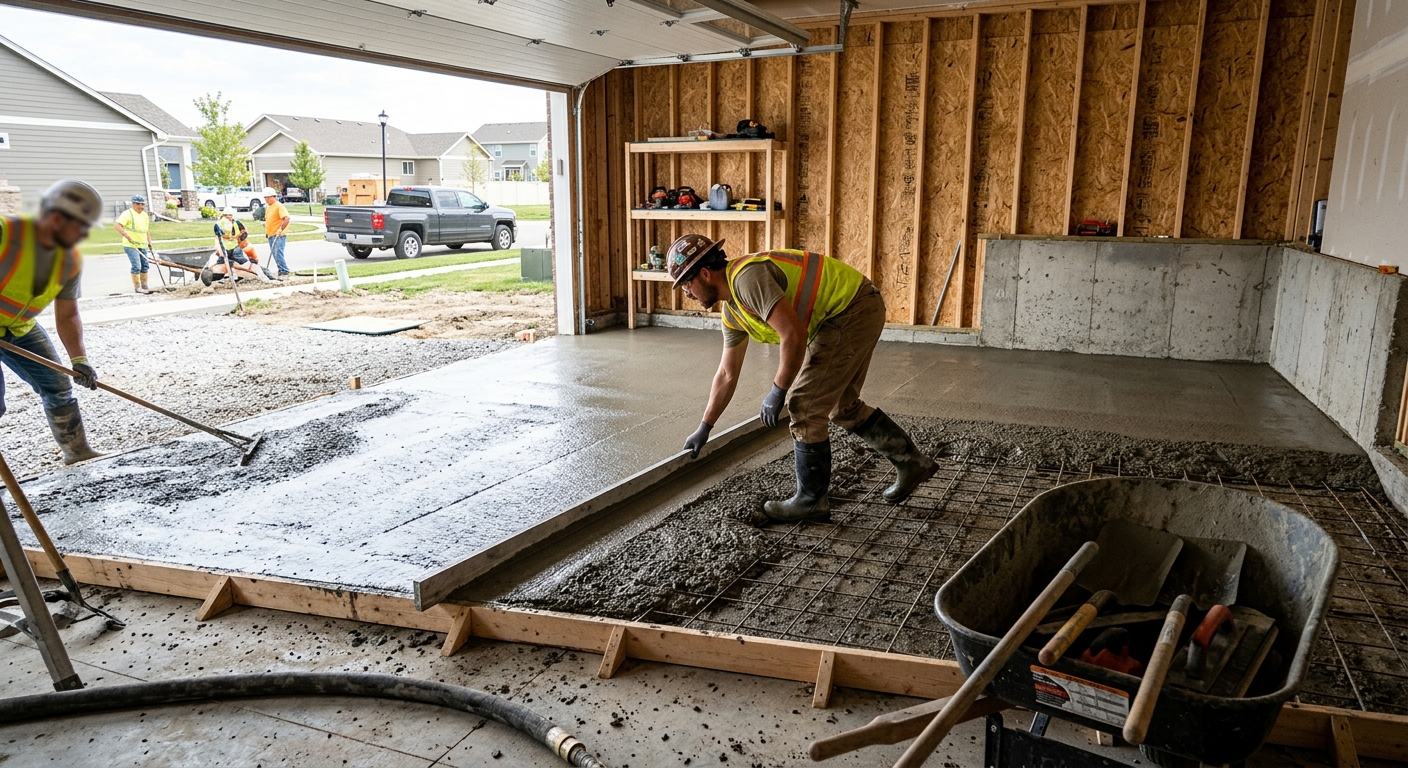
Concrete work options and costs in Thorncliffe
Thorncliffe is a growing community on the east side of Calgary, with a lot of homeowners planning long-life exterior concrete around their homes. In Thorncliffe’s broader market, many residents build and renovate around stable, family-oriented housing stock; Calgary’s 2021 population was 1.4 million (Statistics Canada, 2021 Census), and Thorncliffe itself counted 8,695 people in that same census. That steady demand shows up in repeat work: driveways, patios, walkways, and (for new builds) foundation footings and slabs.
In Calgary’s cold continental climate, concrete pricing is engineered around frost and freeze–thaw more than in milder parts of Alberta. The design frost depth is about 1.2 m (roughly 4 ft), so exterior footings and structural elements need to bear below that zone to reduce the risk of frost heave. On top of that, the freeze–thaw cycle pushes contractors to use air-entrained concrete for exterior flatwork, add granular base preparation, and plan control joints carefully—especially for driveways and patios where moisture and de-icing salts are common.
Labour availability can also affect your budget in Thorncliffe (and nearby neighbourhoods like the community corridor around Chaparral/Deepwood-style suburban pockets). When the weather tightens the exterior pour window, crews may prioritize certain projects, which can change turnaround times and scheduling costs.
Use the table below as a practical starting point before you ask for itemized quotes.
| Application |
Typical Size |
Key Spec |
Finish Option |
Price Range |
| Concrete driveway (standard broom finish) |
24 ft x 10 ft (240 sq. ft.) |
Air-entrained mix, compacted base, control joints |
Broom finish with sealer |
$12,000–$18,000 |
| Exposed aggregate driveway |
24 ft x 10 ft (240 sq. ft.) |
Air-entrained mix, proper curing and wash timing |
Exposed aggregate surface |
$14,500–$22,500 |
| Stamped concrete driveway or patio |
20 ft x 12 ft (240 sq. ft.) |
Air-entrained mix, integral colour or stain, joints |
Stamped pattern (e.g., flagstone/brick) |
$15,000–$26,000 |
| Plain concrete patio or walkway |
16 ft x 10 ft (160 sq. ft.) |
Air-entrained mix, compacted base, edge forms |
Float/trowel or broom finish |
$5,000–$9,000 |
| Garage floor (interior slab) |
20 ft x 22 ft (440 sq. ft.) |
Vapour barrier (as needed), mesh/rebar (as spec’d) |
Broom finish (standard) |
$8,500–$14,500 |
| Foundation footings (structural, below frost) |
Typical house perimeter + interior support |
Engineered depth and steel, below design frost zone |
Structural concrete only (no decorative finish) |
$28,000–$45,000 |
Prices are estimates only and vary by project scope, site access and material selection.
What affects the price of concrete work in Thorncliffe
Even when homeowners are looking at “the same” concrete job in Thorncliffe, quotes can swing by 30–50% across the Calgary region. The reasons usually aren’t cosmetic—they’re structural and scheduling driven. When you move from one contractor to another, differences in excavation scope, granular base sizing, reinforcement details, air-entrainment targets, and cold-weather curing practices can change both labour hours and material requirements.
The frost line depth is the big driver. In Alberta practice, footings and foundation elements must extend below the design frost depth (about 1.2 m in this region) so soil doesn’t heave and stress the structure. Exterior slabs and flatwork also need air-entrained concrete to handle freeze–thaw cycles. In Thorncliffe, that winter exposure is paired with frequent de-icing, which accelerates surface damage if the mix and curing aren’t right.
Cold-weather placement further compresses the pour season. Contractors may need winter-grade mixes, insulated blankets, and sometimes temporary heat to protect curing. That’s why a driveway typically falls into the $12,000–$18,000 band, but a stamped option can jump into the $15,000–$26,000 range—because decorative work demands extra prep, timing control, and finishing steps that are harder to execute consistently in short, cold weather windows.
Here are a few Thorncliffe realities that raise or lower cost: (1) sloped lots or poor drainage can increase excavation and change base thickness; (2) older neighbourhood foundations sometimes have nearby utilities or mature trees that restrict truck access; and (3) larger driveway widths or thicker slabs raise concrete volume quickly. With Calgary’s ongoing housing turnover, even small site constraints can translate into meaningful labour cost differences—often reflected as hundreds to several thousand dollars between bids.
| Price Factor |
Why It Matters |
Cost Impact |
| Frost line depth — determines footing depth and form height |
Footings must bear below the frost zone to prevent movement |
Higher excavation and concrete volume; can add thousands |
| Site preparation — excavation, grading, compacted granular base |
Proper base reduces settlement and helps drainage |
More trucking/working time if soil is unsuitable |
| Reinforcement — rebar or wire mesh requirement |
Controls cracking and supports structural loads |
Material + placement labour increases cost |
| Mix design — air-entrainment and compressive strength spec |
Air entrainment improves freeze–thaw durability |
Correct mix can cost more but reduces future repairs |
| Finish type — broom vs. stamped vs. exposed aggregate |
Decorative finishes add steps and tighter timing |
Stamped/exposed often adds premium labour |
| Pour size and concrete truck access to site |
Access controls pumping time or manual placement |
Pumping/extended labour can raise prices |
| Cold-weather curing precautions — heating and blankets |
Curing must stay within safe temperature range |
Winter gear and labour add direct costs |
| Control joint pattern and sealing cost |
Joints limit random cracking and sealer reduces salt damage |
Better detailing and materials usually increase line-items |
Permits & regulations in Alberta
In Alberta, structural concrete work typically needs a permit. That includes footings, foundation walls, grade beams, and any engineered foundation elements that affect structural load paths. In many cases, municipalities expect engineered drawings to support inspections and compliance, especially where footing depth, reinforcement schedules, or bearing conditions are involved.
Concrete flatwork—driveways, patios, and walkways—usually does not require a building permit by default, unless your project affects lot grading, stormwater drainage, impervious surface coverage limits, or ties into a municipal right-of-way (for example, work near sidewalks or boulevard areas). Because conditions differ by lot, it’s smart to confirm before you break ground.
For Thorncliffe homeowners, a simple step-by-step verification process helps you avoid bad surprises:
- Ask the contractor for their certificate of insurance (liability) before work starts.
- Confirm they have WSIB/WCB coverage and request the clearance/coverage confirmation if applicable.
- Ask whether they pull permits for structural work (footings/foundation) and who pays for them.
- Verify credentials through provincial/online contractor listings (use the contractor’s legal name and licence details exactly as provided in the quote).
- Request references from similar-scale jobs in Calgary-area neighbourhoods and confirm they’re the installer of record.
If anything feels vague—missing insurance, no clear permit responsibility, or no written scope—pause and request clarification. With Thorncliffe’s frost depth demands, structural work is where compliance and engineering details matter most.
Getting concrete right in Thorncliffe's freeze-thaw climate
Concrete fails in Thorncliffe most often because water gets in, freezes, and expands—then repeats through freeze–thaw cycles. In a cold continental climate, this shows up as spalling, scaling, and random cracking if the base, mix, joints, and curing weren’t engineered for exterior exposure. The fix isn’t guesswork; it’s specification.
Start with base preparation: compacted granular sub-base needs to be built to the right thickness and re-compacted in lifts. The goal is a stable, well-drained base that won’t pump fines during wet seasons. For mix design, require air-entrained concrete with an exterior air content target of about 5–7% for freeze–thaw durability, plus a minimum 32 MPa compressive strength (or higher if your engineered spec calls for it). Air-entrainment is the single biggest line-item that protects against spalling when de-icing salts and moisture are present.
Next, control joints. Proper spacing reduces random cracking and gives cracks a “planned path.” Curing is also critical: plan for at least 7 days of protection under proper conditions, and in cold snaps use winter curing precautions such as insulated blankets and, where needed, temporary heat. Finally, sealing matters: a penetrating sealer is typically applied 28 days after the pour, once the concrete has cured, to repel de-icing salts and reduce moisture ingress.
When comparing options, understand why costs differ. For example, a plain patio/side walkway may fit the $5,000–$9,000 band, but a stamped patio in the $15,000–$26,000 range is usually higher because it’s not just colour—it’s extra labour for finishing, pattern mats, and careful timing. If a quote for stamped work doesn’t talk about curing protection and joint layout, it’s a red flag.
| Spec |
Why It Matters in Thorncliffe |
What to Ask For |
Impact if Skipped |
| Compacted granular base (depth?) |
Stable support prevents settlement and water movement in a frost-prone region |
Granular base depth + compaction method (lift thickness and density target if available) |
More cracking, uneven slabs, and faster deterioration |
| Air-entrained concrete mix (target air %?) |
Freeze–thaw durability relies on correct air entrainment in exterior exposure |
Specify target air content around 5–7% for exterior flatwork |
Higher risk of spalling and surface scaling in winter |
| Compressive strength (MPa rating) |
Ensures the slab can handle load and cold weather conditions |
Minimum 32 MPa (or higher if required by engineered design) |
Reduced durability and premature surface damage |
| Control joints (spacing per ACI guidelines) |
Controls where cracks occur under thermal and moisture movement |
Joint spacing plan and sawcut timing |
Random cracking across visible surfaces |
| Minimum 7-day curing period |
Proper strength gain reduces early-age failure and scaling risk |
Minimum 7 days curing with temperature protection plan if cold |
Weak surface layer and higher chance of long-term defects |
| Penetrating sealer (when applied after cure) |
Reduces salt and moisture penetration during Alberta winters |
Apply after cure—commonly 28 days post-pour |
More water ingress and faster spalling near edges |
How to choose a concrete work contractor in Thorncliffe
Choosing the right concrete contractor in Thorncliffe is mostly about proving three things: competency, coverage, and clarity. First, verify Alberta licensing/credentials through the relevant online registry for contractors (use the legal name exactly as shown on the quote). Next, request a certificate of liability insurance and confirm coverage is active before they start. Also ask for WSIB/WCB coverage confirmation—this protects both you and the crew.
Then, get 2–3 itemised written quotes. Don’t accept a “lump sum” without breakdowns. You want line items for excavation/site prep, base material, reinforcement, concrete supply, finishing, sawcut timing, curing blankets/heating (if needed), and sealing. Confirm what’s included: permit pull for structural concrete (if your scope includes footings/foundation), disposal of waste, and concrete truck/pump logistics if access is tight. A cheaper quote that excludes key items is how homeowners get change orders.
Warranty is another differentiator. Ask for a written workmanship warranty length (and what it covers), the product/manufacturer warranty for any sealers or decorative systems, and whether it’s transferable if you sell your home. For payment, never pay more than about 10–15% upfront. Hold back a portion until the finish work is complete, joints are cut/specified, and the curing/sealing steps are finished to the agreed schedule. Finally, insist on a written timeline with a start date and completion estimate.
- Ask for proof of current liability insurance and request to see it before work begins.
- Confirm WSIB/WCB coverage and ask for a clearance/coverage confirmation.
- Request itemized pricing for base, reinforcement, concrete, finishing, and sealing.
- Check whether the contractor includes disposal (or what haul/dump fees are excluded).
- Make sure cold-weather protection is addressed in writing (blankets/heating plan).
- Confirm the mix spec includes air-entrainment for exterior freeze–thaw durability.
- Verify joint plan: spacing, sawcut timing, and sealing expectations.
- Ask about curing procedures and how they protect the slab for at least 7 days.
- Require a clear scope for grading/drainage around edges.
- Ensure the quote mentions reinforcement type (mesh vs rebar) where applicable.
- Review the warranty terms in writing—length, exclusions, and call-back process.
- Use a payment schedule with a holdback until you complete your walkthrough.
In Thorncliffe, common red flags include: contractors who won’t discuss air-entrainment or curing; quotes that omit excavation/base compaction details; “final price later” language with no written scope; warranty terms that are vague or exclude cold-weather performance; and crews starting without confirming access logistics or protective curing plans for Calgary’s shorter exterior pour season.
Frequently asked questions — concrete work in Thorncliffe
What is air-entrained concrete and why does it matter here?
Air-entrained concrete is a mix designed with tiny air bubbles that give freezing water somewhere to expand, reducing internal pressure and protecting the surface. In Thorncliffe and across the Calgary region, freeze–thaw cycles are frequent and de-icing salt is common, so exterior slabs (driveways, patios, walkways) are especially vulnerable to spalling when the air-entrainment target isn’t met. This is why credible contractors spec air content (often around 5–7% for exterior flatwork) and don’t treat mix selection as a “standard.” When you’re budgeting, a plain patio might land in the $5,000–$9,000 band, but the durability differences are often in the mix and curing steps—items that cheaper quotes sometimes underspecify.
How do I prepare the base for a concrete slab?
Base preparation is where a lot of concrete failures start, especially in a frost-prone climate like Thorncliffe. The contractor should excavate to the engineered depth, install and compact a granular sub-base in lifts, and re-check grades so water drains away from the slab edges. For exterior work, proper base thickness and compaction help prevent settlement and reduce “pumping” of fines during wet seasons. Ask your contractor to describe the base material, compacting method, and how they’ll handle unsuitable soil. Also ask how they’ll protect the base from being left open too long before the pour. Done correctly, it supports the slab through the design frost depth demands and freeze–thaw cycles that Calgary experiences.
How do I compare concrete quotes?
Start by comparing quotes line-by-line, not by the bottom-line number. Ask for itemized breakdowns covering excavation/site prep, granular base, reinforcement (mesh or rebar as required), concrete supply (including air-entrainment), finishing, sawcut control joints, curing protection, and sealing. For cold weather, require a written curing/heat/blanket plan—otherwise “cold placement” can turn into scaled surfaces later. Look at scope exclusions too: disposal, permit responsibility (if structural), and truck access/pumping. If one quote places your driveway near $12,000–$18,000 but another is higher, the difference should come from better base/reinforcement/mix specs or more labour for access and curing, not just “premium brand” wording. In Alberta, those technical differences can easily explain 30–50% variation.
Can concrete be poured in cold weather in Thorncliffe?
Yes, it can be poured in cold weather in Thorncliffe, but it must be engineered and protected during curing. Contractors often use winter-grade concrete mixes, insulating blankets, and sometimes temporary heat so the slab reaches safe strength gain without freezing. The key is curing time and temperature management; rushing curing increases the risk of surface scaling and longer-term durability issues in freeze–thaw conditions. Ask your contractor for their cold-weather plan in writing—how they’ll monitor temperatures, how they’ll protect exposed edges, and what minimum curing period they’ll honour. A good contractor won’t just say “we can do it.” They’ll explain the plan and include the materials and labour required. If the weather is too severe, scheduling may be delayed to protect performance.
How do I maintain concrete in Thorncliffe's freeze-thaw climate?
Maintenance in Thorncliffe is about keeping moisture and salt from working its way into the surface. After the pour, let the slab cure properly (commonly at least 7 days, with sealing often applied about 28 days post-pour). Then use a penetrating sealer where recommended to repel de-icing salts. For daily use, avoid aggressive chipping tools and use concrete-friendly de-icers when possible. Keep gutters and downspouts directing water away from driveways and patios, and watch for standing water near expansion joint lines or low spots. If you notice early surface roughening or minor scaling, address it sooner—small repairs and re-sealing are much cheaper than waiting until larger spalls form across control joint areas.
What causes concrete to spall in Thorncliffe winters?
Spalling in Thorncliffe winters is usually caused by water infiltration plus freeze–thaw expansion, often combined with insufficient air-entrainment or poor curing. When the mix doesn’t include adequate air-void structure, freezing water creates pressure in the cement paste and surface layers break down. De-icing salts accelerate damage by introducing additional moisture and chemical stress, particularly near edges and joints. Base issues also contribute: if the slab settles or flexes due to inadequate compaction, tiny cracks widen, and more water enters. That’s why the “boring” specs matter—air-entrainment, proper granular base, control joint layout, and at least 7 days of proper curing. If a contractor can’t clearly explain those items, the risk of spalling increases over time in Alberta’s cold continental conditions.