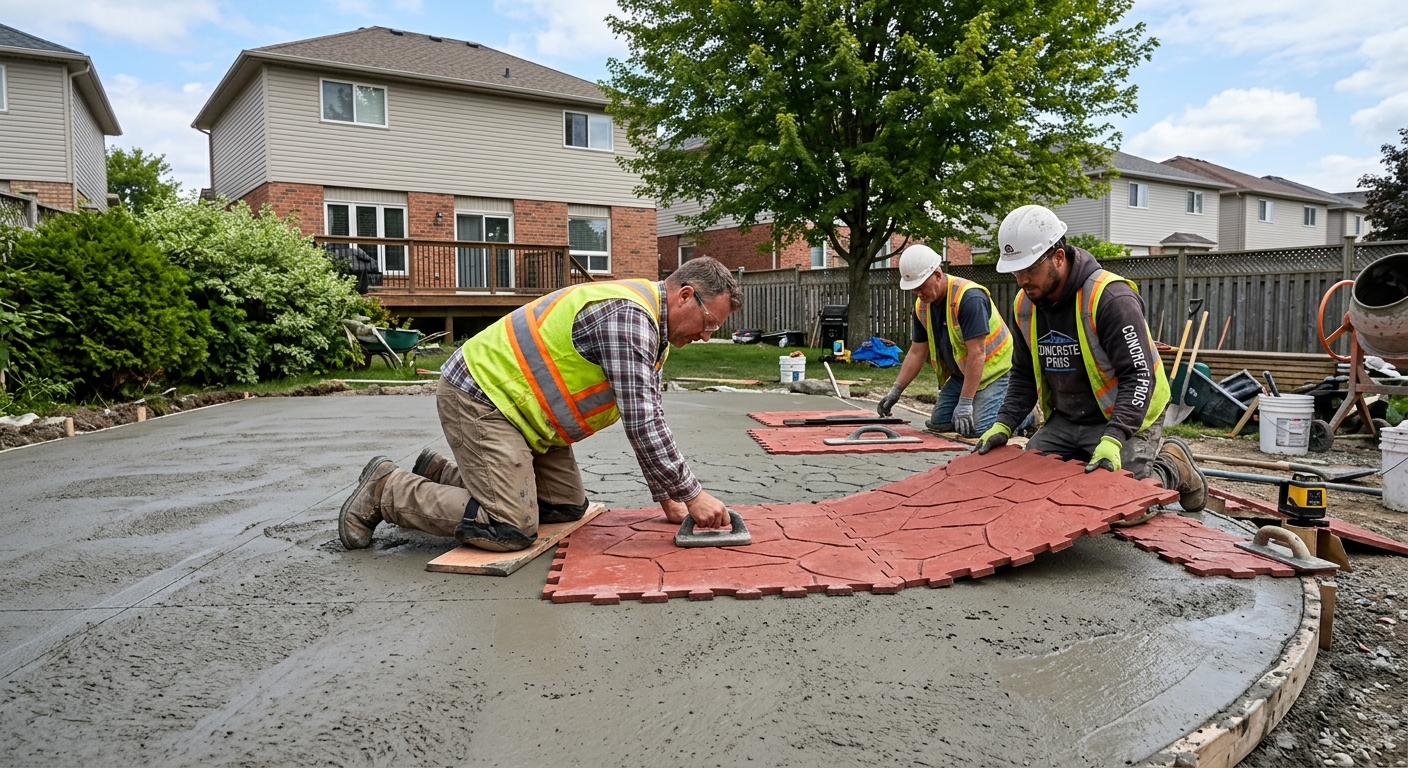
Concrete work options and costs in South Calgary
South Calgary homeowners typically choose concrete because it’s durable, repairable, and well-suited to the area’s winter weather. In this part of Calgary’s market, many households are in single-detached homes (Statistics Canada, 2021 Census), which drives demand for the common “flatwork set”: driveways, patios, walkways, and garage slabs—plus, for newer builds and upgrades, structural footings. Even on the same street, you can see different price outcomes because Calgary and the surrounding region endure frequent freeze–thaw cycles, engineered around a design frost depth of about 1.2 m. That means excavation and footing volumes are higher than in milder climates, and exterior slabs must be built to resist frost heave and salt-driven surface wear.
Contractor availability can also affect cost. Concrete crews are busiest during the interior “shoulder” months when ground conditions are stable enough for base prep and when cold-weather curing can be planned properly. In neighbourhoods such as Mahogany and the newer pockets south of Glenmore Trail, schedules often tighten because lots are frequently staged for landscaping and driveway installations around the same time.
Below is a practical cost comparison for the most requested concrete options in South Calgary, including finishes and a structural line item for foundation footings. Use it as a starting point before you request itemised quotes.
| Application |
Typical Size |
Key Spec |
Finish Option |
Price Range |
| Concrete driveway (standard broom finish) |
500–650 sq. ft. |
Air-entrained exterior mix; compacted granular base; control joints |
Broom finish |
$12,000–$18,000 |
| Exposed aggregate driveway |
500–650 sq. ft. |
Air-entrained mix; exposed stone; proper curing and sealing readiness |
Exposed aggregate |
$15,500–$22,500 |
| Stamped concrete driveway or patio |
400–600 sq. ft. |
Air-entrained exterior mix; integral colour; release agent and timing |
Stamped pattern |
$15,000–$26,000 |
| Plain concrete patio or walkway |
200–450 sq. ft. |
Air-entrained mix; compacted base; trowel/float with broom edges |
Plain with light broom |
$5,000–$9,000 |
| Garage floor (interior slab) |
520–650 sq. ft. |
Vapour control layer where needed; mesh or rebar; proper thickness |
Broom or light trowel + densifier |
$9,000–$16,000 |
| Foundation footings (structural, below frost) |
Typical house footing run(s) |
Excavate to undisturbed soil; below design frost depth; engineered reinforcement |
Structural concrete |
$28,000–$45,000 |
Prices are estimates only and vary by project scope, site access and material selection.
What affects the price of concrete work in South Calgary
In South Calgary, it’s common to see quotes for the “same” concrete job come in 30–50% apart. The reason usually isn’t the cement—it’s the engineered details around Calgary’s cold continental climate: deeper excavation tied to the frost line, freeze–thaw durability specs, and the labour/time required to do proper base prep and curing. For exterior flatwork, contractors typically build around air-entrained mixes and well-spaced control joints so the slab can survive winter scaling and seasonal movement.
Frost line depth is a big driver. Local engineering practice in Alberta uses a design frost depth of about 1.2 m, meaning footings for houses, garages, decks and retaining structures must bear on undisturbed soil below that depth to prevent frost heave. Frequent freeze–thaw cycles across the Calgary area also push costs toward air-entrained concrete and granular base prep. On top of that, cold-weather placement shortens the practical exterior pour season; when crews must use winter-grade mixes, insulated blankets, and sometimes temporary heat to keep curing on track, material and labour costs rise. Finally, de-icing salt accelerates spalling on poorly built surfaces—so sealing strategy matters for both performance and long-term maintenance.
To see how these conditions change price: (1) a straightforward broom-finished driveway with normal access may land in the $12,000–$18,000 band, while (2) a stamped driveway with more colour steps and tighter scheduling often trends into the $15,000–$26,000 range. (3) If your soil needs extra granular rework because of poor bearing, excavation can add costs quickly. In established, older neighbourhoods with mature trees and tighter lot lines, access and disposal can also push the final number above the typical band even when the square footage is the same.
| Price Factor |
Why It Matters |
Cost Impact |
| Frost line depth — determines footing depth and form height |
Footings must extend below the design frost depth to prevent frost heave |
Higher excavation = higher concrete and labour costs |
| Site preparation — excavation, grading, compacted granular base |
Proper base reduces voids and improves slab support |
Extra haul-away and base material can increase the bill noticeably |
| Reinforcement — rebar or wire mesh requirement |
Helps control cracking and supports loads |
More steel and labour for placement/dowels adds cost |
| Mix design — air-entrainment and compressive strength spec |
Exterior durability depends on proper air content for freeze–thaw resistance |
Winter-grade mixes can cost more and require stricter curing logistics |
| Finish type — broom vs. stamped vs. exposed aggregate |
Complexity and timing affect material use and crew time |
Stamped/exposed finishes typically add labour and specialty materials |
| Pour size and concrete truck access to site |
Access affects how efficiently trucks can deliver and place |
Long wheelbarrow runs, crane/boom needs, or waiting time increases labour |
| Cold-weather curing precautions — heating and blankets |
Proper curing prevents scaling and weak surface development |
Adds equipment and monitoring time in late fall/early spring |
| Control joint pattern and sealing cost |
Joints limit random cracking; sealing helps repel de-icing salt intrusion |
Proper joint saw-cut plan and sealer can be an added line item but protects the investment |
Permits & regulations in Alberta
In Alberta, the permit path depends on what you’re building with concrete. Structural concrete work—typically foundation footings, foundation walls, and grade beams—usually requires a building permit and often engineered drawings that the municipality reviews as part of the foundation approval process. For that type of work, your contractor should be coordinating inspections and documentation.
Concrete flatwork such as driveways, patios, and walkways typically does not require a permit by default. However, a permit or approval may be needed if the work affects lot grading, changes impervious surface coverage requirements, or interferes with municipal right-of-way conditions (for example, work near the boulevard or modifications affecting drainage). The safe move: confirm with the local authority before breaking ground—especially if you’re changing drainage patterns or tying into existing services.
Before you hire anyone in South Calgary, verify these items step-by-step: (1) ask for their certificate of insurance (general liability) naming you as the interested party if required, and confirm the coverage limits; (2) request proof of WSIB/WCB coverage—contractors should provide a clearance letter or documentation showing their account status; (3) ensure the contractor is properly licensed/registered for the scope of work they’re advertising, and confirm with any relevant public registry information available online. Finally, ask for references on similar-size projects completed in the last 12–24 months.
Getting concrete right in South Calgary's freeze-thaw climate
Concrete failures in South Calgary are usually predictable: freeze–thaw damage, poor base support, and curing problems. The most common homeowner-visible symptom is spalling or scaling—surface deterioration caused when water enters and the slab expands during cold cycles. To avoid that, you want the job specified around what Calgary needs, not what works “in theory” in milder regions.
Spec the work in five layers. First, base preparation: compacted granular sub-base to the correct depth for your local soil and design frost considerations, with proper grading for drainage. Second, mix design: air-entrainment targeted for exterior exposure (commonly in the 5–7% range for durable freeze–thaw resistance) and a minimum 32 MPa compressive strength spec for typical residential flatwork. Third, control joints: planned crack control at a spacing that limits random cracking. Fourth, curing: minimum 7 days under suitable conditions—cold-weather pours often require insulating blankets or temporary heat so the slab achieves strength. Fifth, sealing: a penetrating sealer applied after the cure period (often at/after 28 days) helps repel de-icing salt and reduce water uptake.
Here’s a practical dollars example. A plain broom-finished driveway may fit the $12,000–$18,000 band. A stamped option can jump toward $15,000–$26,000 because of integral colour, release agents, and higher finishing labour time. The stamp cost is justified when the base, air-entrainment, joints, and curing are still done correctly—otherwise you pay extra for aesthetics on top of a slab that may still scale.
| Spec |
Why It Matters in South Calgary |
What to Ask For |
Impact if Skipped |
| Compacted granular base (depth?) |
Unsupported or poorly compacted soil can move during freeze–thaw |
Confirm excavation depth, granular type, and compaction method |
Premature cracking, settlement, and uneven slab surfaces |
| Air-entrained concrete mix (target air %?) |
Air voids provide room for freezing water expansion in cold winters |
Ask for target air content (commonly 5–7% for exterior flatwork) |
Higher risk of scaling/spalling during Alberta winters |
| Compressive strength (MPa rating) |
Adequate strength helps resist wear and surface damage |
Minimum 32 MPa for typical residential exterior flatwork |
Weaker surface, increased dusting and early deterioration |
| Control joints (spacing per ACI guidelines) |
Joints control where cracks occur as the slab shrinks and expands |
Joint spacing and timing (saw-cut schedule) to match slab size |
Random cracking and wider repair problems over time |
| Minimum 7-day curing period |
Proper curing is critical in cold-weather placements |
How the contractor protects and maintains temperature and moisture |
Surface scaling, poor strength development, and early failure |
| Penetrating sealer (when applied after cure) |
Helps limit water and salt migration into the concrete |
Ask for penetrating sealer and timing after cure (often at/after 28 days) |
Faster spalling from de-icing salts and higher maintenance costs |
How to choose a concrete work contractor in South Calgary
Choosing the right concrete contractor in South Calgary is mostly about documentation and details—not just price. Start by verifying Alberta requirements and coverage. Request proof of general liability insurance (and confirm whether you need to be listed as an interested party). For work tied to payroll, ask for WSIB/WCB clearance or proof of active coverage. Then, ensure the contractor can clearly explain how they’ll meet the technical specs for Calgary’s freeze–thaw climate—especially air-entrainment, base prep, joint timing, and cold-weather curing plan.
When you get quotes, ask for 2–3 itemised written estimates. You want a labour + materials breakdown that shows concrete volume, reinforcement (mesh/rebar), base materials, excavation, disposal, saw cutting, curing/blankets, and sealing (if included). Avoid “lump sum only” proposals where key scope items are buried. Read the contract closely for exclusions: is permit work included where required, is disposal of excess soil included, and is removal of old concrete part of the price?
For warranty, insist on workmanship coverage length and whether it’s backed by the installer or limited to materials only. Also ask whether product/manufacturer warranties apply to stamps, sealers, or admixtures. Payment scheduling matters: never agree to pay more than 10–15% upfront, and request a holdback until completion and final walk-through. Finally, get a written start date and an estimated completion timeline that accounts for curing time, not just pour day.
- Ask for proof of WSIB/WCB clearance (or active coverage documentation) before scheduling.
- Request a current insurance certificate for general liability, and confirm coverage limits.
- Get the quote in writing with itemised labour and materials, not only a total.
- Confirm air-entrained mix and exterior durability specs in the proposal.
- Ask how much excavation and granular base they will install (and to what depth).
- Confirm reinforcement plan: mesh vs. rebar and where it will be placed.
- Require a control joint plan: spacing, saw-cut timing, and layout.
- Ask what they do for cold-weather curing (blankets/heating) and when it applies.
- Ensure sealing is specified: whether included, product type (penetrating), and timing after cure.
- Check whether disposal/haul-away is included for excess soil and old concrete.
- Verify truck access and placement method in your quote (especially with narrow lanes).
- Confirm warranty terms in writing and what triggers any claim or redo.
Concrete red flags in South Calgary include: crews rushing curing to meet an early departure date, quotes that omit air-entrainment language for exterior work, vague scope around base depth and compaction, no written joint layout (or “we’ll fix it later” approach), and contractors insisting on large upfront deposits without a holdback at substantial completion.
Frequently asked questions — concrete work in South Calgary
What is a concrete overlay and is it suited to South Calgary?
A concrete overlay is a thin cement-based topping applied over existing concrete after surface preparation. It’s sometimes a good option in South Calgary when the original slab is still structurally sound and the problem is mainly surface wear or minor scaling—not deep settlement or widespread cracking. Because Calgary’s freeze–thaw cycles can drive moisture into weak edges, proper prep is everything: grinding, cleaning, crack treatment, and using a compatible bonding system. If your driveway is already failing at the joint lines or shows movement, an overlay can hide issues temporarily rather than solve them. Cost-wise, many overlays end up cheaper than full replacement at first, but you should compare the long-term durability—especially in a market where exterior slabs often receive de-icing salts. For heavy cracking or soft base, full replacement is usually the safer route.
How do I seal concrete to protect it in South Calgary?
In South Calgary, sealing is mainly about reducing water and salt intrusion, which helps limit spalling and scaling from winter de-icers. Use a penetrating sealer designed for concrete (not just a film coating), and apply it after the slab cures properly—commonly around 28 days post-pour for typical exterior work. Before sealing, the surface needs to be clean and dry; sealers won’t bond well over dust, laitance, or moisture. Ask your contractor to specify the sealer product and the application rate (how much they plan to apply per square foot). If you’re dealing with a stamped driveway or exposed aggregate, sealing can also enhance stain resistance. In terms of cost, sealer may be an add-on compared to a basic driveway in the $12,000–$18,000 band, but it’s one of the most practical protections against Alberta winter conditions.
What is the difference between concrete and cement?
Concrete is the final building material you see and walk on; it’s a mixture of cement, water, fine and coarse aggregates (sand and stone), and often admixtures such as air-entrainment. Cement is only one ingredient—typically Portland cement or a blend—responsible for the binder that hydrates and develops strength. Homeowners often hear “cement” used casually, but when contractors quote work, they’re really specifying the entire concrete mix design: thickness, air content for freeze–thaw durability, and the compressive strength target. In Alberta’s cold continental climate, that mix design matters because air-entrainment helps the concrete survive the repeated freezing and thawing cycles. That’s also why two quotes can differ significantly even at the same square footage: one may include the correct exterior mix specs and curing protections, while another may not.
How much does concrete work cost in South Calgary?
In South Calgary, pricing depends on whether you’re doing flatwork (driveways/patios/walkways) or foundation work, plus how challenging your site access is and which finish you choose. For a typical concrete driveway (standard broom finish), many projects land around the local band of $12,000–$18,000. Plain patios and walkways commonly fall around $5,000–$9,000, while stamped concrete driveway or patio projects often run higher, around $15,000–$26,000, because they require extra labour steps and specialty materials. Foundation/footings can be a much larger scope, often estimated around $28,000–$45,000 depending on length of runs and engineered reinforcement needs. Also remember Calgary’s deeper frost considerations and winter curing requirements can raise foundation and exterior costs versus milder regions. Always compare itemised quotes for base prep, reinforcement, and curing—those details drive the real differences.
How deep must footings be for South Calgary's frost line?
Footings must be designed to bear on undisturbed soil below the frost depth used by local engineering practice for the area. For Calgary, that design frost depth is about 1.2 m (roughly 4 ft). The exact footing depth can still vary by building design, soil conditions, and engineering requirements for your specific lot, but a contractor should not propose shallow bearing without an engineer’s direction. In South Calgary’s freeze–thaw environment, skipping the frost-depth requirement risks frost heave and seasonal movement—especially around exterior structures like garages, decks, and retaining walls. If you’re building or expanding a foundation, ask for the engineered foundation plan and confirmation that excavation will reach undisturbed soil at the specified depth. That’s one area where the lowest bid is often the most expensive in the long run.
Why does concrete crack in South Calgary and how is it prevented?
Concrete in South Calgary cracks mostly because slabs shrink as they cure and expand/contract through repeated freeze–thaw cycles and seasonal moisture changes. Other contributors include inadequate base preparation, insufficient reinforcement, poor drainage, or missing/incorrect control joint planning. Prevention comes from engineering and execution: proper compacted granular base, air-entrained concrete for exterior durability, and a control joint pattern sized to limit random cracking. Timing matters too—joints must be cut/scheduled correctly so the slab cracks where it’s intended, not wherever stresses concentrate. Curing also plays a role: in cold weather, rushing curing can increase surface weakness and scaling risk. Finally, sealing helps reduce moisture intrusion from de-icing salts, which supports long-term performance. If you’re comparing quotes, look for explicit joint spacing and curing/blanket procedures, not just the finish type.