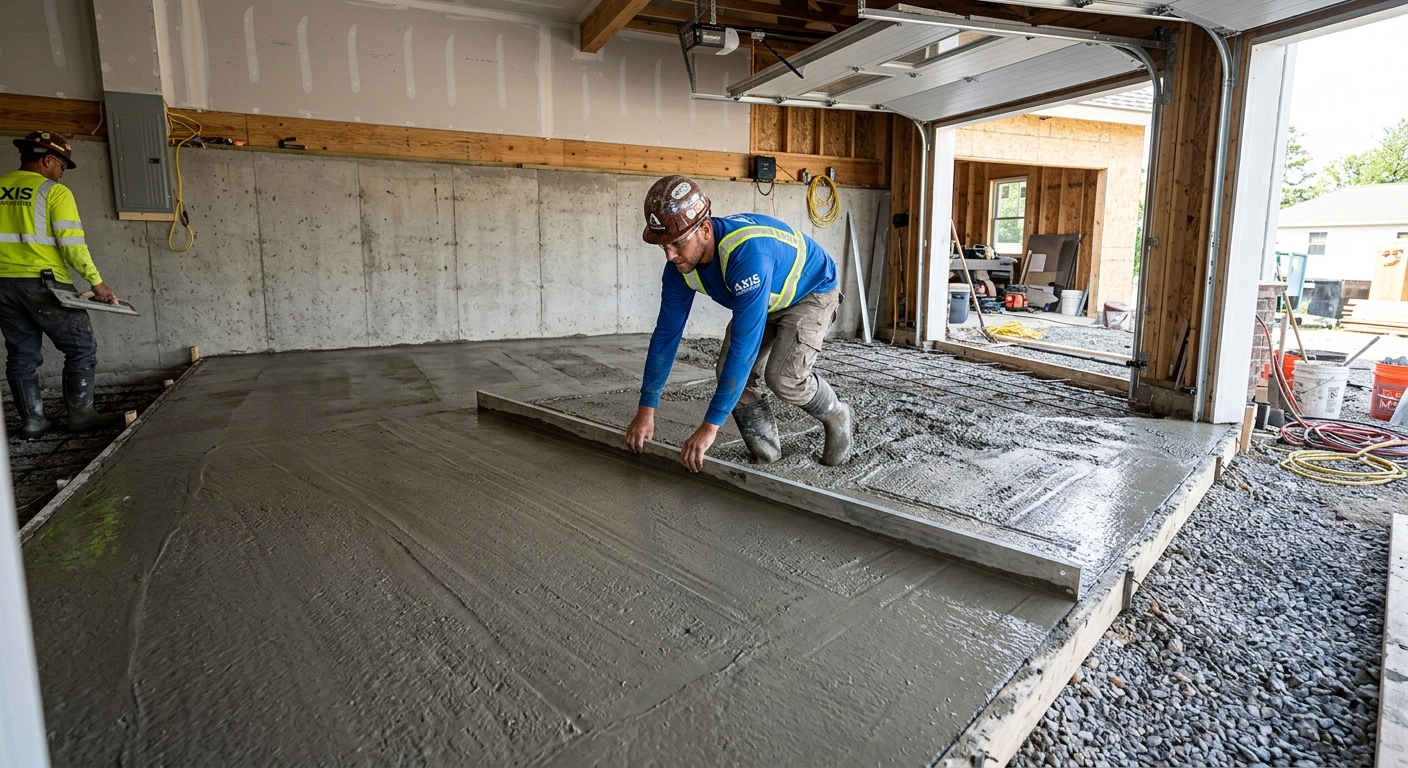
Concrete work options and costs in Millrise
Millrise, Alberta is a tight-knit community inside the Calgary region, and concrete flatwork is a regular part of home upgrades there. With a 2021 population of 6,655 (Statistics Canada, 2021 Census), demand is steady—especially from homeowners in the established areas of the neighbourhood where driveways, patios, and sidewalks get replaced as landscaping and garages are updated. Many properties are decades old, so contractors often see repeat work: driveway widening, patio refreshes, and step repairs—jobs that tie directly into freeze–thaw performance.
In Calgary’s cold continental climate, costs are shaped more by engineering details than by “just pouring a slab.” Local practice plans around a design frost depth of about 1.2 m (roughly 4 ft). That means footings for structures and any foundation-related concrete must bear below frost to limit frost heave and seasonal movement. Exterior slabs also require air-entrained mixes and careful control jointing to reduce cracking and spalling during frequent freeze–thaw cycles across the region. The practical pour season for exterior work can be shorter, so late-fall and early-spring placements may need cold-weather curing measures like insulated blankets or temporary heat—both of which affect labour and materials pricing.
Because trade availability and site conditions vary, you’ll often see the same “driveway or patio” description priced differently across the Calgary area. The table below gives realistic ranges for Millrise so you can compare apples-to-apples before calls and site visits.
| Application |
Typical Size |
Key Spec |
Finish Option |
Price Range |
| Concrete driveway (standard broom finish) |
24 ft × 12 ft (288 sq. ft.) |
Air-entrained mix, mesh/rebar as needed, control joints |
Broom finish |
$12,500–$18,000 |
| Exposed aggregate driveway |
24 ft × 12 ft (288 sq. ft.) |
Air-entrained mix, proper curing, wash exposure |
Exposed aggregate |
$15,000–$21,500 |
| Stamped concrete driveway or patio |
400 sq. ft. driveway/patio combo |
Air-entrained mix, integral colour, release and sealing |
Stamped (brick/stone pattern) |
$18,000–$28,000 |
| Plain concrete patio or walkway |
200 sq. ft. patio or 60 sq. ft. walkway |
Compacted base, air-entrained concrete, joints |
Plain float + light broom |
$5,500–$9,500 |
| Garage floor (interior slab) |
22 ft × 24 ft (528 sq. ft.) |
Vapour barrier, thickened edges as required, fibre/mesh as needed |
Standard trowel/finish |
$13,000–$19,500 |
| Foundation footings (structural, below frost) |
Single-family house typical |
Engineered footing depth/width, rebar, excavation to undisturbed soil |
Structural concrete only |
$28,000–$45,000 |
Prices are estimates only and vary by project scope, site access and material selection.
What affects the price of concrete work in Millrise
In Millrise (and across the Calgary market), two contractors can quote the “same” concrete job and end up 30–50% apart because the price isn’t just concrete—it’s excavation, base engineering, reinforcement detailing, finishing labour, curing protection, and risk. In cold-weather regions, the specification details that prevent freeze–thaw damage drive both material choices (like air-entrainment) and placement methods (like heated curing blankets). The result is that scope language matters: “driveway” can mean anything from a minimal base to a fully engineered frost-safe section with proper compaction and joint strategy.
Frost line depth is a big driver. Local practice uses a design frost depth of about 1.2 m (roughly 4 ft), which means excavation and footing volumes are higher for foundations and any structural element bearing below frost. Freeze–thaw cycles also dictate air-entrained mixes for exterior flatwork and well-spaced control joints to limit random cracking and surface scaling. When you pour later in the year or early in spring, you may need winter-grade concrete, insulation blankets, and sometimes temporary heat to protect curing—costs that show up quickly in the final number. Finally, de-icing salts accelerate surface deterioration if the surface system isn’t built and sealed correctly, so sealing and surface prep can be a necessary line item rather than an optional upgrade.
In Millrise, I typically see excavation depth and base thickness raising cost where soil is disturbed near grade, and lowering cost where access is clean and the right-of-way isn’t involved. For example, a standard broom-finished driveway often tracks closer to the $12,000–$18,000 range, while a stamped option with integral colour and more labour usually sits higher—consistent with the $15,000–$26,000 stamped/decorative band for many comparable projects. The climate and housing-stock reality (older lots needing regrading and more prep) is often why a “quick” replacement estimate turns into a full base rebuild once the site is assessed.
| Price Factor |
Why It Matters |
Cost Impact |
| Frost line depth — determines footing depth and form height |
Footings must bear below frost to prevent heave and seasonal movement |
Higher excavation and concrete volume; can swing structural pricing significantly |
| Site preparation — excavation, grading, compacted granular base |
Proper grading and base thickness reduce settlement and cracking |
Additional trucking, labour, and granular materials for poor-draining or disturbed soils |
| Reinforcement — rebar or wire mesh requirement |
Reinforcement controls crack width and improves performance under loads |
Material cost plus time for correct spacing, chairs, and overlap |
| Mix design — air-entrainment and compressive strength spec |
Air content supports freeze–thaw durability; strength supports structural capacity |
Higher-spec mix and batching; modest material increase but big risk reduction |
| Finish type — broom vs. stamped vs. exposed aggregate |
Complex finishes add labour time and require stricter timing |
Stamped and exposed work typically costs more than plain broom finish |
| Pour size and concrete truck access to site |
Access affects how efficiently concrete can be placed and consolidated |
Extra labour for hand-carrying, pumping, or multiple truck cycles |
| Cold-weather curing precautions — heating and blankets |
Cold slows strength gain and increases scaling/spalling risk |
Insulated blankets, heaters, labour monitoring, and scheduling adjustments |
| Control joint pattern and sealing cost |
Joints manage shrinkage cracking; sealing helps resist de-icing salt damage |
Minor-to-moderate line items that protect the larger investment |
Permits & regulations in Alberta
In Alberta, structural concrete work typically needs a building permit. That includes foundation footings, foundation walls, and grade beams—any concrete element that supports the building’s structure. For many projects, engineered drawings are also reviewed by the municipality or building authority before work begins. For concrete flatwork like patios, walkways, and standard driveways, a permit often isn’t required by default, but it can be triggered if the work affects lot grading, changes drainage patterns, increases impervious surface beyond site requirements, or touches municipal right-of-way areas (like curb/sidewalk interfaces). When you’re in Millrise, the safest approach is to confirm requirements with the local authority before breaking ground, especially if you’re reworking slope, adding retaining elements, or tying into existing concrete.
From a homeowner perspective, also verify the contractor is properly insured and qualified: ask for proof of liability insurance and WSIB/WCB coverage (whichever applies to their business structure). To check coverage, use the certificate of insurance provided—make sure it lists your project address correctly or includes evidence it extends to your contractor’s scope. For licensing and registration, rely on Alberta’s online registries or the appropriate provincial contractor verification resources, and request a clearance letter or equivalent documentation when available. Finally, ask for references on similar Calgary-area projects (exterior flatwork with freeze–thaw detailing and recent winter scheduling) and confirm they’ll follow the approved drawings for any structural pour.
Getting concrete right in Millrise's freeze-thaw climate
Concrete failures in Millrise usually come down to one of five things: weak base prep, the wrong mix, poor reinforcement placement, inadequate control joints, or curing that doesn’t match the weather. In a freeze–thaw-heavy climate, the biggest avoidable problem is spalling and surface scaling caused by inadequate air-entrainment or rushed curing. For a durable exterior slab, you spec the system—not just the slab thickness.
First, base preparation matters: excavation and grading should reach the right depth for compacted granular sub-base, allowing drainage and a stable foundation through seasonal movement. Second, the mix design should include air-entrainment; for exterior flatwork, a typical target air content is around 5–7%. The concrete should also meet a minimum compressive strength requirement (commonly 32 MPa for many flatwork specifications, depending on the engineered/design needs). Third, control joints must be spaced to limit random cracking—then finished so joints don’t become weak spots. Fourth, curing should be at least 7 days under suitable conditions; when cold weather hits, you protect curing with insulation blankets and, in some cases, temporary heat to keep strength gain on track. Fifth, sealing should be applied after proper cure—often at the 28-day mark—so de-icing salts don’t aggressively attack the surface.
If you’re choosing between options, the price difference is usually justified when it buys performance. For example, upgrading from plain broom finish toward exposed aggregate or stamped work can add cost (often moving you into the higher band for decorative finishes), but the real value is when paired with the same frost-safe base, the right air-entrained mix, and proper curing. Without those basics, finish upgrades won’t prevent cracking or spalling.
| Spec |
Why It Matters in Millrise |
What to Ask For |
Impact if Skipped |
| Compacted granular base (depth?) |
Stable support reduces settlement and frost-related movement |
Documented excavation depth and granular base thickness + compaction test |
Cracks, uneven slab, and early failure around edges and joints |
| Air-entrained concrete mix (target air %?) |
Air bubbles give room for freeze expansion |
Target 5–7% air content for exterior flatwork |
Spalling and scaling from freeze–thaw cycles, especially with salt |
| Compressive strength (MPa rating) |
Strength gain supports long-term durability under vehicle and foot traffic |
Minimum 32 MPa (or project-specific spec) |
Lower durability and increased surface wear/cracking |
| Control joints (spacing per ACI guidelines) |
Manages shrinkage cracking in a predictable line |
Joint spacing plan and saw-cut timing |
Random cracking paths and wider cracks over time |
| Minimum 7-day curing period |
Proper curing enables strength development and reduces surface damage risk |
Confirm curing method and cold-weather plan |
Surface scaling, dusting, and reduced strength at early age |
| Penetrating sealer (when applied after cure) |
Repels de-icing salt and helps protect the pore structure |
Apply after curing—typically around 28 days post-pour |
Faster salt-related deterioration and more frequent repairs |
How to choose a concrete work contractor in Millrise
Choosing the right concrete contractor in Millrise starts with verification and documentation. In Alberta, structural concrete work should be coordinated under the proper permit process, and reputable contractors will carry liability insurance and WSIB/WCB coverage for their workers. To check this, request (1) a current certificate of liability insurance that matches your contractor’s business name and includes coverage for the scope, (2) proof of WSIB/WCB registration/coverage in their name, and (3) the applicable Alberta contractor registration details from the relevant online registry resources. Don’t accept a verbal “we’re covered”—get the paperwork.
Next, compare 2–3 itemised written quotes, not lump sums. Ask for a labour + materials breakdown that shows excavation/base work, reinforcement, concrete supply, finishing, sealing (if included), and any disposal or permit-related items. Read the exclusions: for example, is snow removal or winter protection included? Will they handle saw-cutting and joint sealing (if specified)? Also confirm timeline and scheduling—get a start date and a completion estimate in writing, since cold-weather work can affect curing.
Warranty matters. Ask for workmanship warranty length and whether it’s tied to specific failures (spalling, cracking due to improper materials, joint problems). Product/manufacturer warranties apply to sealers or additives; ask if they’re transferable and what they cover. For payment, keep it conservative: never pay more than 10–15% upfront, and hold back a portion until the job is fully complete and cured as required for exterior work.
- Provide proof of liability insurance and WSIB/WCB coverage before signing.
- Use itemised quotes (labour, concrete, excavation, granular base, reinforcement, finish, sealing).
- Confirm if control joints and saw-cut timing are included.
- Ask whether the concrete mix is air-entrained and what target air content is.
- Request confirmation of minimum compressive strength (e.g., 32 MPa unless engineered otherwise).
- Verify cold-weather curing precautions are included if temperatures drop.
- Clarify disposal costs: removal of excess soil, hauling, and dump fees.
- Check whether base compaction testing or documented compaction is included.
- Confirm who supplies and places reinforcement (mesh/rebar) and the placement method.
- Get the finishing plan in writing (broom, exposed aggregate, stamped, sealer type).
- Confirm warranty terms, including what failures are covered and when.
- Agree on payment schedule and holdback; avoid large upfront payments.
Concrete red flags I’ve seen in Millrise include: quotes that don’t mention air-entrainment for exterior slabs, vague “we’ll prep the base” wording without thickness/compaction details, no clear joint plan (spacing and saw-cut timing), missing cold-weather curing protection in late-season scheduling, and contractors who want most payment up front or won’t provide insurance and coverage documentation.
Frequently asked questions — concrete work in Millrise
Concrete vs pavers for a patio in Millrise?
In Millrise and across Alberta’s freeze–thaw climate, both concrete and pavers can perform well, but they fail differently. Concrete patios, when built with a compacted granular base, an air-entrained mix and the right control joints, usually give a smoother surface and fewer joint movements to manage. Pavers can be excellent for aesthetics and easier spot repairs, but they rely on excellent sub-base and edge restraints—if the base shifts, you’ll see unevenness. Price-wise, a plain concrete patio commonly lands around $5,000–$9,000 for typical projects, while decorative options can move higher depending on finish. Ask each contractor how they handle drainage, compaction, and freeze–thaw detailing; those details matter more than the material name.
How long does a concrete driveway last?
A well-built concrete driveway in Millrise can last decades, but longevity depends on the engineering details that handle Alberta winters. Key factors are air-entrained concrete for freeze–thaw durability, a proper compacted granular base sized for the frost depth considerations, correct reinforcement placement (mesh/rebar where needed), and a joint pattern that manages cracking. Curing is equally important—if placed in colder periods, inadequate winter protection can lead to scaling and surface deterioration that shortens service life. If you’re budgeting, many standard driveways align with the $12,000–$18,000 band when the prep and specs are done right. When those elements are skipped to cut cost, the driveway may show issues far sooner, particularly where de-icing salts sit along edges and wheel paths.
What is air-entrained concrete and why does it matter here?
Air-entrained concrete is mixed with tiny, evenly distributed air bubbles designed to reduce freeze–thaw damage. In Millrise, freeze–thaw cycles and de-icing salts create a harsh environment for concrete surfaces; without the right air content, water expands as it freezes and can push the surface layers apart, leading to spalling or scaling. That’s why local exterior work is engineered around air-entrainment and control joints. For many exterior slabs, contractors target about 5–7% air content, and they should confirm the mix meets the project strength requirement (often 32 MPa for typical flatwork specs, depending on engineering). When you’re comparing quotes, ask the contractor to state the air-entrainment spec and the curing plan—those are the details that directly protect your investment over Alberta winters.
How do I prepare the base for a concrete slab?
Base preparation is the foundation of a durable slab in Millrise. A contractor should excavate to the designed subgrade and then place and compact a granular sub-base to the required depth, ensuring stable support and drainage. The base should be graded to the correct slope, especially for driveways and patios, so water doesn’t pool and freeze under the slab. Compaction is not optional—settlement after the pour is a common cause of cracking and uneven surfaces. In cold climates with deeper frost considerations (about 1.2 m design frost depth in this region), the excavation and base design are engineered to bear on stable ground and limit frost-related movement. Ask your contractor what granular type they use, how they confirm compaction, and whether reinforcement chairs/spacers are used correctly so mesh stays in the correct position.
How do I compare concrete quotes?
Comparing concrete quotes is easiest when you require itemised scope details. Don’t compare only the total price—compare what’s included. Ask each contractor to break down excavation and granular base work, reinforcement (mesh or rebar), concrete mix specification (including air-entrainment for exterior slabs), finishing method (broom vs stamped vs exposed aggregate), and whether sealing and disposal are included. For timing, request a curing plan if temperatures drop; cold-weather curing precautions (blankets/heating where needed) can change the cost, but they’re what protect the surface. In Millrise, standard driveways often price around $12,000–$18,000, while decorative stamped jobs can move into the higher decorative band (often $15,000–$26,000 depending on size and scope). If a quote is much cheaper, ask what engineering details were reduced.
Can concrete be poured in cold weather in Millrise?
Yes, concrete can be poured in cold weather in Millrise, but it shouldn’t be treated as “business as usual.” The critical issue is curing: cold temperatures slow strength gain and increase the risk of surface scaling, dusting, and long-term performance problems. Contractors typically use cold-weather methods such as winter-grade mix adjustments, insulated curing blankets, and sometimes temporary heat to keep the slab within an acceptable curing temperature range. The pour season can be shorter in Calgary’s region because freeze–thaw cycles are frequent and unpredictable, so scheduling and protection matter. When you’re getting quotes, ask specifically how they’ll protect curing, how long they’ll insulate, and what minimum curing period they plan to meet (commonly at least 7 days under proper conditions). If a contractor can’t explain the curing protection plan, that’s a red flag—especially for exterior driveways, patios, and walkways.