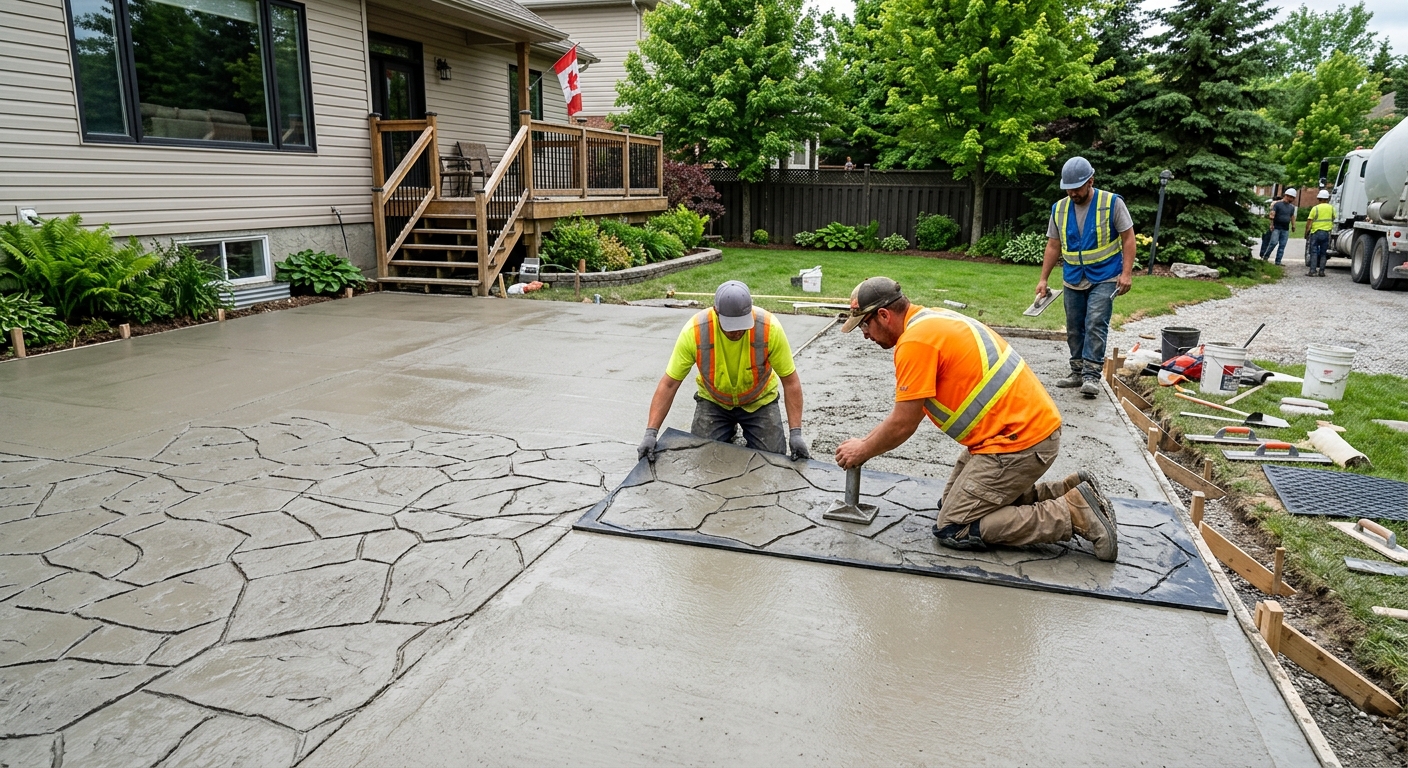
Concrete work options and costs in Bow Island
Bow Island has a lot of single-detached homes, and with 83.0% of dwellings in that style (Statistics Canada, 2021 Census), concrete flatwork is a year-round need: driveways, patios, walkways, and interior garage slabs are among the most common projects homeowners plan. In 2021, Bow Island had 2,036 residents (Statistics Canada, 2021 Census), and that small, steady market tends to concentrate concrete crews into the busiest jobs near warmer months—especially around established neighbourhoods like the downtown core and the older residential lanes close to 4th Street, where driveways and entry steps are frequently replaced.
In the Lethbridge–Medicine Hat economic region, pricing is heavily shaped by deep frost and aggressive freeze–thaw cycles. Footings for structural work are taken below frost—often in the 5–6 ft range—so excavation and forming can drive cost up versus milder climates. For exterior slabs, the mix must be air-entrained and properly cured to resist surface scaling and internal damage as water repeatedly freezes and thaws. Because the practical pour season can be shorter, cold-weather pours may require insulating blankets or heaters, which adds labour and materials.
At the same time, costs can be lowered when access is straightforward, soils are suitable, and base prep is done right the first time. The good news: by matching the right spec to the finish you want, you can compare quotes fairly—so the next table breaks down common options and realistic price bands for Bow Island.
| Application |
Typical Size |
Key Spec |
Finish Option |
Price Range |
| Concrete driveway (standard broom finish) |
24 ft x 20 ft (480 sq ft) |
Air-entrained exterior mix, control joints, compacted granular base |
Broom finish |
$6,720–$10,560 |
| Exposed aggregate driveway |
24 ft x 20 ft (480 sq ft) |
Proper base, air-entrained mix, retarder/exposure process |
Exposed aggregate |
$8,640–$13,440 |
| Stamped concrete driveway or patio |
20 ft x 15 ft (300 sq ft) |
Air-entrained mix, color hardener, release agent, control joints |
Stamped pattern |
$6,000–$9,600 |
| Plain concrete patio or walkway |
12 ft x 12 ft (144 sq ft) |
Air-entrained exterior mix, drainage grade, joints as needed |
Plain trowel or light broom |
$1,728–$2,880 |
| Garage floor (interior slab) |
24 ft x 24 ft (576 sq ft) |
Vapour barrier (as required), fibre or mesh, 30–35 MPa mix |
Power trowel + light burnished finish |
$10,368–$16,128 |
| Foundation footings (structural, below frost) |
Typical footing system for a small home |
Excavate below frost, structural concrete, rebar per engineer |
Structural concrete only |
$11,520–$23,040 |
Prices are estimates only and vary by project scope, site access and material selection.
What affects the price of concrete work in Bow Island
In the Lethbridge–Medicine Hat region, it’s common to see quotes for the “same” concrete job land 30–50% apart. The gap usually isn’t the concrete itself—it’s what’s bundled into the scope: depth of excavation, granular base preparation, reinforcement, mix design, curing provisions, and the finish system. In Alberta climates like Bow Island, those items change because freeze–thaw cycles and frost depth dictate the design. Exterior work needs air-entrained concrete mixes so the water pressure from freezing doesn’t damage the paste. Structural footings must extend below the design frost depth, often up to 2.4 m in Alberta-type design scenarios, which drives excavation and forming costs higher.
Cold-weather timing also matters. When the pour season is shorter, crews may concentrate work into warmer windows, and any late-season pours may require insulating blankets, heaters, or accelerators. That adds labour and materials, and it can shift scheduling so labour rates effectively rise with demand. De-icing salts used by homeowners can accelerate surface spalling if the mix and sealing plan aren’t addressed early—so sealing becomes part of long-term value.
Two examples from Bow Island that move the price: (1) an exposed aggregate or stamped driveway often costs more than a broom-finished slab—up to the higher stamped/decorative band of $20–$32 per sq ft—because it requires extra colour materials and more careful finishing steps; (2) if soils are poor or drainage is unclear, excavation and base depth go up, even for a plain patio in the lower $12–$20 per sq ft band.
| Price Factor |
Why It Matters |
Cost Impact |
| Frost line depth — determines footing depth and form height |
Footings must sit below frost to prevent heave and movement |
High: deeper excavation increases labour and material volumes |
| Site preparation — excavation, grading, compacted granular base |
Base compaction controls settlement and helps water drain away |
Medium to high: poor soils require more removal and rework |
| Reinforcement — rebar or wire mesh requirement |
Improves crack control and slab durability under load |
Medium: materials and placement time add up |
| Mix design — air-entrainment and compressive strength spec |
Freeze–thaw survival depends on air entrainment and proper strength |
Medium: higher-spec mix can cost more but reduces failures |
| Finish type — broom vs. stamped vs. exposed aggregate |
Different systems require different materials and labour |
Varies: stamped/exposed typically adds the most |
| Pour size and concrete truck access to site |
Access affects whether pumping is needed and pour staging |
Medium: narrow drives, distance, or pump fees add cost |
| Cold-weather curing precautions — heating and blankets |
Concrete gains strength slower at low temps and needs protection |
Medium to high: added labour, heaters/blankets, and time |
| Control joint pattern and sealing cost |
Joints manage cracking; sealing helps resist salt scaling |
Low to medium: small materials cost, big performance impact |
Permits & regulations in Alberta
In Alberta, structural concrete work—such as foundation footings, foundation walls, and grade beams—typically requires a building permit and is often tied to engineered drawings reviewed by the municipality. Concrete flatwork (driveways, patios, walkways) usually does not require a permit by default, but it can if the work affects lot grading, changes drainage patterns, increases impervious surface coverage beyond local allowances, or impacts municipal right-of-way requirements. Always confirm requirements with the local authority before breaking ground so you don’t end up redoing base grades or curb cut details.
For homeowners in Bow Island, the practical verification steps should go like this. First, ask for the contractor’s business information and proof they’re operating legally in Alberta. Second, request a certificate of liability insurance (and check the coverage limits match your project size). Third, ask for WSIB/WCB clearance or proof of coverage—then read it for the legal name and policy period, not just a photo. Fourth, confirm they can provide references from similar-scale concrete jobs in the Lethbridge–Medicine Hat area (driveways, exterior slabs, and footing work if applicable). Finally, get everything you discussed—scope, base depth, reinforcement, curing plan, and disposal details—written in the estimate you’ll sign.
If any of those items are “too hard” to provide, that’s a red flag. Concrete failures in freeze–thaw climates aren’t forgiving, and permits/insurance are part of protecting you.
Getting concrete right in Bow Island's freeze-thaw climate
Concrete fails in Bow Island’s freeze–thaw climate when water gets inside the slab or when the slab isn’t supported and cured properly. The fix is all in the spec: correct base preparation, the right air-entrained mix, properly spaced control joints, proper curing protection, and a sealing plan that matches how southern Alberta de-icing is used. Start with the base: compacted granular sub-base to the correct depth for local soils and frost conditions (enough to prevent pumping and settlement). Next, use an air-entrained exterior mix—typical target air content for exterior flatwork is in the 5–7% range—to protect against spalling when water freezes. Specify a minimum 32 MPa compressive strength for exterior durability, and don’t treat it as an afterthought.
Control joints are critical in this region. They guide where shrinkage and temperature movement occurs, so the slab cracks in planned lines rather than random hairline fractures. For curing, plan at least 7 days of curing under suitable conditions; when conditions are cold, additional blankets/heaters are often justified to reach the strength needed before loading or backfill. Finally, sealing matters: apply a penetrating sealer about 28 days after the pour, so it can repel water and reduce the effect of salts on the surface.
When you’re comparing options, an upgrade is only “worth it” when it’s tied to performance. For example, paying the higher stamped/decorative band (often around $20–$32 per sq ft) can be justified for curb appeal—but only if the contractor still meets the freeze–thaw specs: air entrainment, correct joints, and curing. Otherwise, you’re spending more for the same underlying durability risks.
| Spec |
Why It Matters in Bow Island |
What to Ask For |
Impact if Skipped |
| Compacted granular base (depth?) |
Prevents pumping, settlement and keeps water from holding under the slab through freeze–thaw cycles |
Confirm base depth, compaction method, and drainage grade for your soil type |
Higher settlement and early cracking/spalling |
| Air-entrained concrete mix (target air %?) |
Air voids relieve freeze pressure so exterior slabs survive winter scaling |
Ask for exterior air content target and proof of the mix design |
Spalling and surface scaling in 1–3 winters |
| Compressive strength (MPa rating) |
Strength gain supports durability and load resistance in freeze–thaw conditions |
Confirm minimum 32 MPa for exterior flatwork; engineering spec for structural work |
Weak surface, more cracking, reduced lifespan |
| Control joints (spacing per ACI guidelines) |
Controls where cracks open during shrinkage and temperature movement |
Ask for proposed joint spacing and layout tied to slab dimensions |
Random cracking patterns and water infiltration |
| Minimum 7-day curing period |
Low temps slow strength development; curing protection protects against early damage |
Ask what curing method is used when nights are cold (blankets/heaters) |
Lower strength and increased early surface deterioration |
| Penetrating sealer (when applied after cure) |
Helps reduce water and salt penetration from Alberta winter use |
Confirm sealer type and timing (around 28 days post-pour) |
More salt scaling and faster surface breakdown |
How to choose a concrete work contractor in Bow Island
Choosing a concrete contractor in Bow Island comes down to verifying credentials, reading scope details, and making sure the quote matches what your freeze–thaw climate requires. In Alberta, structural concrete (footings, foundation walls, grade beams) should be permitted and executed under appropriate engineered requirements. For any concrete work, ask for (1) proof of liability insurance (certificate showing your contractor’s legal name and active coverage), and (2) WSIB/WCB clearance or coverage proof. You can verify licensing/standing through Alberta’s online contractor resources, and you should always confirm dates and names directly from documents—not from verbal assurances.
Then request 2–3 itemised written quotes. The best quotes break down labour and materials and clearly list things like base prep depth, reinforcement (wire mesh vs. rebar), concrete mix design, thickness, finishing method, curing and any cold-weather plan. Pay close attention to exclusions: disposal, saw-cut control joints, dumpster placement, permit handling (if applicable), and site protection. Warranty matters too—ask how long workmanship coverage lasts, whether the product warranty is manufacturer-backed, and whether either is transferable if you sell the home.
For payment, a safe schedule is to never pay more than 10–15% upfront. Hold back enough to ensure quality checks are completed, and tie release of final payment to completion of curing protection, cleanup, and joint sealing as specified. Get the start date and completion estimate in writing, and ask how they handle schedule pressure when the exterior pour season compresses.
- Ask for Alberta liability insurance certificate before signing.
- Request WSIB/WCB clearance/coverage proof and confirm policy dates.
- Get itemised quotes (labour + materials), not a single lump number.
- Confirm slab thickness, base depth, and compaction method.
- Require exterior mix to be air-entrained and specify the target.
- Ask for reinforcement details (mesh vs. rebar, placement height).
- Confirm control joint layout and whether they’re saw-cut or formed.
- Ask how they cure—especially if nights are cold.
- Confirm sealing scope and timing for penetrating sealer.
- Clarify disposal: topsoil removal, haul-off, and dumpster fees.
- Verify truck access plan and whether pumping/extra labour is included.
- Make sure the quote includes surface protection during cure and early use.
Concrete contractor red flags in Bow Island include vague quotes that don’t state base depth or mix spec, promises to “pour anytime” without a cold-weather curing plan, missing insurance/WSIB/WCB paperwork, and skipping control joint layout or sealing because “it’s optional.” Another warning sign is pressure to pay most of the job upfront or refusing to provide references for similar freeze–thaw exterior slabs.
Frequently asked questions — concrete work in Bow Island
Concrete vs pavers for a patio in Bow Island?
In Bow Island and the Lethbridge–Medicine Hat region, the decision mostly comes down to maintenance and freeze–thaw behaviour. Concrete patios are typically less work to build as a single monolithic surface and, when properly air-entrained and jointed, they hold up well through winter. A concrete patio also benefits from a predictable finish and fewer weeds compared to joints in paver systems. Pavers can look great and are repairable section-by-section if individual units shift, but they still require a well-graded base, correct compaction, and proper edge restraint to avoid movement during freeze–thaw. Pricing varies by size and details; a plain concrete patio is often in the $12–$20 per sq ft range, while pavers usually add base, edging, and labour complexity. If your soil is questionable or drainage is hard to manage, ask contractors to show their base prep plan for either option.
How long does a concrete driveway last?
A properly built concrete driveway in southern Alberta commonly lasts decades. In Bow Island’s freeze–thaw climate, the “lifespan driver” is whether the slab is built for water resistance and movement control: air-entrained exterior mix, correct granular base prep, proper thickness, reinforcement as needed, and a joint plan. If those are done right and the homeowner avoids aggressive salt use or adds sealing, performance is much better. If skipped, you’ll often see surface scaling and spalling sooner—sometimes within a few winters—because freezing expands water trapped near the surface. That’s why quotes for exterior slabs can differ a lot even before finishing changes. If you’re comparing driveway options, remember the finish systems can add cost—like broom-finished standard work versus exposed aggregate or stamped—but the durability spec matters more than the look. Make sure your quote includes curing protection in colder shoulder periods.
What is air-entrained concrete and why does it matter here?
Air-entrained concrete has microscopic air bubbles purposely built into the mix. In Alberta, that’s important because freeze–thaw cycles cause water inside concrete to freeze and expand; the air bubbles give the freezing water room to expand without blowing apart the paste. For exterior flatwork in Bow Island, that’s one of the main reasons contractors specify exterior mixes instead of “regular” mixes. If air entrainment is missing or wrong, spalling and surface scaling can show up even when the slab looks fine at first. That’s also why your quote should mention the mix design, not just the finish. A broom-finished driveway may sound “basic,” but in southern Alberta it still needs proper air entrainment and curing. If you ever see a quote that won’t discuss mix spec or curing, it’s worth asking direct questions before work starts.
How do I prepare the base for a concrete slab?
Base prep is where long-term performance is won or lost. For a concrete slab in Bow Island, the contractor should remove topsoil/organic material, grade to the right slope for drainage, and place compacted granular base to a depth appropriate for soil conditions and slab use. Compaction matters because poorly compacted base can settle, creating cracks and allowing water to sit near the slab edges during winter. The base should be free-draining where possible and aligned with the frost-protection approach used for your type of work. For exterior slabs, ask how they address water management around the driveway or patio—especially near doors and downspout discharge points. Your quote should state the base depth, compaction method, and whether reinforcement is included and placed at the correct height. If those details aren’t provided, request them in writing before committing.
How do I compare concrete quotes?
To compare concrete quotes fairly in Bow Island, don’t start with the lowest total—start with scope and specs. Ask each contractor for itemised pricing that separates labour and materials, including base preparation depth, excavation/haul-off, reinforcement, concrete thickness, mix design (including air entrainment for exterior work), and finishing steps. Confirm whether the quote includes saw-cut control joints, disposal/dumpster costs, and any sealing plan for exterior slabs. Also check curing provisions: if cold nights are expected, the contractor should have a plan for blankets/heaters so concrete can reach strength. Compare the final cost against the local price bands; for example, a plain patio may often land around $12–$20 per sq ft, while stamped decorative work typically sits higher, commonly around $20–$32 per sq ft. If one quote is dramatically cheaper, ask what’s missing—most often it’s base prep, mix spec, reinforcement, or curing.
Can concrete be poured in cold weather in Bow Island?
Concrete can be poured in cold weather in Bow Island, but it should be done with a controlled cold-weather plan. The core issue is that concrete gains strength more slowly when temperatures drop, and early freezing can reduce final performance. A responsible contractor will use protection measures like insulating blankets, heaters, and sometimes accelerators—plus they’ll monitor conditions so curing continues long enough for the slab to reach the needed strength before backfilling or heavy use. Your quote should spell out what they’ll do if the forecast changes. Don’t accept vague statements like “we’ll pour anyway” without talking about curing and protection. Also note that exterior timing matters more in freeze–thaw climates: even if a pour goes smoothly, insufficient curing can lead to scaling or premature cracking. When comparing estimates, ask how they manage cold-weather pours and what additional costs (materials and labour) are included.