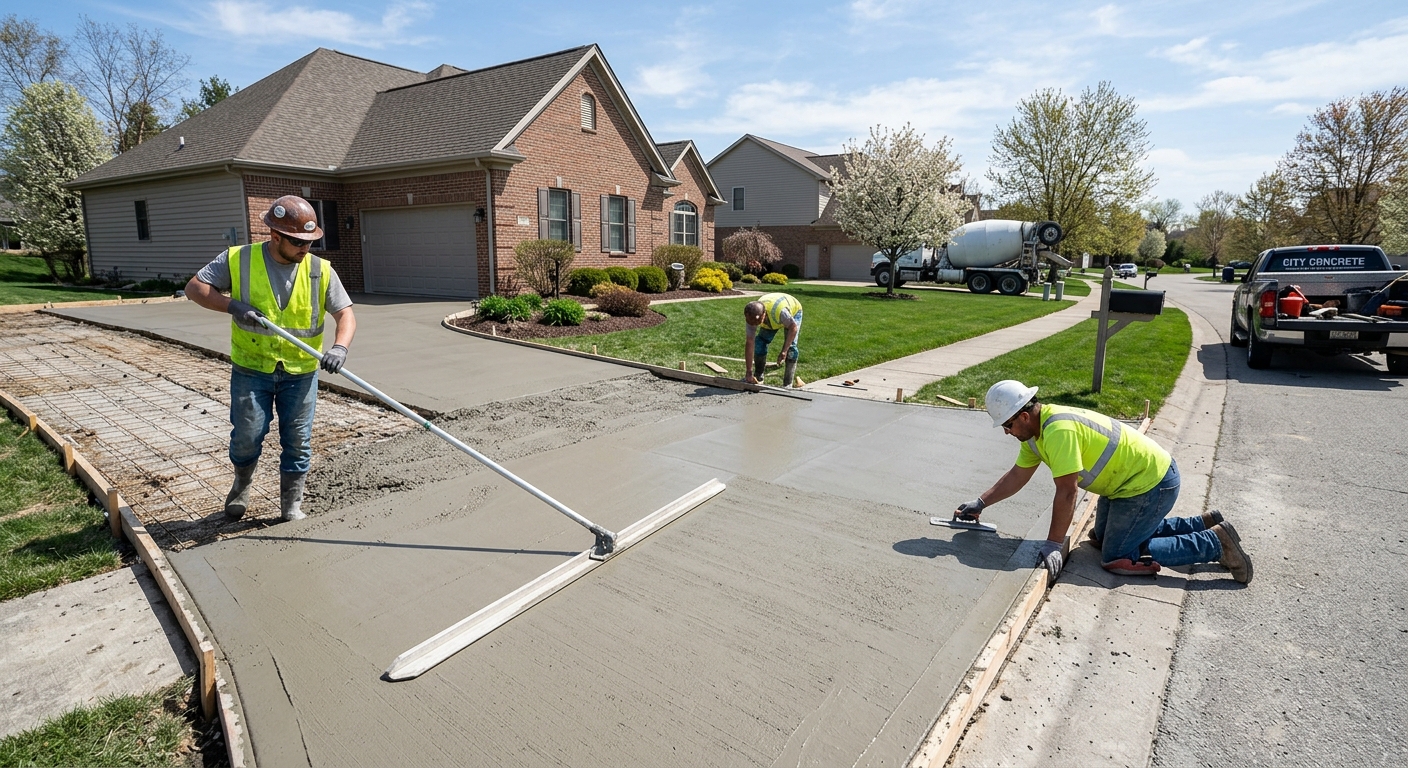
Concrete work options and costs in Ellerslie
Ellerslie, Alberta is a smaller community within the Calgary economic region (population 5,552 per the Statistics Canada, 2021 Census), and that shows up in how concrete crews schedule work around the short exterior pour season. In most Calgary-area neighbourhoods—especially the newer family pockets around Ellerslie-area residential development—driveways, patios and walkways are among the first “must-haves” when homeowners finish the landscaping. Because exterior concrete here is exposed to frequent freeze–thaw cycles, the specs aren’t optional: footings and slabs have to be built to handle frost movement, and exterior mixes must be air-entrained to reduce scaling and spalling.
Pricing also reflects the cold continental climate. In practice, Calgary’s frost design depth drives deeper excavation and larger footing volumes than in milder regions, which is why foundation/footings pricing tends to sit higher. It also means more granular base prep, more careful compaction, and more attention to curing—especially if you’re pouring later in the year or early spring. When contractors have tighter winter scheduling, labour availability can tighten and mobilization costs can rise.
If you’re comparing options, it helps to start with realistic budget ranges. Use the table below to align your finish choice—standard broom, exposed aggregate, stamped—then we’ll translate those numbers into the technical specs that protect the concrete over the long term.
| Application |
Typical Size |
Key Spec |
Finish Option |
Price Range |
| Concrete driveway (standard broom finish) |
400–500 sq ft (typical 2-car) |
Air-entrained exterior mix; compacted granular base |
Broom finish, light saw-cut control joints |
$12,000–$18,000 |
| Exposed aggregate driveway |
400–500 sq ft (typical 2-car) |
Surface retard/aggregate exposure plan; air-entrained mix |
Exposed aggregate with sealer |
$15,000–$22,000 |
| Stamped concrete driveway or patio |
300–500 sq ft (varies by layout) |
Color hardener (where selected); air-entrained exterior mix |
Stamped patterns + integral or overlay color |
$15,000–$26,000 |
| Plain concrete patio or walkway |
200–400 sq ft |
Minimum 32 MPa concrete; compacted base |
Float and broom or light broom finish |
$5,000–$9,000 |
| Garage floor (interior slab) |
400–600 sq ft |
Vapour barrier, reinforcement option by engineer/design |
Satin/steel-trowel finish or light broom |
$10,000–$16,000 |
| Foundation footings (structural, below frost) |
Typical single-family footing perimeter |
Engineered layout; poured concrete below design frost depth |
Structural formwork + steel as required |
$28,000–$45,000 |
Prices are estimates only and vary by project scope, site access and material selection.
What affects the price of concrete work in Ellerslie
In Ellerslie and across the Calgary region, it’s common to see quotes for the “same” concrete job come in 30–50% apart. The difference usually isn’t the concrete itself—it’s the engineered details: how deep the excavation goes, how thick the granular base is, what reinforcement is included, and how the contractor plans curing around cold nights. Even for flatwork, a driveway built as true exterior concrete (proper air-entrainment, base compaction, jointing and sealing) costs more than a rushed pour with thinner base or generic mix specs.
Frost depth and freeze–thaw cycles drive nearly every line item here. Footings and any structural concrete that must resist frost movement are engineered to bear on undisturbed soil below the design frost depth (Alberta often uses about 2.4 m as a reference point in practice). For exterior slabs—driveways, patios and walkways—air-entrained concrete is essential to survive repeated cycles. The colder pour season is shorter, so contractors may charge more for winter-grade placement precautions. That can include insulated blankets and, in some situations, temporary heat to keep curing within a safe window.
De-icing salt is another local reality. Salt accelerates surface deterioration, so sealing isn’t “optional” if you want to slow spalling and keep maintenance predictable. For example, a standard broom driveway budget might land in the $12,000–$18,000 range, while a stamped option can climb into the $15,000–$26,000 range—often justified when extra labour for formwork, pattern work, and curing control joints is included rather than treated as cosmetic extras. In older homes (and many long-established lots) where drainage has already been modified, excavation and grading can be heavier, which pushes costs upward; in newer, flatter lots with easy access, your numbers can come in nearer the low-to-mid end of the bands.
| Price Factor |
Why It Matters |
Cost Impact |
| Frost line depth |
Determines footing depth and form height so concrete sits below frost movement |
Higher depth means more excavation and more concrete; can swing foundation/footings budgets notably |
| Site preparation |
Excavation, grading and compacted granular base reduce voids and frost-susceptible fill |
More haul/extra base thickness increases labour and material |
| Reinforcement |
Rebar or mesh controls shrinkage and distributes loads for driveways and structural elements |
Material + placement labour adds cost, especially on irregular geometries |
| Mix design |
Air-entrainment and minimum strength spec protect against freeze–thaw scaling and structural weakness |
Exterior winter-grade mix and testing/verification can raise unit costs |
| Finish type |
Broom is simpler; stamped and exposed aggregate require more labour and time |
Stamped/exposed finishes typically increase cost versus plain broom finish |
| Pour size and concrete truck access to site |
Smaller pours often need more setups; difficult access increases labour and pump/placement costs |
Pumps, extra crew time, or waiting time can add several thousand dollars |
| Cold-weather curing precautions |
Heating, blankets and curing protection prevent surface scaling and allow strength gain |
Adds direct materials and labour during off-peak temps |
| Control joint pattern and sealing cost |
Jointing reduces random cracking; sealing helps resist salt-driven spalling |
Skipping/under-specifying increases long-term repair risk |
Permits & regulations in Alberta
In Alberta, structural concrete work typically needs a building permit and often engineered drawings reviewed through the municipal process. That usually includes footings, foundation walls, grade beams, and other structural elements that affect the building’s load path and stability. Concrete flatwork—such as driveways, patios and walkways—often does not require a permit by itself, unless it impacts lot grading, stormwater drainage, impervious surface limits, or the municipal right-of-way. The practical takeaway: confirm requirements with the local authority before breaking ground, especially if you’re changing drainage, elevations, or extending the driveway footprint.
To verify a contractor in Ellerslie, I suggest a simple checklist. First, ask for their provincial licensing details (where applicable for the trade/structure of the business) and confirm the information matches their legal name. Second, request a certificate of insurance showing liability coverage appropriate for concrete work. Third, confirm they carry WSIB/WCB coverage for their workers (or provide the current clearance documentation if applicable). Finally, ask for references from similar-scale Calgary-area projects—ideally exterior flatwork that includes proper base build-up and jointing. If a contractor can’t produce insurance/coverage documentation quickly, that’s usually a sign to keep shopping.
Getting concrete right in Ellerslie's freeze-thaw climate
Concrete failures in Ellerslie almost always trace back to the same chain: weak base, incorrect mix, poor jointing, or rushed curing in cold weather. When water gets under a slab or penetrates the surface, repeated freeze–thaw cycles expand and contract the concrete. Over time that can lead to scaling, cracking, and ultimately spalling—especially once homeowners start using de-icing salts. The fix is to spec the job properly at the start.
1) Base preparation matters most: compacted granular sub-base to the right depth for local soil and frost, with proper grading so water can move away from the slab. 2) Mix design is critical: for exterior flatwork, target 5–7% air content using an air-entrained mix, and ensure a minimum 32 MPa compressive strength. 3) Control joints need a spacing plan to limit random cracking. 4) Curing should be protected for at least 7 days; in cold snaps, curing blankets or temporary heat may be required to prevent early strength loss and surface scaling. 5) Sealing—typically a penetrating sealer applied after the concrete cures (often around 28 days)—helps repel de-icing salts and reduces deterioration.
When you compare options, a small price difference can be justified if it buys the right engineering details. For instance, moving from a basic broom driveway toward a properly specified exterior broom slab in the $12,000–$18,000 range is often worth it versus a cheaper “fast pour,” because the additional cost usually covers granular base work and air-entrained mix verification. By contrast, you might not need stamped concrete if your goal is durability—stamping adds labour, colour materials, and extra sealing expectations, which is why stamped driveway budgets often land closer to $15,000–$26,000 depending on size and pattern complexity.
| Spec |
Why It Matters in Ellerslie |
What to Ask For |
Impact if Skipped |
| Compacted granular base (depth?) |
Controls frost action and prevents pumping/voids under the slab in freeze–thaw cycles |
Confirm granular type and compacted thickness (engineered for frost conditions) |
More settlement and cracking; higher risk of early spalling and trip hazards |
| Air-entrained concrete mix (target air %?) |
Air bubbles provide space for freezing water, reducing scaling and scaling-driven damage |
Ask for target 5–7% air for exterior flatwork and that the mix is air-entrained |
Higher chance of surface scaling/spalling during Alberta winters |
| Compressive strength (MPa rating) |
Ensures the slab gains adequate strength under local curing conditions |
Minimum 32 MPa specified for the mix design |
Reduced durability; surface can deteriorate faster under load and salt exposure |
| Control joints (spacing per ACI guidelines) |
Limits random cracking so cracks are manageable and don’t widen with freeze–thaw |
Request joint spacing/plan for your slab size and geometry |
Random cracking increases water entry and accelerates freeze–thaw damage |
| Minimum 7-day curing period |
Cold nights in Calgary area can delay strength gain and increase early surface damage |
Confirm curing protection plan and that curing continues for at least 7 days |
Surface weakness, scaling, and potential long-term performance issues |
| Penetrating sealer (when applied after cure) |
Helps repel de-icing salts and reduces salt-driven surface deterioration |
Ask for penetrating sealer and timing—often around 28 days after pour |
Faster spalling/roughening and more frequent maintenance cycles |
How to choose a concrete work contractor in Ellerslie
Start with verification. In Alberta, ask every contractor you’re considering for (1) proof of liability insurance, (2) proof they carry WSIB/WCB coverage for their workers, and (3) their business details that let you confirm they’re insured to do the type of work they’re quoting. You can check licensing and compliance through provincial online resources, then cross-check the insurance certificate: it should list the correct legal business name and include jobsite liability appropriate for concrete work. If they can provide clearance documentation promptly for WSIB/WCB status, it usually reflects good administrative practice.
Next, compare itemised written quotes rather than lump sums. I recommend you request a breakdown for: excavation/grading, granular base, formwork, reinforcement (if included), concrete supply, finishing, and curing/sealing. Confirm whether a permit pull is included (for structural work that needs it) and whether disposal/hauling of excess material is included. Make sure your quote includes joint layout, curing method in cold weather, and the exact finish (broom vs stamped vs exposed aggregate).
For warranty, ask for workmanship coverage length and what it covers if cracking occurs due to drying/shrinkage versus what’s excluded. Also clarify product/manufacturer warranty details for sealers/colour systems. On payment terms, never pay more than 10–15% upfront; hold back funds until the job is complete and the cleanup is verified. Get a written start date, weather contingency plan, and completion estimate.
- Ask what frost-related excavation depth they plan for your specific footprint and soil conditions.
- Confirm air-entrained mix and target air content for exterior work.
- Require the granular base compaction method and thickness in writing.
- Make sure joint spacing and sawing timing are part of the scope.
- Ask how they handle cold-weather curing (blankets, heat, protected curing).
- Request reinforcement specs (mesh vs rebar) and where it’s placed.
- Verify concrete truck access—how they’ll place concrete without overworking it.
- Confirm if sealing is included, and what type (penetrating vs film-forming).
- Get a disposal/hauling line item so surprises don’t appear later.
- Confirm whether cleanup includes removal of excess materials and final grading touches.
- Check insurance and WSIB/WCB status before signing anything.
- Review warranty terms in plain language (who pays, what’s included, timelines).
Concrete red flags I’ve seen around Ellerslie include: refusing to provide insurance/WSIB/WCB documentation, quoting “same finish, cheaper mix” without air-entrainment proof, omitting joint layout and curing precautions in winter, leaving reinforcement decisions vague (“we’ll see on site”), and not including sealing where de-icing salt exposure is expected.
Frequently asked questions — concrete work in Ellerslie
How do I prepare the base for a concrete slab?
For Ellerslie (Calgary region), base prep is the difference between a slab that lasts and one that cracks or heaves. A good contractor excavates to an engineered depth and replaces unsuitable material with compacted granular sub-base. The goal is a stable, well-drained foundation that resists frost action—remember, Alberta frost protection is built around deep frost design considerations. Ask your contractor to specify granular type, compacted thickness, and compaction method (usually proof via field compaction testing records). Also confirm they’ll maintain proper slope so water doesn’t pond beside the slab. If you’re budgeting, base prep is often part of why driveway/flatwork quotes land in the $12,000–$18,000 band for standard exterior pours.
How do I compare concrete quotes?
To compare concrete quotes in Ellerslie, insist on line-by-line detail—not just one “total price.” Compare what’s included for excavation, granular base depth, reinforcement (rebar/mesh), concrete mix spec (air-entrainment for exterior work), finishing, curing protection, joint layout, and sealing. Quotes that look “closer” on paper may differ by the cost-critical parts that protect concrete from freeze–thaw damage. Ask whether each price assumes easy access for the concrete truck and whether disposal/hauling is included. If you’re considering finishes, compare apples to apples: a standard broom driveway is commonly around the $12,000–$18,000 range, while stamped concrete budgets often move toward $15,000–$26,000 because of labour and finishing time.
Can concrete be poured in cold weather in Ellerslie?
Yes, concrete can be poured in cold weather in Ellerslie, but only if the contractor follows cold-weather placement and curing precautions. In the Calgary area’s freeze–thaw conditions, low temperatures can slow strength gain and increase the risk of surface scaling if curing isn’t protected. Ask how they’ll maintain concrete temperature and curing conditions—common solutions include insulated blankets and, when required, temporary heat around forms and exposed surfaces. Your contractor should plan pour timing, specify a winter-grade mix, and define the minimum curing period. A good sign is that the quote includes cold-weather curing measures instead of “we’ll pour and see.” Skipping this can shorten the concrete’s service life and lead to earlier repairs.
How do I maintain concrete in Ellerslie's freeze-thaw climate?
Maintenance in Ellerslie is mainly about controlling water and salt exposure. Keep drainage paths clear so meltwater doesn’t pond at slab edges, and don’t allow soil to pile against the concrete. Use de-icing products carefully: rock salt is effective but harsh, so limit usage where possible and avoid over-salting concentrated areas. Sealing helps—ask for a penetrating sealer applied after full cure (commonly around 28 days) because it can improve resistance to salt-driven surface deterioration. Visually inspect seasonally for early spalling, joint blow-outs, or cracks that are widening. Small repairs to joint sealant or surface patching done early can prevent water migration into the slab, which is where freeze–thaw damage accelerates.
What causes concrete to spall in Ellerslie winters?
Spalling in Ellerslie winters is typically caused by a combination of moisture, salts, and freeze–thaw movement—usually made worse when the mix or curing wasn’t done for exterior Alberta conditions. The most common root cause is inadequate air-entrainment, which leaves freezing water without room to expand inside the concrete matrix. Base issues also play a role: if the slab base isn’t compacted or is too thin/unstable, water can reach the slab and create freeze action. Add de-icing salt on top, and surface scaling can progress to flaking and spalling. Proper control joints, correct curing (at least 7 days, with cold-weather protection when needed), and timely penetrating sealing are the best prevention steps. If you’re budgeting, correct exterior specs are part of why durable driveways aren’t “the cheapest” at any given time.
What is rebar and when is it required in Alberta?
Rebar is reinforcing steel bars used to strengthen concrete and control cracking by improving load distribution and tensile resistance. In Alberta, when rebar is required depends on the engineered design and the structural role of the element. For structural work like footings and foundation components, rebar placement is usually specified on engineered drawings and is part of the permit/structural design package. For exterior flatwork such as driveways, some projects may use welded wire mesh or rebar depending on slab thickness, reinforcement detailing, and anticipated loads (for example, heavier vehicle traffic). The key is that reinforcement decisions should be explicit in the quote and drawings—not left “for the site.” If your quote is vague on rebar/mesh, ask directly how it matches the design and what happens if excavation depth or slab thickness changes.