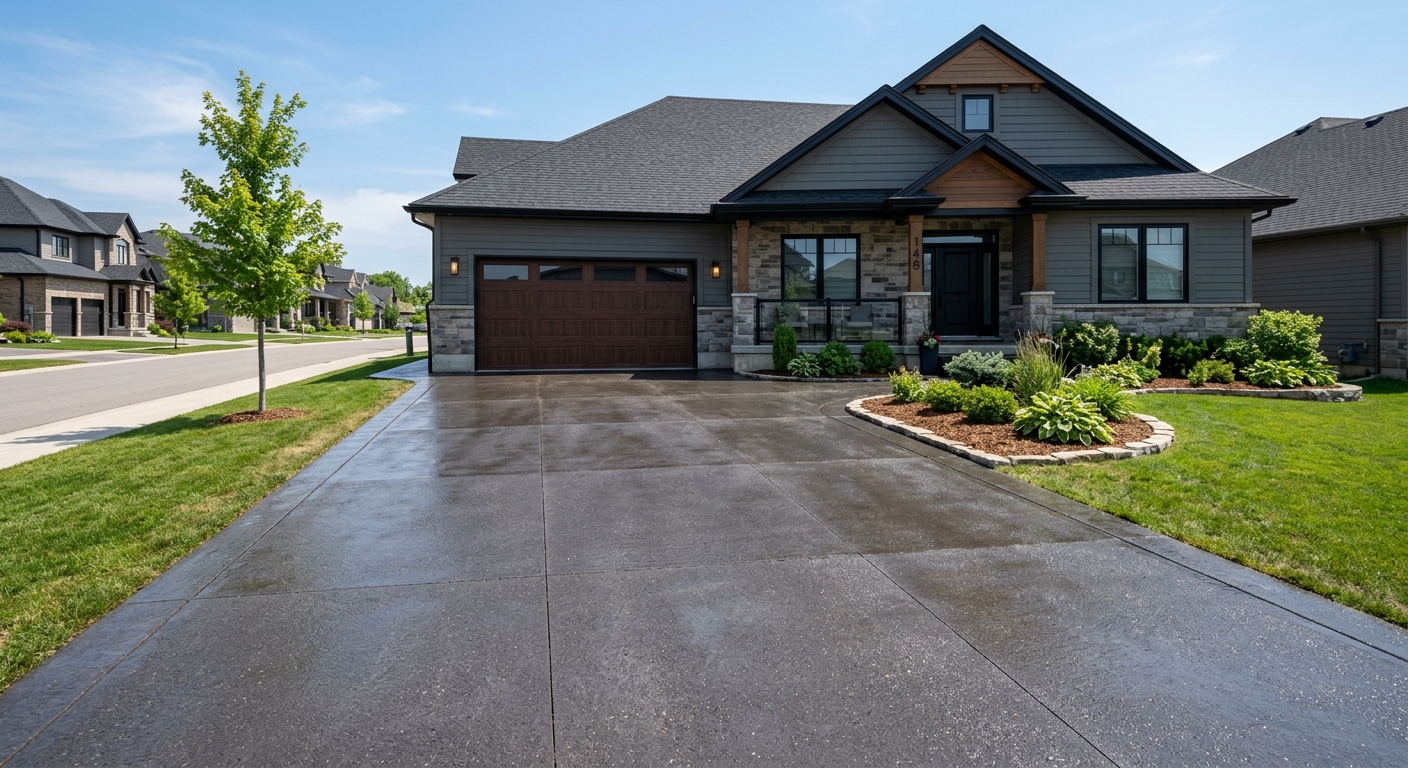
Concrete work options and costs in Signal Hill
Signal Hill, Alberta is a great place to build, but concrete flatwork and foundations have to be engineered for Calgary-area winters. With a population of about 13,000 (Statistics Canada, 2021 Census), the neighbourhood demand is steady, and most projects come from homeowners upgrading driveways, patios, walkways and upgrading house/garage foundations over time. In practice, a large share of the local housing stock is family-oriented, and that directly drives repeat work like driveway replacements and backyard patios—both are among the most common concrete projects we see in Signal Hill and nearby communities.
Pricing in Calgary-area concrete is shaped by a few non-negotiables. The design frost depth is roughly 1.2 m (around 4 ft), so footings for houses, garages, decks and retaining structures must bear on undisturbed soil below that depth to reduce frost heave and seasonal movement. On top of that, frequent freeze–thaw cycles push the specs toward air-entrained mixes and better control joint layouts to limit cracking and surface scaling. The pour season is also shorter for exterior work, and winter-grade placement and curing precautions—like heated enclosures and insulated blankets—can add real costs if a job slips into colder months.
We often see the highest demand for new driveways and stamped patios in the older, more established pockets near the main residential corridors—where homeowners are replacing aging asphalt and leveling sunken slabs. From there, the cost differences between options become clear, so the comparison table below will help you place each scope in the right ballpark.
| Application |
Typical Size |
Key Spec |
Finish Option |
Price Range |
| Concrete driveway (standard broom finish) |
10 ft x 35 ft (350 sq. ft.) |
4 in slab, air-entrained mix, wire mesh / rebar as needed, control joints |
Broom |
$12,000–$18,000 |
| Exposed aggregate driveway |
10 ft x 35 ft (350 sq. ft.) |
4 in slab, air-entrained mix, seeded / washed aggregate, proper curing |
Exposed aggregate |
$15,000–$22,000 |
| Stamped concrete driveway or patio |
12 ft x 30 ft (360 sq. ft.) |
4 in slab, air-entrained mix, integral colour, release agent & sealer |
Stamped |
$15,000–$26,000 |
| Plain concrete patio or walkway |
10 ft x 20 ft (200 sq. ft.) |
4 in slab, air-entrained mix, compacted base, joints as required |
Plain / broom |
$5,000–$9,000 |
| Garage floor (interior slab) |
20 ft x 22 ft (440 sq. ft.) |
4 in slab, vapour barrier as needed, mesh/rebar, edges doweled where required |
Float & broom / light trowel |
$7,500–$14,000 |
| Foundation footings (structural, below frost) |
Per typical house footprint |
Excavation, reinforced footings engineered to frost depth (~1.2 m) and soil conditions |
Structural concrete |
$28,000–$45,000 |
Prices are estimates only and vary by project scope, site access and material selection.
What affects the price of concrete work in Signal Hill
In Calgary and across Alberta, two quotes for the “same” concrete job can swing 30–50% because the scope is rarely truly identical. A driveway that looks identical on paper can differ in base depth, reinforcement design, concrete mix requirements, removal/disposal, and whether cold-weather curing is needed. Contractors also price risk differently—if the soil is wet, access is tight, or the schedule pushes the pour closer to freezing, the cost naturally moves up.
In Signal Hill, the biggest technical driver is frost. With a design frost depth of about 1.2 m (roughly 4 ft), footings for foundations and retaining structures must extend below that level into undisturbed soil. Exterior slabs also need air-entrained concrete mixes to survive freeze–thaw cycling, and quality control joints matter because random cracking becomes a maintenance problem when water gets underneath. Calgary’s shorter pour season means fewer comfortable weeks for exterior placement, and if a job lands in late fall or early spring, winter-grade approaches—insulated blankets, curing compounds, and sometimes temporary heating—add labour and material costs.
Local condition examples that change the number: (1) a driveway replacement where old concrete must be demolished and hauled away commonly adds cost even before new concrete is poured; (2) a backyard walkway on expansive or poorly drained soils may require deeper granular base, which moves a plain concrete patio from the lower end of the $5,000–$9,000 band toward the higher end; and (3) a stamped job that needs extra time for forming, colouring and sealing can justify stepping from the $12,000–$18,000 driveway band into the $15,000–$26,000 stamped range. With many Signal Hill homes built/updated over decades, older sites often have unknown base conditions—so excavation can reveal surprises and raise foundation volumes accordingly.
| Price Factor |
Why It Matters |
Cost Impact |
| Frost line depth |
Determines footing depth and form height |
Higher excavation and concrete volume; major driver for foundation work |
| Site preparation |
Excavation, grading, compacted granular base |
Can add days of labour when access or soil conditions are difficult |
| Reinforcement |
Rebar or wire mesh requirement |
Costs more material; can reduce future cracking risk—often worth it |
| Mix design |
Air-entrainment and compressive strength spec |
Air-entrained mixes cost more; protects against freeze–thaw damage |
| Finish type |
Broom vs. stamped vs. exposed aggregate |
Stamped/exposed require extra labour, curing time and sealing |
| Pour size and concrete truck access to site |
Large pours need more logistics; access affects reach and equipment |
Tighter access can increase labour and pump/handling costs |
| Cold-weather curing precautions |
Heating and blankets |
Added materials and labour if temps fall near freezing during cure |
| Control joint pattern and sealing cost |
Joints control cracking; sealing repels de-icing salts |
Often a small line item that can prevent expensive surface repairs |
Permits & regulations in Alberta
In Alberta, structural concrete work—like foundation footings, foundation walls, grade beams and other load-bearing elements—generally requires a building permit, and municipalities often expect engineered drawings where structural systems are involved. For concrete flatwork (driveways, patios, walkways), permits usually aren’t required unless the work affects lot grading, introduces or changes drainage patterns, or runs into impervious surface coverage limits/right-of-way constraints. Even when a permit isn’t typical, you should still confirm the details with the local authority before breaking ground, especially in established neighbourhoods where drainage and setback rules matter.
For Signal Hill homeowners, a safe process looks like this: (1) ask your contractor for their liability insurance certificate and confirm it covers the types of work you’re hiring; (2) verify they have the correct coverage for their workers (WSIB/WCB as applicable in Alberta); (3) request a copy of any clearance letter or proof that their coverage is current; and (4) for structural work, confirm the permit package is being handled through the appropriate channel and that engineering is included where required.
Licensing checks: start by confirming the contractor’s business details and eligibility through Alberta’s public contractor resources (look for the firm’s registered information and any trade-related standing), then compare that to the certificate of insurance paperwork you receive. Finally, ask for references on similar concrete scopes—especially below-frost foundation jobs—so you can validate experience with Calgary-area specs and winter-ready curing.
Getting concrete right in Signal Hill's freeze-thaw climate
Concrete fails in Signal Hill mainly because freeze–thaw cycling gets inside a weak or improperly built system. The most common issues we prevent—when the specs are right—are surface scaling and spalling caused by water getting into the slab and inadequate resistance in the concrete matrix. To spec a durable exterior job, focus on five items: base preparation, mix design, control joints, curing and sealing.
First, base prep means compacted granular sub-base to the right depth for local soils and frost conditions. Next, the mix design should be air-entrained, which creates space for freezing water to expand, typically targeting 5–7% air content for exterior flatwork. Then, add a control joint pattern that limits random cracking; joints are where you want the slab to crack, not at edges or near fixtures. For curing, the rule of thumb is minimum 7-day curing under proper conditions—short-cure in cold weather increases scaling risk. After the cure, apply a penetrating sealer about 28 days post-pour to repel de-icing salt intrusion.
Ask your contractor why they’re using air-entrainment and how they’ll maintain cure temperatures. If someone tries to “save cost” by skipping blankets in late-season pours, that can lead to expensive repairs later. For dollars: a standard broom-finished driveway might land in the $12,000–$18,000 band, while a stamped driveway often sits in the $15,000–$26,000 range. That premium is only justified if the contractor is also matching freeze–thaw durability specs—proper base, air-entrainment, jointing and sealing—because aesthetics don’t compensate for structural and moisture failures.
| Spec |
Why It Matters in Signal Hill |
What to Ask For |
Impact if Skipped |
| Compacted granular base (depth?) |
Provides stiffness and controls frost-related movement |
Granular base thickness engineered for soil and frost conditions; compaction proof/testing where applicable |
Settling, slab cracking, uneven load paths |
| Air-entrained concrete mix (target air %?) |
Helps concrete resist freeze–thaw scaling and spalling |
Air-entrained mix targeting about 5–7% air for exterior flatwork |
Surface scaling, spalling and accelerated deterioration |
| Compressive strength (MPa rating) |
Improves durability and structural capacity under repeated freeze–thaw |
Minimum 32 MPa compressive strength (or higher if engineered for the project) |
Higher risk of surface wear and cracking |
| Control joints (spacing per ACI guidelines) |
Reduces random cracking by directing where shrinkage/curling occurs |
Joint layout and spacing plan to limit uncontrolled cracks; jointing timing coordinated with pour |
Random cracks, water entry and faster freeze–thaw damage |
| Minimum 7-day curing period |
Ensures proper hydration for strength and durability |
Minimum curing time under suitable conditions; blankets/heating if cold weather hits |
Lower strength gain, scaling risk and reduced long-term performance |
| Penetrating sealer (when applied after cure) |
Repels de-icing salts and helps limit moisture ingress |
Apply penetrating sealer after cure—commonly around 28 days post-pour |
Higher risk of salt-driven deterioration and patchwork repairs |
How to choose a concrete work contractor in Signal Hill
Start by verifying Alberta coverage and credentials before you discuss the pour. Ask for a current certificate of liability insurance (make sure it lists your property address or the project scope) and confirm workers’ compensation coverage (WSIB/WCB as applicable in Alberta) for anyone working on site. For “how to check”: (1) request the documents before work begins; (2) verify the certificate is not expired; (3) ensure the coverage types fit the scope (excavation/demolition plus concrete placement); and (4) confirm the contractor can provide references for jobs close to your project size and finish type—especially exterior flatwork built for freeze–thaw conditions.
Then get 2–3 written, itemised quotes instead of one lump sum. You want labour and materials breakdowns (demo/haul-off, excavation, granular base, reinforcement, concrete supply, finishing, curing/blankets if required, and sealing). Read the exclusions: what’s not included if rock is encountered, if access requires extra equipment, or if the city/utility locate needs scheduling. Confirm whether permits are included for structural work and whether disposal/haul-away is included for removed concrete.
On warranty, ask for a workmanship warranty length and whether any product/manufacturer warranty is included. Also clarify whether warranties are transferable if you sell the home. For payment schedule, never pay more than 10–15% upfront; hold a reasonable holdback until substantial completion and final cure/sealing steps are done. Finally, require a written start date and completion estimate—cold-weather delays are common, and your plan should account for curing time, not just the pour day.
- Uses air-entrained concrete for exterior slabs and can state target air %.
- Provides base prep depth and compaction approach, not just “we’ll level it”.
- Shows a joint plan (spacing/layout) matched to your slab size.
- Explains cold-weather curing options (blankets/heating) if forecasts turn.
- Includes sealing timing (often ~28 days post-pour) if you want de-icing salt protection.
- States reinforcement approach (mesh vs rebar, and why) for your loading needs.
- Documents concrete truck access and placement method (no guesswork).
- Lists demolition and disposal/haul-away line items clearly.
- Provides a written schedule with pour date and curing milestones.
- Includes a clear warranty for workmanship and describes what’s covered.
- Specifies finish standard (broom, stamped mix/process, exposed aggregate method).
- Has a tidy site plan: protection for landscaping, property edges, and cleanup responsibilities.
Concrete red flags in Signal Hill include: contractors who won’t specify air-entrainment; quotes that omit base prep depth and reinforcement details; promises to “pour whenever” without a cold-weather curing plan; missing or vague joint layout; and insurance documents that are outdated, incomplete, or don’t match the scope.
Frequently asked questions — concrete work in Signal Hill
What is air-entrained concrete and why does it matter here?
Air-entrained concrete is designed with tiny, evenly distributed air bubbles that give freezing water a place to expand. In Signal Hill and the Calgary region, freeze–thaw cycles are frequent, and that’s exactly where standard concrete can start scaling and spalling when moisture gets into the surface. That’s why credible exterior concrete bids specify air-entrainment rather than treating it as optional. When you’re comparing quotes, look for a stated mix design (air content and durability spec) and ask how they’ll verify it for your pour.
In practical terms, this is one reason exterior slabs priced in the $5,000–$9,000 and driveway ranges don’t “just” come down to thickness. It’s the engineering and materials that keep the slab serviceable through winter, not only the look. For stamped or decorative work (often in the $15,000–$26,000 range), air-entrainment still matters because aesthetics don’t prevent freeze–thaw breakdown.
How do I prepare the base for a concrete slab?
Base prep is where many problem slabs are born, especially in Calgary-area soils that shift with moisture and frost. For Signal Hill projects, the contractor should excavate to a planned depth, then install a compacted granular sub-base suited to the soil and the frost conditions. Ask what granular material is being used, how deep it will be, and what compaction approach they’ll follow. You should also ask whether they’ll address drainage issues before pouring—because standing water under a slab accelerates freeze–thaw damage.
A solid base plan also supports longevity for flatwork like patios and walkways priced around the $5,000–$9,000 band, and for driveways in the $12,000–$18,000 range. If a quote doesn’t clearly explain excavation and granular base depth, you’re at risk of paying for a “nice finish” over a system that can move.
How do I compare concrete quotes?
Start by comparing quotes line-by-line, not just the total. For Signal Hill concrete work, insist on an itemised breakdown that includes demolition and disposal (if removing existing slabs), excavation and grading, granular base depth and compaction, reinforcement type (mesh vs rebar), concrete mix design (including air-entrainment), finish method, and curing/blankets. If you’re getting a stamped or exposed aggregate option, confirm exactly what’s included for colouring, release agents, texture, and sealing.
Look for inclusions/exclusions: permit pull for structural work, protection for surrounding landscaping, and whether concrete truck access/pumping is accounted for. It’s also smart to compare the curing plan—cold-weather placement can add costs but protects the slab. If one contractor offers a price far below the $12,000–$18,000 driveway band without explaining base depth or air-entrainment, that’s a common sign a key durability item is missing.
Can concrete be poured in cold weather in Signal Hill?
Concrete can be poured in cold weather in Signal Hill, but it must be placed and cured properly. The Calgary region’s freeze–thaw cycle and frost considerations mean curing failures are costly—surface scaling and reduced strength gain can appear later, especially if the pour sits near freezing during the early set period. A reputable contractor will watch the forecast, plan for cold-weather placement, and use winter-grade approaches when needed.
That can include insulated blankets, heating enclosures, managing water content, and maintaining curing conditions for at least the minimum 7-day cure window (often longer with challenging temps). Ask directly whether your pour date falls into a period that requires blankets/heating and how that affects cost. It’s normal for winter precautions to increase a driveway estimate within the $12,000–$18,000 or stamped $15,000–$26,000 ranges—because durability measures are not optional in our climate.
How do I maintain concrete in Signal Hill's freeze-thaw climate?
Maintenance is mostly about keeping water and de-icing salts from accelerating surface wear. In Signal Hill, use de-icing products thoughtfully—over-salting can drive deterioration where water repeatedly enters and freezes. Make sure the slab has a good seal; for many exterior flatwork projects, a penetrating sealer applied about 28 days after the pour helps repel salts and moisture. Resealing schedules vary by product and wear, but the key is not delaying early repairs.
Keep an eye on joint edges and cracks—control joints are normal, but widening or spalling indicates moisture pathways. Small crack repairs and timely joint sealing can prevent freeze–thaw from scaling the surface. Also address drainage: if downspouts or grading direct runoff onto your patio or driveway, you’ll likely see more scaling. Routine cleaning with a non-damaging method helps, and avoiding high-heat sources directly on fresh concrete protects curing integrity.
What causes concrete to spall in Signal Hill winters?
Spalling typically happens when water penetrates the concrete and then freezes, expanding inside the slab. In Signal Hill winters, freeze–thaw cycling is repeated and relentless, so the most common root causes are inadequate air-entrainment, poor base drainage, insufficient curing, and weak or missing sealing. If concrete was placed without properly entraining air, freezing water can damage the paste and break down the surface layer, leading to scaling and flaking (spalling).
Other contributors include poor control joint execution, which allows water to track into random cracks rather than controlled joints, and inadequate curing—especially if cold weather arrives before the slab gains enough strength. That’s why we treat freeze–thaw durability specs as part of the cost, not an upgrade. If you’re comparing bids for a driveway in the $12,000–$18,000 range or a patio around $5,000–$9,000, ensure the quote includes air-entrainment, a solid granular base, joint planning and an appropriate curing and sealing approach.