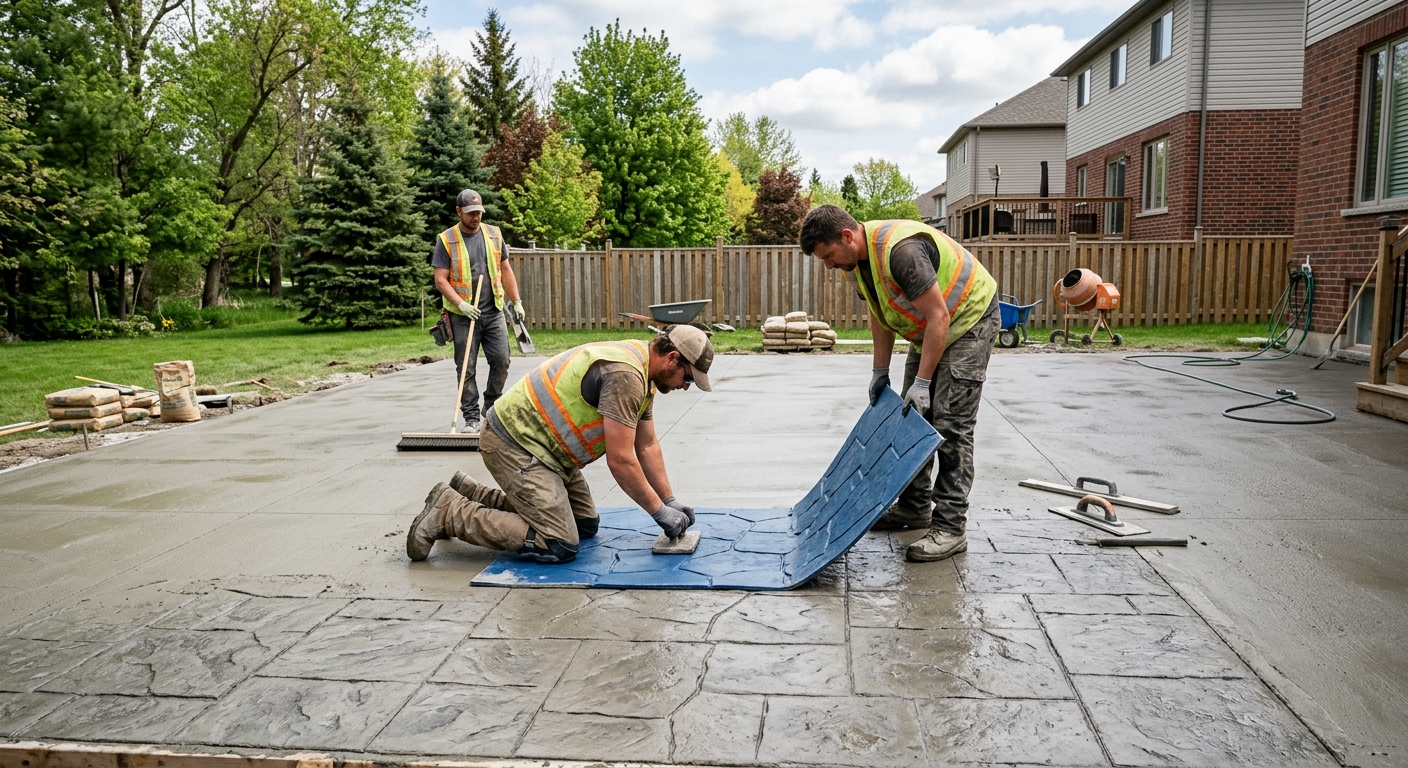
Concrete work options and costs in Rio Terrace
In Rio Terrace, Alberta, concrete flatwork is a practical choice for driveways, patios and walkways because it can be detailed to handle Calgary-area freeze–thaw cycles. With a population of 1,305 (Statistics Canada, 2021 Census), the local market is smaller than in Calgary proper, so scheduling can depend on how busy crews are coming out of the city. That matters when you want cold-weather planning, proper curing, and enough manpower for excavation and finishing—especially in neighbourhoods like Auburn Bay-style lake-adjacent developments where exterior surfaces are exposed to de-icing and rapid temperature swings.
Most concrete work demand typically centres around residential lots and accessory structures—think standard garage aprons, backyard pads, and driveway replacements—where homeowners want a durable surface without constant re-labouring. In a cold continental climate, the frost depth drives foundation and base excavation, and the freeze–thaw cycle drives mix design and joint spacing for exterior slabs. For example, local engineering practice in Alberta uses a design frost depth of about 1.2 m (roughly 4 ft), meaning footings and some slab bases must extend below frost-affected soil to reduce frost heave and seasonal movement. That deeper excavation and higher material specifications are a key reason foundation / footings routinely price higher than in milder regions.
To help you compare apples-to-apples, here are realistic cost ranges you’ll see in the Calgary economic region, then a note on what changes each number.
| Application |
Typical Size |
Key Spec |
Finish Option |
Price Range |
| Concrete driveway (standard broom finish) |
400–600 sq. ft. |
Air-entrained mix, proper base and joints |
Broom finish |
$12,000–$18,000 |
| Exposed aggregate driveway |
400–600 sq. ft. |
Air-entrained mix, decorative stone exposure |
Exposed aggregate |
$14,500–$21,500 |
| Stamped concrete driveway or patio |
300–550 sq. ft. |
Air-entrained mix, integral colour |
Stamp + seal |
$15,000–$26,000 |
| Plain concrete patio or walkway |
200–450 sq. ft. |
Proper thickness, reinforcement as needed |
Smooth or broom finish |
$5,000–$9,000 |
| Garage floor (interior slab) |
400–600 sq. ft. |
Vapour barrier, welded mesh where required |
Standard trowel + saw cuts |
$9,500–$16,500 |
| Foundation footings (structural, below frost) |
Typical house/garage footprint |
Designed depth below frost, engineered rebar |
Structural concrete |
$28,000–$45,000 |
Prices are estimates only and vary by project scope, site access and material selection.
What affects the price of concrete work in Rio Terrace
In Rio Terrace and across the Calgary economic region, it’s common to see quotes for the “same” concrete project swing by 30–50%—even when the square footage looks identical. The biggest reason is that concrete isn’t just poured concrete; it’s engineered excavation, base preparation, reinforcement, mix design, finishing, curing and sealing. In cold-weather markets like Calgary, contractors also price in scheduling risk and the cost of winter-grade placement (insulated blankets, curing practices, and sometimes temporary heating) because rushing curing is a fast path to scaling and long-term surface failure.
Frost line depth and freeze–thaw cycles dictate nearly every spec. In Alberta, exterior concrete needs to be placed with air-entrained mixes to survive repeated expansion and contraction, and footings must bear below the design frost depth (about 1.2 m in local practice) to prevent frost heave. Frequent freeze–thaw also means granular base prep and a disciplined control joint plan—especially on driveways, patios and walkways—to reduce random cracking and spalling.
Two examples from Rio Terrace that regularly move the cost: (1) If the base is over-excavated for poor soil or frost-sensitive backfill, foundation-style excavation effort can carry into flatwork scope, pushing a plain patio up toward the upper end of the $5,000–$9,000 band. (2) If you choose stamped or exposed aggregate, you pay for extra labour and finishing time, which is why decorative driveway projects often land in the $15,000–$26,000 or $12,000–$18,000 backbone ranges depending on square footage and colour/seal package.
On the foundation side, deeper excavation and higher reinforcement requirements are the reason footings commonly sit in the $28,000–$45,000 range. And because Rio Terrace is part of the same cold continental climate system as greater Calgary, the pour season is shorter and curing requirements are less forgiving—so contractors plan for materials and labour accordingly.
| Price Factor |
Why It Matters |
Cost Impact |
| Frost line depth |
Determines footing depth and form height |
More excavation and concrete; higher foundation / footing pricing |
| Site preparation |
Excavation, grading, compacted granular base |
Poor access or soft soil can add trucks, time and material |
| Reinforcement |
Rebar or wire mesh requirement |
Rebar adds labour and material; mesh may be insufficient for some slabs |
| Mix design |
Air-entrainment and compressive strength spec |
Exterior durability specs increase material cost but reduce failure risk |
| Finish type |
Broom vs. stamped vs. exposed aggregate |
Decorative finishes increase labour, tools and sealing requirements |
| Pour size and concrete truck access to site |
Truck scheduling and distance affects placement time |
Long carries or tight access can add labour and risk of cold seams |
| Cold-weather curing precautions |
Heating and blankets |
Winter-grade curing can add significant labour and equipment charges |
| Control joint pattern and sealing cost |
Joints manage cracking; sealant repels de-icing salts |
Proper spacing reduces random cracks; sealing adds cost but improves surface life |
Permits & regulations in Alberta
In Alberta, structural concrete work generally needs proper review because it affects structural stability. That means things like foundation footings, foundation walls, grade beams and any load-bearing concrete elements typically require a building permit, and engineered drawings are often part of the process before the municipality approves the foundation plan.
Concrete flatwork—like patios, walkways and driveways—usually does not require a permit by itself. However, permits can become necessary when the work affects lot grading, drainage, or impervious surface coverage limits, or if it ties into municipal right-of-way features (for example, certain driveway approaches or changes that impact roadside drainage). Before you break ground in Rio Terrace, confirm requirements with your local authority based on how the project changes surface water movement.
Step-by-step, here’s how a homeowner should verify a contractor in Alberta:
- Request the contractor’s liability insurance certificate showing current coverage and your job address if possible.
- Ask for proof of WSIB/WCB coverage (or an equivalent clearance letter, if applicable for their business structure).
- Confirm the company is properly licensed for the scope they’re doing and that the person quoting is authorized to act for the company.
- Verify past projects similar in size (e.g., driveway tear-outs with base rebuilds, not just “new pours”).
- Get everything in writing: scope, curing plan for the date, and whether disposal is included.
Getting concrete right in Rio Terrace's freeze-thaw climate
Concrete failures in Rio Terrace usually trace back to one of five issues: inadequate base support, incorrect mix design, weak reinforcement placement, poor jointing, or rushed curing. In a cold continental climate with frequent freeze–thaw cycles, the biggest “hidden” risk is spalling—surface scaling and chipping—often caused by insufficient air-entrainment or finishing steps that trap poor durability at the surface. That’s why the specifications matter as much as the contractor’s finish quality.
To spec the job correctly, start with base preparation: compacted granular sub-base should be placed to the right depth for local soils and below frost-affected zones. Next, specify an exterior-rated air-entrained mix; for Calgary-area flatwork, a target air content of 5–7% is typical, along with a minimum 32 MPa compressive strength requirement for the structural slab needs of most exterior residential applications. Then plan control joints to limit random cracking; spacing is not guesswork. For curing, insist on a minimum 7-day curing period under proper conditions—cold-weather work may require insulated blankets and, at times, temporary heat to keep concrete developing strength. Finally, sealing is important: use a penetrating sealer after cure (often around 28 days post-pour) to repel de-icing salts that accelerate freeze-thaw damage.
On cost, decorative options can be worth it when they’re properly engineered. For instance, a stamped driveway can run in the $15,000–$26,000 range compared with a standard broom driveway at $12,000–$18,000; the price jump is justified when you’re also getting the correct base, air-entrainment, and joint/seal system. If a low bid skips those essentials, the “savings” usually show up later as spalling repairs.
| Spec |
Why It Matters in Rio Terrace |
What to Ask For |
Impact if Skipped |
| Compacted granular base (depth?) |
Supports the slab and reduces frost-driven movement |
Documented excavation depth and compacted base thickness |
Settlement, cracking, and premature surface failure |
| Air-entrained concrete mix (target air %?) |
Helps concrete resist freeze–thaw scaling/spalling |
Air content target (commonly 5–7% for exterior flatwork) |
Surface scaling, spalling and flaking after winters |
| Compressive strength (MPa rating) |
Strength development supports durability and load performance |
Minimum 32 MPa spec (per project requirements) |
Higher risk of wear, cracking and durability loss |
| Control joints (spacing per ACI guidelines) |
Controls where shrinkage cracks occur |
Planned joint spacing and layout before the pour |
Random cracking patterns and water intrusion |
| Minimum 7-day curing period |
Cold nights can slow strength gain |
Curing method for the pour date (blankets/heating if needed) |
Weak surface, scaling risk and long-term cracking |
| Penetrating sealer (when applied after cure) |
Repels de-icing salts and reduces damage in winter |
Application timing after cure (often ~28 days) |
Faster spalling and more frequent rework |
How to choose a concrete work contractor in Rio Terrace
Choosing the right concrete contractor in Rio Terrace (and the wider Calgary market) comes down to proof: proof they understand freeze–thaw detailing, proof they’re properly insured, and proof they write scopes clearly enough that you can compare bids without guessing. First, verify Alberta licensing for the work being performed and request a current certificate of liability insurance. Next, confirm WSIB/WCB coverage by asking for documentation or a clearance letter as applicable. If a contractor can’t produce these items quickly, treat it as a red flag—concrete disputes become expensive when coverage is unclear.
Then get 2–3 itemised written quotes that break out labour, materials and key line items (demo, excavation, base, reinforcement, concrete supply, finishing, joints and sealing). Avoid “lump sum only” quotes unless the scope is fully described. Read exclusions: is disposal of removed concrete included? Who hauls spoil? Is permit work included if needed for grading impacts? And ask about the curing plan for your exact pour date—winter-grade placement isn’t optional in this climate.
Warranty matters too. Ask for the workmanship warranty length, what it covers (cracking vs. spalling vs. settlement), whether product/manufacturer warranties apply, and if warranties are transferable if you sell your home. For payment, don’t pay more than 10–15% upfront; a holdback until completion is standard. Finally, require a start date and completion estimate in writing, not by “sometime in October.”
- Ask how they’ll protect curing concrete during cold nights.
- Request base rebuild thickness details, not just “compacted base.”
- Confirm air-entrainment target for exterior flatwork.
- Have them show a joint plan (layout and saw-cut timing).
- Ask whether reinforcement is required and where it sits in the slab.
- Confirm de-icing salt durability and whether sealing is included.
- Get a truck access plan for your driveway/yard layout.
- Confirm if demolition and disposal are included or extra.
- Ask who supplies and places formwork and edging.
- Ensure the quote lists curing/blanket measures by temperature window.
- Request references for similar-scale projects in the Calgary region.
- Review warranty terms in writing before signing.
Concrete red flags I often see in Rio Terrace: skipping or minimizing excavation for a “minimum thickness” slab, no clear air-entrainment or curing plan for the pour date, vague joint spacing (“we’ll cut it later”), contractors asking for large upfront payments, and quotes that don’t include disposal or base rebuild details—making the final price creep up after the pour.
Frequently asked questions — concrete work in Rio Terrace
Do I need a permit for concrete work in Alberta?
In Alberta, structural concrete like foundation footings, foundation walls and grade beams typically requires a building permit and often engineered drawings that are reviewed before construction. Concrete flatwork—driveways, patios and walkways—usually does not require a permit on its own, but it can if your project affects lot grading, drainage, or impervious surface limits, or if it impacts municipal right-of-way conditions. In Rio Terrace, it’s smart to check early because snowmelt drainage and winter thaw can complicate grading decisions.
When you’re reviewing contractor scope, ask directly whether any permit pull is required for your specific layout. Also confirm they carry liability coverage and WSIB/WCB. If a contractor tells you “permits never apply,” get it in writing—or switch quotes.
Concrete vs pavers for a patio in Rio Terrace?
For patios in Rio Terrace, concrete and pavers can both perform well, but they fail differently. Concrete slabs—when properly air-entrained, built on a compacted base, jointed and cured—handle freeze–thaw cycles predictably, especially if you plan for sealing against de-icing salts. A plain concrete patio in the Calgary region commonly lands in the $5,000–$9,000 band depending on size and access, while stamped/decorative work increases cost.
Pavers can be easier to replace sectionally if you get frost-related movement, but they still require good base compaction and correct slope/drainage. In our climate, the real differentiator is not the surface material alone—it’s the base prep and detailing. If a concrete quote is low and doesn’t explain air-entrainment, jointing and curing, it’s not a fair comparison to pavers built with the same attention to base depth and drainage.
How long does a concrete driveway last?
With correct design in Alberta’s freeze–thaw environment, a concrete driveway often provides long service life—many homeowners see decades of performance. The key is durability at the surface: exterior driveways need an air-entrained mix, proper finishing, disciplined control joints, and curing that isn’t rushed in cold weather. Sealing later (after cure) helps repel de-icing salts that accelerate spalling.
In Rio Terrace, driveway age is also influenced by how hard the winters are on your specific area (wind exposure, shaded sections that stay damp longer, and how often you use salt). A well-built broom-finished driveway priced around the $12,000–$18,000 range tends to hold up when the base prep and joint plan are done right. If you see scaling within a few winters, it’s usually linked to inadequate air content, poor curing, or insufficient base support—not just “concrete is weak.”
What is air-entrained concrete and why does it matter here?
Air-entrained concrete is engineered with tiny air bubbles that provide pressure relief when water in the concrete freezes. In Rio Terrace and the Calgary region, frequent freeze–thaw cycles make that feature critical. Without adequate air entrainment, surface scaling and spalling become much more likely as the concrete expands and contracts repeatedly through the winter.
This is why quotes should specify exterior mix design and not just “standard concrete.” For exterior flatwork, the commonly targeted air content is about 5–7%, paired with a minimum compressive strength spec (often 32 MPa for many residential applications). You can also hear contractors talk about winter-grade placement, curing blankets, and insulated protection when temperatures drop—those steps protect strength gain and reduce early-age damage.
If a contractor won’t confirm air-entrainment and curing steps, it’s a major technical gap, especially for driveways, patios and walkways.
How do I prepare the base for a concrete slab?
Base prep is where good concrete starts. For Rio Terrace projects, the process typically involves: excavating to the right depth (accounting for frost-affected soils and required slab build-up), removing unsuitable material, and then placing a compacted granular sub-base in lifts. Each lift is compacted so you don’t end up with settlement that later shows up as cracking or uneven surfaces.
Contractors should also confirm the drainage slope and edge conditions, and they should plan reinforcement and joints appropriate to the slab size and use. For exterior slabs, air-entrained concrete and a proper joint layout are as important as the base, because freeze–thaw will exploit weak points.
When comparing quotes, don’t accept vague statements like “we’ll grade and pack.” Ask for the base thickness they’re proposing, and whether reinforcement and joint patterns will be installed to manage shrinkage cracking.
How do I compare concrete quotes?
Comparing concrete quotes in Alberta is easiest when you compare scopes, not just totals. Start by requiring itemised quotes that separate labour and materials and list the key technical specs: base excavation depth and granular thickness, reinforcement (mesh vs rebar and placement), concrete mix type (including air-entrainment for exterior), thickness, finishing method, joint layout, curing plan and whether sealing is included.
Be careful about exclusions: demolition and disposal of old concrete, truck access charges, regrading, and permit-related work (if grading impacts trigger requirements). In the Calgary region, pricing for a driveway often fits the $12,000–$18,000 band for standard broom finish, while decorative projects can move into the $15,000–$26,000 range depending on size and detailing. If one quote is dramatically lower, ask what they’re cutting—commonly it’s base prep depth, air specs, curing blankets, or joint/seal scope.
Finally, verify each contractor’s liability insurance and WSIB/WCB coverage, then confirm warranty terms in writing before you decide.