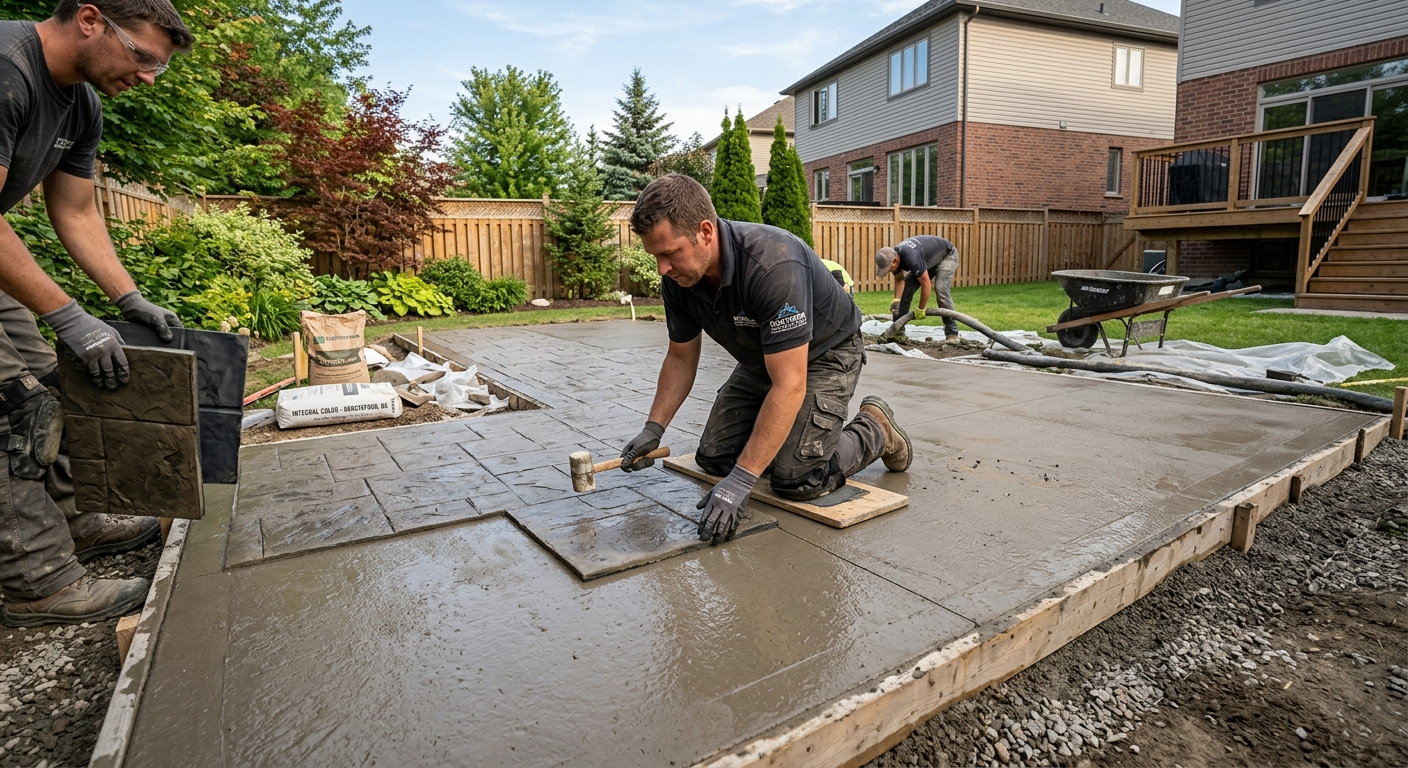
Concrete work options and costs in Kernohan
Kernohan, Alberta is a small community (population 3,073 per the Statistics Canada, 2021 Census) that still sees steady demand for durable exterior concrete, especially as homeowners maintain driveways, entry walkways and backyard flatwork. In the Calgary region, most new construction and renovations lean toward single-detached living; that’s the primary market for concrete slabs and steps because driveways, patios and walkways are standard “first upgrades” for curb appeal and day-to-day function. Calgary-area concrete contractors are particularly busy in the nearby east and southeast corridors and in established housing pockets around local service areas, where infill and maintenance cycles overlap.
Pricing in Kernohan follows Calgary’s cold continental reality: concrete is engineered around a deeper design frost depth (about 1.2 m, roughly 4 ft) and frequent freeze–thaw cycles. That means more excavation, better granular base prep, air-entrained mixes, and tighter control-joint planning than in milder provinces. It also shapes scheduling—exterior pours have a shorter practical season, and late-fall or early-spring placement may require winter-grade concrete, insulated blankets, and sometimes heat to protect curing. Those steps protect the surface from scaling and spalling, but they’re not “optional,” so they show up directly in the quote.
Below is a practical comparison of the most common options homeowners request in Kernohan, along with typical sizing and what you can expect to pay in this market—then you can match specs to the budget you’re aiming for.
| Application |
Typical Size |
Key Spec |
Finish Option |
Price Range |
| Concrete driveway (standard broom finish) |
24 ft x 10 ft (240 sq. ft.) |
Air-entrained exterior mix, rebar where required, control joints |
Broomed |
$12,000–$18,000 |
| Exposed aggregate driveway |
24 ft x 10 ft (240 sq. ft.) |
Air-entrained exterior mix, proper base, accent stone binder system |
Exposed aggregate |
$15,000–$21,000 |
| Stamped concrete driveway or patio |
20 ft x 12 ft (240 sq. ft.) |
Air-entrained exterior mix, integral colour, release agent system |
Stamped pattern + seal |
$15,000–$26,000 |
| Plain concrete patio or walkway |
12 ft x 10 ft (120 sq. ft.) |
Air-entrained exterior mix, compacted base, expansion where needed |
Plain + broom/steel trowel edge |
$5,000–$9,000 |
| Garage floor (interior slab) |
22 ft x 22 ft (484 sq. ft.) |
Vapour barrier, insulation if required, reinforced slab |
Smooth finish + light broom pattern |
$9,500–$15,500 |
| Foundation footings (structural, below frost) |
Varies (typical 2–3 levels) |
Engineered footing size/depth to design frost, dowels, rebar |
Structural concrete |
$28,000–$45,000 |
Prices are estimates only and vary by project scope, site access and material selection.
What affects the price of concrete work in Kernohan
In Calgary and surrounding Alberta communities, it’s common to see quotes for the “same” concrete job vary by 30–50%. The differences usually come down to how thoroughly the contractor is building for frost and freeze–thaw durability—not just how thick the slab looks on paper. In this region, footings must extend below the design frost depth (about 1.2 m, or roughly 4 ft) into undisturbed soil to prevent frost heave and seasonal movement, and that drives excavation volume and formwork cost. Exterior slabs also need air-entrained concrete to survive repeated freeze–thaw cycles, plus a control-joint plan to manage cracking. When winter-grade curing precautions are needed—insulated blankets, heated enclosure, or warm-mix practices—labour time and equipment costs increase, and that’s one reason cold-season placements cost more.
De-icing salts are another real-world factor. In a neighbourhood where homeowners regularly salt driveways and edges (typical of established communities near serviced areas), surface spalling becomes a risk if the mix air content and curing practices aren’t right. Sealing adds cost but meaningfully slows chloride-driven deterioration. In Kernohan specifically, the local housing stock often includes older slabs that were poured without modern air-entrainment discipline, and replacing those frequently means higher demolition/disposal and deeper base correction than a brand-new spec.
As a budgeting example, a standard broom driveway often lands in the $12,000–$18,000 band, while stamped work moves you toward $15,000–$26,000 because of colouring, pattern mats, timing precision and sealing. A small change—like widening a driveway or adding adequate truck access—can add excavation and increase labour hours, sometimes enough to explain the higher quote.
| Price Factor |
Why It Matters |
Cost Impact |
| Frost line depth |
Footing depth and form height must reach below design frost to prevent heave. |
More excavation and concrete; can swing foundation/footings pricing by thousands. |
| Site preparation |
Excavation, grading and compacted granular base control settlement and drainage. |
Hard-to-reach sites, poor soils or extra base material increase labour and supply costs. |
| Reinforcement |
Rebar or mesh helps limit cracking and supports structural demands. |
Higher reinforcement and tying/labour time can raise slab cost materially. |
| Mix design |
Air-entrainment and minimum strength target durability in freeze–thaw. |
Cold-weather mixes and engineered air can increase material costs and scheduling. |
| Finish type |
Broom is straightforward; exposed aggregate/stamping requires more steps and timing. |
Stamped/exposed systems add labour, materials and tighter finishing tolerances. |
| Pour size and concrete truck access to site |
Access affects how quickly you place and finish before the mix starts setting. |
More labour for chute/placing or additional trucks increases cost. |
| Cold-weather curing precautions |
Heating, blankets and insulated protection protect curing performance. |
Equipment and added crew hours can be a major driver in late-season pours. |
| Control joint pattern and sealing cost |
Joints manage cracking; sealing helps resist salt-driven deterioration. |
More joints/plan details add labour; sealing adds materials and application time. |
Permits & regulations in Alberta
In Alberta, the rule of thumb is that structural concrete work needs municipal review and documentation. Work such as foundation footings, foundation walls, and grade beams typically requires a building permit and often engineered drawings for sizing and reinforcement. For concrete flatwork—driveways, patios and walkways—a permit usually is not required by default, unless the project affects lot grading, meets impervious surface coverage limits, or impacts drainage and municipal right-of-way conditions. Because bylaws and thresholds can vary by municipality, confirm with the local authority before any excavation.
Before you sign a contract in Kernohan, ask for and verify three items in order: (1) contractor licence/registration, (2) liability insurance and (3) worker protection coverage (WSIB/WCB, as applicable). Step-by-step: first, have the contractor provide their current proof of insurance. Your best practice is to request a certificate of insurance showing the limits and coverage type, and confirm the concrete work activity is covered. Second, check workers coverage using the contractor’s clearance letter or verification document they can provide. Third, verify the contractor’s registration/licence status through the appropriate Alberta online registry resources (the contractor should be able to point you to the correct reference). Finally, insist on references for similar-scale Alberta projects—especially exterior slabs built for freeze–thaw durability.
Getting concrete right in Kernohan's freeze-thaw climate
Concrete tends to fail in Kernohan when the system is designed for a milder freeze profile instead of Calgary’s freeze–thaw realities. The most common problems are spalling and surface scaling, which are strongly linked to inadequate air-entrainment and rushed or poorly protected curing. To spec the job correctly, start from the bottom up. (1) Base preparation: place and compact a granular sub-base to the correct depth for the local soil and frost conditions; in this region, frost protection is engineered so footings and exterior slab design account for movement below the design frost depth. (2) Mix design: require air-entrained concrete with target exterior air content in the 5–7% air range and a minimum 32 MPa compressive strength. (3) Control joints: plan joint spacing so any cracking is controlled and happens where it can be sealed and maintained. (4) Curing: protect the pour for at least 7 days, and in cold weather use blankets and/or temporary heat as needed so the concrete reaches strength before it freezes. (5) Sealing: apply a penetrating sealer after cure—commonly at 28 days—to help repel moisture and de-icing salts.
When you ask the right questions, you reduce the “cheap at first, expensive later” risk. For example, if you choose plain broom-finish flatwork you may stay around the $5,000–$9,000 patio/walkway band, but if the contractor cuts corners on base prep or air-entrainment, you might pay again sooner for surface repairs. Conversely, investing in proper spec details is often what allows stamped work—closer to the $15,000–$26,000 band—to actually look good and remain serviceable through winters.
| Spec |
Why It Matters in Kernohan |
What to Ask For |
Impact if Skipped |
| Compacted granular base (depth?) |
Durable slabs need firm support and drainage control through freeze–thaw cycles. |
Granular sub-base depth and compaction testing/verification; confirm thickness to your design and soil. |
Settlement, edge cracking, and early failure of the slab surface. |
| Air-entrained concrete mix (target air %?) |
Air voids give the concrete room to expand during freezing. |
Exterior mix with 5–7% air content (verify on ticket/mix design). |
Spalling and scaling accelerated by salt and winter freeze–thaw. |
| Compressive strength (MPa rating) |
Strength affects durability and how well the slab handles loads over time. |
Minimum 32 MPa compressive strength (confirm mix design spec). |
Premature cracking, reduced wear resistance, higher maintenance needs. |
| Control joints (spacing per ACI guidelines) |
Joints control where cracks occur and reduce random cracking. |
Joint spacing plan matched to slab dimensions; saw-cut timing and layout. |
Random cracks that are harder to repair and more likely to let water in. |
| Minimum 7-day curing period |
Proper curing helps concrete reach early strength before freeze conditions. |
Concrete protection plan for cold snaps; stay cured for at least 7 days. |
Reduced strength gain and higher surface defects/long-term deterioration. |
| Penetrating sealer (when applied after cure) |
Sealers reduce moisture and chloride intrusion from de-icing salts. |
Penetrating sealer after full cure—typically 28 days post-pour. |
Faster salt-driven deterioration and increased likelihood of spalling. |
How to choose a concrete work contractor in Kernohan
For concrete work in Kernohan, start by verifying the contractor’s Alberta standing and protections. Ask for their current liability insurance (usually evidenced by a certificate of insurance) and confirm they have the right WSIB/WCB coverage for workers. How to check: (1) request the certificate and ensure the policy is active for the project period, (2) ask for a clearance letter or verification document for workers coverage, and (3) verify their registration/licence status using the relevant Alberta online registry resources (the contractor should provide the correct reference number).
Next, insist on 2–3 itemised written quotes instead of a single lump-sum number. A good quote breaks labour and materials: excavation and disposal, base prep, reinforcement, concrete supply, finishing labour, curing protection, and sealing (if included). Read exclusions carefully—especially removal of old concrete, snow/ice management prior to the pour, permit pull (for structural work), and concrete truck access charges. For warranty, ask for (a) workmanship warranty length, (b) product/manufacturer warranty details, and (c) whether the warranty is transferable if you sell the home.
Finally, manage payments. Never pay more than 10–15% upfront; hold back a meaningful portion until the work is complete, cleaned, and inspected to your satisfaction. In cold-season projects, demand a written start date and completion estimate so you can align curing protection equipment with the schedule.
- Confirm liability insurance limits and request the certificate before any work starts.
- Verify WSIB/WCB clearance (or equivalent coverage documentation) and keep copies.
- Get itemised quotes that separate excavation, base prep, reinforcement, concrete supply, finishing and sealing.
- Ask who supplies rebar/wire mesh and confirm placement (chairs/tie-in) details.
- Require the air-entrainment and curing plan in writing for exterior pours.
- Clarify joint layout and who is responsible for saw-cut timing.
- Confirm disposal/recycling of demolished concrete is included or excluded.
- Ask how they handle drainage slopes away from the house and any tie-ins to existing slabs.
- Make sure winter curing precautions (blankets/heating) are included if pouring in shoulder season.
- Check if the quote includes sealing (and when it will be applied, commonly after 28 days).
- Review warranty terms in plain language and ask what’s covered for spalling or cracking.
- Set a payment schedule and holdback amount tied to completion and inspection.
Concrete red flags in Kernohan include: vague quotes that don’t specify air-entrainment or curing protection, promises to “pour no matter the temperature” without winter curing measures, missing proof of insurance or workers coverage, refusing to itemise disposal and base correction, and finishing decisions made without a joint plan (which often leads to random cracking in the first or second winter).
Frequently asked questions — concrete work in Kernohan
Why does concrete crack in Kernohan and how is it prevented?
In Kernohan and the wider Calgary region, cracking is often caused by temperature swings, freeze–thaw movement and shrinkage during curing. Even well-made concrete will crack—what matters is where it cracks. The prevention strategy is a combination of properly compacted granular base prep, correct mix design (including exterior air-entrainment), and a planned control joint layout. Control joints give the concrete a preferred “weak point,” so cracks are smaller, straighter and easier to seal. Proper curing is also critical: if concrete freezes too early, it can gain less early strength and crack sooner. When homeowners compare bids for driveway or patio work, the spec details (air content, curing protection, joint spacing and base prep) explain why one quote can be materially higher than another.
Stamped vs broom-finish concrete — cost difference?
Stamped concrete costs more than broom-finish because it requires extra materials and tighter finishing timing. With a stamped driveway or patio, you’re paying for integral colour (or compatible colouring), release agents, pattern mats/rollers and additional labour to texture consistently. In the Calgary-area pricing bands, a broom-finish driveway typically sits around $12,000–$18,000, while stamped driveway or patio projects commonly fall in the $15,000–$26,000 range depending on size and base correction needs. Stamping also makes sealing more important, since coloured surfaces can be more sensitive to moisture and salt exposure. If your main goal is longevity on a budget, broom-finish with correct air-entrainment, joints and sealing often delivers the best “value per winter,” whereas stamping is the best choice for appearance when budget allows.
When is the best time to pour concrete in Kernohan?
The best time to pour exterior concrete in Kernohan is when temperatures stay consistently above freezing long enough to complete finishing and early curing—typically late spring through early fall in the Calgary region. Late fall or early spring can still work, but it must be engineered with winter-grade mixes, insulated curing blankets and sometimes temporary heat to prevent freezing before the concrete gains the required strength. Because freeze–thaw cycles are frequent, pouring when the forecast is volatile can increase the risk of surface scaling or spalling, especially on driveways and steps that face de-icing salt. If you’re budgeting, winter precautions can add cost, but they often protect you from a premature repair cycle. For foundation/footing work, structural scheduling is different and usually follows engineered schedules and permit requirements.
How long does concrete take to cure?
Concrete curing has two timelines: “finish/early protection” and “strength development.” For typical exterior flatwork in Alberta, you should plan on at least 7 days of proper curing conditions (moisture and temperature control) before exposing it to harsh conditions like heavy traffic. Full strength development continues beyond that point, and many contractors treat 28 days as the practical mark when applying penetrating sealer and when the slab is more mature for long-term durability. In cold weather, curing can be extended and protected longer because freezing disrupts the early hydration process. That’s why reputable contractors include a winter curing plan in the quote for shoulder-season pours. If you’re comparing prices in Kernohan, ask whether curing protection is included or an “extra” later.
Do I need a permit for concrete work in Alberta?
In Alberta, structural concrete work generally requires a building permit—commonly including foundation footings, foundation walls and grade beams. Concrete flatwork like driveways, patios and walkways often does not require a permit by default, unless the project affects lot grading, drainage, impervious surface coverage limits, or impacts municipal right-of-way conditions. Even when permits aren’t typically required for simple slabs, it’s still smart to confirm with the local authority before you excavate, especially if you’re changing elevations near the house or adding new connections. Your best safeguard is to have the contractor state clearly whether permit paperwork is included (for structural projects) and provide details in writing.
Concrete vs pavers for a patio in Kernohan?
Both concrete and pavers can look great, but they behave differently in Kernohan’s freeze–thaw climate. Concrete patios (especially properly air-entrained and jointed) provide a continuous surface that, when sealed and maintained, can resist moisture movement and salt exposure. Pavers can also perform well if the base is engineered and the paver bedding is installed correctly, but uneven base settlement or poor drainage can lead to rocking stones and weeds at joints. Pricing often reflects complexity: plain concrete patio/walkway work commonly lands in the $5,000–$9,000 range, while pavers can vary widely based on unit cost, labour for setting patterns and edging details. If your priority is a simpler, more uniform long-term surface, concrete is often the better fit; if you want easy zone repairs and design flexibility, pavers can win.