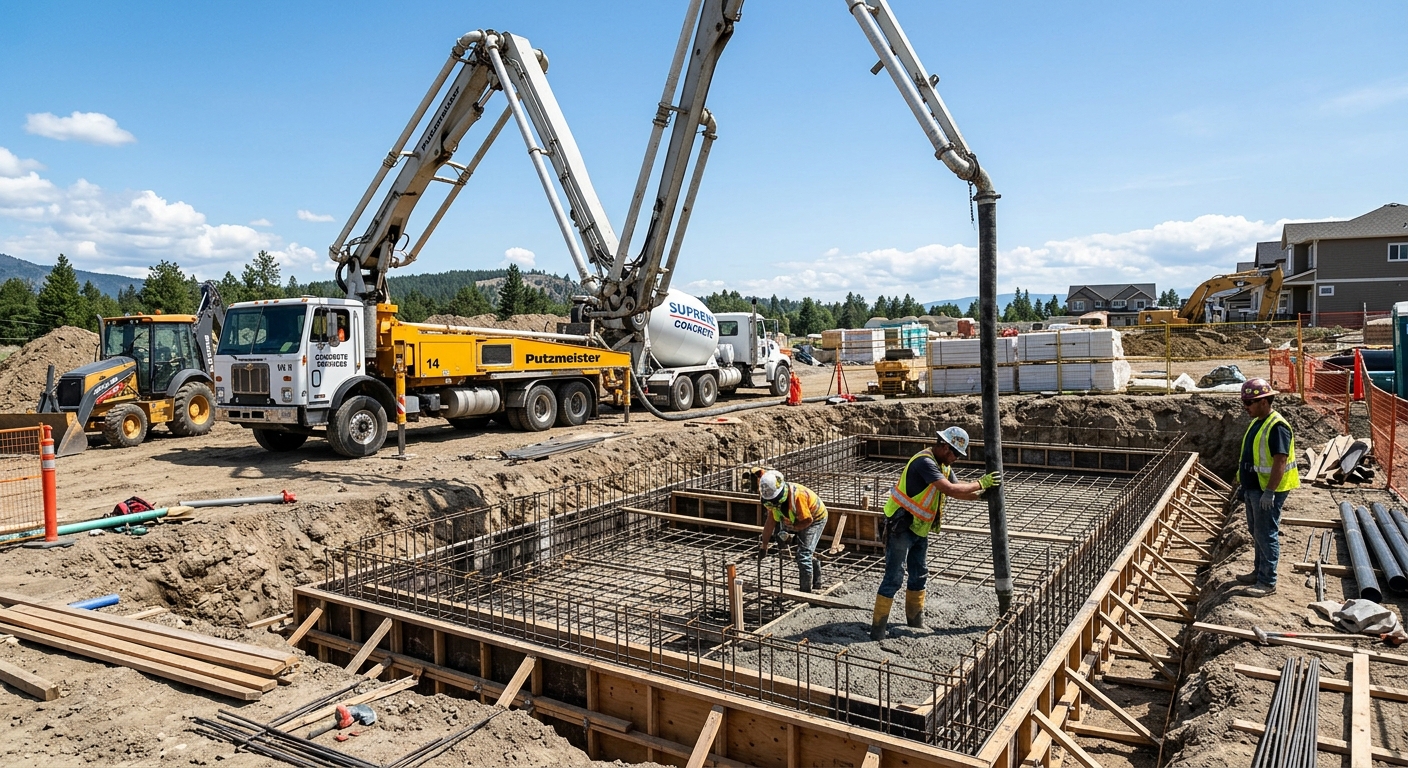
Concrete work options and costs in Miller
Miller, Alberta is a growing Calgary-area community where homeowners commonly upgrade driveways, add patios, and plan new foundations for single-family homes. While the city is small (population 2,972, Statistics Canada, 2021 Census), the practical demand for contractors still tracks the wider Calgary housing market, especially in established streets where driveways and walkways take the brunt of winter freeze–thaw cycles. In this region, the frost depth design is engineered around about 1.2 m (roughly 4 ft), so foundation and footing excavation typically comes with higher concrete volumes than in warmer provinces. That climate-driven foundation cost affects everything that ties into it—access for trucks, base prep depth, and how much reinforcing is needed.
On flatwork, the Calgary-area freeze–thaw pattern means air-entrained mixes, granular base prep, and control joints are not optional if you want long-term performance. Sealing is also more important here than in milder climates because de-icing salts accelerate spalling and scaling. The pour season is shorter, and when late fall or early spring temperatures drop, crews may add winter-grade mix, insulated blankets, or temporary heat to protect curing—cost that shows up in contractor quotes.
In Miller, trade activity is often especially noticeable around established residential pockets near the main commuting corridors to Calgary, where homeowners tend to refresh driveways and backyard walkways ahead of winter. Below is a practical comparison of typical options and what homeowners in Miller usually budget before comparing quotes.
| Application |
Typical Size |
Key Spec |
Finish Option |
Price Range |
| Concrete driveway (standard broom finish) |
400–600 sq. ft. |
Air-entrained exterior mix, compacted granular base, control joints |
Broom finish, saw-cut joints, optional light sealing |
$12,000–$18,000 |
| Exposed aggregate driveway |
400–600 sq. ft. |
Air-entrained mix, proper base, finishing schedule for exposure |
Exposed aggregate with uniform wash/exposure timing |
$14,000–$22,000 |
| Stamped concrete driveway or patio |
300–500 sq. ft. |
Air-entrained mix, reinforcement as required, jointing plan |
Stamped patterns with integral colour and release |
$15,000–$26,000 |
| Plain concrete patio or walkway |
200–400 sq. ft. |
Air-entrained mix, compacted base, edge protection |
Broom or smooth trowel (as specified) |
$5,000–$9,000 |
| Garage floor (interior slab) |
400–600 sq. ft. |
Vapour control where needed, 30+ MPa, reinforced mesh/wire |
Float and finish, broom or smooth finish option |
$7,000–$14,000 |
| Foundation footings (structural, below frost) |
Typical single-family perimeter |
Excavation to undisturbed soil, engineered steel, frost-depth bearing |
Standard reinforced footings (engineered) |
$28,000–$45,000 |
Prices are estimates only and vary by project scope, site access and material selection.
What affects the price of concrete work in Miller
In Miller (and throughout the Calgary region), quotes for the “same” concrete job can swing 30–50% because the true variables are rarely visible at first glance: excavation depth, soil conditions, reinforcement requirements, truck access, and how long crews must protect curing in cold snaps. A driveway might look like it’s just 500 sq. ft. of concrete, but in winter/shoulder seasons the local market often prices in air-entrained mixes, granular base prep, and sometimes heat/blankets to achieve proper strength gain. In a small community like Miller (population 2,972, Statistics Canada, 2021 Census), contractor scheduling also matters—when the pour season is tight, experienced crews may have less availability, which can affect labour pricing.
Frost-depth engineering is the biggest driver. In this region, footings for houses, garages, decks and retaining elements must bear on undisturbed soil below the design frost depth—about 1.2 m. That means deeper excavation and higher concrete volumes for foundations than in warmer areas. Freeze–thaw cycles then dictate air-entrainment for every exterior slab (driveways, patios, walkways) to reduce spalling risk. Also, de-icing salts accelerate deterioration, so sealing is often recommended.
Two common Miller examples: (1) A driveway on soft or disturbed soil can require extra granular removal and replacement, pushing a standard broom-finish job toward the upper end of the $12,000–$18,000 band; (2) A stamped driveway/patio with integral colour and pattern mats can justify the higher $15,000–$26,000 range because finishing time and materials are greater. If your home was built decades ago and the base was compromised during past repairs, you’re often paying more for prep than you would on a green-site pour.
| Price Factor |
Why It Matters |
Cost Impact |
| Frost line depth — determines footing depth and form height |
Concrete must bear below frost to prevent heave and seasonal movement |
Higher excavation and footing volumes; can move foundation pricing toward the upper band ($28,000–$45,000) |
| Site preparation — excavation, grading, compacted granular base |
Proper sub-base prevents settlement and cracking under freeze–thaw stress |
Soft soils or poor drainage often add thousands in granular supply and labour |
| Reinforcement — rebar or wire mesh requirement |
Rebar mesh supports shrinkage and loading; specifications may change with slab type |
More steel and tying time can raise material and labour costs |
| Mix design — air-entrainment and compressive strength spec |
Air-entrainment helps resist freeze–thaw deterioration and scaling |
Winter-grade or higher-spec mixes add cost, especially during cold pours |
| Finish type — broom vs. stamped vs. exposed aggregate |
Finishing time, materials (forms/mats/release or aggregate exposure steps) and workmanship requirements |
Stamped and exposed work typically pushes pricing toward the top of flatwork bands |
| Pour size and concrete truck access to site |
Smaller access changes how crews place concrete and affects equipment labour time |
Restricted access can add pumps, additional labour, and longer placement effort |
| Cold-weather curing precautions — heating and blankets |
Strength gain and surface protection are critical in shoulder seasons |
Temporary heat/blankets can add several thousand dollars on exterior pours |
| Control joint pattern and sealing cost |
Jointing and sealing reduce random cracking and protect from salt exposure |
Incorrect jointing increases long-term repair risk; sealing is an additional but lower-cost risk reducer |
Permits & regulations in Alberta
In Alberta, structural concrete work—such as footings, foundation walls, and grade beams—typically requires a building permit, and engineered drawings are often reviewed as part of the permit process. For concrete flatwork like patios, walkways, and driveways, permits usually are not required unless the work affects lot grading, impervious surface coverage limits, or the municipal right-of-way. Even when a permit is not common for flatwork, you still need to confirm the specific scope with the local authority before breaking ground.
Before you hire anyone in Miller, ask for proof of coverage and confirm licensing/credentials. Here’s a practical step-by-step homeowner approach:
- Request the contractor’s business details and ask for their Alberta licence information (as applicable for their trade scope), then verify it using the relevant online registry for Alberta trades/contractors.
- Ask for a current certificate of insurance: liability insurance should be active for the work date.
- Confirm WSIB/WCB coverage (or the contractor’s equivalent coverage status as applicable) before work starts.
- Get clearance letters or proof of good standing where applicable—don’t accept “we have coverage” without documents.
- Ask for references on similar-scale work: a foundation crew should show prior footing/foundation experience, while flatwork crews should show projects with air-entrained exterior specs.
If you’re unsure whether your driveway needs a permit due to grading or drainage changes, call before scheduling. In Calgary-area winters, correcting drainage later is far more expensive than confirming requirements upfront.
Getting concrete right in Miller's freeze-thaw climate
Concrete failures in Miller usually trace back to three things: inadequate base support, wrong mix design for freeze–thaw, and poor curing (especially in cold weather). In our Calgary-area continental climate, water moves in and out of the slab and sub-base during freeze–thaw cycles. If the base isn’t compacted to the right depth and density for local soil, the slab can settle and crack. If the mix isn’t air-entrained, freeze–thaw damage can lead to scaling and spalling—surface breakdown that gets worse once de-icing salts are used.
To spec the job correctly: (1) base preparation must include a compacted granular sub-base sized for the soil and project design, reaching the required bearing conditions for exterior flatwork; (2) specify an air-entrained exterior mix (commonly 5–7% air content for exterior flatwork) and a minimum 32 MPa compressive strength; (3) require a control joint plan with saw-cut joints spaced to limit random cracking; (4) curing matters—plan for at least 7 days of proper curing conditions, with winter-grade precautions (insulated blankets and/or temporary heat) when temperatures dip; (5) apply a penetrating sealer after the slab has properly cured (often 28 days post-pour) to help repel salt and water.
Here’s where price differences are often justified: a broom-finish driveway might land in the $12,000–$18,000 range, while stamped concrete with integral colour and finishing complexity usually moves into the $15,000–$26,000 band. The extra money isn’t just aesthetics—it’s labour time, finishing sequencing, and jointing discipline needed for a durable patterned surface. If a quote is “much cheaper” but skips air-entrainment, proper base prep, or curing protection, you’ll likely pay later for patching and resealing.
| Spec |
Why It Matters in Miller |
What to Ask For |
Impact if Skipped |
| Compacted granular base (depth?) |
Prevents settlement and cracking under freeze–thaw movement |
Granular base depth and compaction method tied to your soil and design |
Early cracking, rocking slab, and water infiltration |
| Air-entrained concrete mix (target air %?) |
Reduces freeze–thaw scaling and spalling from trapped water |
Air target stated (commonly 5–7% for exterior flatwork) |
Surface deterioration within a few seasons, especially with salt |
| Compressive strength (MPa rating) |
Ensures durability and strength gain in Alberta conditions |
Minimum 32 MPa (or higher per design) |
Reduced wear resistance; higher risk of damage during winter |
| Control joints (spacing per ACI guidelines) |
Limits random cracking by giving concrete a planned weak spot |
Joint spacing plan and saw-cut timing after finishing |
Uncontrolled cracking and water entry at random locations |
| Minimum 7-day curing period |
Allows strength gain and reduces surface scaling risk |
Confirm curing plan (including winter-grade precautions when needed) |
Weaker early-age surface and premature deterioration |
| Penetrating sealer (when applied after cure) |
Helps repel de-icing salt and reduces moisture ingress |
Penetrating sealer application after cure (often at 28 days) |
Faster spalling and staining; higher maintenance costs |
How to choose a concrete work contractor in Miller
Choosing the right contractor in Miller comes down to verifying coverage, getting clear scope, and paying for the work you can actually inspect. First, verify Alberta licensing/credentials for the trade scope they’re performing, then confirm liability insurance and WSIB/WCB coverage. Ask to see: (1) a current certificate of insurance showing the jobsite coverage dates and limits; (2) proof of WSIB/WCB clearance or active account coverage; and (3) any licence/registration details relevant to their concrete services. If they can’t provide documents quickly, that’s a red flag.
Next, insist on 2–3 itemised written quotes rather than a single lump sum. You want line items that separate labour and materials, including excavation, granular base, reinforcement, concrete supply (including air-entrainment/winter-grade when needed), forming, finishing, joints, and sealing. Clarify exclusions: is disposal included for excess soil? Is permit work (if required for structural elements) included? Who supplies saw-cutting equipment? What happens if temperatures drop during the cure window?
Warranty matters too. Ask for the workmanship warranty length, whether it covers cracking, scaling, or joint failure, and how the product/manufacturer warranty applies. Make sure you understand whether warranties are transferable if you sell the home. For payment, keep it controlled: never pay more than 10–15% upfront, and hold a portion until you’ve confirmed completion and final cleanup. Finally, get start date and completion estimate in writing so you can plan around the shorter pour season and winter curing requirements.
- Confirm their Alberta licensing/credentials for the concrete scope they’re quoting.
- Verify liability insurance (active policy, correct project dates, adequate limits).
- Confirm WSIB/WCB coverage with documentation (clearance/status where applicable).
- Request at least two recent references for similar work in Calgary-area conditions.
- Get itemised quotes: excavation, base, reinforcement, concrete, finishing, joints, sealing.
- Ask whether air-entrainment and compressive strength specs are included in the quote.
- Ask about cold-weather procedures (blankets/heating) for shoulder-season pours.
- Confirm control joint spacing and saw-cut timing—don’t accept “we’ll do joints as we go.”
- Clarify disposal and hauling of excess soil and any backfill requirements.
- Check what’s included for truck access (forms removal, cleanup, surface protection).
- Review warranty details in writing, including what’s covered and timelines.
- Use a payment schedule with a holdback until you pass final inspection.
Concrete red flags in Miller: (1) quotes that don’t mention air-entrainment for exterior flatwork; (2) no plan for proper base depth/compaction; (3) skipping or under-specifying control joints; (4) rushing curing with no winter-grade plan; and (5) contractors who won’t show insurance/WSIB/WCB proof or won’t provide an itemised scope.
Frequently asked questions — concrete work in Miller
How do I seal concrete to protect it in Miller?
In Miller and the Calgary region, sealing helps a lot because de-icing salts and winter moisture work together to speed up surface breakdown. After your driveway or patio cures properly (commonly around 28 days post-pour), use a penetrating sealer designed for concrete—not just a surface film. The surface should be clean and dry before application, and you should follow the sealer’s temperature and humidity requirements. If your concrete already has widespread staining or scaling, you may need cleaning or minor repairs first.
For budgeting, sealing is usually much cheaper than redoing a driveway, and it protects the texture and joint edges where water can enter. If your project is in the $12,000–$18,000 driveway band, sealing is typically a small add-on relative to the total—so I recommend planning for it rather than delaying until damage appears. (Statistics Canada, 2021 Census)
What is the difference between concrete and cement?
It’s a common question. Cement is one ingredient inside concrete. Concrete is the final engineered material made from cement, water, sand, and gravel (and sometimes admixtures like air-entrainers for freeze–thaw durability). In Miller’s cold climate, exterior concrete needs the right mix design, especially air-entrainment, so it survives the region’s frequent freeze–thaw cycles. When you hear “32 MPa concrete” or “air-entrained mix,” those are concrete performance specs, not cement alone.
If a contractor focuses only on “cement brand” but can’t explain the concrete spec (air content, strength, and curing plan), ask more questions. The difference shows up in durability: the right concrete mix reduces scaling and spalling on driveways and walkways, particularly when homeowners use salt over winter.
How much does concrete work cost in Miller?
For Miller-area homeowners, typical budgeting often lines up with Calgary-region price bands. A standard concrete driveway with broom finish commonly falls around $12,000–$18,000 depending on size, excavation, access, and whether you need winter-curing precautions. Plain patios and walkways are often around $5,000–$9,000, while stamped concrete usually runs higher—often $15,000–$26,000—because it takes more labour time and finishing materials. Foundations and structural footings are typically in the $28,000–$45,000 range for typical residential scopes, with frost-depth excavation being a major cost driver.
Because Miller is part of the Calgary economic region and has a smaller local population (2,972, Statistics Canada, 2021 Census), scheduling and site access can affect quotes—so always compare like-for-like scopes.
How deep must footings be for Miller's frost line?
In this Calgary-area climate, engineering practice uses a design frost depth of about 1.2 m (roughly 4 ft). That means structural footings and any foundation elements that need frost protection generally must extend below that design frost depth to bear on undisturbed soil. The exact required depth for your specific foundation is confirmed by the engineer’s drawings and the geotechnical conditions for your lot, but the frost depth target is what drives excavation volume and foundation cost.
If a proposal suggests bearing near the surface or “minimum depth to save costs,” that’s usually where problems start—frost heave and seasonal movement can crack walls and disrupt floors. For Miller homeowners planning structural work, make sure the quote references engineered specs and includes excavation down to the required bearing level.
Why does concrete crack in Miller and how is it prevented?
Concrete cracks mainly because of shrinkage (as it cures), temperature changes, and the concrete’s natural movement against the base. In Miller, freeze–thaw cycles and moisture movement add another layer: if water gets in through edges or joints, surface scaling and micro-cracking can worsen over time—especially with de-icing salt. The prevention strategy is to combine proper base prep and correct specs: compacted granular base, air-entrained exterior concrete, and a deliberate control joint plan.
Ask your contractor for control joint spacing and saw-cut timing, and confirm curing protection in cold weather. Skipping joints or doing them late can lead to random cracking. Sealing after cure helps protect joints and edges from salt and water intrusion, which is one reason well-specified jobs last longer in our Calgary-area winters.
Stamped vs broom-finish concrete — cost difference?
Stamped concrete typically costs more than broom-finish because it requires additional steps: pattern mats, release agents, careful finishing timing, and colour processes (often integral colour). In the Miller market, broom-finish exterior driveways are commonly budgeted around $12,000–$18,000, while stamped concrete driveways or patios often fall around $15,000–$26,000 depending on square footage and how complex the pattern/colourwork is.
The cost difference is usually justified when the contractor also maintains the same durability standards—air-entrainment, proper base compaction, reinforcement as needed, and disciplined control joints. If a quote is low on stamped work, ask whether air-entrainment and curing protection are included. In Miller’s freeze–thaw climate, poor durability can ruin the look quickly.