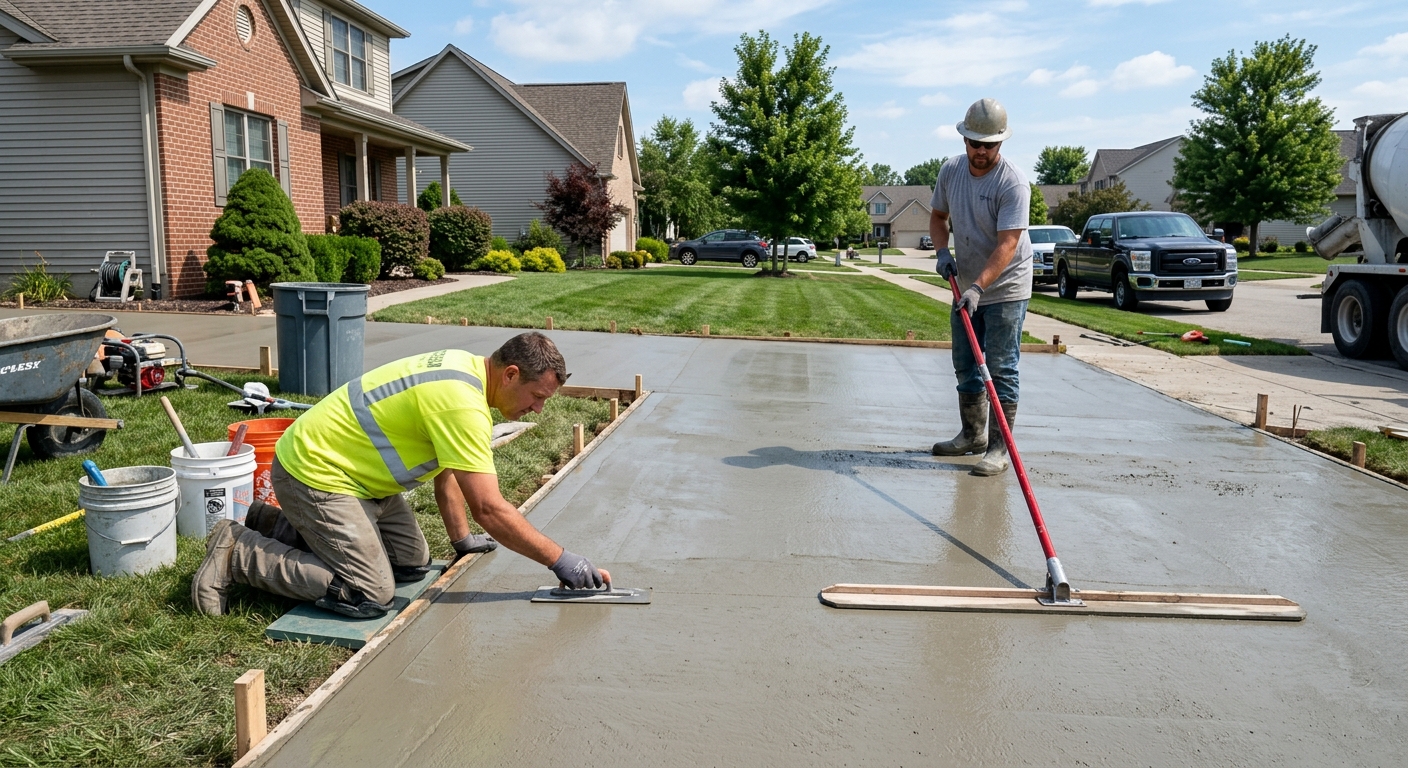
Concrete work options and costs in Taradale
Taradale is a strong market for concrete flatwork because the neighbourhood’s housing mix and lot conditions are well-suited to durable exterior slabs. With a population of 17,630 people (Statistics Canada, 2021 Census), demand is steady, especially from homeowners upgrading driveways, adding backyard patios, and reworking garage approaches. Most of these projects start as standard broom-finish concrete and then “upgrade” to exposed aggregate or stamped styles once residents see how Calgary-area freeze–thaw affects performance over time.
In Calgary’s cold continental climate, concrete pricing is engineered around frost and freeze–thaw more than in milder parts of Canada. The design frost depth is about 1.2 m (roughly 4 ft), so exterior footings and foundation work must bear below that zone to reduce frost heave and seasonal movement. Frequent freeze–thaw cycles also mean exterior concrete needs air-entrained mixes, better base prep, and a control-joint plan that limits random cracking and surface scaling. That’s why you’ll often see higher foundation / footings numbers compared with regions where frost penetration is shallow.
Contractor availability and scheduling also matter here. Exterior pours have a shorter practical season, so crews may be booked earlier for spring and late-summer work, and winter placement often requires cold-weather curing precautions. In Taradale, demand is especially high around residential pockets with older, more drainage-sensitive yards near local roads, where driveways and patios commonly settle or crack and need full-depth repairs.
Below are realistic cost bands for common options, then we’ll break down what drives those numbers in the next section.
| Application |
Typical Size |
Key Spec |
Finish Option |
Price Range |
| Concrete driveway (standard broom finish) |
24 ft x 10 ft (240 sq ft) |
Air-entrained mix, compacted base, control joints |
Broom finish |
$12,000–$18,000 |
| Exposed aggregate driveway |
24 ft x 10 ft (240 sq ft) |
Air-entrained mix, saw-cut joints, proper curing |
Exposed aggregate |
$14,500–$21,500 |
| Stamped concrete driveway or patio |
20 ft x 16 ft (320 sq ft) |
Air-entrained mix, integral color, release agent, joints |
Stamped (pattern + color) |
$15,000–$26,000 |
| Plain concrete patio or walkway |
12 ft x 15 ft (180 sq ft) |
Air-entrained mix, compacted granular base, edging |
Broom or light trowel + joints |
$5,000–$9,000 |
| Garage floor (interior slab) |
24 ft x 22 ft (528 sq ft) |
Vapour barrier (as specified), slab thickness per design |
Standard finish |
$9,000–$15,000 |
| Foundation footings (structural, below frost) |
Varies by footprint |
Engineered dimensions, below design frost depth bearing |
Reinforced structural concrete |
$28,000–$45,000 |
Prices are estimates only and vary by project scope, site access and material selection.
What affects the price of concrete work in Taradale
In Taradale and across the Calgary region, two homeowners can get quotes that differ by 30–50% for what looks like the “same” concrete job. The most common reasons are hidden scope items—how deep the base needs to go, how much excavation is required to reach undisturbed soil, how much reinforcement is specified, and whether the schedule forces cold-weather placement. Concrete pricing is also labour-driven: experienced crews who place to freeze–thaw durability standards typically spend more time on base compaction, formwork, curing protection, and joint layouts.
For Calgary-area work, frost and freeze–thaw dictate the engineering basics. Footings must extend below the design frost depth (about 1.2 m here) to prevent frost heave and seasonal movement. Exterior slabs also need air-entrained concrete to survive repeated freeze–thaw cycles, plus well-timed curing so you don’t get surface scaling and early-life spalling. Because the practical pour season is shorter, late fall/early spring work often requires winter-grade placement methods—insulating blankets and sometimes temporary heat—which adds cost.
De-icing salt is another real factor in this area: it can accelerate surface deterioration if the mix, finishing, and sealing aren’t done correctly. In Taradale, I often see cost move up when homeowners require full-depth driveway replacement rather than patching—especially where prior repairs left voids under the slab. Cost can also move down when a clear access route reduces truck time and when the base prep scope is straightforward. A standard broom driveway in the $12,000–$18,000 band can turn into an exposed aggregate driveway in the mid-to-high teens or beyond when stone washing, colour consistency, and additional crew time are included. Likewise, stamped work typically lands in the $15,000–$26,000 range because it adds colour, stamps, and careful joint/pattern planning.
| Price Factor |
Why It Matters |
Cost Impact |
| Frost line depth — determines footing depth and form height |
Footings must bear below the design frost zone |
Higher excavation and concrete volume; can push foundation costs toward the upper band |
| Site preparation — excavation, grading, compacted granular base |
Correct base depth and compaction prevent settlement and cracking |
Extra trucking, labour, and granular material; often responsible for quote gaps |
| Reinforcement — rebar or wire mesh requirement |
Controls cracking and supports loads in exterior conditions |
Material and placement time; increases price especially on driveways and footings |
| Mix design — air-entrainment and compressive strength spec |
Durability against freeze–thaw and required structural performance |
“Better” mixes are typically a meaningful add, but reduce long-term failure risk |
| Finish type — broom vs. stamped vs. exposed aggregate |
Impacts crew time, materials, and quality control |
Stamped/exposed options usually move you into the higher bands |
| Pour size and concrete truck access to site |
Truck access limits how much can be poured efficiently |
Long pump/access setups can add labour and equipment time |
| Cold-weather curing precautions — heating and blankets |
Strength gain needs protection when temperatures drop |
Blankets/heat and slower procedures can add to the job total |
| Control joint pattern and sealing cost |
Joints control where cracks happen; sealing protects from salt |
More saw-cuts and sealing line items raise total but improve lifespan |
Permits & regulations in Alberta
In Alberta, structural concrete work typically needs a building permit, and many projects also require engineered drawings reviewed through the municipality’s process. That includes foundation footings, foundation walls, grade beams, and other structural elements where concrete is part of the load-bearing system. For concrete flatwork—driveways, patios, and walkways—permits are often not required by default. However, you may need to coordinate when the work affects lot grading, stormwater drainage, impervious surface coverage limits, or when the concrete impacts municipal right-of-way or access requirements.
For Taradale homeowners, the practical approach is to confirm in writing before excavation. Then, verify your contractor can legally and responsibly perform the work. Step-by-step: (1) ask for their certificate of liability insurance—ensure the policy is active and lists your property/address as applicable where required; (2) request WSIB/WCB coverage proof (as applicable for the trades involved) and confirm it covers the crew doing the concrete work; (3) check Alberta licensing/registry details through the appropriate provincial online resources for the contractor’s business category; (4) request references from projects that are the same scale (driveway replacement, stamped work, or foundation-related pours) and ask to see photos of cured work in freeze–thaw conditions.
If a contractor tells you “permits aren’t needed, ever,” that’s a red flag—especially for structural concrete. Always confirm with the local authority before breaking ground.
Getting concrete right in Taradale's freeze-thaw climate
Concrete failures in Taradale usually come down to three issues: the base isn’t prepared to the right depth and compaction, the mix isn’t engineered for freeze–thaw, and curing is rushed. In Calgary’s cold continental climate, the design frost depth is about 1.2 m (roughly 4 ft), so anything related to footings must bear below that zone. For driveways, patios, and walkways, the key durability spec is air-entrainment and a controlled joint layout—because freeze–thaw cycles pull moisture in and out of the slab, and poorly air-entrained concrete is much more prone to spalling and scaling.
To spec the job correctly, insist on: (1) base preparation with a compacted granular sub-base to the depth your engineer/contractor specifies for your soil conditions; this is where many “cheap” quotes quietly cut corners. (2) Mix design with air-entrainment for exterior flatwork (commonly 5–7% air content) and a minimum 32 MPa compressive strength spec, so the concrete reaches adequate strength under local conditions. (3) Control joints placed to reduce random cracking—joints are planned “weak points,” not mistakes. (4) Curing for at least 7 days under proper conditions; in colder periods, curing protection (insulating blankets and/or approved heat) can be essential for strength gain. (5) Sealing: apply a penetrating sealer around 28 days after the pour to repel de-icing salts.
Here’s a real decision point on dollars: a standard broom driveway can land in the $12,000–$18,000 range, while stamped work often reaches the $15,000–$26,000 band. The price jump is justified when the contractor maintains the same exterior durability specs (air-entrainment, joints, curing, and sealing) while adding colour/stamp labour and pattern control—otherwise you’re paying more for aesthetics without improving longevity.
If you want to avoid the most common failure—spalling—ask directly: “What air-entrainment target are you placing, how do you protect curing in cold weather, and how are joints and sealing handled in your scope?”
| Spec |
Why It Matters in Taradale |
What to Ask For |
Impact if Skipped |
| Compacted granular base (depth?) |
Prevents settlement and reduces cracking during freeze–thaw |
Base thickness and compaction standard for your soil conditions |
Low areas, voids under slab, early cracking and uneven performance |
| Air-entrained concrete mix (target air %?) |
Air void system manages expansion from freeze–thaw cycles |
Target air content (commonly 5–7% for exterior flatwork) |
Higher risk of spalling, scaling, and surface deterioration |
| Compressive strength (MPa rating) |
Ensures strength gain and durability under cold Alberta conditions |
Minimum 32 MPa (or project-specific higher requirement) |
Under-strength concrete may fail sooner under traffic and weather |
| Control joints (spacing per ACI guidelines) |
Controls where cracks happen to protect slab integrity |
Planned joint spacing and timing for saw-cutting |
Random cracking and widened joints that let water in |
| Minimum 7-day curing period |
Strength develops properly and reduces surface scaling risk |
How curing is protected during cold weather (blankets/heat if needed) |
Premature drying/strength loss and early surface damage |
| Penetrating sealer (when applied after cure) |
Salt and moisture resistance for driveway and patio surfaces |
Penetrating sealer applied after full cure (around 28 days post-pour) |
Faster deterioration from de-icing salts and moisture movement |
How to choose a concrete work contractor in Taradale
Choosing the right concrete contractor in Taradale is mainly about confirming they can build to Alberta durability standards, not just pour quickly. Start by verifying Alberta business licensing/registration for the contractor’s category, and ask for a current certificate of liability insurance. For the crews, request proof of WSIB/WCB coverage as applicable to the work being performed. If the contractor can’t provide paperwork promptly, move on—concrete projects expose you to higher risk when crews are not properly covered.
Then get 2–3 itemised written quotes. You want a labour + materials breakdown, including excavation, formwork, granular base, reinforcement, concrete mix specification (air-entrainment and strength), finishing, joints, curing protection, sealing, and disposal. A lump sum with no line items is harder to compare and easier to “adjust” later. Read the scope carefully: what’s excluded (tree removal, rock excavation, restoring landscaping), is a permit pull included where required, and is disposal/hauling part of the price? For Taradale, excavation and disposal can become major cost drivers if access is tight or the site needs extra grading.
Warranty matters: confirm workmanship warranty length, product/manufacturer warranty coverage, and whether warranties are transferable if you sell your home. Payment schedule should be conservative—never pay more than 10–15% upfront, and hold back a portion until the job is complete, cured to expectations, and clean-up is done.
Finally, insist on a written timeline with a stated start date and completion estimate, plus what happens if temperatures drop below placement thresholds.
- Provide Alberta proof of licensing/registration for the concrete scope they’re doing.
- Show active liability insurance (ask for the policy details/certificate).
- Confirm WSIB/WCB coverage documentation for the crew.
- Include line items: excavation, base prep, reinforcement, concrete mix spec, joints, curing, and sealing.
- State air-entrainment target and minimum compressive strength (e.g., 32 MPa).
- List control joint pattern and timing (and whether saw-cut is included).
- Explain how curing will be protected during cold weather (blankets/heat if needed).
- Clarify whether disposal of excess soil and concrete washout is included.
- Confirm truck access plan, pour sequence, and whether pumps/finishing help is included.
- Provide warranty terms for workmanship and how long the warranty lasts.
- Set payment milestones: 10–15% max upfront, holdback at completion/acceptance.
- Ask for references from similar-scale Taradale or Calgary freeze–thaw projects.
Concrete red flags in Taradale: contractors who won’t state the mix spec or air-entrainment target, quotes that don’t mention base depth/compaction, no plan for curing protection when weather turns cold, missing joint layout/saw-cut timing, and vague warranties paired with aggressive upfront payment demands.
Frequently asked questions — concrete work in Taradale
Stamped vs broom-finish concrete — cost difference?
In Taradale, stamped concrete typically costs more than broom-finish because it adds integral colour (or staining), stamp mats/release agent, extra finishing time, and more careful joint/pattern planning. For a driveway or patio where broom-finish might land in the $12,000–$18,000 range, stamped projects commonly land in the $15,000–$26,000 band depending on size and whether the design includes multiple colours or complex pattern layouts. The important part is that the durability specs should be the same—air-entrainment, minimum strength, proper curing, and sealing. If a contractor only “upgrades the look” but doesn’t engineer for freeze–thaw, you pay for aesthetics without improving lifespan.
When is the best time to pour concrete in Taradale?
For exterior flatwork in Alberta, the best results usually come from late spring through summer and early fall when temperatures allow proper curing without excessive heating or blankets. Calgary-area freeze–thaw cycles are hard on newly placed slabs, and a short practical pour season means crews often book earlier. If you’re aiming for a driveway or patio near Taradale, plan for a pour before sustained cold nights arrive. If winter work is unavoidable, a qualified contractor should spell out cold-weather curing precautions (insulated blankets and, when approved, temporary heat) and confirm the mix is winter-grade. The goal is minimum 7-day strength development under controlled conditions—rushing that window is when surface scaling becomes more likely.
How long does concrete take to cure?
Concrete curing has two parts: strength gain and readiness for typical use. Most homeowners should plan for at least 7 days of curing under proper conditions, especially for exterior slabs exposed to Calgary freeze–thaw cycles. Full strength development generally takes longer (often around 28 days), which is why sealing is typically scheduled after cure—around 28 days post-pour for many penetrating sealers. If the contractor is doing winter placement in Taradale, curing may require protection so strength gain isn’t slowed by cold temperatures. Always confirm when you can walk on the surface, when equipment or vehicles can cross it, and when sealing will be applied as part of the agreed scope.
Do I need a permit for concrete work in Alberta?
In Alberta, structural concrete work like foundation footings, foundation walls, and grade beams usually requires a building permit and often engineered drawings reviewed through the municipal process. Concrete flatwork such as patios, walkways, and driveways often does not require a permit by default, but you should still confirm if the work affects lot grading, stormwater drainage, impervious surface limits, or municipal right-of-way/access. For Taradale homeowners, the safest approach is to ask your contractor what permit (if any) is included and to verify with the local authority before breaking ground. A professional contractor can explain what portion of the work is permit-triggered and provide documentation like engineering references when structural items are involved.
Concrete vs pavers for a patio in Taradale?
Concrete and pavers both work well for patios, but the right choice depends on how you want it to behave under Calgary freeze–thaw cycles and how much maintenance you want. A plain concrete patio or walkway typically sits around the $5,000–$9,000 range, and if it’s built with air-entrained concrete, correct base prep, joints, and curing, it can be very durable. Pavers can be easier to lift and replace if a section fails, but they still require proper compaction and drainage detailing to avoid shifting. In Taradale, I often recommend concrete when homeowners want a monolithic, low-maintenance surface and are okay with planned control joints; pavers can make sense when aesthetics and segmented repair are priorities.
How long does a concrete driveway last?
With the right specs and installation in Alberta, a concrete driveway often lasts many decades, but lifespan depends heavily on base preparation, air-entrained mix, joint placement, curing, and how it’s treated with de-icing salts. In Taradale’s freeze–thaw climate, the biggest early failure causes are spalling/scaling from inadequate air-entrainment or rushed curing, and cracking from poor base compaction or missing joint control. That’s why the best contractors include details like air-entrainment targets, minimum 32 MPa strength, joint timing, and sealing (commonly around 28 days post-pour). If your driveway is currently patchy or scaling, it may be cheaper long-term to replace full sections rather than repeatedly repairing weak areas.