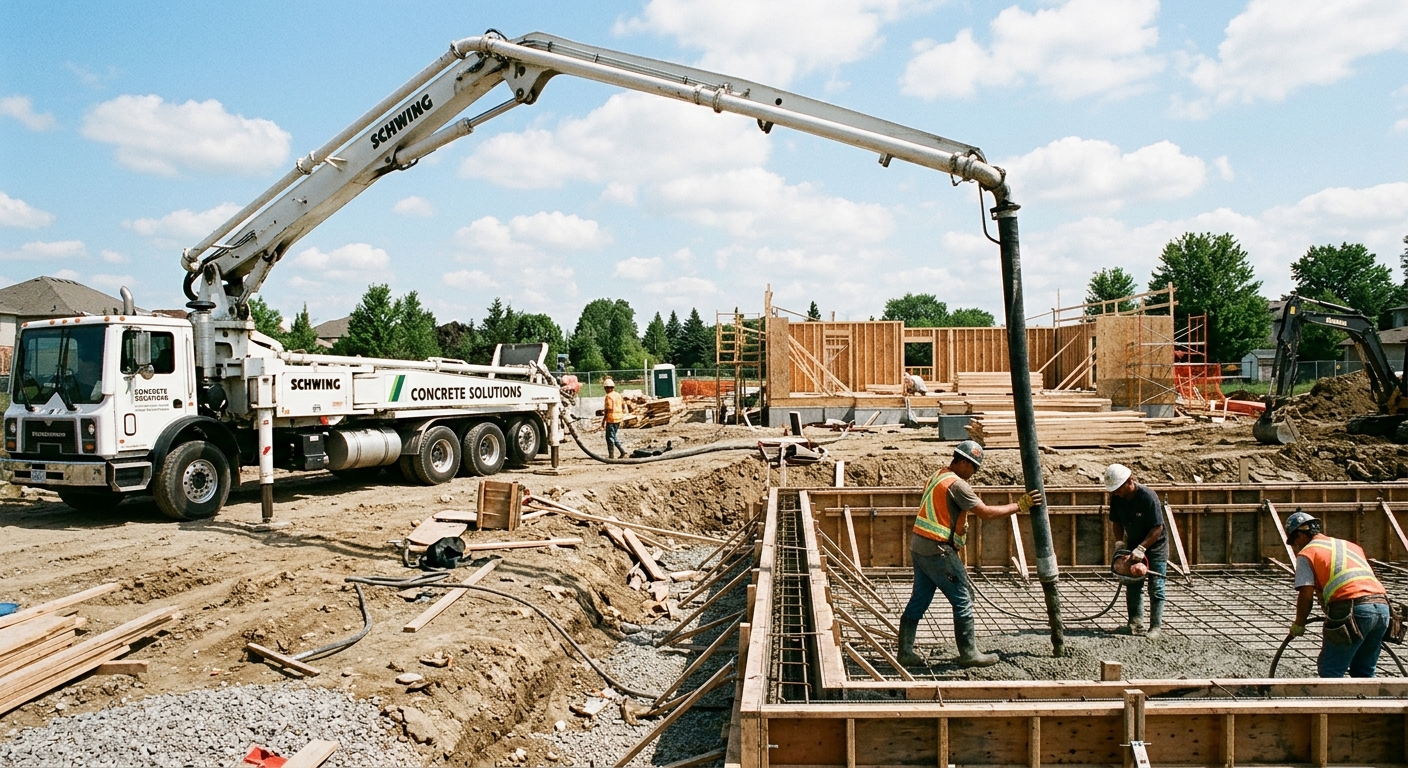
Concrete work options and costs in Carlton
Carlton, Alberta is a smaller community within the Calgary economic region, and that shows up in how concrete quotes are planned: local crews schedule work efficiently, but the site-prep and engineering details still matter. In the 2021 Census, Carlton had 2,735 residents (Statistics Canada, 2021 Census), and the broader Calgary area has a mix of single-detached homes and newer builds where driveways, patios and sidewalks are often updated as lots mature. Concrete flatwork like driveways, patios and walkway slabs is the most common “visible” upgrade homeowners request, while foundation footings and structural pours are driven by design frost depth and soil conditions.
In this cold continental climate, contractors engineer every exterior detail around freeze–thaw. Alberta engineering practice typically uses a design frost depth of about 1.2 m (roughly 4 ft), meaning footings for houses, garages, decks and retaining structures must bear on undisturbed soil below that depth to reduce frost heave and seasonal movement. Frequent freeze–thaw cycles also require air-entrained concrete mixes, proper granular base prep, and well-spaced control joints to limit cracking and spalling. Because the practical pour season is shorter, cold-weather placements may need insulated blankets and sometimes temporary heat—cost items you won’t see in milder regions.
In and around the Carlton Lake / rural-edge properties (and similar lots on the outskirts), demand tends to spike when homeowners update long, drainage-heavy drive approaches or expand outdoor living spaces. With that context, here are realistic cost bands for common concrete projects to compare your options side-by-side.
| Application |
Typical Size |
Key Spec |
Finish Option |
Price Range |
| Concrete driveway (standard broom finish) |
400–600 sq. ft. |
Air-entrained exterior mix, compacted granular base, control joints |
Broom / light texture, optional edge forms |
$12,000–$18,000 |
| Exposed aggregate driveway |
400–600 sq. ft. |
Air-entrained mix, retarder/seed stone technique, stronger surface wear resistance |
Exposed aggregate with broom-clean edges |
$14,000–$20,000 |
| Stamped concrete driveway or patio |
300–600 sq. ft. |
Air-entrained mix, integral colour, thicker finish control plan |
Stamp mats + release + wash, sometimes borders |
$15,000–$26,000 |
| Plain concrete patio or walkway |
200–400 sq. ft. |
Air-entrained exterior mix, compacted base, scoring/control joints |
Float + broom or light trowel texture |
$5,000–$9,000 |
| Garage floor (interior slab) |
480–600 sq. ft. |
Vapour control/underlay as needed, mesh or fibres, proper thickness |
Broom finish / light trowel, optional densifier |
$9,000–$15,500 |
| Foundation footings (structural, below frost) |
Typical house perimeter + probes |
Excavation to undisturbed bearing, reinforced concrete, below design frost |
Engineered concrete placement |
$28,000–$45,000 |
Prices are estimates only and vary by project scope, site access and material selection.
What affects the price of concrete work in Carlton
In Carlton and across the Calgary region, you’ll often see quote variation of 30–50% for “the same” concrete job because the real drivers aren’t just the concrete itself—they’re the excavation depth, the granular base, reinforcement, and the winter-cure requirements. Two contractors can both quote a driveway, but if one includes engineered frost-proof footing depth, thicker base, proper air-entrainment, and curing protection while the other assumes ideal conditions, the total cost can swing materially.
Frost line depth and freeze–thaw cycles dictate almost everything in this climate. Exterior slabs typically need air-entrained concrete mixes to survive repeated freeze–thaw, and footings must extend below the local design frost depth of about 1.2 m to avoid frost heave and seasonal movement. Calgary’s shorter pour season also pushes crews to plan for cold-weather placement—heating, insulated blankets, and tighter temperature control—so the concrete achieves proper early strength. Salt and de-icing accelerate surface scaling, which is why sealing is often recommended once the slab has properly cured.
Here are a few concrete examples of how local conditions raise or lower costs in Carlton: (1) if your driveway ties into an existing approach or crosses soft/variable fill, excavation and replacement granular base can add hours of work and increase the material volume; (2) if your project is in an exposed windy area, curing protection can be required, which impacts labour and equipment time; and (3) if you choose stamped or exposed aggregate, the finish step increases both labour and material complexity. As a reference point, a standard broom driveway commonly lands within the $12,000–$18,000 band, while stamped options often fall within $15,000–$26,000 once colour and finish time are included.
| Price Factor |
Why It Matters |
Cost Impact |
| Frost line depth — determines footing depth and form height |
Footings must bear below design frost to resist frost heave |
Higher excavation depth and more concrete/steel |
| Site preparation — excavation, grading, compacted granular base |
Proper base reduces settlement and keeps slabs flat |
Extra hauling, compaction passes, and drainage adjustments |
| Reinforcement — rebar or wire mesh requirement |
Controls cracking and improves load performance |
Material cost + labour to place and chair steel |
| Mix design — air-entrainment and compressive strength spec |
Air-entrainment helps resist freeze–thaw spalling |
Winter-grade materials and specified strength mix cost |
| Finish type — broom vs. stamped vs. exposed aggregate |
Surface durability and appearance complexity |
Extra labour steps, release agents, and finishing time |
| Pour size and concrete truck access to site |
Haul distance and pumping/placement limits affect productivity |
Additional set-up time, possible pump costs, or extra labour |
| Cold-weather curing precautions — heating and blankets |
Ensures concrete reaches strength before it freezes |
Heaters/blankets and more time on site |
| Control joint pattern and sealing cost |
Joints reduce random cracking; sealing helps resist salt damage |
Saw-cut labour and sealant/material application |
Permits & regulations in Alberta
In Alberta, structural concrete work generally requires a building permit and—depending on the project—engineered drawings reviewed through the municipal permitting process. This includes foundation footings, foundation walls, grade beams and other load-bearing structural elements. For concrete flatwork like patios, walkways and driveways, a permit often isn’t required unless the work affects lot grading, drainage, impervious surface coverage limits, or the municipal right-of-way (for example, where a driveway tie-in impacts the public interface). Still, the safest approach is to confirm what triggers a permit for your exact location in Carlton (and the specific lot grading/drainage situation).
Before you hire anyone, verify the contractor is properly insured. Step-by-step: (1) confirm Alberta business credentials using the appropriate online registry sources your contractor provides; (2) ask for an up-to-date Certificate of Insurance for liability coverage—your contractor should name you (or your property entity) appropriately as required by your agreement; (3) request WSIB/WCB clearance or evidence of coverage for their workers; and (4) keep a record of who provides which letter/document for your project file. Then ask for references from similar-scale jobs in the Calgary area (driveways, garage slabs, or foundation work) so you can see how they perform under freeze–thaw and cold-weather curing requirements.
If you’re unsure whether your job impacts grading or drainage, have the contractor explain the plan in writing and tie it to the expected permit requirements before any excavation begins.
Getting concrete right in Carlton's freeze-thaw climate
In Carlton and the wider Calgary market, concrete failures are usually about movement and surface damage, not “bad luck.” The two most common problems are (1) cracking that begins when slabs settle or cure unevenly, and (2) spalling from freeze–thaw cycles when air-entrainment and curing aren’t done to spec. To spec the job correctly, start with base preparation: build a compacted granular sub-base to the correct depth based on soil and local frost requirements, not just “whatever fits.” Next, use a properly engineered exterior mix. For exterior flatwork, air-entrainment around 5–7% is typical for durability in freeze–thaw, and many specs target minimum 32 MPa compressive strength for structural performance. Control joints matter as well—spacing and timing are what limit random cracking. Finally, curing: aim for a minimum of 7 days of curing under good conditions. In cold snaps, insulating blankets and temperature control are often necessary to prevent early freezing. After the slab has cured, seal with a penetrating sealer (often applied after 28 days) to help repel de-icing salts.
When homeowners compare quotes, a common question is why the “better” option costs more. For example, a plain broom patio might land in the $5,000–$9,000 range, while a stamped patio typically increases cost into the $15,000–$26,000 band depending on size and detailing. That premium can be justified if the contractor is also upgrading the base, specifying proper air-entrainment, and controlling the joint layout so the aesthetic finish isn’t undermined by early surface scaling.
Ask technical questions early—especially about air content, base compaction, joint spacing, and cold-weather curing—because those are the levers that most directly prevent spalling and premature deterioration in our freeze–thaw environment.
| Spec |
Why It Matters in Carlton |
What to Ask For |
Impact if Skipped |
| Compacted granular base (depth?) |
Prevents settlement and supports the slab through freeze–thaw |
Documented excavation depth, granular type, and compaction plan |
Uneven settling, cracking, and shortened service life |
| Air-entrained concrete mix (target air %?) |
Resists freeze–thaw pressure that causes spalling |
Batch ticket notes and target air content around 5–7% |
Surface scaling/spalling, especially with de-icing salt |
| Compressive strength (MPa rating) |
Ensures the slab reaches expected durability and load capacity |
Minimum 32 MPa (or project-engineered equivalent) |
Reduced strength and increased cracking risk |
| Control joints (spacing per ACI guidelines) |
Limits random cracks by creating planned crack locations |
Joint spacing plan and saw-cut timing |
Cracks appear where they’re weakest, leading to water intrusion |
| Minimum 7-day curing period |
Early strength development protects against frost and thermal stress |
Planned curing method and cold-weather protection |
Premature surface damage and weaker long-term performance |
| Penetrating sealer (when applied after cure) |
Reduces salt and moisture impact on the surface |
Sealer type and application timing after full cure (often 28 days) |
Higher risk of scaling and staining from winter chemicals |
How to choose a concrete work contractor in Carlton
Choosing the right concrete contractor in Carlton is mostly about verifying competence and protecting yourself against avoidable rework. Start with Alberta licensing/business standing and then confirm insurance coverage. Ask for their Certificate of Liability Insurance (so you’re not left holding the bag for injuries or property damage) and request WSIB/WCB clearance or evidence of coverage for their workers. In practice, you should be able to see current documentation before work begins—don’t accept “we’ll get it later.”
Next, get 2–3 itemised written quotes that break out labour and materials rather than one lump sum. You’re looking for details like excavation, granular base build-up, reinforcement method (rebar vs. mesh), air-entrainment/winter-grade mix notes, joint layout, finishing, curing protection (if temperatures require it), disposal of excess material, and whether sealing is included. If a contractor excludes disposal or assumes free access, your final cost can climb fast—especially in frosty months when hauling schedules can be tighter.
For warranty, ask for both workmanship warranty length and any product/manufacturer warranty (and whether it’s transferable to you). Payment should be controlled: never pay more than 10–15% upfront. Hold back a portion until the job is complete, reviewed, and you’ve confirmed curing, finishing, and documentation. Finally, demand a written timeline with a start date and completion estimate—freeze–thaw planning matters in Alberta, and reputable crews coordinate curing protection rather than rushing the surface.
- Confirm liability insurance and WSIB/WCB coverage with current documents
- Ask who pulls the permit (if required) and whether it’s included in the quote
- Require a written scope: thickness, base depth strategy, and drainage notes
- Get proof of air-entrainment and winter-grade curing plan for cold pours
- Request joint spacing and whether joints will be saw-cut vs. formed
- Verify reinforcement approach (rebar size, spacing, or mesh specification)
- Make sure disposal/hauling of excess soil and forms waste is included (or excluded clearly)
- Confirm truck access plan: staging area, offloading method, and no “make it work” assumptions
- Check for finishing and sealing details: broom spec, curing duration, sealer product and timing
- Ask about warranty terms in writing and what counts as a defect vs. normal wear
- Use a payment schedule: maximum 10–15% upfront; holdback until punch-list is complete
- Request schedule language that accounts for weather (cold snaps, curing protection, and temperature thresholds)
Red flags to watch for in Carlton: contractors who won’t talk about air-entrainment or winter curing; quotes that ignore base compaction depth; vague joint and sealing plans; offers that require a large upfront payment; and crews who start without confirming permit needs for drainage/grading impacts.
Frequently asked questions — concrete work in Carlton
How do I maintain concrete in Carlton's freeze-thaw climate?
In Carlton and across the Calgary region, maintenance is about reducing moisture and salt exposure. After your slab has fully cured, use a penetrating sealer (typically around the 28-day mark) to help repel de-icing salts, which are a major driver of winter scaling. Sweep regularly so grit doesn’t abrade the surface, and avoid high-salt products when possible. For cracks, keep them clean and dry; small hairline cracks often widen if water gets in and then freezes. If you notice spalling spots or scaling, address them early—spot repairs cost much less than replacing sections. During thaw, check drainage so meltwater doesn’t pond near the slab edges, since trapped water accelerates freeze–thaw damage.
What causes concrete to spall in Carlton winters?
Concrete spalls when water enters the surface and the freeze–thaw cycle builds pressure inside the paste or near the surface. In our cold continental climate, the most preventable cause is inadequate air-entrainment and improper curing. Without the right air content (commonly around 5–7% for exterior flatwork) and without protecting the pour during cold nights, the concrete can’t tolerate repeated freezing. Poor base prep and settlement also contribute by creating micro-cracks that let water move. Finally, de-icing salts increase scaling severity, especially if you don’t use a penetrating sealer after cure. If your slab is only a few seasons old and is scaling, it’s often a spec and execution issue, not just “weather.”
What is rebar and when is it required in Alberta?
Rebar is steel reinforcement placed inside concrete to improve tensile capacity and control cracking. In Alberta, rebar may be required by engineering design for structural elements such as foundation walls, grade beams, and many footing systems, especially when loads and soil conditions demand it. For exterior flatwork like driveways and garage slabs, the requirement depends on slab thickness, soil support, load expectations (heavy vehicles), and the contractor’s/specifying engineer’s design. Many driveways rely on a combination of correct base prep, thickness, air-entrained mix, and either rebar, welded wire mesh, or alternative reinforcement systems. A good contractor will show you the reinforcement plan in writing and explain why it’s included for your specific thickness and use.
How long does a concrete project take in Carlton?
Timelines vary, but you can think in stages. For a typical exterior patio or walkway, the “on-site pour day” is often the shortest part—excavation and base prep are usually the bulk of the schedule. After the concrete is placed, finishing and initial curing happen the same day, but proper curing continues for days. Many homeowners can use the space partially sooner, yet durable performance depends on a minimum curing period (commonly at least 7 days, depending on weather and protection). For larger driveways, schedule time can expand because of formwork, control joint planning, and curing protection if nights are near freezing. In cold snaps, cold-weather curing precautions can add days. If you’re comparing quotes, ask for a written timeline that includes weather contingencies in Alberta.
What is a concrete overlay and is it suited to Carlton?
A concrete overlay is a new concrete layer placed on top of an existing slab—often to restore appearance or correct minor surface issues. It can be suited to Carlton when the existing base is still stable, cracks are not actively moving, and the slab has enough bonding potential (proper surface prep is critical). Overlays are usually best when the original concrete isn’t failing structurally; otherwise, you’re effectively covering the problem. In freeze–thaw conditions, any moisture trapped under an overlay can contribute to new cracking if prep and drainage aren’t handled correctly. If your existing driveway is scaling badly, lifting at joints, or showing repeating settlement, full removal may be the more durable path. Use a contractor who can explain what they’ll do with joint areas, crack repairs, and moisture control—not just “pour on top.”
How do I seal concrete to protect it in Carlton?
Sealing is about timing and product choice. In Carlton’s climate, sealing a newly poured slab generally means waiting until it has cured sufficiently (often around 28 days for many sealers) and the surface is clean and dry. Use a penetrating sealer rather than only a surface film so moisture movement is managed more effectively. Apply in temperatures that support proper penetration and follow the manufacturer’s coverage rate. After sealing, reduce the impact of winter salt: use moderate de-icers where possible and avoid abrasive removal methods that scrape the surface. If you’re paying for sealing, make sure it’s included in your scope and that the contractor specifies the product, the application date relative to cure, and whether additional cleaning is required before application.