Concrete work options and costs in Carstairs
Concrete work in Carstairs typically comes down to three things homeowners ask for most: durable driveways, low-maintenance patios/walkways, and structurally sound foundations. With Carstairs having a housing profile where single-detached homes make up 79.9% of dwellings (Statistics Canada, 2021 Census), it’s no surprise that concrete flatwork is a steady demand item for driveways, garages and backyard access. The community’s ownership base is also strong—owner households are 86.4% (Statistics Canada, 2021 Census)—so many projects focus on long service life rather than the cheapest first cost.
In the Calgary region, concrete pricing is shaped by the cold continental climate. Frost depth and freeze–thaw cycles force deeper engineered footings and more careful exterior mix design (air-entrainment) than you’d see in milder parts of Canada. Costs also climb because the pour season for exterior slabs is shorter, and cold-weather placement often requires winter-grade mixes, insulated blankets, and sometimes temporary heat to protect curing. Even small schedule delays can add labour and equipment time.
In Carstairs, trade demand is especially visible around established residential pockets near the downtown core, where infill and upgrading older properties are common. That matters because older homes often have mismatched grading, thicker asphalt removals, or buried services—extra excavation and disposal can move the needle quickly.
Below is a realistic comparison of common concrete options so you can benchmark your quote before you compare specifications and site conditions.
| Application |
Typical Size |
Key Spec |
Finish Option |
Price Range |
| Concrete driveway (standard broom finish) |
400–600 sq. ft. (approx. 20’×20’) |
Air-entrained exterior mix, compacted base, control joints |
Broom finish, light sealer optional |
$12,000–$18,000 |
| Exposed aggregate driveway |
400–600 sq. ft. |
Air-entrained mix, engineered base and jointing |
Exposed aggregate (surface wash) |
$15,000–$21,000 |
| Stamped concrete driveway or patio |
300–500 sq. ft. |
Air-entrained exterior mix, proper curing timing |
Stamp mats + release + color |
$15,000–$26,000 |
| Plain concrete patio or walkway |
200–400 sq. ft. |
Air-entrained mix, compacted granular base, joints |
Float/wood finish or light broom |
$5,000–$9,000 |
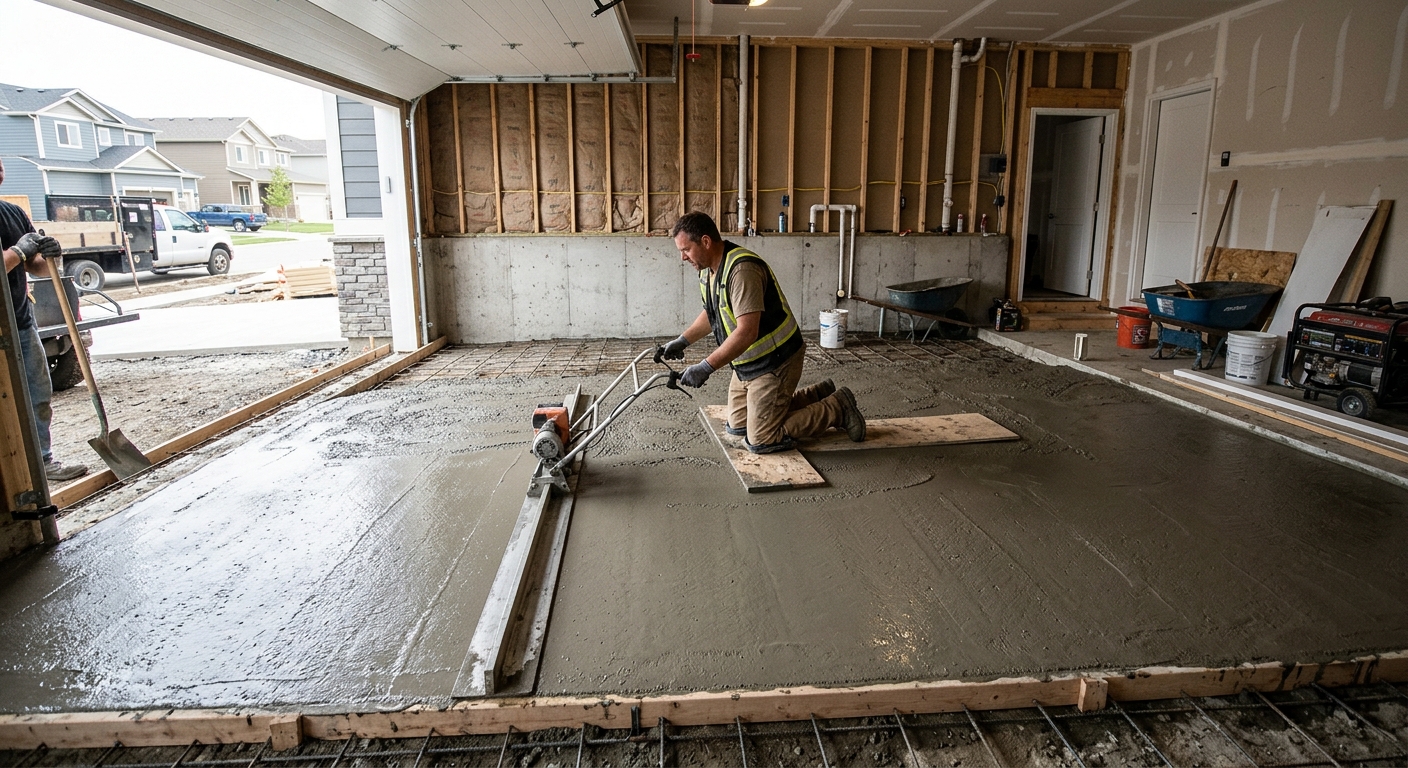
| Garage floor (interior slab) |
400–500 sq. ft. |
Vapour barrier as required, fibre/rebar as specified |
Steel-trowel or broom + sealant |
$6,500–$12,500 |
| Foundation footings (structural, below frost) |
Typical house/garage perimeter (engineered) |
Excavation to undisturbed bearing, below design frost depth |
Rebar cage + proper placement |
$28,000–$45,000 |
Prices are estimates only and vary by project scope, site access and material selection.
What affects the price of concrete work in Carstairs
In and around Calgary, it’s common to see the same “concrete driveway” project come back with bids that differ by 30–50%. The difference usually isn’t the concrete itself—it’s the engineered depth of preparation, the mix and air-content spec, the jointing plan, and how the contractor protects curing in Carstairs’ freeze–thaw conditions. Labour availability also swings with the season, and late-fall scheduling can add costs because exterior work requires a tighter curing window.
Start with frost line depth: in cold regions, footings must extend below the design frost depth to reduce frost heave. In Alberta, that often means deeper excavation than homeowners expect, and it increases formwork height, pump time, and the amount of granular base and structural concrete used. At the same time, all exterior slabs need an air-entrained concrete mix to survive repeated freeze–thaw cycles. Finally, colder regions have a shorter pour season; winter-grade placement (insulated blankets and sometimes heat) can be required to achieve proper curing—skipping that can lead to scaling and spalling later, which is expensive to repair.
To see how this shows up on quotes in Carstairs: (1) removing an existing asphalt drive down to proper grade and hauling disposal can add thousands, even if the replacement slab is the same size. (2) Choosing stamped concrete increases material and labour because curing and finishing timing must be controlled closely; it’s justified when homeowners want higher curb appeal because stamped work typically sits around the $15,000–$26,000 band for the same general footprint. (3) A basic broom-finish driveway might align more with the $12,000–$18,000 range when excavation is straightforward and access is easy.
Older housing stock also plays a role: about 25.8% of homes in Carstairs were built before 1981 (Statistics Canada, 2021 Census), and those properties often have more grading surprises, settlement issues, or unknown drainage patterns. When the contractor must correct drainage and sub-base conditions, costs rise—even before decorative finishes are chosen.
| Price Factor |
Why It Matters |
Cost Impact |
| Frost line depth |
Determines footing depth and form height |
More excavation and concrete; often a major cost driver on foundations/footings |
| Site preparation |
Excavation, grading, compacted granular base |
Disposal, hauling, and additional base materials can add significant labour and equipment time |
| Reinforcement |
Rebar or wire mesh requirement |
Material + labour cost varies based on design load and slab thickness |
| Mix design |
Air-entrainment and compressive strength spec |
Proper exterior mix costs more but reduces freeze–thaw damage risk and long-term repairs |
| Finish type |
Broom vs. stamped vs. exposed aggregate |
Stamped/exposed require extra labour, release/color materials, and strict timing |
| Pour size and concrete truck access to site |
Access limits how quickly and how evenly you can place concrete |
Longer set-up time, smaller loads, or additional pumping/hoisting raises labour cost |
| Cold-weather curing precautions |
Heating and blankets to protect strength gain |
Temporary heat, insulated coverings, and added supervision can materially increase price |
| Control joint pattern and sealing cost |
Controls cracking and reduces water/salt intrusion |
Joint saw timing and sealer material/labour add cost but help performance in Alberta winters |
Permits & regulations in Alberta
In Alberta, many homeowners assume any concrete job is “just a slab,” but the rules depend on what you’re building and whether it affects structure or grading. Structural concrete work—such as footings, foundation walls, grade beams, and other elements that support a building—typically requires a building permit and often engineered drawings that are reviewed by the municipality. If you’re changing the structural system, adding foundation elements, or altering load paths, assume you’ll need permits.
Concrete flatwork (patios, walkways, and driveways) usually does not require a permit unless it affects lot grading, drainage, impervious surface coverage limits, or the municipal right-of-way (for example, work tied directly to boulevard/sidewalk areas). Even then, you may need approvals or conditions—especially in winter when thaw-free drainage and snow storage can be impacted.
To verify a contractor in Carstairs step-by-step: start by asking for their certificate of liability insurance and making sure it matches the work scope (driveway/flatwork vs. foundation/structural). Next, confirm Workers’ Compensation coverage (WSIB/WCB) paperwork—no coverage is a red flag. Finally, look for licensing/registration information through the province’s public business resources and ask for clearance letters where applicable. For structural projects, ask whether they’re coordinating permits with the engineer and builder, and request the engineered drawings that govern reinforcement and footing dimensions.
If the contractor can’t clearly explain who pulls permits and what is included, that’s often where cost disputes start later.
Getting concrete right in Carstairs's freeze-thaw climate
Concrete failures in Carstairs usually trace back to water and ice movement—either water gets in, or the slab can’t accommodate expansion/contraction. The right specification starts with base preparation: compacted granular sub-base placed to the correct depth and shaped to drain. In Calgary-area soils, inadequate base depth or poor compaction leads to settlement, and settlement leads to cracking and water pathways.
Next is mix design. For exterior flatwork, air-entrainment is essential to survive repeated freeze–thaw cycles; in practice we target roughly 5–7% air for typical exterior slabs, with a minimum compressive strength of 32 MPa (project-specific). Then come control joints: correct spacing helps limit random cracking. Jointing should be planned early so the finished surface still looks neat while still controlling where cracks occur.
Curing matters just as much as the mix. Aim for at least 7 days of proper curing conditions—particularly in cold snaps where late fall/early spring placement may require insulation blankets or temperature management to protect strength gain. Finally, apply a penetrating sealer after the cure period (commonly around 28 days post-pour) to help repel de-icing salts and reduce spalling risk.
When you’re comparing options, it’s fair to spend more only where performance improves. For example, a plain broom-finish patio in the $5,000–$9,000 range often gives excellent value when base, air-content, joints, and curing are done right. In contrast, stamped concrete in the $15,000–$26,000 range is worth it when you want aesthetics and the contractor proves they’re managing curing timing and surface finishing in cold conditions. The technical question that saves the most money is simple: “What air-entrainment percentage and joint plan are you specifying for this exact exposure?”
| Spec |
Why It Matters in Carstairs |
What to Ask For |
Impact if Skipped |
| Compacted granular base (depth?) |
Improves load support and drainage to reduce frost-related movement |
Base thickness and compaction testing method; drainage slope |
Settlement, uneven slab, water pooling, faster cracking |
| Air-entrained concrete mix (target air %?) |
Provides freeze–thaw resistance in Alberta winters |
Documented air content target (typically 5–7% for exterior flatwork) |
Higher risk of scaling and spalling |
| Compressive strength (MPa rating) |
Ensures durability and strength gain under cold-weather conditions |
Minimum 32 MPa (project-specific confirmation) |
Weaker surface, poor long-term performance |
| Control joints (spacing per ACI guidelines) |
Limits random cracking in freeze–thaw cycles |
Planned joint spacing and saw-cut timing |
Chaotic cracking and water intrusion |
| Minimum 7-day curing period |
Strength gain and durability depend on curing time and conditions |
Curing plan for cold weather (blankets/heating if needed) |
Surface scaling, reduced strength, early deterioration |
| Penetrating sealer (when applied after cure) |
Helps repel salts and moisture during freeze–thaw |
Sealer type and application timing after cure (commonly ~28 days) |
Faster salt/water damage and more frequent repairs |
How to choose a concrete work contractor in Carstairs
Choosing the right contractor in Carstairs is mostly about proof: proof they spec for freeze–thaw, proof they’re insured, and proof they build to scope. Start with Alberta coverage checks. Ask for a certificate of liability insurance (and verify the policy limits are appropriate for the job). Confirm Workers’ Compensation coverage (WSIB/WCB) so you’re not exposed if a worker is injured. Then request their contractor registration/licensing details through Alberta’s public business resources; if they’re vague, insist on it before any site prep starts.
Next, get 2–3 itemised written quotes—not one lump price. A proper quote should show concrete supply, excavation/grading, granular base, reinforcement, finishing, saw-cutting, sealing (if included), and disposal. Ask what’s excluded: permit fees, engineer drawings (for structural work), snow/ice removal for access, underground locates, and whether temporary heating/blankets are included for cold-weather placement.
Warranty is another differentiator. Look for a workmanship warranty length in writing, and ask whether product/manufacturer warranties apply to sealers or admixtures. Also ask if the warranty is transferable if you sell your home.
Finally, protect your cash flow: never pay more than 10–15% upfront. Hold back payment until the work is complete, joints are done, and curing/sealing steps (when specified) are finished. Get a start date and completion estimate in writing, and confirm what happens if weather delays affect curing.
- Insured and covered: liability + WSIB/WCB proof provided before contracting.
- Itemised quote with labour and materials (not just “concrete supply and pour”).
- Written scope states excavation limits, disposal, and base prep thickness.
- Mix spec includes exterior air-entrainment and minimum strength.
- Joint plan described (saw-cut timing and expected spacing).
- Curing plan stated, including winter precautions if dates overlap cold weather.
- Sealer scope clarified: included or optional, and application timing.
- Reinforcement noted: mesh/rebar type and placement depth if required.
- Site access plan: where trucks can park and how concrete is handled.
- Permits responsibility stated (especially for anything structural).
- Schedule commitments in writing with weather-delay language.
- References provided for similar Carstairs freeze–thaw exposure projects.
Concrete red flags in Carstairs include: refusing to state air-entrainment and joint spacing; giving a low price that ignores base excavation/disposal; starting pours without a curing/blanket plan when temperatures are borderline; requesting large upfront payments (over ~15%); and not providing insurance/WSIB/WCB documentation or recent project references.
Frequently asked questions — concrete work in Carstairs
When is the best time to pour concrete in Carstairs?
In Carstairs and the broader Calgary region, the best time to pour exterior concrete is when temperatures support curing without needing heavy winter measures. Typically, that means planning your driveway, patio or walkway for late spring through early fall, when overnight lows are more stable. The reason is that freeze–thaw cycles are hard on curing; if strength gain is interrupted, you’ll see issues like scaling or surface damage later. If you’re trying to pour later in the season, reputable contractors may use winter-grade mixes, insulated blankets, and sometimes temporary heat—those precautions can add cost but protect performance. If you’re budgeting, a standard broom-finish driveway often lands around $12,000–$18,000, but cold-weather protection can shift the final number depending on the schedule and exposure.
How long does concrete take to cure?
Concrete has two timelines: setting and achieving strength. For most exterior work in Alberta, you’ll typically see initial set within hours, but you shouldn’t treat it as “fully cured” right away. For durable performance—especially where freeze–thaw is a concern—we plan on a minimum 7-day curing period with proper conditions so strength gain is protected. After that, full long-term durability continues to develop over weeks. If your contractor includes sealing, that penetrating sealer is commonly applied after the cure window is complete (often around 28 days post-pour) so it can work effectively against moisture and de-icing salt intrusion. This is why timelines in winter can matter as much as mix design; curing that’s rushed or poorly insulated is one of the biggest causes of premature spalling in exterior slabs in Carstairs.
Do I need a permit for concrete work in Alberta?
It depends on what you’re building. In Alberta, structural concrete work—such as footings, foundation walls, and grade beams—generally requires a building permit and may need engineered drawings reviewed by the municipality. That’s different from most concrete flatwork like patios, walkways, and standard driveways, which usually do not require a permit unless the work changes lot grading, affects impervious surface limits, or involves municipal right-of-way impacts. For Carstairs homeowners, the safest approach is to ask your contractor what approvals they handle and confirm with the local authority before breaking ground, especially if you’re raising or regrading drainage around an existing house. If it’s not structural but it affects drainage patterns, it can still trigger review. Always confirm liability insurance and WSIB/WCB coverage too—permits don’t replace contractor coverage requirements.
Concrete vs pavers for a patio in Carstairs?
Both can look great, but concrete usually wins on life-cycle cost and performance when it’s correctly engineered for Carstairs’ freeze–thaw. A properly built plain patio—compacted granular base, air-entrained mix, and control joints—handles seasonal movement more predictably. Pavers can be excellent, but they rely heavily on the sub-base and drainage system staying stable; if the base shifts, you’ll see uneven settling and weed growth. Concrete also tends to be simpler to maintain: sweeping and occasional cleaning, and optional sealing for added protection. On price, a plain concrete patio or walkway often comes in around $5,000–$9,000 for typical project sizes, while pavers usually become costlier once you include excavation depth, base materials, and edging. Your best choice depends on whether you want monolithic, crack-managed durability (concrete) or segmented replaceable sections with flexible design (pavers).
How long does a concrete driveway last?
With correct specifications, a concrete driveway can last decades in Carstairs. The real deciding factors are exterior air-entrainment, base preparation, jointing strategy, curing quality, and surface protection against salt and meltwater. In Calgary-area freeze–thaw conditions, inadequate air-entrainment is one of the fastest routes to scaling and spalling, even if the driveway looks fine at first. A driveway built with a compacted granular base, control joints placed and timed correctly, and (where appropriate) a sealer plan has the best chance of long service life. If you’re comparing options and want a realistic benchmark: a standard broom-finish driveway typically falls around $12,000–$18,000, while decorative finishes can push higher. Investing in the “hidden” specs—base depth, air-content, and curing—often protects your lifespan more than swapping finishes.
What is air-entrained concrete and why does it matter here?
Air-entrained concrete is designed to include microscopic air bubbles in the mix. Those bubbles give freeze–thaw “relief” when water inside the concrete expands during winter cycles. In Carstairs, where repeated freeze–thaw events are common, air-entrainment is critical to reducing scaling and spalling on exterior slabs like driveways, patios, and walkways. Without the proper air content, water trapped in the paste can damage the surface over time—even if the slab was poured during good weather. That’s why credible Alberta contractors specify air-entrainment and talk about curing precautions and jointing. It’s also why concrete pricing differences can be substantial: the mix design and supervision to get those specs right often cost more upfront, but it’s cheaper than replacing a prematurely failing driveway or walkway. If you’re budgeting, make sure your quote aligns with a realistic exterior scope—standard driveways often sit near $12,000–$18,000 once the right specs are included.