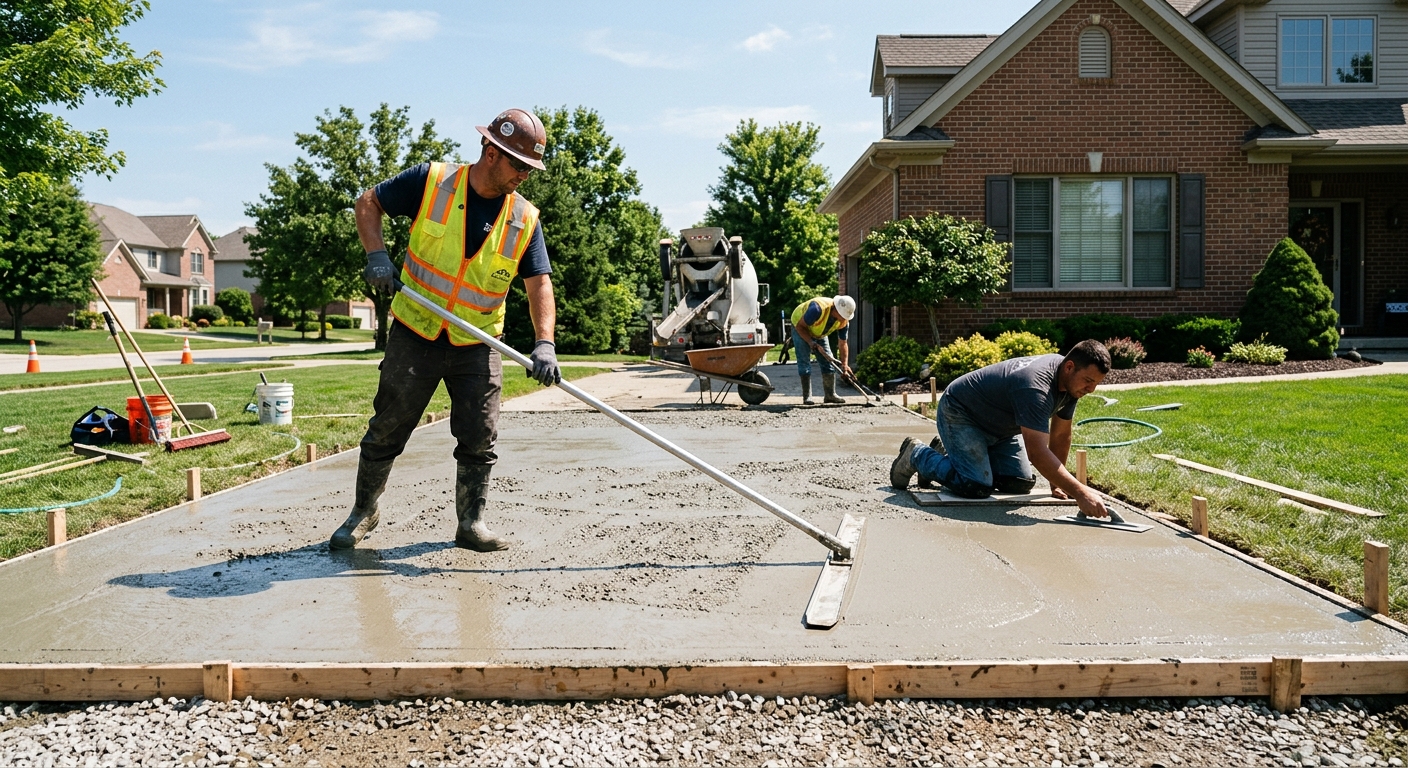
Concrete work options and costs in Banff
Banff homeowners typically choose concrete because it stands up well to the freeze-thaw swings common across the Banff–Jasper–Rocky Mountain House region. In 2021, 8,305 people called the area home (Statistics Canada, 2021 Census), and concrete flatwork is especially in demand for the large share of single-detached dwellings—about 11.8% of the housing stock—where driveways, patios and walkways are part of everyday use. With many neighbourhood homes built long ago (38.1% built before 1981), upgrades are frequent: replacing aging slabs, re-grading around foundations, or adding new entry and backyard flatwork.
Pricing in Banff isn’t just about concrete volume. Freeze-thaw exposure, frost depth requirements and a shorter warm-weather pour season all raise labour, truck mobilization and risk management costs. Local contractors also plan for deeper excavation at exterior elements (often around 4 feet as a practical rule-of-thumb for frost depth in colder Alberta conditions) and for air-entrained concrete on all exterior slabs. Work is particularly busy in areas like the Spring Creek corridor and the Bow Valley frontage where access can be tighter and winter scheduling can compress timelines.
Below are realistic cost bands for common concrete options so you can compare quotes apples-to-apples, then we’ll unpack the exact drivers behind differences between bids.
| Application |
Typical Size |
Key Spec |
Finish Option |
Price Range |
| Concrete driveway (standard broom finish) |
400–600 sq. ft. |
Air-entrained mix, compacted granular base, control joints |
Broom finish |
$14,000–$26,000 |
| Exposed aggregate driveway |
400–600 sq. ft. |
Air-entrained mix, adequate curing, joint pattern to manage shrinkage |
Exposed aggregate (wash) |
$18,000–$32,000 |
| Stamped concrete driveway or patio |
300–500 sq. ft. |
Air-entrained mix, coloured topping (if selected), stamped pattern + sealer |
Stamping + colouring + sealing |
$22,000–$40,000 |
| Plain concrete patio or walkway |
200–400 sq. ft. |
Air-entrained mix, compacted base, edges and joints |
Plain finish |
$12,000–$22,000 |
| Garage floor (interior slab) |
400–600 sq. ft. |
Vapour barrier (where required), reinforcement, proper curing |
Float and trowel (light broom optional) |
$16,000–$28,000 |
| Foundation footings (structural, below frost) |
Approx. 200–450 sq. ft. of footing area (project-dependent) |
Engineered design, excavation below frost, reinforcing and proper placement |
Structural concrete |
$35,000–$70,000 |
Prices are estimates only and vary by project scope, site access and material selection.
What affects the price of concrete work in Banff
In Banff–Jasper–Rocky Mountain House, two contractors can quote the “same” job and still land 30–50% apart once frost depth, access and finishing requirements are considered. The region’s freeze-thaw exposure is a constant: exterior slabs need air-entrained concrete mixes to survive repeated cycling, and footings must extend below the design frost depth to limit heave and cracking. In Alberta, it’s common to plan for roughly up to 2.4 m in colder contexts, and local guidance often uses about 4 feet as a practical rule-of-thumb for residential excavation depth planning. The takeaway is simple—if a bid assumes shallow digging or a non-air-entrained mix, it may look cheaper, but it’s not built for Banff’s reality.
Banff also has a shorter warm-weather pour season, which affects labour scheduling and cold-weather precautions. If a crew needs to heat the site, protect freshly placed concrete with insulated blankets, or stage deliveries to reduce downtime, costs go up. De-icing salt use by property owners can accelerate surface spalling when finishing and sealing aren’t properly spec’d, so sealing is often treated as part of the lifecycle cost.
Real examples: a plain patio may fall in the $12,000–$22,000 range when base prep and joints are straightforward. A stamped driveway typically climbs into the $22,000–$40,000 band because colour/stamping labour plus weather-controlled finishing windows and a proper sealer schedule are required. For homes built before 1981, existing grades and drainage patterns can be off—fixing drainage and re-prepping base can add thousands, but it prevents repeat failures.
| Price Factor |
Why It Matters |
Cost Impact |
| Frost line depth |
Determines footing depth and form height |
Higher excavation and rebar placement; can be a major driver on foundations |
| Site preparation |
Excavation, grading, compacted granular base |
Extra base material, labour time, and disposal for unsuitable soil |
| Reinforcement |
Rebar or wire mesh requirement |
Material and installation labour; may require additional chairs/ties |
| Mix design |
Air-entrainment and compressive strength spec |
Air-entrained mixes and higher spec strength add material cost |
| Finish type |
Broom vs. stamped vs. exposed aggregate |
More steps, tighter timing, and extra finishing labour for decorative work |
| Pour size and concrete truck access to site |
Impacts batching schedule and placement time |
Smaller or hard-to-access sites can require additional crews and staging |
| Cold-weather curing precautions |
Heating and blankets |
Temporary heat, blankets/insulation and monitoring can add significant cost |
| Control joint pattern and sealing cost |
Manages shrinkage and reduces freeze-thaw damage |
Proper joints and penetrating sealer add materials and labour for longevity |
Permits & regulations in Alberta
In Alberta, structural concrete work generally requires oversight through permitting, especially where it affects a building’s engineered stability. For Banff homeowners, the items that typically DO require a permit and often engineered drawings reviewed by the municipality include: foundation footings, foundation walls, grade beams and other structural concrete elements that form part of the load-bearing system. If you’re adding an engineered foundation, underpinning, or major structural repairs, assume a permit is required.
Concrete flatwork—driveways, patios, and walkways—typically does NOT require a permit unless the work changes lot grading, drainage, or relates to impervious surface coverage limits, or if it involves municipal right-of-way concerns. Even then, the permit question is site-specific, so confirm before breaking ground.
Before hiring, verify contractor compliance step-by-step. Start by checking the contractor’s Alberta licence/registration status through the appropriate online registry for the trade and business. Next, request a certificate of insurance (liability) naming the right legal entity and ensure coverage limits are current. Then confirm WSIB/WCB coverage by asking for proof of clearance or active account status. Finally, ask for references on similar-scale jobs in mountain-access conditions—especially flatwork that had to survive Alberta freeze-thaw.
Getting concrete right in Banff's freeze-thaw climate
Banff concrete failures are rarely “mystery problems”—they’re usually predictable: inadequate base preparation, wrong mix design, missing or poorly spaced control joints, and curing that’s rushed by weather. In the Banff–Jasper–Rocky Mountain House region, freeze-thaw cracking and spalling are the big risks for exterior slabs. The most common technical mistake I see in low bids is insufficient air-entrainment, which can make the surface break down faster when de-icing salts and winter moisture are present.
To spec correctly, focus on five items. (1) Base preparation: use a compacted granular sub-base to the depth required for local soil and frost management, then compact properly and keep grades true so water doesn’t pond. (2) Mix design: air-entrained concrete is typically targeted at about 5–7% air content for exterior flatwork, with minimum 32 MPa compressive strength. (3) Control joints: plan a joint pattern to limit random cracking, and do not “stretch” spacing just to reduce saw cuts. (4) Curing: plan for at least 7 days of curing under protected conditions; in cold weather, cold-weather precautions matter more than most homeowners expect. (5) Sealing: penetrating sealer is commonly applied after proper cure (around 28 days post-pour) to help repel de-icing salts and water.
Where is the money difference justified? If a stamped driveway quote is $22,000–$40,000 versus a broom-finished driveway at $14,000–$26,000, the extra cost usually buys controlled finishing time, colour/stamp labour, and sealer readiness—provided the contractor also meets the same air-entrained, curing and joint specs.
| Spec |
Why It Matters in Banff |
What to Ask For |
Impact if Skipped |
| Compacted granular base (depth?) |
Banff freeze-thaw needs stable support to prevent movement |
State base depth by drawings/spec; confirm compaction method |
Settlement and cracking; edges fail first |
| Air-entrained concrete mix (target air %?) |
Reduces spalling risk during repeated freezing and thawing |
Confirm air content target (typically 5–7% for exterior flatwork) |
Surface pop-outs/spalling within seasons |
| Compressive strength (MPa rating) |
Cold weather slows strength gain, so correct strength spec protects longevity |
Minimum 32 MPa (verify mix design sheet) |
Higher risk of early damage and durability loss |
| Control joints (spacing per ACI guidelines) |
Controls shrinkage cracking pattern through winter cycles |
Ask for proposed joint layout and saw-cut schedule |
Random cracking and moisture paths into sub-base |
| Minimum 7-day curing period |
Strength and durability development depend on curing conditions |
Confirm temperature protection plan in cold weather |
Weakened surface and faster deterioration |
| Penetrating sealer (when applied after cure) |
Helps repel de-icing salts common in Alberta winters |
Apply after proper cure (often around 28 days post-pour) |
More surface scaling and salt-driven damage |
How to choose a concrete work contractor in Banff
Choosing the right contractor in Banff is about verification and documentation, not just the lowest line on the estimate. In Alberta, confirm the contractor’s licensing/registration for the work they’re doing, then request proof of liability insurance. Next, verify WSIB/WCB coverage—ask for current clearance or account confirmation rather than a verbal assurance. You can then make a simple comparison: if a contractor can’t provide clean documentation and clear scope details, expect more change orders once weather and access issues hit.
Get 2–3 itemised written quotes instead of lump sums. The best quotes break down labour and materials, including concrete volume, base prep, reinforcement, finishing type, jointing, sealing (if included), disposal, and any permit or inspection coordination. Read the exclusions carefully: is cold-weather protection included, and who supplies/charges for heating blankets if temperatures dip? If you’re upgrading existing flatwork, confirm whether saw-cutting, demo, and haul-off are included.
Warranty matters. Ask for a workmanship warranty length and whether it is tied to the finish type (plain vs. stamped vs. exposed aggregate) and the sealing schedule. Clarify if any manufacturer/product warranty is included and whether it transfers if you sell your home.
Payment should also be controlled: never pay more than 10–15% upfront, and hold back a meaningful portion until completion and cleanup are finished. Finally, request a start date and completion estimate in writing—Banff timelines are weather-sensitive, so you want those assumptions documented.
- Ask who will be on-site daily and who is responsible for curing protection
- Confirm concrete mix design is air-entrained for all exterior flatwork
- Verify frost-depth planning for exterior elements and below-grade structural work
- Request base prep details (depth and compaction method), not just “excavate and prep”
- Confirm reinforcement type (mesh vs. rebar) and placement supports
- Check the joint layout plan (pattern + saw-cut schedule)
- Ask about finishing window requirements for stamped or coloured concrete
- Ensure sealing is specified (penetrating sealer, timing after cure)
- Confirm disposal and hauling are included if demo is required
- Review cold-weather precautions: blankets/heating/mats and temperature monitoring
- Get an explicit change-order process and unit prices for common extras
- Confirm warranty terms are in writing and cover workmanship separately from materials
Banff concrete red flags to watch for: no air-entrained specification for exterior slabs; vague curing promises like “we’ll pour and it’s fine” (especially in cold snaps); quotes that ignore frost-depth excavation assumptions; finishing claims that don’t mention jointing/sealing for freeze-thaw durability; and contractors who ask for large deposits (more than 10–15%) or won’t provide insurance/WSIB/WCB proof.
Frequently asked questions — concrete work in Banff
When is the best time to pour concrete in Banff?
The best time for concrete in Banff is typically late spring through early fall when day temperatures are consistently above freezing and crews can protect the pour during cool nights. In the Banff–Jasper–Rocky Mountain House region, a short warm-weather season means scheduling matters: if a contractor can’t commit to curing protection (like insulated blankets or heating) during shoulder-season cold, durability can suffer. For most driveways and patios, a properly managed season with cold-weather precautions is crucial because strength gain slows in colder conditions. If you’re aiming for a standard broom-finished driveway (often in the $14,000–$26,000 band), plan for good access and reliable finishing windows. For stamped/decorative work (often $22,000–$40,000), timing is even more sensitive due to tighter finishing steps and sealer readiness. Always ask what temperatures trigger protection on your specific project.
How long does concrete take to cure?
Concrete cure time depends on temperature and what you mean by “cure.” Practically, crews should plan for at least 7 days of curing before you apply typical light use, and for full performance (especially durability in Banff’s freeze-thaw cycle) you should allow 28 days for cement hydration to reach near-design strength. In cold weather, curing can take longer because temperature slows the chemical reactions—so Banff projects often include cold-weather curing precautions like blankets, heaters (where appropriate) and monitoring. That’s why two bids can differ even for similar slabs: one contractor bakes curing protection into the plan, while another relies on favorable weather that may not materialize. If your plan includes penetrating sealer, the timing is usually tied to cure (often around 28 days post-pour) so the surface can repel water and de-icing salt more effectively.
Do I need a permit for concrete work in Alberta?
In Alberta, the permit question depends on whether the work is structural or just flatwork. Structural concrete—such as foundation footings, foundation walls and grade beams—typically requires a building permit and often engineered drawings reviewed by the municipality. Concrete flatwork like patios, walkways and driveways usually does not require a permit unless it affects lot grading, drainage, impervious surface coverage limits, or involves municipal right-of-way considerations. For Banff, the safest approach is to confirm with the local authority before starting, especially if you’re changing how water runs off your property. To stay protected, verify the contractor’s insurance and WSIB/WCB coverage and ask whether the scope includes permit coordination if structural elements are involved. If your quote is silent on permits for anything structural, ask directly—don’t assume it’s handled.
Concrete vs pavers for a patio in Banff?
Concrete and pavers can both work well in Banff, but the right choice depends on your priorities. A plain concrete patio is often the lowest-cost option in this market—frequently landing around the $12,000–$22,000 band depending on size, base prep, and access. Concrete also performs well when joints, air-entrainment, and sealing are done correctly for freeze-thaw durability. Pavers can look great and are repairable in sections, but they still require careful base construction and proper drainage; if the sub-base shifts, you can see settlement and uneven edges over time. The biggest difference is that concrete relies on a controlled joint pattern, while pavers rely on a stable bedding and edging system. If you want colour or a custom look, stamped concrete usually moves into the $22,000–$40,000 range because of the extra labour and weather-sensitive finishing steps.
How long does a concrete driveway last?
A well-built concrete driveway in Alberta conditions can last many years, but longevity depends heavily on freeze-thaw durability details. In Banff, air-entrained concrete for exterior slabs, proper compacted granular base prep, a correct joint layout, and good curing are the difference between a driveway that spalls early and one that holds up. Sealing and good snow/ice practices also matter because de-icing salts can accelerate surface scaling if the finish isn’t protected. A driveway in the standard broom-finish category (often quoted around $14,000–$26,000 for typical sizes) usually performs best when control joints are properly cut and traffic loads are delayed until the slab has gained adequate strength. If decorative finishes are involved—stamped or exposed aggregate—the installation should still meet the same structural specs; otherwise the surface will fail even if the look is impressive.
What is air-entrained concrete and why does it matter here?
Air-entrained concrete is a mix designed to include tiny air bubbles that give freezing water room to expand, reducing internal damage. In Banff, that matters because freeze-thaw cycles and moisture exposure repeatedly stress the concrete surface. Without proper air-entrainment, exterior slabs are more likely to spall—small pieces flake off—especially where de-icing salts sit on the surface. That’s why reputable contractors specify air-entrained mixes for all exterior flatwork (driveways, patios, and walkways) and plan curing protection in colder weather. Ask your contractor to confirm the mix design targets (commonly about 5–7% air for exterior flatwork) and the minimum compressive strength (often at least 32 MPa). If those specs aren’t mentioned, treat the quote as incomplete. In Banff’s climate, skipping this line item can be the difference between a driveway that lasts and one that needs repairs sooner than expected.