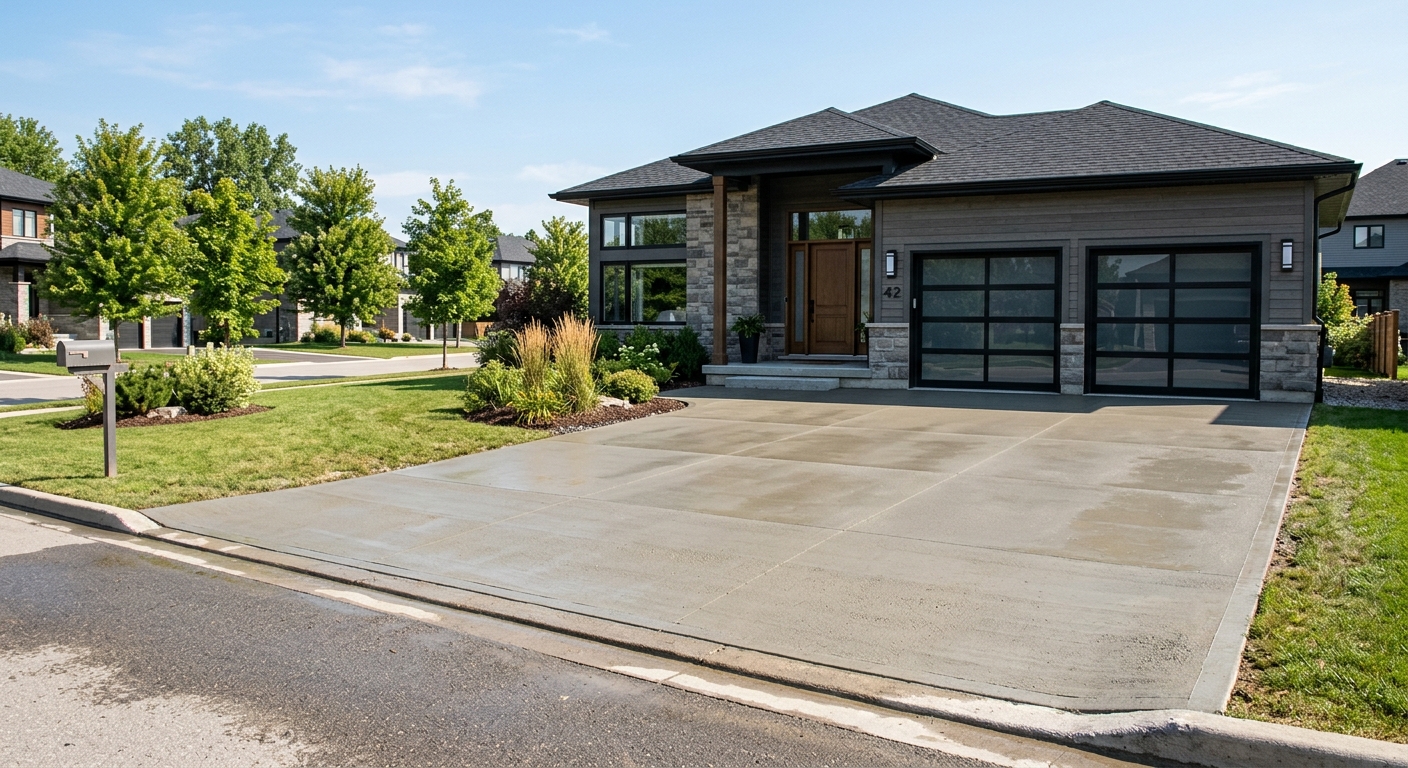
Concrete work options and costs in Carlisle
Concrete work in Carlisle, Alberta is all about building durable flatwork that survives Calgary-area freeze–thaw cycles and a frost depth that engineers plan for carefully. Carlisle’s population is 3,850 (Statistics Canada, 2021 Census), and the surrounding Calgary market keeps steady demand for driveways, patios and walkways—especially on newer infill streets and established neighbourhoods like Okotoks-area commuting corridors where homeowners are upgrading curb appeal. In this area, many local projects revolve around single-detached living, which means long driveways, raised grade transitions, and frequent exterior salt exposure—factors that strongly affect concrete specifications and labour time.
Because the design frost depth is about 1.2 m (roughly 4 ft), footing and sub-base excavations tend to be more intensive here than in milder parts of Canada, and foundation costs can run higher. Calgary’s frequent freeze–thaw cycles also push contractors toward air-entrained mixes, properly sized granular bases, and well-planned control joints. The seasonal schedule is tighter too: pouring exterior slabs late in fall or early spring often requires cold-weather curing precautions (insulating blankets, sometimes temporary heat), which can raise the total quote even when the slab size is the same.
Below is a practical comparison of typical options and price ranges for Carlisle homeowners, so you can benchmark bids before your contractor starts layout and pricing.
| Application |
Typical Size |
Key Spec |
Finish Option |
Price Range |
| Concrete driveway (standard broom finish) |
480–600 sq ft |
Air-entrained concrete, control joints, compacted granular base |
Broomed |
$12,000–$18,000 |
| Exposed aggregate driveway |
480–600 sq ft |
Air-entrained concrete, proper base, wash timing |
Exposed aggregate |
$14,500–$20,500 |
| Stamped concrete driveway or patio |
400–650 sq ft |
Air-entrained mix, integral colour (or dye), releasable stamp |
Stamped (pattern/texture) |
$15,000–$26,000 |
| Plain concrete patio or walkway |
200–450 sq ft |
Air-entrained mix, smooth grade control, joints as needed |
Float/steel trowel (light broom if desired) |
$5,000–$9,000 |
| Garage floor (interior slab) |
500–700 sq ft |
Vapour barrier (where appropriate), reinforcement per design, 28 MPa+ |
Steel trowel with broom edge where transitions occur |
$6,500–$12,500 |
| Foundation footings (structural, below frost) |
Varies by foundation plan |
Footings engineered for load and placed below design frost depth |
Structural concrete |
$28,000–$45,000 |
Prices are estimates only and vary by project scope, site access and material selection.
What affects the price of concrete work in Carlisle
In Calgary and the wider Alberta area, it’s common to see concrete quotes for the “same” job swing by 30–50% once you look past the driveway or patio square footage. The difference is usually in how deep they excavate, what they use under the slab, how they reinforce, and whether the contractor is pricing cold-weather controls properly. In practice, one contractor may include a properly compacted granular base and air-entrained mix, while another may under-spec reinforcement, omit insulation/blankets for early/late-season pours, or leave out sealing and joint detailing—then the labour surface cost looks “lower” but the long-term service life suffers.
In Carlisle, the design frost depth is engineered at about 1.2 m, so exterior work that ties into the foundation or requires structural footings costs more because excavation and concrete volume go up. Freeze–thaw cycles also dictate air-entrained concrete for exterior slabs, and that mix specification changes both materials and how the crew times finishing and curing. When pour season is shorter—especially late fall/early spring—contractors may need winter-grade placement and curing precautions, which can add cost through labour planning, insulating blankets, and sometimes temporary heat. De-icing salt accelerates surface scaling, so sealing becomes an important value step rather than an upsell.
Two examples from typical Carlisle projects: (1) if a driveway needs additional base depth and re-grading to reach undisturbed soil below frost, the project often lands in the upper part of the $12,000–$18,000 driveway band; (2) a stamped patio might look like “just finish,” but the colour system and labour for stamping can be a big driver—moving it toward the $15,000–$26,000 range when you’re adding colour, detailing, and more complex joint patterns. Housing age matters too: older lots often have variable fill or drainage issues that increase excavation and base replacement, which shows up in the price quickly in dollars, not percentages.
| Price Factor |
Why It Matters |
Cost Impact |
| Frost line depth |
Determines footing depth and form height |
More excavation and concrete volume; can push foundation/footing jobs toward the high end |
| Site preparation |
Excavation, grading, compacted granular base |
Stronger base work increases labour days but reduces later settlement/cracking |
| Reinforcement |
Rebar or wire mesh requirement |
Higher material and placement labour; essential for slabs tied to structural loads |
| Mix design |
Air-entrainment and compressive strength spec |
Air-entrained exterior mixes and proper strength increase material cost and may require more scheduling |
| Finish type |
Broom vs. stamped vs. exposed aggregate |
Stamped/exposed finishes add forms, labour time, and colour/aggregate steps |
| Pour size and concrete truck access to site |
Placement speed and boom/line pumping requirements |
Poor access can add extra equipment time and labour hours |
| Cold-weather curing precautions |
Heating and blankets for proper cure |
Can add cost during shoulder seasons but prevents scaling and strength loss |
| Control joint pattern and sealing cost |
Crack control plus salt resistance on exterior surfaces |
Better joint layout reduces random cracking; sealing adds materials but extends service life |
Permits & regulations in Alberta
In Alberta, structural concrete work—such as footings, foundation walls, and grade beams—typically requires a building permit and often engineered drawings reviewed by the municipality. Concrete flatwork (like patios, walkways, and driveways) usually does not require a permit by default, unless it affects lot grading, triggers requirements around impervious surface coverage, or impacts the municipal right-of-way. Before any excavation or forming, confirm the requirements with the local authority so you don’t get surprises after the base is already stripped.
For contractor credibility in Carlisle, verify three things: (1) licensing/registration where applicable, (2) liability insurance, and (3) WSIB/WCB coverage. Step-by-step: ask the contractor for a certificate of insurance showing general liability limits (and request to be added as an additional insured if your contract allows). Then ask for their current WSIB/WCB clearance proof. Finally, check their standing using the relevant Alberta online registry tools (if the trade applies to their registration category) or their business information listed on their quotes and invoice header.
Also request references for similar-scale jobs—driveways and structural footings—so you can confirm they handle excavation below frost depth and the cold-weather curing details that Calgary-area conditions demand.
Getting concrete right in Carlisle's freeze-thaw climate
Concrete fails in Carlisle when it’s designed for an easier climate: weak base prep, insufficient air-entrainment, poorly planned joints, or rushed curing. In a cold continental setting with frequent freeze–thaw cycles, the biggest red flag is spalling (flaking/scaling at the surface) caused by inadequate air-entrained mix. If water gets into the slab and freezes repeatedly, the concrete needs the right pore structure to resist expansion pressure—otherwise you’ll see deterioration where de-icing salt hits hardest.
To spec the job correctly for Carlisle, focus on five core items. (1) Base preparation: place compacted granular sub-base to match local frost considerations and the designer’s depth/grade, with proper drainage to prevent trapped water. (2) Mix design: for exterior flatwork, target air-entrainment around 5–7% and use a minimum compressive strength of about 32 MPa (or per engineering). (3) Control joints: plan joint spacing so cracks occur where you expect them, not randomly. (4) Curing: plan for minimum 7 days curing under appropriate conditions—especially if you’re pouring in late fall or early spring with cold-weather precautions. (5) Sealing: apply a penetrating sealer after cure (commonly around 28 days post-pour) to repel salt-laden meltwater.
Price-wise, paying for the correct mix and base is usually the difference between a driveway that looks great for a few winters versus one that stays serviceable. For example, moving from a basic broom-finish build toward an exposed aggregate or better-detailed exterior package can raise your driveway cost into higher territory of the $12,000–$18,000 band, but it’s justified when it includes proper air entrainment, base work, and joint/sealing steps—not just a “nicer top layer.”
| Spec |
Why It Matters in Carlisle |
What to Ask For |
Impact if Skipped |
| Compacted granular base (depth?) |
Supports the slab and manages water movement through freeze–thaw cycles |
Base depth and compaction test approach; confirm drainage and any undercut/replacement |
Settlement and cracking; premature edge spalling |
| Air-entrained concrete mix (target air %?) |
Creates freeze–thaw durability at the surface and within the slab |
State target air content (commonly 5–7% for exterior flatwork) |
Spalling/scaling in winter, especially where salt is applied |
| Compressive strength (MPa rating) |
Ensures long-term load capacity and resistance to deterioration |
Minimum 32 MPa (or specified by your design/engineer) |
Reduced durability; higher risk of cracking and surface damage |
| Control joints (spacing per ACI guidelines) |
Directs cracking and reduces random reflective cracks |
Joint spacing plan and cutting/timing schedule |
Wider uncontrolled cracks; moisture entry leading to surface failure |
| Minimum 7-day curing period |
Allows proper strength development in cold conditions |
How curing is protected (blankets/heating if needed) |
Surface scaling and strength loss |
| Penetrating sealer (when applied after cure) |
Repels meltwater and salt to reduce scaling |
Confirm sealer type and timing (commonly around 28 days post-pour) |
Faster deterioration from salt exposure and freeze–thaw pumping |
How to choose a concrete work contractor in Carlisle
Start by verifying Alberta-related protections and then move into pricing clarity. To check licensing/registration, ask the contractor which trade category applies and request their business registration details; then confirm it using the relevant Alberta online registry or the public business listing tied to their quote. For liability insurance, request a current certificate of insurance showing limits and coverage for concrete/placement activities. For WSIB/WCB, ask for proof of clearance or current account status before work begins—then keep a copy with your contract package. If they can’t produce these quickly, that’s a sign to pause.
Next, get 2–3 itemised written quotes with labour and material breakdowns. Don’t accept a vague line like “concrete supply and place.” Ask whether excavation, haul-off/disposal, granular base, reinforcement, joints, sealing, and curing blankets are included. Confirm whether the contractor will pull permits if structural work is involved (footings/foundation walls) and what’s excluded. A quality warranty should cover workmanship for a defined period (often with conditions), and you should know the difference between workmanship coverage and product/manufacturer warranties.
Payment matters in winter-heavy climates. Keep deposits modest: never pay more than about 10–15% upfront, and use a holdback until the job is complete and deficiencies are addressed. Finally, require a start date and estimated completion in writing—cold-weather scheduling and curing can affect timelines in the Calgary region.
- Ask for proof of insurance and WSIB/WCB coverage before you sign.
- Require itemised quotes (labour, concrete supply, excavation, base, reinforcement, finishing).
- Confirm excavation depth strategy tied to frost considerations.
- Get the proposed concrete mix spec (air content and strength) in writing.
- Ask how they handle cold-weather curing (blankets/heating) if pour timing is late/early.
- Confirm joint locations, spacing, and cutting schedule.
- Ask whether sealing is included, and when it will be applied.
- Clarify disposal/haul-off and whether it’s included in the quote.
- Verify reinforcement placement method (chairs/spacers and cover).
- Check concrete truck access plan and any equipment needed for placement.
- Review warranty terms: duration, exclusions, and what “workmanship” includes.
- Set payment milestones tied to inspection points—not just “progress.”
Concrete red flags in Carlisle include: (1) promises of “standard concrete” without air-entrainment for exterior work, (2) avoiding discussion of curing blankets/heating for cold-weather pours, (3) missing itemised excavation/base and joint plans, (4) asking for large deposits upfront, and (5) refusing to show insurance/WSIB/WCB documentation before mobilization.
Frequently asked questions — concrete work in Carlisle
How do I prepare the base for a concrete slab?
For Carlisle slabs, base prep is where durability is won or lost. A good contractor will excavate to a depth that fits the design and frost considerations, then place and compact a granular sub-base in lifts to reach the required bearing and drainage. The goal is to prevent soft spots and standing water that can freeze and pump under the slab. Ask what base material they use (commonly granular types suitable for compaction), what compaction method they follow, and whether they address drainage away from the slab. If your lot has older fill or drainage issues, the excavation/replacement scope can change the total—this is one reason bids can move into higher ranges within the driveway bands. In Carlisle’s freeze–thaw conditions, base quality directly affects cracking and edge deterioration.
How do I compare concrete quotes?
To compare concrete quotes in Carlisle, don’t start with the total price alone—compare the scope line-by-line. Look for itemised costs covering excavation, granular base depth, reinforcement (if required), concrete mix spec, finishing, control joints, and whether sealing is included. A “cheap” driveway quote often omits air-entrainment details, joint planning, or cold-weather curing precautions. For reference, a typical broom-finish driveway often lands in the $12,000–$18,000 band, while stamped jobs commonly run higher in the $15,000–$26,000 band depending on detailing and colour. Ensure each contractor proposes the same size, finish, and joint/sealing plan—or you’re comparing different products, not the same job.
Can concrete be poured in cold weather in Carlisle?
Yes, concrete can be poured in cold weather in Carlisle, but it must be done correctly. Calgary-area winter conditions mean the contractor needs a cold-weather placement plan so curing still happens properly; otherwise you can see scaling, reduced strength gain, and durability problems later. Ask whether they use winter-grade mixes and how they protect the pour with insulated blankets and/or temporary heating, especially for exterior slabs and when temperatures drop quickly after placement. The curing window is critical: rushing it in late fall or early spring raises risk. If a contractor won’t discuss curing protection, it’s a major concern. For concrete flatwork, correct air-entrainment plus a protected curing period are key for surviving freeze–thaw cycles and de-icing salt exposure.
How do I maintain concrete in Carlisle's freeze-thaw climate?
Maintenance in Carlisle should focus on protecting the surface from water and salt. First, ensure the contractor applies sealing after the concrete has cured—commonly around 28 days post-pour for a penetrating sealer. Sealing helps repel meltwater and reduces salt-driven scaling, especially on driveways and patios where de-icing is frequent. Second, keep an eye on joints: if joints crack or gap, water can infiltrate and worsen freeze–thaw damage. Third, avoid harsh salt overuse near edges when possible; shovel carefully to avoid gouging the surface. If you see early spalling or loss of surface aggregate, address it sooner rather than later. Proper installation—including air-entrained mix, correct joints, and curing—reduces how much maintenance you’ll need year to year.
What causes concrete to spall in Carlisle winters?
Spalling in Carlisle winters is most often linked to freeze–thaw action combined with salt exposure. When concrete isn’t properly air-entrained for exterior conditions, water that enters pores and micro-cracks freezes and expands, breaking the surface paste and causing flaking/scaling. This is especially noticeable on areas receiving de-icing salt and repeated freeze cycles. Other contributors include weak base prep (allowing minor settlement), inadequate curing protection during cold placement, and poor control joint detailing that lets moisture track into the slab. If you’re comparing quotes, ask specifically for the air-entrainment target (commonly around 5–7% for exterior flatwork) and a compressive strength spec (often minimum 32 MPa or as required). Those technical items matter as much as finish colour or broom texture.
What is rebar and when is it required in Alberta?
Rebar is reinforcement steel installed inside concrete to help resist tensile forces and cracking under loads. In Alberta, whether rebar is required depends on the structure’s design and loading, not just the contractor’s preference. For example, structural concrete like foundation elements and engineered footings often require reinforcement per the engineered drawings. For slabs-on-grade (such as garage floors), rebar or mesh may be specified based on slab thickness, span, soil conditions, and expected loading (vehicles, point loads, and how the slab is detailed). In a freeze–thaw region like Carlisle, base conditions and correct jointing matter alongside reinforcement. When reviewing quotes, ask whether reinforcement is included, what it is (rebar vs wire mesh), and how it’s supported to maintain the correct cover—so the reinforcement works as intended rather than sitting at the wrong depth.