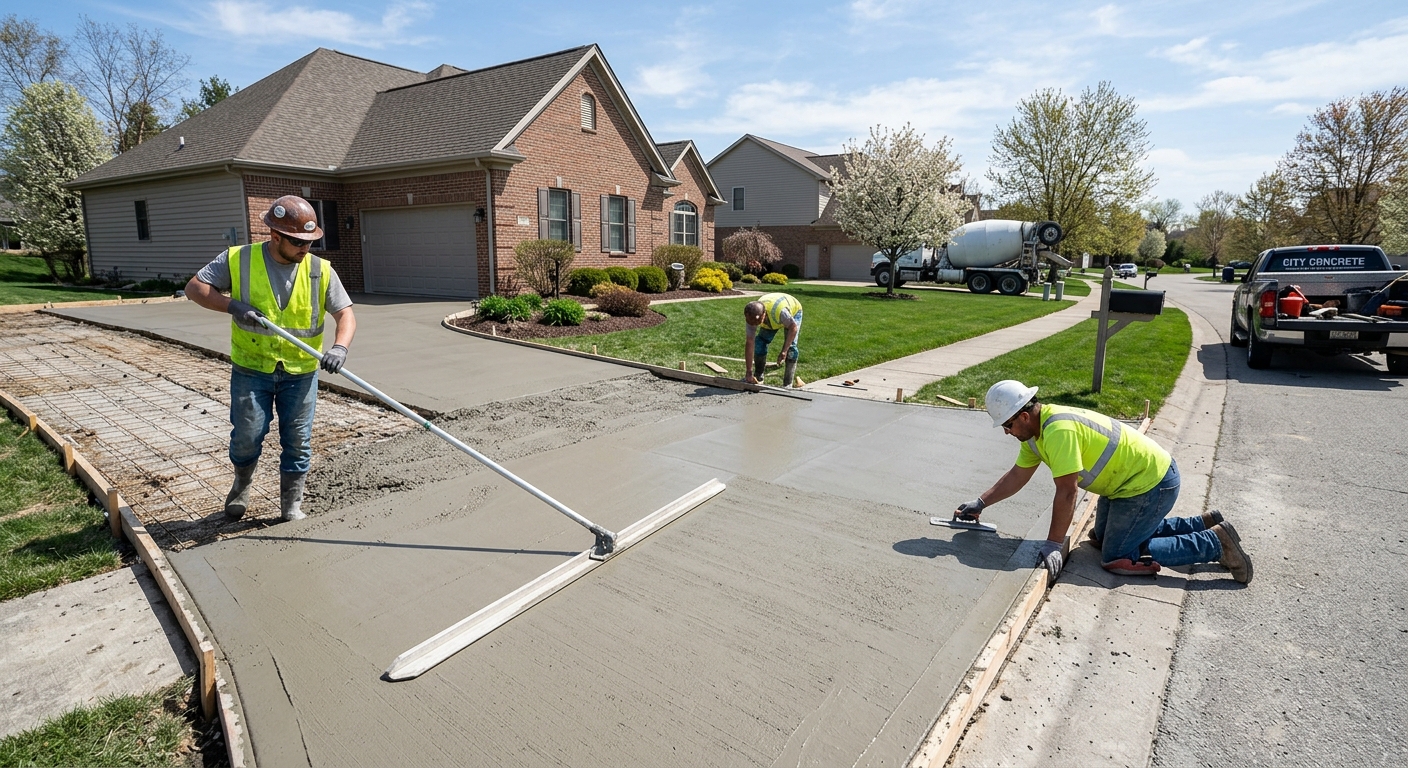
Concrete work options and costs in High Prairie
High Prairie homeowners typically start with concrete when planning driveways, patios, walkways, or foundation work—and the options you pick can change both the look and the total budget. In a town of 2,380 people (Statistics Canada, 2021 Census), concrete flatwork is a common upgrade because 67.0% of area dwellings are single-detached houses, which usually have visible exterior hardscapes like approaches and entry steps. With 585 homeowner households (Statistics Canada, 2021 Census), there’s steady demand for practical, durable slabs that can handle winter road salt and repeated freeze–thaw.
In the Athabasca–Grande Prairie–Peace River region, pricing is driven heavily by climate and logistics. Frost impacts are deeper here than southern Alberta norms, so exterior footings and some slab edges need extra excavation and forming, which increases volume and labour. Freeze–thaw cycles across the Peace region also mean air-entrained concrete and tighter control-joint planning are non-negotiable for exterior slabs. On top of that, the reliable pour season is shorter, so when crews and equipment are booked, you may feel it in the cost.
Concrete work is especially in demand around newer development areas and busier residential pockets such as downtown High Prairie, where homeowners often replace older approaches on tight schedules. The next step is comparing typical scopes side-by-side—see the table for realistic budget bands by application.
| Application |
Typical Size |
Key Spec |
Finish Option |
Price Range |
| Concrete driveway (standard broom finish) |
10 m x 4.5 m (about 45 m²) |
Air-entrained, compacted base, control joints |
Broom finish + edges/expansion allowances |
$14,000–$20,000 |
| Exposed aggregate driveway |
10 m x 4.5 m (about 45 m²) |
Air-entrained, careful curing for surface durability |
Exposed aggregate with broom-clean reveal |
$16,500–$24,500 |
| Stamped concrete driveway or patio |
8 m x 4 m driveway/patio (about 32 m²) |
Air-entrained, higher cement paste density |
Stamp pattern + colour release/sealer |
$18,000–$29,000 |
| Plain concrete patio or walkway |
4 m x 6 m (about 24 m²) |
Air-entrained, compacted granular base, joints |
Broom or lightly trowelled finish |
$3,000–$4,600 |
| Garage floor (interior slab) |
6 m x 7 m (about 42 m²) |
Vapour barrier, appropriate base, jointing |
Plain power-trowel edge finish |
$12,000–$18,000 |
| Foundation footings (structural, below frost) |
Typical 2–3 bedroom footing package |
Engineered/required depth, rebar, formwork |
Structural concrete (no decorative finish) |
$30,000–$52,000 |
Prices are estimates only and vary by project scope, site access and material selection.
What affects the price of concrete work in High Prairie
In the Athabasca–Grande Prairie–Peace River region, it’s common to see quotes for the “same” concrete job swing by 30–50%. The reason isn’t just concrete cost—it’s everything around the pour: frost-depth excavation, freeze–thaw durability specs, curing practices, and how far crews must travel to your site. In High Prairie, many homes were built earlier—56.2% of dwellings were built before 1981 (Statistics Canada, 2021 Census)—and retrofits often require more demo, hauling, and tie-in work around existing foundations and older drainage.
Frost line depth and freeze–thaw cycles dictate the design. Exterior footings must extend below design frost depth to prevent heave, which drives more excavation, more form height, and more concrete volume than a typical “thin” slab. For exterior slabs and driveways, air-entrained mixes are essential to survive repeated freezing and thawing. Also, our shorter reliable pour season compresses labour demand—when crews are working peak weeks, your schedule matters and costs can rise.
Concrete also needs time and temperature to cure. In colder, wetter conditions, cold-weather curing precautions (insulated blankets, sometimes heating, and extended cure monitoring) add labour hours but reduce the risk of scaling and premature surface damage. Finally, de-icing salt accelerates spalling on poorly specified mixes—so sealing becomes a smart add-on for long-term durability.
Examples that move the number up or down in High Prairie: replacing an older driveway often adds disposal and grading time, pushing standard flatwork toward the mid-range (for example, $14–$20 per m² tiers). Choosing stamped concrete can be justified when you want a premium finish in a smaller area—like a 24–32 m² patio—because the higher finish cost is concentrated where it’s most visible.
| Price Factor |
Why It Matters |
Cost Impact |
| Frost line depth — determines footing depth and form height |
Below-frost excavation and proper base support prevent heave |
Higher depth increases excavation, rebar, and formwork (often the biggest driver for foundations) |
| Site preparation — excavation, grading, compacted granular base |
Proper base thickness and compaction reduce settlement and cracking |
More hauling and granular supply can push costs up 10–25% on rough sites |
| Reinforcement — rebar or wire mesh requirement |
Controls cracking and improves slab/foundation performance |
Material + placement labour typically adds several hundred to several thousand dollars |
| Mix design — air-entrainment and compressive strength spec |
Air-entrainment is crucial for freeze–thaw scaling resistance |
Improved durability costs more but reduces early failure and patching |
| Finish type — broom vs. stamped vs. exposed aggregate |
Surface wear and aesthetics depend on finish system |
Stamped/exposed finishes raise labour and material (often a noticeable premium) |
| Pour size and concrete truck access to site |
Smaller pours and limited access can require extra labour/time |
Poor access may increase cost via additional handling or modified routing |
| Cold-weather curing precautions — heating and blankets |
Cold temps can delay strength gain and increase surface damage risk |
Adds crew hours and materials; can raise total cost materially on late-season pours |
| Control joint pattern and sealing cost |
Joints manage shrinkage cracking; sealing helps resist salts and moisture |
Sealing and labour for correct jointing are usually modest but highly valuable |
Permits & regulations in Alberta
In Alberta, structural concrete work—like footings, foundation walls, and grade beams—generally requires a building permit and often engineered drawings reviewed through the municipal process. Concrete flatwork (like driveways, patios, and walkways) usually does not require a permit by default unless it affects lot grading, drainage, impervious surface coverage limits, or the municipal right-of-way. Because rules can vary based on drainage and site layout, confirm with your local authority before any digging starts in High Prairie.
Before work begins, verify the contractor carries the right coverage. Ask for liability insurance and confirm WSIB/WCB coverage. Also request references from similar-scale concrete projects completed in northern conditions—crew experience matters where freeze–thaw durability and curing are critical.
To verify a contractor step-by-step, start with an online registry for Alberta contractor information (licensing/registration where applicable). Then request a certificate of insurance for general liability and ensure it includes your job site as an insured location where required. Finally, ask for proof of WSIB/WCB clearance and keep that paperwork with your quote and contract. If anything is missing or vague, treat it as a red flag and move on—concrete failures are expensive to fix, especially once frost begins.
Getting concrete right in High Prairie's freeze-thaw climate
Concrete fails in High Prairie’s climate for predictable reasons: water gets into the slab or foundation, freezes, expands, and slowly breaks down the surface. The biggest avoidable cause is poor freeze–thaw durability—especially inadequate air-entrainment. Add in deep frost requirements, freeze–thaw cycles, and winter road salt, and you can see why the job specifications matter as much as the concrete price.
To spec the work correctly, start with (1) base preparation: compacted granular sub-base at the right depth for the soil and local frost conditions. Next, (2) mix design: exterior flatwork should use air-entrainment of about 5–7% air content and a minimum 32 MPa compressive strength (engineer/spec-driven for structural items). Then (3) control joints: plan joint spacing to reduce random cracking—especially on larger driveways and patios. For (4) curing, plan for minimum 7-day curing under proper conditions; in colder weather, use insulated blankets/heating and extend cure time so strength gain is on track. Finally, (5) sealing: apply a penetrating sealer after curing—commonly around 28 days post-pour—to help repel de-icing salts and surface moisture.
Here’s a practical dollar example: if you choose a broom-finish driveway over a stamped option, you might save toward the lower end of typical flatwork pricing bands (often closer to the $14–$20 per m² range for standard driveways). You can then allocate some of that savings to better base prep, correct joints, and sealing—those steps are what prevent early spalling and scaling rather than just changing appearance.
If you want to avoid the most common issue, ask your contractor directly: “What air content are you targeting, what is the joint spacing, and how will you cure this in High Prairie temperatures?”
| Spec |
Why It Matters in High Prairie |
What to Ask For |
Impact if Skipped |
| Compacted granular base (depth?) |
Supports the slab through deep frost and soil movement |
Documented base thickness and compaction method |
Settlement, uneven cracking, and premature failure |
| Air-entrained concrete mix (target air %?) |
Reduces freeze–thaw damage and surface scaling |
Target 5–7% air content for exterior flatwork |
Spalling, scaling, and rapid surface deterioration from salt |
| Compressive strength (MPa rating) |
Ensures long-term strength despite cold curing windows |
Minimum 32 MPa (or higher if specified for structure) |
Lower durability and greater risk of cracking and wear |
| Control joints (spacing per ACI guidelines) |
Controls shrinkage cracking under winter temperature swings |
Planned joint layout and spacing based on slab geometry |
Random cracking and more water intrusion into the slab |
| Minimum 7-day curing period |
Strength gain must happen before freeze exposure |
Cooling/cold-weather plan if temperatures drop |
Surface weakness, dusting, scaling and reduced wear life |
| Penetrating sealer (when applied after cure) |
Helps repel moisture and salt-driven surface damage |
Apply after cure (commonly around 28 days post-pour) |
Faster spalling and staining; shorter service life |
How to choose a concrete work contractor in High Prairie
Choosing the right concrete contractor in High Prairie comes down to proof and process, not just price. Start with Alberta verification: ask for the contractor’s Alberta licensing/registration details (where applicable), and confirm liability insurance for your project. Then verify WSIB/WCB coverage—you can request a clearance letter or proof of coverage documentation. A reputable crew should provide these quickly and clearly; if they “can’t find it” or only share screenshots, request updated documents before you sign anything.
Next, get 2–3 itemised written quotes. Don’t accept a single lump-sum without details. You want labour + materials breakdowns covering excavation, granular base, reinforcement, formwork, concrete supply, finishing, curing measures, jointing, and disposal. Also check what’s excluded: snow removal before paving, repairing sub-grade, permit fees, regrading, or site drainage tie-ins can change your final cost.
Warranty matters in concrete. Ask for the workmanship warranty length and whether it’s tied to proper curing and sealing. Clarify if there’s a product/manufacturer warranty for sealers or special materials, and whether it’s transferable if you sell your home.
For payment schedule, never pay more than 10–15% upfront. Hold back the balance until the job is complete, graded correctly, and cleanup is finished. Finally, require a start date and completion estimate in writing—late-season pours and cold-weather curing need scheduling discipline.
- Provide Alberta documentation clearly (licence/registration where applicable)
- Show current liability insurance certificate
- Provide WSIB/WCB clearance or proof of coverage
- Itemised quote: excavation, base prep, reinforcement, finishing, disposal
- Explicit air-entrainment and curing plan for exterior work
- Concrete truck access plan (turning, distance, pumping if needed)
- Joint layout drawings or written joint spacing plan
- Sealing included or clearly excluded (and when applied)
- Identify what temperatures trigger cold-weather procedures (blankets/heating)
- Confirm whether old concrete is demolished and hauled away
- Get a written warranty for workmanship and conditions for coverage
- Clear payment schedule with a holdback until final acceptance
In High Prairie, common concrete contractor red flags include: vague curing promises (“we’ll pour and it’ll be fine”), no mention of air-entrainment for exterior slabs, missing proof of WSIB/WCB coverage, quotes that omit base thickness/compaction, and contracts that don’t spell out jointing and sealing responsibilities.
Frequently asked questions — concrete work in High Prairie
How deep must footings be for High Prairie's frost line?
In High Prairie, footing depth must be set below the local design frost depth to prevent frost heave. The exact depth is not a one-size number because it depends on the engineered foundation design and soil conditions, but in Alberta we plan excavation so the structural elements sit below frost and on properly prepared base. This is why the same foundation price can vary by site—if soil is deeper or excavation is harder, your forming and concrete volume increase. For older homes (56.2% built before 1981 in the area profile, Statistics Canada, 2021 Census), retrofits can also require additional work around existing drainage and foundation interfaces. The best approach is to ask for the engineered footing specification (or municipal requirement) and confirm the contractor’s excavation and form plan matches it.
Why does concrete crack in High Prairie and how is it prevented?
Concrete cracks are often expected, but the goal is to prevent random cracking that lets water into the slab. In High Prairie’s freeze–thaw climate, temperature swings and moisture movement drive contraction and expansion, while frost can magnify movement if the base is underprepared. Cracking is reduced by proper base preparation, correct reinforcement placement where required, and—most importantly—control joints designed for the slab geometry. A contractor should specify a joint pattern and spacing and finish timing to reduce shrinkage stress. Air-entrainment is also critical for durability; while it doesn’t “stop” cracks, it helps prevent freeze-driven surface failure like spalling. If you seal properly after cure, you also reduce salt and moisture attack on exposed surfaces.
Stamped vs broom-finish concrete — cost difference?
Stamped concrete costs more than broom-finish because you’re paying for extra steps: colour release or integral colour, pattern mats, more labour-intensive finishing, and usually a higher-spec sealer system. In High Prairie, broom-finished driveways and standard flatwork are typically closer to the region’s standard concrete driveway/slab bands (for example, about $14,000–$20,000 for a typical driveway-sized scope in this tier). Stamped projects often land higher—especially when you’re stamping a driveway with larger surface area—so many homeowners choose stamped designs for patios or entry pads where the premium is visible but the square footage is lower. A good contractor will quote stamped vs broom as separate line items (not as a vague “upgrade”), so you can see where the extra cost is justified.
When is the best time to pour concrete in High Prairie?
The “best” time is when temperatures and weather support proper curing. In the Athabasca–Grande Prairie–Peace River region, the reliable pour season is shorter than southern Alberta, and cold nights can trigger curing problems if the contractor doesn’t use cold-weather precautions. Typically, the safest window is late spring into early fall when you can maintain curing conditions for the required strength gain. If you pour late-season, ask exactly what they’ll do: insulated curing blankets, heating if needed, and how they’ll monitor temperature until strength targets are met. For exterior slabs and driveways, curing discipline is especially important because freeze–thaw cycles and road salt can quickly expose weak surfaces. A thorough contractor will build curing measures into the plan rather than assuming everything will cure naturally.
How long does concrete take to cure?
Concrete needs time to gain strength, and “cure” depends on temperature and mix design. For most typical residential exterior flatwork, you should plan for a minimum of 7 days curing under proper conditions before expecting normal stresses, and longer if cold weather slows strength gain. For sealer planning, it’s common to wait until the concrete has fully cured—often around 28 days post-pour—so the surface is stable and ready to accept a penetrating sealer. In High Prairie, cold nights and freeze–thaw cycles mean that curing isn’t just a calendar date; it’s temperature management too. That’s why you should ask about insulated blankets or heating for cold periods and confirm that they’re included in the scope. If you’re sealing, you’ll want the right timeline or the sealer may not perform as expected.
Do I need a permit for concrete work in Alberta?
In Alberta, structural concrete like footings, foundation walls, and grade beams usually requires a building permit and often engineered drawings reviewed through the municipal process. For most homeowners, flatwork like patios, walkways, and driveways typically does not require a permit unless the work affects lot grading, drainage, impervious surface coverage limits, or the municipal right-of-way. In High Prairie, always confirm details before breaking ground—especially if you’re changing drainage patterns or reworking approach elevations. Also make sure your contractor provides the documentation you need to feel comfortable: liability insurance and WSIB/WCB coverage proof. If the contractor is unsure about permit requirements, they should know who to check with locally rather than guessing.