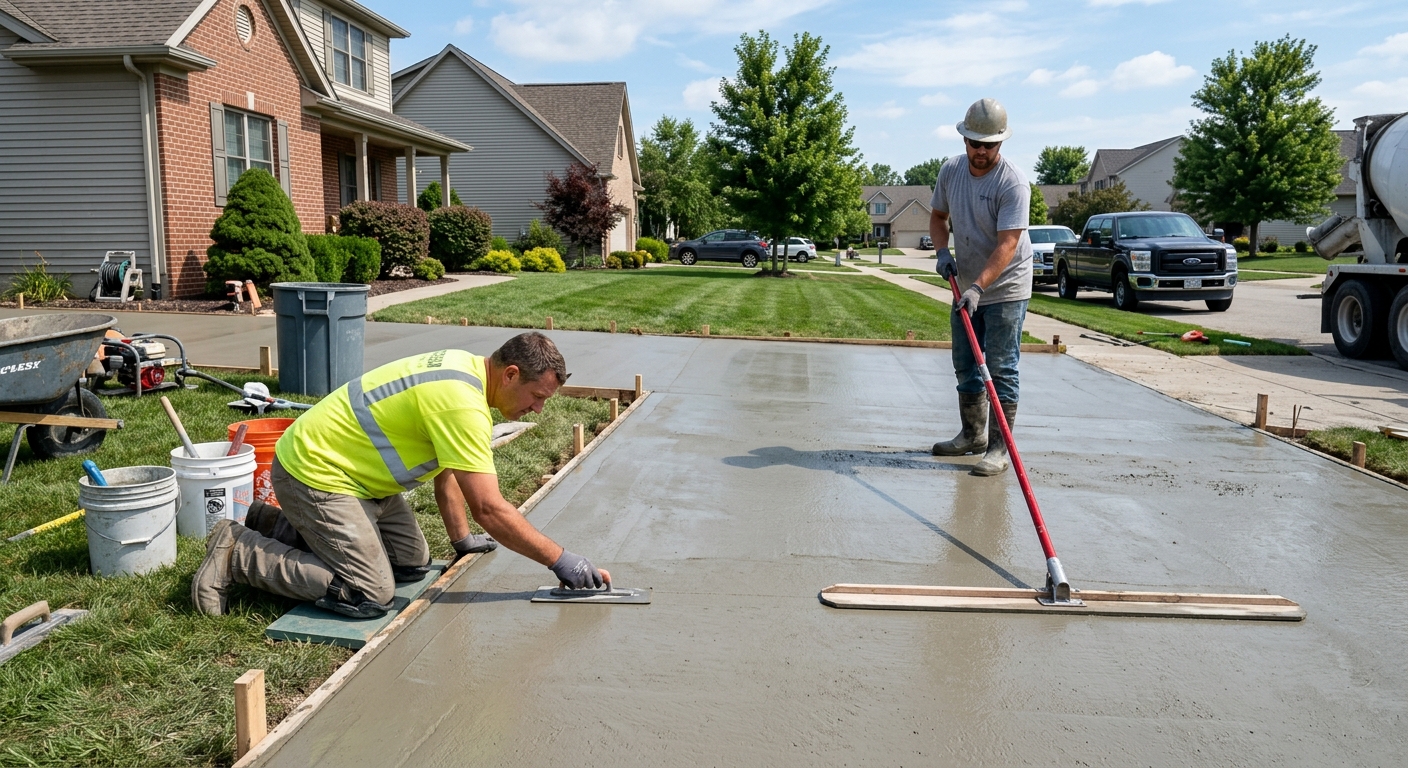
Concrete work options and costs in Woodbine
Woodbine, Alberta is a growing community, and that growth shows up directly in concrete flatwork demand—especially for driveways, patios, and walkway replacements. With a population of 8,745 (Statistics Canada, 2021 Census), most homeowners are either building new or upgrading older outdoor surfaces, and that’s why concrete contractors tend to stay busy around the neighbourhood’s newer infill pockets. In the Calgary market, the trade is also shaped by how cold the winters get and how often freeze–thaw cycles hit in shoulder seasons. In practice, Calgary’s design frost depth is about 1.2 m (roughly 4 ft), so footings and many exterior bases must be built deeper and engineered more carefully than in milder regions. That means more excavation, more granular base, and more concrete volume—real drivers of cost. On top of that, exterior flatwork needs air-entrained concrete and correctly spaced control joints to reduce cracking and protect against scaling and spalling. The local pour season is shorter, and cold-weather placement often requires winter-grade concrete, insulated blankets, and sometimes temporary heat so curing isn’t compromised.
Because of those climate-driven constraints, two quotes for “the same size” driveway can still differ meaningfully—one crew may be building a stronger base and using the right mix design, while another may price it faster. For Woodbine homeowners, it helps to compare apples to apples across finish levels and structural scope. The table below outlines typical sizes, key specs, finish options, and realistic price bands for common concrete projects in your area, including foundation work where the frost depth requirement becomes a major cost factor.
| Application |
Typical Size |
Key Spec |
Finish Option |
Price Range |
| Concrete driveway (standard broom finish) |
24 ft x 10 ft (240 sq. ft.) |
Air-entrained mix for exterior; reinforced where required; control joints |
Broom finish |
$12,000–$18,000 |
| Exposed aggregate driveway |
24 ft x 10 ft (240 sq. ft.) |
Air-entrained mix; proper base compaction; jointing plan |
Exposed aggregate finish |
$15,000–$22,500 |
| Stamped concrete driveway or patio |
20 ft x 12 ft (240 sq. ft.) |
Air-entrained mix; adequate curing; release agent and colour system |
Stamped + coloured |
$15,000–$26,000 |
| Plain concrete patio or walkway |
12 ft x 12 ft (144 sq. ft.) |
Air-entrained mix; compacted base; edged forms; joints |
Plain broom or smooth trowel edge |
$5,000–$9,000 |
| Garage floor (interior slab) |
22 ft x 22 ft (484 sq. ft.) |
Vapour/insulation approach as specified; reinforcement; slab thickness per design |
Float finish |
$10,500–$16,500 |
| Foundation footings (structural, below frost) |
Typical single-family home (engineering-based) |
Footings bear below design frost depth (~1.2 m typical); rebar schedule per engineer |
Structural concrete (no aesthetic finish) |
$28,000–$45,000 |
Prices are estimates only and vary by project scope, site access and material selection.
What affects the price of concrete work in Woodbine
In Woodbine and the wider Calgary region, it’s common to see quotes for the “same” concrete job swing by 30–50%—even when the square footage looks identical. The reason is that concrete pricing is driven less by the flatwork surface and more by everything underneath it: excavation depth, base preparation, reinforcement, mix design, curing requirements, and how much labour time is needed to do it correctly in cold weather.
First, frost depth and freeze–thaw cycles dictate every exterior spec. In Alberta, footings and structural bases must extend below the design frost depth to prevent frost heave and seasonal movement. Calgary’s design frost depth is about 1.2 m (roughly 4 ft), so foundation-related excavation and footing volumes are higher than in warm provinces. Second, exterior slabs and driveways should use air-entrained concrete so the freeze–thaw cycle doesn’t break down the surface. Third, the colder region shortens the practical pour season for exterior flatwork, and cold-weather curing precautions can add real cost—heating, insulated blankets, and tighter scheduling to protect early-age concrete. Finally, de-icing salts accelerate surface deterioration, so sealing and proper drainage matter for long-term performance.
Concrete examples in Woodbine that commonly raise costs: clayey/variable soils that require more excavation and replacement; a driveway relocation that increases truck access time and disposal. Projects can cost less when the site is already level, the required base depth matches typical conditions, and truck access is direct—those factors can trim time and hauling. A standard broom-finished driveway often lands in the $12,000–$18,000 band, while stamped work can step into the $15,000–$26,000 range mainly because of labour-intensive forming, stamping, and colouring plus careful curing.
| Price Factor |
Why It Matters |
Cost Impact |
| Frost line depth — determines footing depth and form height |
Footings must bear below design frost depth to stop heave and seasonal movement. |
Higher excavation volume; can move a foundation/footing scope up significantly. |
| Site preparation — excavation, grading, compacted granular base |
Concrete is only as good as the base; proper compaction prevents settlement cracks. |
Extra trucking, disposal, and granular material increase labour and material costs. |
| Reinforcement — rebar or wire mesh requirement |
Reinforcement controls shrinkage and improves slab performance under loads. |
Materials plus placement time; often required for driveways and structural slabs. |
| Mix design — air-entrainment and compressive strength spec |
Exterior air content and strength protect concrete through freeze–thaw cycles. |
Right mix typically costs more than basic mixes but reduces premature spalling. |
| Finish type — broom vs. stamped vs. exposed aggregate |
Finish complexity affects labour hours and materials (colours, release agents, finishing steps). |
Stamped/exposed finishes usually add the largest upsell costs over plain broom work. |
| Pour size and concrete truck access to site |
Smaller pours with multiple mobilizations cost more per yard; limited access slows crews. |
Extra labour time and pump/haul requirements can raise total price quickly. |
| Cold-weather curing precautions — heating and blankets |
Early-age concrete must be protected so strength develops properly. |
Insulated blankets, heaters, and added supervision increase cost during shoulder season. |
| Control joint pattern and sealing cost |
Joints control cracking location; sealing improves resistance to de-icing salt damage. |
Materials and workmanship time; often overlooked but important for long-term durability. |
Permits & regulations in Alberta
In Alberta, structural concrete work—like foundation footings, foundation walls, and grade beams—typically requires a building permit and is commonly supported by engineered drawings that the municipality reviews. For Woodbine homeowners, that means if your project involves below-grade structural concrete, you should expect permit requirements and inspections as part of the process. Concrete flatwork (driveways, patios, and walkways) usually does not require a permit unless it affects lot grading, impervious surface coverage limits, or municipal right-of-way considerations. Still, the right answer depends on your exact location, elevation changes, and how the slab ties into existing drainage.
Here’s a straightforward step-by-step way to verify your contractor in Alberta before work starts:
- Confirm the contractor’s trade licensing (where applicable) using provincial/industry registry resources and their business documentation.
- Request a certificate of liability insurance showing adequate coverage for concrete work and confirm dates are current.
- Ask for evidence of WSIB/WCB coverage (and verify it’s active), especially important for crews working on excavation and elevated formwork.
- Ask for references on similar-scale projects in the Calgary area (driveways, walkouts, or foundation work) and follow up.
- Make sure the quote clarifies what the contractor is responsible for—demo, disposal, and any permit coordination.
Be direct: if a contractor can’t provide proof of insurance and coverage, or their scope doesn’t clarify permit responsibility, that’s a warning sign—especially for structural concrete where compliance and inspection are non-negotiable.
Getting concrete right in Woodbine's freeze-thaw climate
Concrete failures in Woodbine usually trace back to a few predictable causes: weak or improperly compacted base, incorrect mix design for cold exposure, poor joint spacing, and rushed curing. In Calgary’s continental climate, freeze–thaw cycles stress the concrete surface repeatedly. That’s why specifications need to be engineered around frost depth (about 1.2 m in this region for design) and built to resist scaling and spalling. For homeowners, the safest approach is to ensure the project includes the right base prep, an air-entrained exterior mix, an appropriate control-joint layout, protected curing, and sealing timed for Alberta’s de-icing season.
When asking for a quote or reviewing a scope, focus on five items. (1) Base preparation: the contractor should excavate to the correct depth and place a compacted granular sub-base sized for local soil and frost considerations, not “whatever fits.” (2) Mix design: exterior flatwork should use air-entrained concrete (target air content commonly 5–7% for durability) and meet a minimum compressive strength such as 32 MPa. (3) Control joints: proper spacing reduces random cracking pathways during shrinkage and temperature swings. (4) Curing: plan for at least 7 days of curing under conditions that keep the slab protected; in cold weather, insulated blankets or heating may be necessary. (5) Sealing: apply a penetrating sealer after proper cure (often around 28 days) to help repel de-icing salts.
Dollar example: stepping from a basic broom driveway approach to a correctly engineered air-entrained mix, reinforced placement where required, and a sealed finish can justify the difference between a lower end $12,000–$18,000 estimate and a more complete scope. In the long run, that extra work is cheaper than redoing a scaling-prone driveway that starts to flake after one or two winters.
| Spec |
Why It Matters in Woodbine |
What to Ask For |
Impact if Skipped |
| Compacted granular base (depth?) |
Prevents settlement and reduces frost-related movement in Alberta soils. |
Documented excavation depth and compacted granular sub-base thickness per design |
More cracking, uneven slab, premature failure around edges and joints |
| Air-entrained concrete mix (target air %?) |
Improves freeze–thaw durability and reduces scaling/spalling risk. |
Exterior mix with target air content of 5–7% (as appropriate for exposure class) |
Higher chance of surface deterioration after freeze–thaw cycles |
| Compressive strength (MPa rating) |
Higher strength supports structural performance and durability. |
Minimum 32 MPa compressive strength |
Lower long-term performance and increased cracking under load |
| Control joints (spacing per ACI guidelines) |
Controls where cracks form, especially with temperature fluctuations. |
Joint spacing and layout plan submitted before the pour |
Random cracking and water intrusion into unplanned fracture lines |
| Minimum 7-day curing period |
Ensures strength gain; cold weather can interrupt early curing. |
At least 7 days protected cure; winter plan with blankets/heating if needed |
Surface weakness, scaling, and reduced durability |
| Penetrating sealer (when applied after cure) |
Helps reduce chloride penetration from de-icing salts. |
Penetrating sealer applied after full cure (commonly around 28 days) |
Faster spalling and surface erosion on driveways and walkways |
How to choose a concrete work contractor in Woodbine
Choosing the right contractor in Woodbine starts with proof and clarity. First, verify Alberta-related credentials and coverage. Ask for the contractor’s liability insurance certificate and confirm coverage is active for the current job. Then request evidence of WSIB/WCB coverage for their workers—concrete projects include excavation and heavy handling where jobsite injuries can be costly. If the contractor is doing structural concrete, ask whether any permit coordination or engineered requirements are included in their process.
Next, insist on 2–3 itemised written quotes, not just a lump sum. For concrete, the best quotes break down labour and materials (demo, excavation, granular base, reinforcement, concrete supply, finishing, joints, sealing, and disposal/haul). Read the exclusions carefully: is permit pulling included if required for structural work? Is removal and disposal of the old slab included? If you see vague wording like “miscellaneous charges,” ask for clarification before signing.
Warranty matters too. Ask for workmanship warranty length, and whether product/manufacturer warranties apply to sealers, admixtures, or related materials. Clarify if the warranty is transferable if you sell your home.
Payment scheduling: never agree to more than about 10–15% upfront for a typical residential pour, and hold back remaining payments until the job is complete and any punch-list items are addressed. Finally, demand a written start date and completion estimate—especially important in Alberta’s shorter exterior pour season.
- Confirm liability insurance and WSIB/WCB coverage dates (not just “we have it”).
- Use itemised quotes: excavation, base, reinforcement, concrete, finishing, joints, sealing, and disposal.
- Ask whether the concrete mix is specifically air-entrained for exterior freeze–thaw exposure.
- Request a jointing plan (spacing and location) for driveways and walkways.
- Verify curing protection in cold weather (blankets/heating plan if temperatures drop).
- Check whether reinforcement is included where required (driveways, structural slabs, or per engineer).
- Confirm slab thickness and whether dowels/ties are used at connections.
- Clarify site access: will they pump, use wheelbarrows, or stage trucks to avoid rehandling?
- Ask if sealing is included (and timing—after proper cure, not immediately).
- Request a timeline in writing, including weather contingencies.
- Understand warranty terms: workmanship duration and any exclusions.
- Make sure the quote includes cleanup and disposal—no surprise hauling fees.
Concrete red flags I’ve seen in Woodbine: contractors who won’t show proof of insurance or WSIB/WCB, quotes that omit air-entrainment and jointing details, vague “one price for everything” scopes with no thickness or reinforcement notes, crews that plan to pour and then “figure out curing later,” and offers that push higher upfront payments without a clear schedule.
Frequently asked questions — concrete work in Woodbine
How long does a concrete driveway last?
A well-built driveway in Woodbine typically lasts 20 to 30 years, and sometimes longer, when the base is properly compacted, the exterior mix is air-entrained, and the joint pattern controls cracking. In Calgary’s freeze–thaw climate, the biggest durability killers are inadequate air content and poor curing—both can lead to scaling and spalling after winter seasons. Sealing also plays a role: a properly timed penetrating sealer (often around 28 days after the pour) helps reduce de-icing salt damage. If you’re comparing quotes, a broom-finished driveway in the local market often sits around $12,000–$18,000, but the “cheapest” bid is usually the one that skimps on base depth, reinforcement, curing, or sealing.
What is air-entrained concrete and why does it matter here?
Air-entrained concrete contains tiny, evenly distributed air bubbles that give freezing water a place to expand. That’s exactly what you need in Alberta, where repeated freeze–thaw cycles can otherwise break down the cement paste and cause surface scaling or spalling. For exterior flatwork like driveways and walkways in Woodbine, asking for an air-entrained mix is one of the most important technical checks you can make. Many specs aim for roughly 5–7% air content (based on exposure and mix design), and the concrete should also meet a durability strength target such as 32 MPa or better. If a quote doesn’t clearly state air-entrainment or the contractor can’t explain the freeze–thaw approach, treat that as a major risk—especially during the colder part of the pour season.
How do I prepare the base for a concrete slab?
Base prep is where most driveway and patio problems are prevented. In Woodbine, preparation means excavating to the correct depth, placing the right granular base, and compacting in lifts to achieve proper density—not just dumping gravel and leveling. The exact depth varies with soil conditions and the frost-related design for your project; Calgary’s design frost depth is about 1.2 m (roughly 4 ft) for structural bearing considerations, and exterior slab bases must still be built to resist movement through freeze–thaw cycles. A good contractor will document what they remove, what they replace, and how they compact. When you review quotes, confirm granular base, compaction expectations, and drainage details are included before you compare a $5,000–$9,000 patio/walkway price to another proposal.
How do I compare concrete quotes?
Start by comparing quotes side-by-side using the same scope. Ask for itemised pricing that separates labour and materials: demo, excavation and disposal, granular base, reinforcement, concrete supply, formwork, finishing, joint cutting, curing protection, and sealing. Look for details like slab thickness, reinforcement type (rebar vs. mesh), and whether the mix is air-entrained for exterior exposure. Verify whether permit handling is included when structural work is involved. In a climate like Woodbine/Calgary, curing protection in cold weather can swing pricing, so ask what happens if temperatures drop. Finally, compare “finish apples-to-apples”: standard broom finish vs exposed aggregate vs stamped work can legitimately differ, which is why driveway bids commonly cluster around $12,000–$18,000 for standard broom but reach $15,000–$26,000 for stamped/decorative scopes.
Can concrete be poured in cold weather in Woodbine?
Yes, concrete can be poured in cold weather in Woodbine, but it requires a plan—placement alone isn’t enough. In Calgary’s region, crews typically use winter-grade concrete, manage temperature and protection, and protect early-age curing with insulated blankets and sometimes temporary heat. The goal is to keep the concrete within a curing range long enough to develop strength safely. A responsible contractor will also adjust scheduling and communicate weather contingency steps in writing. If a quote doesn’t mention cold-weather curing precautions, insulated protection, or monitoring, assume the risk is on you and pricing may be artificially low. For exterior slabs, missing proper curing is a common cause of early scaling and surface weakness after freeze–thaw seasons.
How do I maintain concrete in Woodbine's freeze-thaw climate?
Maintenance in Woodbine is mostly about protecting the surface from salts and water movement. After installation, keep off the slab until the concrete has cured sufficiently per the contractor’s instructions, then plan for a penetrating sealer after full cure (often around 28 days). During winter, use de-icing salts carefully: they’re helpful for safety, but they accelerate deterioration if the surface is not sealed. Use sand or safer alternatives when appropriate to reduce salt load. Visually inspect your driveway or walkway each spring for spalls, soft spots, or joint failure. Recaulk or patch joints early so water doesn’t pump through the crack network. With the right mix design and sealing, a driveway built in the local band of $12,000–$18,000 can stay serviceable for decades rather than degrading quickly after one or two winters.