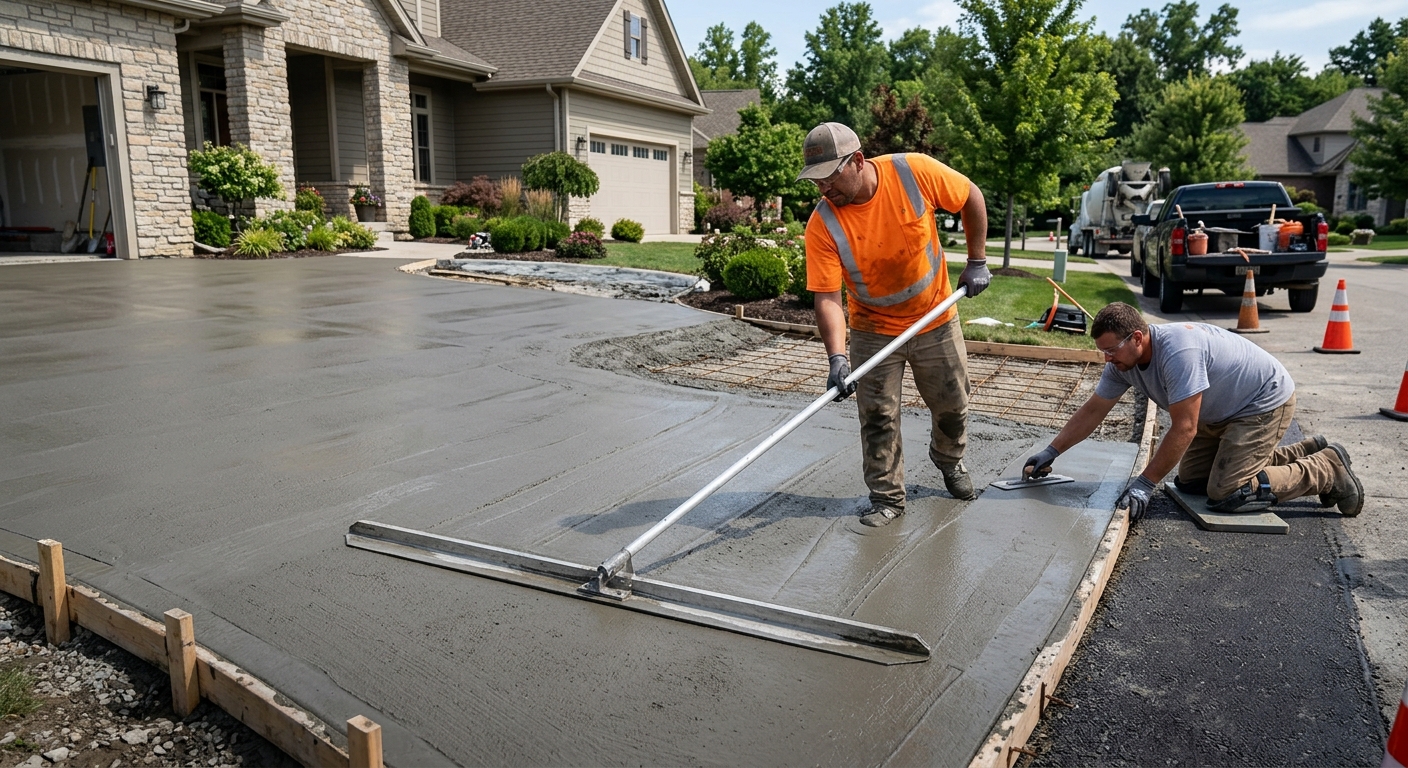
Concrete work options and costs in Bon Accord
In Bon Accord, Alberta, concrete flatwork is a go-to upgrade for the 85.6% of homes that are single-detached houses—driveways, patios, walkways, and interior garage slabs see constant wear from winter conditions and spring thaw. With 63.1% of homes built before 1981 (Statistics Canada, 2021 Census), many homeowners are refreshing older entrances where settling, minor heaving, or surface wear has finally pushed them to replace cracked sections. The Edmonton economic region’s cold continental climate also shapes the price from the start: frost depths here are commonly designed around 1.5 m or more, so residential footings and edge support need to be placed below frost to prevent heave. Exterior slabs then face frequent freeze–thaw cycles, which makes proper base compaction, drainage detailing, air-entrained concrete, and well-planned control joints non-negotiable.
In Bon Accord’s active residential pockets—especially along the approach areas toward the Edmonton commuting corridor—concrete demand spikes during the late spring to early fall window. Because the weather window for exterior pours is shorter, crews often compress schedules, and cold-weather protection (insulated blankets or heated enclosures for early-season work) can add labour and material costs. That’s why two quotes for a “similar” driveway can differ: thickness, access, reinforcement, and finish choices can’t be treated like commodities here.
Below is a realistic pricing snapshot so you can compare options before you request a quote and confirm dimensions and site conditions.
| Application |
Typical Size |
Key Spec |
Finish Option |
Price Range |
| Concrete driveway (standard broom finish) |
12' x 24' (288 sq. ft.) |
Reinforced with rebar or mesh; air-entrained mix |
Broomed surface, edged and sealed where suitable |
$9,500–$16,500 |
| Exposed aggregate driveway |
12' x 24' (288 sq. ft.) |
Air-entrained mix; controlled aggregate exposure |
Exposed aggregate with brush/seed finish look |
$13,500–$20,500 |
| Stamped concrete driveway or patio |
12' x 20' (240 sq. ft.) |
Air-entrained mix; integral color |
Stamp patterns with color hardener and release agent |
$14,000–$26,000 |
| Plain concrete patio or walkway |
10' x 12' (120 sq. ft.) |
Compacted base; control joints |
Broom finish or smooth float (location-dependent) |
$3,800–$8,500 |
| Garage floor (interior slab) |
22' x 20' (440 sq. ft.) |
Vapour control as needed; reinforced slab |
Broom finish, saw-cut joints |
$11,000–$20,000 |
| Foundation footings (structural, below frost) |
~1,000–1,800 sq. ft. of footing area |
Engineered dimensions; placed below design frost depth |
Structural concrete walls/footings (not decorative) |
$28,000–$58,000 |
Prices are estimates only and vary by project scope, site access and material selection.
What affects the price of concrete work in Bon Accord
In the Edmonton region, it’s common to see concrete quotes for the “same” job land 30–50% apart once you include real-world site conditions and specs. For homeowners in Bon Accord, the biggest drivers are frost depth requirements, freeze–thaw exposure, base preparation, and finish complexity. Edmonton-area residential footings must be placed below the design frost depth (often around 1.5 m or more in colder continental designs) to prevent frost heave. That alone can increase excavation, forming, and backfill quantities compared to milder parts of Alberta. Exterior slabs also need air-entrained concrete mixes to survive repeated freezing and thawing, and that impacts materials and sometimes the mix-design approval process.
Labour and scheduling premiums also show up because the pour season is realistically shorter. Early-season work may require insulated blankets or heated enclosures to protect curing, and colder curing tends to be more demanding. De-icing salt accelerates surface wear and can contribute to spalling if air content and finishing/jointing aren’t handled correctly—this is why sealing and correct joint layouts often become part of the “real” scope for driveways and walkways.
Two practical examples from Bon Accord: (1) If your soil has soft pockets or poor drainage, contractors may recommend deeper excavation and additional compacted granular base—this can move a simple patio closer to the higher end of the $3,500–$9,000 band; (2) If you choose decorative work like stamping or exposed aggregate, the finish process adds colour hardener, release agents, and more labour time, which is where projects start trending from basic driveway pricing toward the $12,000–$26,000 stamped & decorative band.
Older housing stock (63.1% of homes built before 1981) also means some lots have older grades, trees near driveways, or outdated drainage swales that must be corrected before concrete is replaced—often for thousands of dollars in added prep, but it prevents the premature cracking that otherwise follows.
| Price Factor |
Why It Matters |
Cost Impact |
| Frost line depth |
Determines footing depth and form height |
More excavation and concrete volume; can increase foundation/footing scope significantly |
| Site preparation |
Excavation, grading, compacted granular base |
Extra haul-off, base material, and compaction passes raise costs, especially on uneven lots |
| Reinforcement |
Rebar or wire mesh requirement |
Material and labour add cost, but reduces settlement and cracking risk |
| Mix design |
Air-entrainment and compressive strength spec |
Air-entrained and higher spec mixes typically cost more than basic mixes |
| Finish type |
Broom vs. stamped vs. exposed aggregate |
Stamped/exposed processes are labour- and material-intensive |
| Pour size and concrete truck access to site |
Distance from road, gate width, staging needs |
Pumps, skid-steer/telebelt assistance, and extra labour increase pricing |
| Cold-weather curing precautions |
Heating and blankets |
Insulation blankets, heaters, and added protection labour can increase total job costs |
| Control joint pattern and sealing cost |
Regulates cracking and extends surface life |
Proper saw cuts, sealant, and labour for sealing add cost but reduce failure risk |
Permits & regulations in Alberta
In Alberta, structural concrete work—such as foundation footings, foundation walls, and grade beams—typically requires a building permit, and engineered drawings are often part of the review package depending on the project. Concrete flatwork (patios, walkways, and driveways) usually does not require a permit by itself, unless it affects lot grading, impervious surface coverage limits, or works within the municipal right-of-way. Before any excavation in Bon Accord, confirm with the local authority if your specific scope touches drainage, grading, or property boundaries.
Homeowners should also verify contractor credentials. Concrete is one of those trades where a “licensed contractor” piece matters because structural work can affect the integrity of a foundation. Step-by-step, here’s how to check:
- Verify the contractor’s Alberta business/contractor authorization details through the appropriate online government registry or professional listing used for contractor verification.
- Ask for a current certificate of insurance (liability) and confirm it’s valid for the job dates; request the insurer and policy limits on the COI.
- Confirm WSIB/WCB coverage. Request documentation showing account status/clearance (the contractor should be able to provide proof upon request).
- Request references for similar projects in the Edmonton area—driveway and patio work should include photos from freeze–thaw exposure seasons.
- For structural work, ask whether engineered drawings are included and who stamps/provides the engineered portion.
If someone can’t provide insurance proof, clearance documentation, or they won’t give a clear written scope, pause the decision—concrete repairs in winter conditions usually cost more than doing it right the first time.
Getting concrete right in Bon Accord's freeze-thaw climate
Concrete fails in Bon Accord mainly because of freeze–thaw movement, poor drainage, and insufficient base support—then surface problems show up as spalling, scaling, and cracking along weak points. To spec correctly, the job has to be treated as a system: base preparation, mix design, reinforcement/jointing, curing, and (for exterior) sealing. Start with base preparation: a properly compacted granular sub-base to the right depth for local soil and frost conditions is what keeps the slab from moving. If you skimp on excavation depth or compaction, the concrete may crack early or heave after a wet freeze.
Next is the mix design. For exterior flatwork in Alberta, insist on air-entrainment and a minimum 32 MPa compressive strength. A typical target is 5% to 7% air content for exterior exposure so the concrete can tolerate freeze–thaw without damaging the paste. Control joints are the “planned crack”—they limit random cracking by giving the slab a place to release stresses. For curing, plan for at least 7 days of protected curing under suitable conditions; cold-weather work may need insulated blankets or heated protection so the concrete actually hydrates and gains strength. Finally, sealing matters: apply a penetrating sealer only after the slab cure period (often around 28 days post-pour for full readiness) to help repel de-icing salt and moisture.
Here’s a dollar example: if you’re comparing a plain broom-finish patio versus a higher-spec option, the price difference is often modest compared to the repair risk. A properly prepared broom-finish patio may sit around the middle of the $3,500–$9,000 band, while a “cheaper” approach that under-compacts the base or uses insufficient air can lead to early scaling—then you’re paying again to remove and replace, which usually costs more than doing the proper spec upfront in the first place.
Use these specs to ask the right questions—especially about air-entrainment, base depth/compaction, joint layout, and curing protection—because spalling from inadequate air content is the most common “same concrete, different result” failure I see in cold climates.
| Spec |
Why It Matters in Bon Accord |
What to Ask For |
Impact if Skipped |
| Compacted granular base (depth?) |
Prevents movement during freeze–thaw and supports slab load |
Granular base depth, compaction method (passes), and drainage/grading plan |
Heaving, cracking, and uneven settlement that often returns season after season |
| Air-entrained concrete mix (target air %?) |
Protects paste from freeze–thaw damage in exterior exposure |
Air content target (typically 5%–7% for exterior flatwork) and confirmation on mix ticket |
Spalling/scaling and surface deterioration, especially with de-icing salt |
| Compressive strength (MPa rating) |
Ensures strength development for cracking resistance and wear performance |
Minimum 32 MPa specified and ready-mix documentation |
Higher risk of early cracking and reduced durability under traffic |
| Control joints (spacing per ACI guidelines) |
Provides planned crack control during curing and temperature changes |
Planned joint spacing and saw-cut timing, plus sealing plan if applicable |
Random cracking and moisture paths that worsen freeze damage |
| Minimum 7-day curing period |
Concrete needs time to gain strength before exposure to cold/wet conditions |
How curing will be protected; whether blankets/heaters are used when cold |
Weak concrete surface leading to scaling and reduced long-term performance |
| Penetrating sealer (when applied after cure) |
Helps repel salt and moisture during winter cycles |
Sealer type and timing (typically after full cure, commonly around 28 days) |
Faster surface wear and greater likelihood of spalling in salted areas |
How to choose a concrete work contractor in Bon Accord
Choosing the right concrete contractor in Bon Accord starts with verification. In Alberta, insist on proof of liability insurance and WSIB/WCB coverage before work begins—this is your protection if a worker is injured or property is damaged during excavation, forming, or concrete placement. How to check each: (1) request a current certificate of liability insurance and confirm it matches the company doing the work and the dates of the project; (2) ask for WSIB/WCB clearance documentation or equivalent proof of coverage status; and (3) confirm any required licensing/registrations for the contractor’s scope, especially if structural concrete elements are involved.
Then compare quotes properly. Get 2–3 itemised written quotes, not just a lump sum—ask for a breakdown of excavation/grading, base material and compaction, reinforcement, concrete supply, forming, finishing, joints, sealing (if included), and concrete delivery/access requirements. Read exclusions carefully: is permit pulling included (when needed for structural work), is disposal/haul-off included, and is protection for cold-weather curing included in early-season dates?
For warranty, look for workmanship warranty length in writing and whether product/manufacturer warranties apply to specific components like sealers or admixtures. Confirm if any warranty is transferable if you sell your home. Finally, schedule and payment: never pay more than 10–15% upfront; hold back payment until the job is complete and deficiencies are corrected. Get the start date and completion estimate in writing—especially important in Edmonton’s shorter pour season.
- Ask who supplies the concrete and confirm air-entrainment and compressive strength targets.
- Require written dimensions and slab thickness (and footing depth if structural).
- Confirm base preparation depth and compaction method (not just “we’ll compact”).
- Ask about joint layout—where joints will be placed and how/when saw-cuts happen.
- Request a curing plan for cold mornings or early spring pours.
- Clarify reinforcement type (rebar vs. mesh) and cover requirements.
- Confirm drainage slope and tie-in to existing grades.
- Ask whether sealing is included and the timing relative to cure.
- Check concrete truck access requirements (pumping or extended reach tools) in advance.
- Confirm disposal/haul-off for removed concrete/soil is included.
- Verify warranty details: length, coverage, and process for repairs.
- Avoid quotes that omit line items for joints, reinforcement, or curing protection.
Concrete red flags in Bon Accord include: quotes that don’t mention air-entrainment for exterior slabs, no plan for frost-protected footing depth when the scope touches foundations, vague joint spacing that “sounds standard,” missing proof of WSIB/WCB or liability insurance, and a schedule that ignores late spring cold nights without curing blankets or heating.
Frequently asked questions — concrete work in Bon Accord
Why does concrete crack in Bon Accord and how is it prevented?
In Bon Accord and the Edmonton area, cracking usually comes from movement: freeze–thaw cycles expand and contract moisture in the soil and in the slab edges. If the granular base isn’t compacted deeply enough or drainage is off, the slab can settle and then crack. Temperature swings also create stress, which is why control joints are critical—joints give the slab a planned place to crack instead of letting it break randomly. The prevention package is consistent: compacted granular base sized to the frost environment, air-entrained exterior concrete (to reduce spalling), reinforcement where required, and a reliable joint layout with proper saw-cut timing. Sealing helps reduce moisture and salt ingress. If you’re budgeting, a plain patio in the $3,500–$9,000 band can last long when the spec is right; “cheaper” installs often fail sooner because base prep and joints get skipped.
Stamped vs broom-finish concrete — cost difference?
Stamped concrete typically costs more than broom-finished concrete because it adds colour hardener or integral colour, release agents, stamping mats, and more labour time to achieve consistent patterning. In Bon Accord, the climate doesn’t change the decorative process, but it does mean both options still need proper air-entrainment, jointing, and freeze-aware base prep—decorative doesn’t mean “skip the structure.” A broom-finish concrete driveway often aligns with the $9,000–$18,000 range depending on size and thickness, while stamped & decorative concrete commonly lands in the $12,000–$26,000 range for driveways and patios. The bigger difference is usually labour and finish materials, not just the colour.
When is the best time to pour concrete in Bon Accord?
For exterior flatwork in Bon Accord, the best timing is late spring through summer when daytime temperatures support normal curing and overnight frosts can be managed. Even in warm stretches, cold snaps can affect finishing and curing, so contractors should include a cold-weather plan when temperatures drop—insulated blankets or heated enclosures are sometimes needed to keep concrete curing properly. Because Edmonton’s pour season is realistically shorter, scheduling can also tighten in late spring and early fall, and that can impact availability and labour. If you’re planning a driveway or patio, confirm whether the contractor is booking for peak weeks and ask how they protect the concrete if there’s a forecasted cold night. Doing it right during the right window helps avoid weak surfaces that lead to scaling.
How long does concrete take to cure?
Concrete cures in stages. You’ll often see finishing and early strength within the first day, but durability depends on continued curing. A practical guideline for homeowners is to plan for a minimum 7-day curing period under suitable conditions before treating the slab as fully supported for typical outdoor use. In colder Alberta conditions, proper protection may be required to keep curing on track. For exterior sealing, many contractors plan penetrating sealer applications after full cure readiness—commonly around 28 days post-pour—so the concrete surface is not trapped with excess moisture. If a contractor pushes sealing too early or treats curing as “just overnight,” you may end up with higher maintenance needs and quicker surface wear, especially with de-icing salt in Bon Accord winters.
Do I need a permit for concrete work in Alberta?
In Alberta, structural concrete work—like foundation footings, foundation walls, and grade beams—generally requires a building permit and often engineered drawings reviewed as part of the municipality’s process. Concrete flatwork (driveways, patios, and walkways) usually does not require a permit by itself, but permits may come into play if the work affects lot grading, drainage, or impervious surface coverage limits, or if the scope touches municipal right-of-way considerations. For Bon Accord homeowners, the safe approach is to confirm with the local authority before you excavate, especially if you’re changing slopes, adding drainage, or altering how water runs off your property. A reputable contractor should ask the right questions early and coordinate any permit-related steps when the job calls for it.
Concrete vs pavers for a patio in Bon Accord?
Concrete and pavers can both work well in Bon Accord, but the best choice depends on your goals and your tolerance for long-term maintenance. Concrete patio slabs benefit from monolithic construction and can be engineered with control joints to manage cracking. With exterior slabs in Edmonton’s freeze–thaw conditions, concrete with proper air-entrainment, compacted granular base prep, and correct curing tends to perform predictably. Pavers offer design flexibility and easier localized repairs if a section shifts, but they still require excellent base preparation and drainage; otherwise weed growth, uneven settling, or rocking stones can show up as the freeze–thaw cycle repeats. Cost-wise, a plain concrete patio often falls within the $3,500–$9,000 range, while pavers may vary widely based on materials and base depth requirements. If your lot drainage is questionable, discuss base and grading specifics for whichever option you choose.