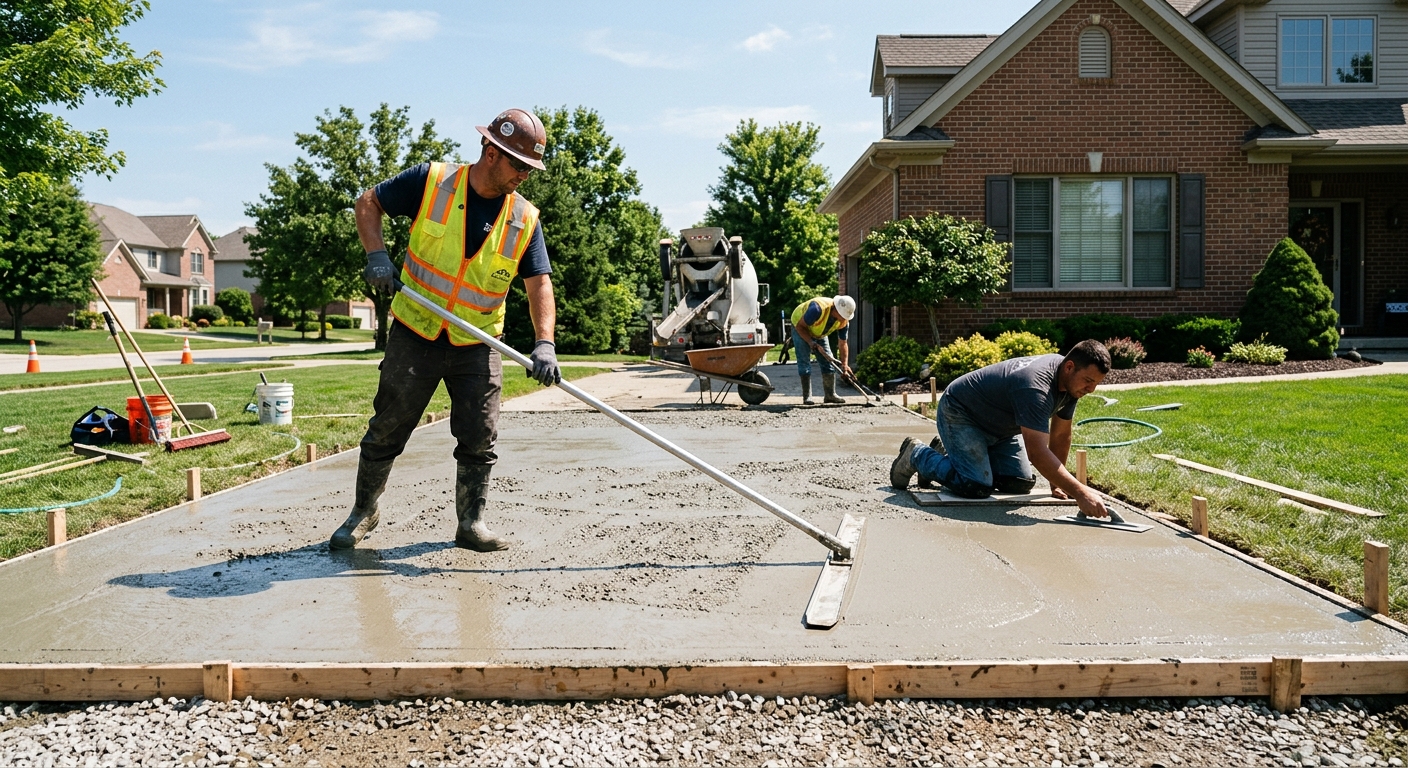
Concrete work options and costs in Allard
Allard is growing steadily, and that’s exactly where homeowners start noticing the value of good, well-timed concrete work. With a 2021 population of 6,847 (Statistics Canada, 2021 Census), there’s enough local demand to keep crews busy, but projects still have to be scheduled carefully around the short exterior pour season. Concrete flatwork like driveways, patios and walkways is especially common for single-detached home lots across the Calgary economic region—these are the surfaces that take the most abuse from cold nights, freeze–thaw cycles, and de-icing salts. In Calgary-area suburbs, including the Allard area, contractors are also balancing more foundation/flatwork demand as homes age and lots get upgraded. That means you can see larger spreads between quotes when excavation, rebar, and winter curing precautions vary from site to site.
Because Calgary’s climate uses engineering around a design frost depth of about 1.2 m (roughly 4 ft), footings and any structural work beneath exterior slabs must bear below undisturbed soil at that depth to limit frost heave. For driveways and patios, freeze–thaw drives higher-spec air-entrainment, better base prep, and control joints spaced to reduce cracking and spalling. In late fall or early spring, cold-weather curing (blankets and sometimes temporary heat) can add cost—but it’s also what protects the finish and surface durability over time.
In Allard, concrete work is often in strongest demand in the newer-infill pockets near the larger family-lot developments, where owners are upgrading driveways, adding rear patios, or coordinating foundation work alongside landscaping. Below is a practical comparison of common options so you can line up scope and expectations before you request quotes.
| Application |
Typical Size |
Key Spec |
Finish Option |
Price Range |
| Concrete driveway (standard broom finish) |
20 ft x 10 ft (200 sq. ft.) |
Air-entrained concrete, compacted base, standard thickness |
Broom finish + expansion/control joints |
$12,000–$18,000 |
| Exposed aggregate driveway |
20 ft x 10 ft (200 sq. ft.) |
Washed aggregate mix, proper curing, consistent texture control |
Exposed aggregate finish + sealer-ready surface |
$14,500–$22,500 |
| Stamped concrete driveway or patio |
200 sq. ft. driveway OR 160 sq. ft. patio |
Air-entrained mix, integral colour/liner system |
Stamp pattern + release + brushed/washed texture |
$15,000–$26,000 |
| Plain concrete patio or walkway |
12 ft x 12 ft (144 sq. ft.) walkway/patio |
Air-entrained exterior mix, broom finish option |
Plain broom + control joints where needed |
$5,000–$9,000 |
| Garage floor (interior slab) |
20 ft x 22 ft (440 sq. ft.) |
Vapour barrier (where required), reinforced slab |
Standard trowel/smooth finish (or broom depending on use) |
$6,500–$12,000 |
| Foundation footings (structural, below frost) |
Per engineered design (typical double driveway/house footprint varies) |
Excavation to design frost depth; reinforced concrete |
Structural finish for below-grade applications |
$28,000–$45,000 |
Prices are estimates only and vary by project scope, site access and material selection.
What affects the price of concrete work in Allard
In Allard, two homeowners can request “the same” concrete job and still get quotes that differ by 30–50% across Calgary and the surrounding area because concrete pricing is driven by engineered specs, excavation conditions, and the type of finishing system—not just square footage. When footings and slabs must be built around a deeper frost requirement (Alberta commonly designs for roughly 1.2 m to keep bearing below frost), excavation is more intensive and the volume of concrete and rebar goes up. On the exterior side, repeated freeze–thaw cycles also require air-entrained mixes and carefully planned control joints, so contractors can’t simply substitute a cheaper mix and hope for the best.
Concrete work pricing also shifts with the practical pour season. In cold snaps, crews may need winter-grade mixes, insulated curing blankets, or temporary heating to achieve proper curing. That curing window matters: rushing it increases surface scaling and can lead to long-term durability problems in a region where de-icing salt accelerates spalling. Finish choices add another layer: broom-finish is typically more straightforward, while stamped or exposed aggregate involves extra labour for forms, stamps, colour systems, and finishing control.
Here are a few local examples of how conditions raise or lower cost in Allard. If your driveway ties into a slope that needs significant grading, the site prep portion can rise quickly—sometimes pushing a standard driveway from the low end of the $12,000–$18,000 band toward the upper end. If your project is late-season and requires cold-weather curing precautions, that can add meaningful cost to get cure time right. Conversely, a straightforward patio on stable grade with easy truck access may land closer to the $5,000–$9,000 band, especially if reinforcement and drainage details are minimal.
Housing age matters too: older lots often have more uneven subgrade or reused fill that needs more base correction—an issue that becomes more expensive when the frost line and freeze–thaw cycles do their work year after year.
| Price Factor |
Why It Matters |
Cost Impact |
| Frost line depth — determines footing depth and form height |
Footings must bear below design frost to prevent heave and seasonal movement |
Often the biggest driver for foundation/footing quotes; can add significant excavation and concrete volume |
| Site preparation — excavation, grading, compacted granular base |
Proper base prevents settlement and keeps slabs flat through freeze–thaw cycles |
Highly variable; poor access or unstable soils can push costs up quickly |
| Reinforcement — rebar or wire mesh requirement |
Reinforcement controls cracking under load and improves durability |
Materials + labour; required for driveways, patios in traffic areas, and most slabs/footings |
| Mix design — air-entrainment and compressive strength spec |
Air content and strength support freeze–thaw resistance and long-term performance |
Typically increases material costs but reduces premature spalling/scaling |
| Finish type — broom vs. stamped vs. exposed aggregate |
Decorative finishes require extra steps, materials and tight timing |
Stamped/exposed options usually add labour and finish system costs |
| Pour size and concrete truck access to site |
Large or restricted sites may require more logistics and tighter scheduling |
Can increase labour and equipment charges; poor access may require pump/extra handling |
| Cold-weather curing precautions — heating and blankets |
Cold conditions slow hydration and increase scaling risk if curing is insufficient |
Adds cost for winter-grade measures and labour time; usually worthwhile in late fall/early spring |
| Control joint pattern and sealing cost |
Joints reduce random cracking; sealing helps limit salt and moisture damage |
Smaller line item but impacts long-term durability; skipping can reduce service life |
Permits & regulations in Alberta
In Alberta, structural concrete work—such as foundation footings, foundation walls, and grade beams—typically requires a building permit and often engineered drawings that get reviewed as part of municipal approvals. Concrete flatwork (patios, walkways, and most driveways) usually does not require a separate permit unless it affects lot grading, stormwater/lot drainage, impervious surface coverage limits, or the municipal right-of-way. Because requirements can vary based on how your project ties into drainage and property services, confirm with your municipality before any excavation.
For Allard homeowners, also make sure your contractor is properly insured and compliant. Step one: verify they carry general liability insurance and provide you with a certificate of insurance. Step two: ask for proof of clearance for workers under the Alberta workers’ compensation system (WCB coverage), and confirm that they aren’t subcontracting uninsured labour. Step three: verify licensing status through the appropriate online provincial registries used for contractors in Alberta (your contractor should be able to share their licence details, classification, or registration number).
Finally, insist on references from similar-scale concrete projects (driveways/patios or foundation/footings, depending on your scope). A reputable crew will also tell you if a permit is required for your exact scope and won’t pressure you to break ground before approvals.
Getting concrete right in Allard's freeze-thaw climate
Concrete failures in Allard are almost always tied to three things: base problems, mix/cold-weather issues, and moisture getting into weak surfaces. In freeze–thaw conditions, inadequate air-entrainment can trap water and lead to spalling and surface scaling. If the granular base isn’t compacted to the correct depth and bearing level, frost heave can create settlement and cracking. And if curing is rushed during cold spells, the concrete may not reach adequate strength before it faces winter stresses. The fix is to spec the right details up front—not to “patch later.”
To get it right, start with base preparation: use a compacted granular sub-base to the depth required by the site and local frost considerations so the slab sits on stable, well-draining material. Next, mix design: for exterior flatwork, target air-entrainment in the 5–7% range and set a minimum 32 MPa compressive strength spec (as required for typical residential exterior concrete durability). Then use control joints to limit random cracking—spacing matters. For curing, plan on minimum 7-day curing under proper conditions; in cold weather, blankets and/or heating are often required to keep temperatures in range and avoid early freeze. After the concrete cures fully, apply a penetrating sealer about 28 days post-pour to repel de-icing salts and reduce moisture migration.
Questions to ask are practical: “What air content are you targeting for my driveway/patio?”, “How deep is the compacted base?”, “How will you protect curing if temperatures drop overnight?”, and “When do you seal, and what product type do you use?”
On price, stamped decorative work often costs more, but it can be justified: if a broom-finish driveway lands around $12,000–$18,000, a stamped driveway can move toward $15,000–$26,000 because of colour/stamp systems and additional finishing labour. However, cutting corners on base prep or air-entrainment is never the place to save money—the repair cost and disappointment can exceed the original difference quickly.
| Spec |
Why It Matters in Allard |
What to Ask For |
Impact if Skipped |
| Compacted granular base (depth?) |
Stable, well-draining base reduces settlement and frost-related movement |
Confirm excavation depth, granular type, and compacted lift/compaction test plan |
More cracking, uneven slab edges, faster deterioration in freeze–thaw |
| Air-entrained concrete mix (target air %?) |
Air voids protect against freeze–thaw damage and surface scaling/spalling |
Ask for targeted air content (typically 5–7% for exterior flatwork) and mix ticket specs |
Spalling and premature surface failure, especially with de-icing salts |
| Compressive strength (MPa rating) |
Adequate strength supports durability under traffic and winter stresses |
Confirm minimum 32 MPa spec and curing approach |
Lower strength development, increased cracking and surface wear |
| Control joints (spacing per ACI guidelines) |
Joints guide where cracks happen and reduce random cracking |
Request proposed joint spacing and saw-cut timing plan |
Random cracking patterns and higher maintenance risk |
| Minimum 7-day curing period |
Cold snaps slow hydration; curing determines long-term performance |
Ask how curing will be managed if temperatures drop overnight (blankets/heating) |
Scaling, weak surface, and reduced long-term durability |
| Penetrating sealer (when applied after cure) |
Sealer reduces moisture and salt ingress that drive freeze–thaw damage |
Confirm it’s applied after full cure (commonly around 28 days) and product type |
More spalling risk and shorter service life for exterior surfaces |
How to choose a concrete work contractor in Allard
Choosing the right contractor in Allard is less about the lowest number and more about proof. Start with Alberta coverage and compliance: ask for a certificate of liability insurance showing current coverage limits, and request confirmation of WSIB/WCB participation through the Alberta workers’ compensation system (your contractor should provide proof or clearance documentation). Next, verify Alberta licensing/registration status through the contractor registry channels appropriate to their classification and trade, and don’t be shy about calling references from similar projects (driveway sizes, slab thickness, and whether they’ve handled late-season pours).
Then compare quotes the right way. Get 2–3 itemised written quotes that break out labour, concrete supply, excavation, rebar/mesh, base materials, finishing, joints, and sealing (if included). Avoid lump-sum quotes that don’t state thickness, reinforcement, and how much excavation is assumed. Read exclusions carefully: is permit handling included, is disposal of excess soil/rock included, and who installs any drainage ties or forms removal? If any of that is unclear, ask before signing.
On warranty, request both workmanship warranty length and product/manufacturer warranty terms (and whether warranty is transferable to future owners). For payment, don’t pay more than 10–15% upfront; hold back a portion until completion, including final cleanup and any sealing schedule requirements. Finally, confirm the start date and completion timeline in writing—especially because cold-weather curing may shift delivery and protection requirements.
- Ask for mix design details: targeted air content and minimum compressive strength.
- Confirm footing/slab thickness and reinforcement (rebar vs. mesh) in the written scope.
- Require a base preparation description: excavation depth, granular type, and compaction approach.
- Look for a clear control joint plan (locations and spacing) and when joints are cut.
- Verify cold-weather curing approach for late-season pours (blankets/heating method).
- Check whether truck access, crane/pump needs, and material placement limitations are included.
- Ask if demolition/haul-away and disposal of excess soil are included.
- Confirm if sealing is included (and when it will be applied after cure).
- Request proof of WCB coverage and a current certificate of liability insurance.
- Get Alberta licence/registration details and verify with the appropriate online channels.
- Insist on a written schedule: pour date, finishing date, curing/sealer date.
- Ensure the contract includes workmanship warranty and who handles repairs if defects appear.
Concrete red flags in Allard include: vague specs that don’t mention air-entrainment or curing protection; quotes that exclude control joints or reinforcement; contractors asking for large upfront payments beyond 10–15%; no written timeline for start/completion; and “we’ll seal later” promises without a date, product type, or responsibility in the contract.
Frequently asked questions — concrete work in Allard
How do I seal concrete to protect it in Allard?
Sealing in Allard is mainly about managing moisture and de-icing salt exposure during Calgary’s freeze–thaw cycles. For exterior driveways and patios, the best practice is to wait until the concrete has fully cured—typically around 28 days—before applying a penetrating sealer. Penetrating sealers help reduce how easily water and salts migrate into the surface, which lowers the chance of spalling over time. Before sealing, the surface should be clean and dry; pressure washing is common, but any remaining dust or curing compounds can interfere with penetration. If you were quoted a driveway in the $12,000–$18,000 band, ask whether sealing is included and whether they’re using a penetrating product (not just a surface film), plus what preparation steps are included.
What is the difference between concrete and cement?
Concrete is the final engineered material used for slabs, driveways and foundations; it’s a mix of aggregates (sand and stone), water, and cement paste that acts as the binder. Cement is one component inside the concrete mix—essentially the powder that reacts with water to create strength. In practice, when a contractor talks about “concrete mix design,” they’re discussing cement content, water-cement ratio, air-entrainment (critical in Allard for freeze–thaw durability), and the target compressive strength spec. That’s why two “concrete” quotes can differ even if the square footage is the same: the mix ticket and the curing plan are what determine long-term performance, not just the word concrete. For exterior work, insist the quote references air-entrained concrete and a minimum strength requirement.
How much does concrete work cost in Allard?
In Allard, pricing typically tracks the same bands used across the Calgary region because the climate and engineering requirements are similar—especially for freeze–thaw durability and deeper footing considerations. For a standard broom-finished driveway, homeowners often fall into the $12,000–$18,000 range depending on excavation complexity, reinforcement needs, and access for the truck. Plain concrete patios and walkways usually come in around $5,000–$9,000 for typical residential sizes, assuming a straightforward base and drainage situation. If you want stamped or decorative concrete, you should expect the higher $15,000–$26,000 range because of the colour/stamp system and extra finishing labour. Always compare itemised quotes—late-season curing precautions or added base correction can move a project within those bands quickly.
How deep must footings be for Allard's frost line?
For Allard (Calgary region), footings are designed around a design frost depth of about 1.2 m (roughly 4 ft). Practically, that means structural concrete elements like foundation footings must bear on undisturbed soil below that depth to help prevent frost heave and seasonal movement. The exact depth can vary with your lot’s soil conditions, drainage, and engineered design requirements, but the design frost depth is the starting point for planning excavation and footing form height. This is one reason foundation/footing quotes often sit in the $28,000–$45,000 band—because deeper excavation usually increases both concrete volume and labour. Your engineer or drawings (required for structural work) should state the footing bearing depth and reinforcement details.
Why does concrete crack in Allard and how is it prevented?
Concrete cracking in Allard is common because freeze–thaw cycles expand and contract moisture in the slab, and because temperature swings create movement. If the base isn’t compacted properly, settlement can also cause cracks. Additionally, without the right mix design (including air-entrainment for exterior work) and a controlled joint plan, cracks can form randomly where stresses concentrate. Prevention is about engineering and process: compacted granular base to the correct depth, air-entrained exterior concrete (commonly targeted at 5–7% air content), proper reinforcement where required, and control joints spaced to guide cracking. Don’t overlook curing—minimum 7-day curing under suitable conditions is critical, especially during cold spells. Finally, sealing after cure helps limit salt and moisture intrusion. If you’re planning a driveway in the $12,000–$18,000 range, confirm the quote includes these durability specs.
Stamped vs broom-finish concrete — cost difference?
Stamped concrete usually costs more than a broom-finish because it’s not just “a different texture”—it involves a decorative system with additional colour materials, stamp pattern labour, and tight timing during finishing. In Allard, a typical broom-finished driveway often lands around the $12,000–$18,000 band, while stamped decorative concrete generally falls into the $15,000–$26,000 range depending on square footage, complexity of patterns, and site access. The real value question is whether the added cost is buying visual upgrades and consistent finish quality—not cutting corners on base prep or curing. Ask whether the stamped job uses air-entrained exterior mix, the same joint strategy as standard work, and proper curing protection in cold conditions. With the right specs, stamped concrete can perform well; without them, it can still fail like any other exterior slab under freeze–thaw.