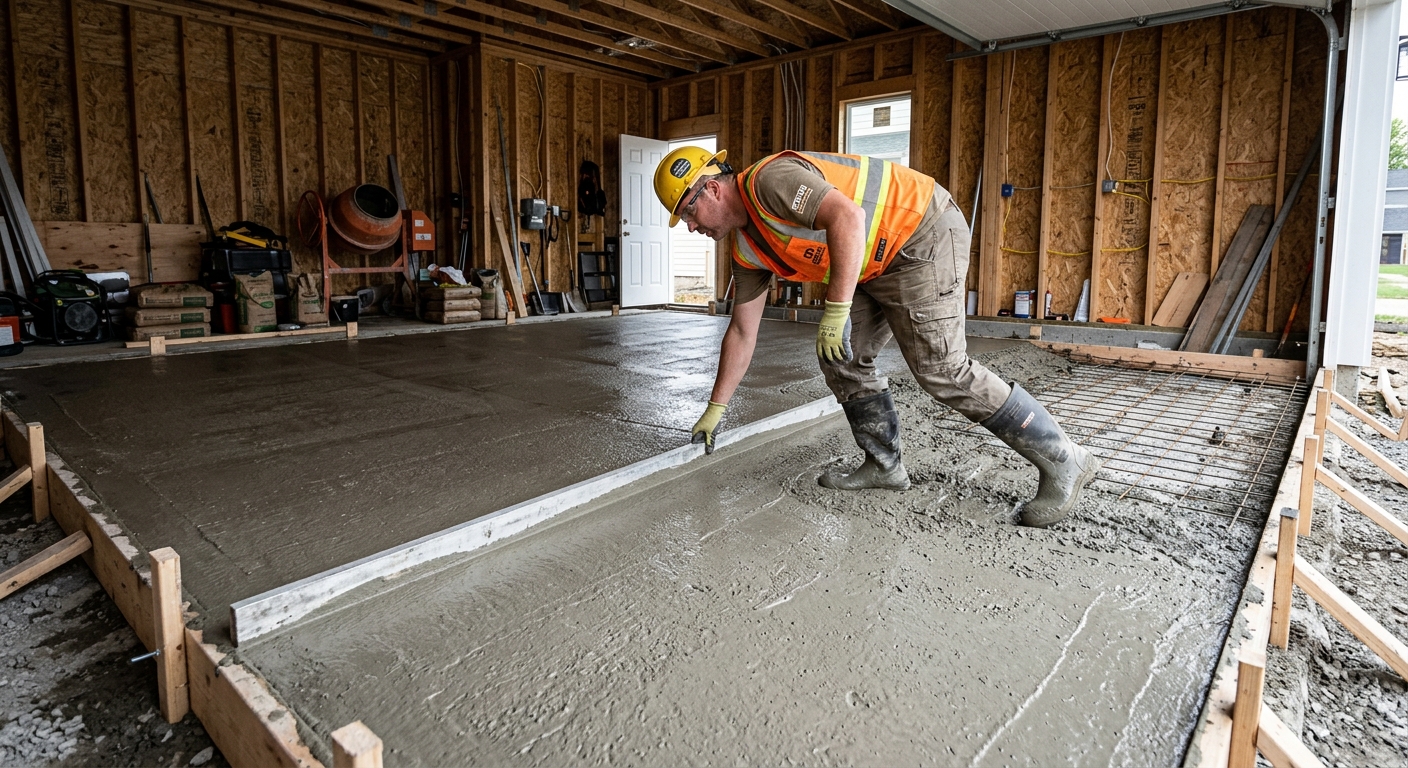
Concrete work options and costs in Summerlea
In Summerlea, Alberta, concrete flatwork is a go-to choice for homeowners because it’s durable, serviceable, and engineered for our freeze–thaw winters. The broader Calgary economic region is growing around established residential neighbourhoods, and with a population of 2,058 in Summerlea (Statistics Canada, 2021 Census), contractor availability and mobilization can vary by season and job size. A lot of concrete demand centers on single-detached homes and their outdoor improvements—driveways, patios, walkways, and garages—plus the recurring need to maintain or upgrade surfaces exposed to road spray, snowplough traffic, and de-icing salt.
Calgary-region concrete pricing is shaped less by “style” and more by engineering and timing. The design frost depth is about 1.2 m (roughly 4 ft), so foundation footings and any slab-on-grade work that interfaces with grading must be excavated to undisturbed soil at the proper depth. Frequent freeze–thaw cycles also mean exterior flatwork typically uses air-entrained mixes and requires control joints and proper curing to prevent surface scaling and spalling. In Summerlea, trades may have shorter exterior-pour windows than milder provinces, so cold-weather placement (insulated blankets and sometimes heat) can add cost—especially when people want late-season work.
Demand is particularly high in and around newer subdivisions approaching the outskirts of Calgary, where lots are being graded and driveways are upgraded as homes settle. If you’re budgeting, the table below compares common options we see for Summerlea projects, from standard driveway broom finish to structural foundation footings, and it sets expectations for realistic price ranges.
| Application |
Typical Size |
Key Spec |
Finish Option |
Price Range |
| Concrete driveway (standard broom finish) |
9 m x 3.0 m (27 m²) |
4 in. (100 mm) slab, air-entrained mix, rebar where required |
Broom finish + control joints |
$12,000–$18,000 |
| Exposed aggregate driveway |
9 m x 3.0 m (27 m²) |
Engineered base prep, air-entrained mix, retarder/washer prep |
Exposed aggregate + sealer |
$14,500–$21,500 |
| Stamped concrete driveway or patio |
9 m x 3.0 m (27 m²) or 30 m² patio |
Air-entrained mix, proper joint spacing, integral colour |
Stamped pattern + release + seal |
$15,000–$26,000 |
| Plain concrete patio or walkway |
3.0 m x 5.0 m (15 m²) patio / 1.0 m x 6.0 m (6 m²) walk |
Slab thickness per grade, air-entrained mix, compacted granular base |
Smooth trowel or light broom |
$5,000–$9,000 |
| Garage floor (interior slab) |
6.1 m x 6.1 m (37 m²) |
Slab on grade, vapour barrier, mesh where specified |
Broom or smooth finish |
$9,500–$14,500 |
| Foundation footings (structural, below frost) |
Perimeter and stem wall system (varies by plan) |
Footings extended to undisturbed soil below design frost depth |
Structural concrete (typically form-faced) |
$28,000–$45,000 |
Prices are estimates only and vary by project scope, site access and material selection.
What affects the price of concrete work in Summerlea
In Summerlea and the Calgary region, the same concrete project can come back with a 30–50% spread from one quote to another because the “hidden” parts of the job—excavation, base prep, reinforcement detailing, and curing—change with site conditions and engineering choices. A driveway that looks similar on paper can still require different footing and base depths to reach undisturbed soil below the frost zone, different reinforcement (wire mesh vs. rebar), and a different mix design to handle our freeze–thaw cycles and winter de-icing.
Here, frost depth and temperature swings drive specs. Exterior slabs and driveways are exposed to repeated freezing cycles, so air-entrained concrete is standard to reduce freeze–thaw damage. Also, Calgary-area engineering expects footings for homes, garages, decks, and retaining structures to bear below the design frost depth (about 1.2 m). That depth is a big reason foundation / footing work typically sits at the higher end of the local bands (for example, $28,000–$45,000), especially where excavation is deeper or soils are less compact at the surface.
Cold-weather placement further influences cost. If you pour late in the season, contractors may need winter-grade practices—insulated blankets and sometimes heat—to keep curing on track. That can move a patio or walkway from the lower end of $5,000–$9,000 toward the higher end once labour time and protective measures are included. Two real Summerlea examples: (1) a driveway built over looser topsoil often requires thicker compacted granular base and more truckloads, and (2) a stamped driveway with integral colour and release materials costs more than broom-finish because it needs extra labour time and careful curing control to avoid mottling or colour mismatch.
| Price Factor |
Why It Matters |
Cost Impact |
| Frost line depth — determines footing depth and form height |
Concrete must extend below frost heave risk for structural stability |
Higher excavation and concrete volume; can push foundation/footings toward the upper band ($28,000–$45,000) |
| Site preparation — excavation, grading, compacted granular base |
Proper sub-base prevents settlement and reduces future cracking |
Extra labour, heavier equipment, and granular material can add thousands |
| Reinforcement — rebar or wire mesh requirement |
Reinforcement controls shrinkage cracking and distributes loads |
Material and placement time increase; can move exterior flatwork pricing upward |
| Mix design — air-entrainment and compressive strength spec |
Freeze–thaw durability depends on air content and strength targets |
Air-entrained mixes and higher-strength specs typically add cost vs. basic mixes |
| Finish type — broom vs. stamped vs. exposed aggregate |
Complex finishes require additional materials and skilled labour |
Stamped/exposed aggregate commonly moves driveways toward $15,000–$26,000 |
| Pour size and concrete truck access to site |
Long carries, tight turns, or difficult access slows crews |
Extra pumping/placement logistics can increase labour and equipment charges |
| Cold-weather curing precautions — heating and blankets |
Proper curing prevents surface scaling and strength loss |
Can add winterization labour and supplies, especially in late fall/early spring |
| Control joint pattern and sealing cost |
Joints limit random cracking; sealing helps protect against de-icing salt |
Skimping here often costs more later; proper sealing adds a predictable line item |
Permits & regulations in Alberta
In Alberta, structural concrete work typically requires a building permit, and it’s common for engineered drawings to be reviewed by the municipality before construction starts. That usually includes footings, foundation walls, grade beams, and any structural elements that support the house or attached structures. Concrete flatwork—driveways, patios, and walkways—often does not require a permit unless your project affects lot grading, drainage, impervious surface coverage limits, or the municipal right-of-way (for example, work close to the street or modifications that change runoff paths). Before anyone breaks ground in Summerlea, confirm requirements with your local authority.
Contractor compliance matters for both safety and accountability. Ask your concrete contractor to show current liability insurance and their workers’ compensation coverage (WSIB/WCB). Then verify they carry the appropriate coverage for the type of work being performed (and that the policy limits are realistic for the job size). For structural work, ensure permits and engineered plan requirements are included in the contractor’s scope or clearly stated as a homeowner responsibility.
Step-by-step verification you can do:
- Check the contractor’s licence/registration status using the relevant provincial online verification tools (and match the company name exactly as it appears on your quote).
- Request a certificate of insurance dated for the current period; confirm liability coverage and ensure the address on the COI matches the job.
- Ask for proof of workers’ compensation coverage (WSIB/WCB clearance or an active status document) and verify it’s current.
- Confirm whether permits are included, who pulls them, and what inspections are required for structural pours.
- Ask for references from recent local jobs with similar scale (driveway, patio, or footing work) and confirm completion timelines.
Getting concrete right in Summerlea's freeze-thaw climate
Concrete failures in Summerlea usually aren’t random—they’re predictable outcomes of inadequate base preparation, wrong mix design, weak or rushed curing, or poor jointing and sealing. In our Calgary-area freeze–thaw environment, the most common visible problem is spalling and surface scaling, which happens when water gets into the slab and the concrete can’t resist repeated freezing. That’s why exterior slabs need air-entrained concrete and correct drainage-compatible base work, not just “standard” mix.
Spec the job with five core requirements. First, base preparation: excavate and compact a properly graded granular sub-base to the frost-risk needs of the project so the slab doesn’t settle or heave. Second, mix design: exterior flatwork should be air-entrained (commonly 5–7% air content for durable outdoor performance) and typically target a minimum of 32 MPa compressive strength. Third, control joints: place them intentionally and align them with load paths so cracking happens at planned locations, not randomly across the field. Fourth, curing: plan for a minimum 7-day curing period under conditions that support strength development; in cold weather, blankets and heating help protect the surface and internal temperature. Fifth, sealing: apply a penetrating sealer after cure (commonly at 28 days) to reduce the slab’s vulnerability to de-icing salt.
To illustrate cost trade-offs: stamped concrete driveways commonly fall around $15,000–$26,000 compared to broom-finish driveway pricing at $12,000–$18,000. The difference is often justified because stamped work requires more labour and careful finishing timing, plus the same freeze–thaw durability specs underneath. Paying for air-entrainment and correct base prep is non-negotiable in Summerlea; saving on those parts is where you end up funding repairs later.
| Spec |
Why It Matters in Summerlea |
What to Ask For |
Impact if Skipped |
| Compacted granular base (depth?) |
Prevents settlement and reduces frost-related movement |
Confirm excavated depth to design sub-base and required compaction targets for your soil |
Cracks, uneven surface, and faster deterioration |
| Air-entrained concrete mix (target air %?) |
Improves freeze–thaw durability in Calgary winters |
Specify air-entrainment target of 5–7% for exterior flatwork |
Spalling and scaling from freeze–thaw damage |
| Compressive strength (MPa rating) |
Ensures the slab reaches strength needed for loading |
Specify minimum 32 MPa at required curing age |
Surface failure, cracks, and reduced service life |
| Control joints (spacing per ACI guidelines) |
Controls where cracks form under thermal movement |
Ask for the proposed joint layout and spacing based on slab dimensions |
Random cracking and potential water intrusion |
| Minimum 7-day curing period |
Cold-season protection is critical for strength gain |
Confirm curing plan and protection measures if temperatures drop |
Lower strength, surface scaling, and long-term cracking risk |
| Penetrating sealer (when applied after cure) |
Reduces salt and water absorption during winter freeze cycles |
Confirm application after full cure (commonly at 28 days) |
Faster wear from de-icing salts and water penetration |
How to choose a concrete work contractor in Summerlea
Choosing the right concrete contractor in Summerlea starts with proof. In Alberta, verify licensing/registration status for the business you’re hiring, and confirm they carry active liability insurance. Then ask for proof of workers’ compensation coverage (WSIB/WCB) and check that it’s current for the period the work will occur. If a contractor can’t provide these documents quickly, assume risk and move on.
Next, get 2–3 itemised written quotes. You want the breakdown: excavation and disposal, granular base and compaction, reinforcement (wire mesh vs. rebar, and where it’s placed), concrete supply (including air-entrainment and strength spec), finishing, joints, and sealer if included. Avoid quotes that only state a single lump sum with vague scope. In Calgary-area conditions, the “scope details” are usually what make the difference between a driveway that lasts and one that needs patching the next winter.
Read exclusions carefully. Ask whether permits are included (if required), whether temporary protection/curing blankets are included for cold-weather work, and whether crack-control joint sealing is part of the finish package. Warranty should be in writing: confirm workmanship coverage length, whether there’s any product/manufacturer warranty for decorative materials, and if coverage is transferable if you sell the home.
Payment schedule matters. Never pay more than 10–15% upfront. Hold back a portion until completion and cleanup are finished, and ensure the remainder aligns with agreed milestones. Finally, insist on a start date and completion estimate in writing—Summerlea exterior work can be delayed when curing conditions aren’t met.
- Ask for proof of Alberta registration/licence status and match the company name to the quote.
- Request certificate of insurance (liability) and confirm it’s active and job-relevant.
- Verify WSIB/WCB coverage with a current clearance or status letter.
- Get 2–3 itemised quotes (materials + labour, not only lump sum).
- Confirm concrete spec: air-entrainment and minimum 32 MPa strength for exterior work.
- Ask for reinforcement details (mesh vs rebar, thickness, and placement).
- Confirm base prep depth and compaction approach for your soil conditions.
- Check cold-weather curing measures: blankets/heating if temps drop.
- Ask for proposed control joint layout and spacing based on slab dimensions.
- Confirm sealing scope: penetrating sealer timing after cure (often at 28 days).
- Ensure permit responsibility is written (who pulls it, who pays it, what inspections occur).
- Use a payment plan with 10–15% max upfront and holdback until completion.
Concrete contractor red flags in Summerlea: (1) quotes that don’t mention air-entrainment or strength targets, (2) promises of late-season pours without winter curing blankets or heat plans, (3) unclear base thickness/compaction details, (4) no written scope for joints and sealing, and (5) unwillingness to provide insurance/WSIB/WCB documents before starting work.
Frequently asked questions — concrete work in Summerlea
Why does concrete crack in Summerlea and how is it prevented?
In Summerlea and across the Calgary region, concrete cracks mostly come from predictable shrinkage and thermal movement—then the frost line and freeze–thaw cycles decide whether cracks stay harmless or turn into spalling. The best prevention is engineered scope: correct compacted granular base, air-entrained concrete for freeze durability, and a control joint pattern that guides where cracking happens. If joints are too widely spaced or not sealed, water and de-icing salts can work into the slab. That’s why we plan joints from the start and discuss sealing after proper cure. For budgeting, a driveway might land in the $12,000–$18,000 range (broom finish), but the durability isn’t achieved by finish alone; it’s achieved by base, air content, and jointing.
Stamped vs broom-finish concrete — cost difference?
Stamped concrete costs more mainly because it requires extra finishing steps and materials: colouring systems, release agents, stamps, and more careful timing during placement. In Summerlea, you still need the same winter durability specs underneath—air-entrainment, jointing, and proper curing—so you’re paying for the decorative process, not a “weaker” slab. A broom-finish driveway typically sits around $12,000–$18,000, while stamped concrete driveways or patios often land around $15,000–$26,000 depending on size, access, and how detailed the pattern is. If you want a similar look with lower risk, broom finish plus a good sealer and well-planned joints is the practical baseline for freeze–thaw survival.
When is the best time to pour concrete in Summerlea?
The “best time” is when temperatures support proper curing without excessive heating or blanket rental. In Summerlea (and Calgary-area conditions), exterior slabs are most straightforward during milder spring and summer windows. Late fall pours are sometimes still possible, but only with a winter curing plan—insulated blankets and, in some cases, temporary heat—to ensure the slab gains strength and doesn’t scale at the surface. That winterization can move costs upward on patios and driveways. For most homeowners, scheduling earlier in the season helps you avoid the cold-weather premium and reduces the chance of surface deterioration that shows up after the first few freeze–thaw cycles.
How long does concrete take to cure?
Concrete strength gain happens in stages. Practically, you should plan for at least 7 days for initial curing before routine surface loading and finishing-related confidence. For durability—especially in the Calgary/Summerlea climate—don’t rush the job into full seasonal stress; temperature and curing conditions matter. For sealing, penetrating sealer is typically applied after the concrete has fully cured, often around 28 days, because the slab needs time to mature so moisture levels are appropriate. If cold weather arrives early, curing time and protection requirements may increase, which is why your contractor should provide a clear curing plan in the quote and timeline.
Do I need a permit for concrete work in Alberta?
Often, concrete flatwork like driveways, patios, and walkways does not require a permit in Alberta—unless it affects lot grading, drainage, impervious surface coverage, or work is near the municipal right-of-way. Structural concrete work is different: footings, foundation walls, and grade beams usually require a building permit and often engineered drawings for municipal review. For Summerlea homeowners, the safe approach is to confirm with the local authority before excavation. On contractor paperwork, ask whether permits are included in their scope (or clearly stated as homeowner responsibility) and make sure they have liability insurance and WSIB/WCB coverage—those are non-negotiable regardless of whether a permit is required for your specific flatwork.
Concrete vs pavers for a patio in Summerlea?
For a patio in Summerlea, concrete and pavers can both work, but freeze–thaw behaviour and maintenance expectations differ. Concrete patios—when built with the right compacted granular base, air-entrained mix, and control joints—generally provide a monolithic surface with fewer individual unit failures. That’s why exterior concrete patios and walkways commonly fall around $5,000–$9,000 depending on size and finish. Pavers can be attractive and easier to isolate if one section fails, but they rely heavily on base design, bedding sand, and proper edge restraints to prevent movement during freeze–thaw. If you want lower long-term hassle in Alberta winters, a properly engineered concrete patio with sealing after cure is often the more predictable path.