Concrete work options and costs in Crestwood
Crestwood homeowners typically start with one of three concrete categories: flatwork (driveways, patios, walkways), interior slabs (like garage floors), or structural work (foundation footings). In Crestwood, with a population of 2,063 (Statistics Canada, 2021 Census), the local market is heavily tied to owner-occupied, low- to mid-density neighbourhoods where driveways and sidewalks are routinely maintained or expanded. That’s important because, in Calgary’s wider market, concrete contractors are often busiest around exterior construction seasons, and pricing tightens when demand spikes in areas like the Crestwood–Shaganappi corridor where lots are frequently upgraded.
What makes Crestwood’s pricing different from milder parts of Alberta is the cold continental climate and freeze–thaw cycles. Local engineering practice uses a design frost depth of about 1.2 m (roughly 4 ft) for bearing, so excavation and footing volumes are higher than you’d see in warmer regions. For exterior slabs, the mix and jointing are engineered to manage cracking and spalling during repeated cycles. Even the “same” driveway can land in different cost brackets depending on whether crews need winter-grade concrete and curing blankets, how tight the truck access is, and whether decorative finishes are chosen.
To give you a practical comparison, the table below summarizes typical sizes and the cost ranges homeowners in Crestwood usually see for common scopes—then you can match the scope to your site conditions and finish expectations.
| Application |
Typical Size |
Key Spec |
Finish Option |
Price Range |
| Concrete driveway (standard broom finish) |
24 m² (about 10 ft x 25 ft) |
Air-entrained exterior mix, compacted granular base, control joints |
Broom finish + minimal edging |
$12,000–$18,000 |
| Exposed aggregate driveway |
24 m² (about 10 ft x 25 ft) |
Air-entrained exterior mix, retarder/stone exposure process, sealed |
Exposed aggregate with protective seal |
$14,500–$21,500 |
| Stamped concrete driveway or patio |
18–28 m² |
Air-entrained exterior mix, coloured topping (if specified), texture release |
Stamped pattern + colour (integral and/or surface colour) |
$15,000–$26,000 |
| Plain concrete patio or walkway |
12–20 m² |
Air-entrained mix, compacted base, scored/control joints |
Float/trowel + light broom texture |
$5,000–$9,000 |
| Garage floor (interior slab) |
24–30 m² |
Vapour barrier (where required), reinforced slab, proper sub-base |
Standard broom or smooth trowel with seal (optional) |
$10,500–$16,500 |
| Foundation footings (structural, below frost) |
Per engineered design; typical house bearing walls |
Reinforced footings on undisturbed soil below design frost depth |
Engineered structural concrete (no decorative finish) |
$28,000–$45,000 |
Prices are estimates only and vary by project scope, site access and material selection.
What affects the price of concrete work in Crestwood
For the same basic concrete project in the Calgary region, it’s not unusual to see quotes swing by 30–50%. The biggest reasons are structural depth requirements, base prep complexity, reinforcement choices, and how winter conditions are handled. In Crestwood specifically, the design frost depth and freeze–thaw cycles dictate nearly every spec: footings and bearing must extend below the design frost depth (often about 1.2 m in Alberta engineering practice) to prevent frost heave and seasonal movement. On exterior slabs, air-entrained concrete is essential for durability through repeated freeze–thaw events. Crews also need to manage a shorter practical pour season for outdoor work; in colder periods, contractors use winter-grade mixes, insulated blankets, and sometimes temporary heat to achieve proper curing—each one adds cost.
Beyond climate, you can see cost differences from one lot to the next. A driveway may fall closer to the $12,000–$18,000 band when access is straightforward and the base is already well-drained. It tends to climb toward the higher end when excavation is deeper, when granular base has to be replaced due to unsuitable soils, or when reinforcement density is increased. Likewise, a plain walkway can sit in the $5,000–$9,000 range if you’re simply upgrading to a compacted base and a standard joint layout, but a stamped driveway or patio typically moves into the $15,000–$26,000 band once colour, pattern tooling, and additional labour time are included.
Finally, Crestwood’s housing stock matters in practice. Older properties often have regrading or subgrade issues that force extra excavation and disposal, and those added truck trips and granular replacement can materially change the final number.
| Price Factor |
Why It Matters |
Cost Impact |
| Frost line depth — determines footing depth and form height |
Footings must bear below design frost to prevent heave and movement |
Higher excavation and formwork increases structural concrete cost |
| Site preparation — excavation, grading, compacted granular base |
Undersized or poorly compacted base leads to settlement and early cracking |
May add substantial labour, granular supply, and disposal charges |
| Reinforcement — rebar or wire mesh requirement |
Control cracking and support slab performance under freeze–thaw and loads |
Material and placement labour can push costs up notably |
| Mix design — air-entrainment and compressive strength spec |
Exterior freeze–thaw durability relies on correct air content and strength |
Winter-grade and engineered mixes increase material costs |
| Finish type — broom vs. stamped vs. exposed aggregate |
Decorative finishes require additional layers and careful finishing timing |
Stamped/exposed generally costs more in both materials and labour |
| Pour size and concrete truck access to site |
Smaller pours or difficult access increase time, labour, and risk |
Extra crew time, smaller loads, or pumping can raise total price |
| Cold-weather curing precautions — heating and blankets |
Proper curing prevents surface scaling and durability issues later |
Insulation/heat rentals and labour can add a meaningful premium |
| Control joint pattern and sealing cost |
Joints manage shrinkage cracking; sealing helps with de-icing salt exposure |
More joints/spec sealer add cost but reduce long-term repair risk |
Permits & regulations in Alberta
In Alberta, structural concrete work typically needs a building permit and often engineered drawings reviewed as part of the municipal approval process. This includes concrete for footings, foundation walls, grade beams, and other structural elements supporting the building. Concrete flatwork—such as driveways, patios, and walkways—often does not require a permit by default, but it can if it affects lot grading, drainage, impervious surface coverage limits, or the municipal right-of-way. In Crestwood, the safe approach is to confirm requirements with your municipality before breaking ground, especially if you’re reworking drainage toward a swale or changing the slope to a front entry.
Before you hire anyone, verify the contractor can legally and safely do the work. Step-by-step for a homeowner: (1) Ask for the contractor’s certificate of insurance for liability (and ensure it includes concrete construction-related work) and note the policy effective dates; (2) Confirm the contractor has Workers’ Compensation coverage—request proof of clearance or coverage documentation; (3) For structural scopes, confirm that the contractor will follow the required engineered design and permit conditions; (4) Use references from similar-scale projects in the Calgary area and ask to see photos or jobsite examples that match your freeze–thaw reality.
If you want, send me what type of concrete you’re planning (driveway, patio, footing, basement wall) and I’ll tell you what to ask your contractor and what to check first.
Getting concrete right in Crestwood's freeze-thaw climate
Concrete fails in Crestwood mostly because the freeze–thaw cycle stresses the slab at the surface and at joints. When base prep is shallow or poorly compacted, the slab can move, widening cracks and letting water reach the concrete. When the mix isn’t properly air-entrained, freeze–thaw damage accelerates and you’ll often see surface scaling and spalling—especially where de-icing salts sit on the driveway and walkways. The fix starts with specs and process: build a compacted granular base to the required depth for your site and local frost considerations; use an exterior air-entrained mix; provide control joints at the right spacing; cure properly for at least a minimum 7-day period under suitable conditions; and seal after the concrete has cured enough to accept it.
In the Calgary market, this is where low bids can go wrong. A “cheap” patio can still look fine for a season, then degrade as salts and water migrate through microcracks. For example, stepping from a basic broom-finished driveway to a properly engineered exposed aggregate may add cost, but it can be justified when it includes better surface durability and sealing practices. If you’re seeing options swing across the driveway range of about $12,000–$18,000 for standard work versus $15,000–$26,000 for stamped decorative scopes, that difference is usually labour intensity, finish materials, and time—not just “branding.” Asking the right questions up front helps you avoid paying twice.
| Spec |
Why It Matters in Crestwood |
What to Ask For |
Impact if Skipped |
| Compacted granular base (depth?) |
Prevents settlement and reduces frost-related movement under the slab |
Base depth and compaction method; confirmation it’s to engineered grade/subgrade |
Cracking, unevenness, and premature failure around edges and joints |
| Air-entrained concrete mix (target air %?) |
Improves freeze–thaw resistance for exterior exposure and de-icing salt contact |
Target air content (commonly 5%–7% for exterior flatwork) and verification on delivery |
Surface scaling and spalling risk increases significantly in winter |
| Compressive strength (MPa rating) |
Controls structural capacity and durability under load and thermal stress |
Minimum 32 MPa compressive strength at specified curing/age |
Reduced durability and higher likelihood of surface damage over time |
| Control joints (spacing per ACI guidelines) |
Manages shrinkage cracking and keeps cracks where you want them |
Planned joint spacing and cutting timeline; match joint layout to slab dimensions |
Random cracking patterns and water intrusion |
| Minimum 7-day curing period |
Curing builds strength and resists early freeze damage |
Confirm curing plan; ask about insulation/heating if temps are near or below freezing |
Surface scaling, weakness, and long-term durability problems |
| Penetrating sealer (when applied after cure) |
Repels moisture/salt exposure and helps protect the surface through winter |
Penetrating sealer applied after the cure window (commonly at about 28 days) |
Faster deterioration from de-icing salts and trapped moisture |
How to choose a concrete work contractor in Crestwood
Choosing the right contractor in Crestwood comes down to proof, process, and paperwork—not just the lowest price. First, verify Alberta compliance: request the contractor’s liability insurance certificate and confirm it’s active and appropriate for concrete construction work; ask for proof of Workers’ Compensation coverage (clearance or related documentation) and ensure it aligns with provincial requirements; and, if the job involves structural components (like footings or foundation walls), confirm they’re prepared to work within the required permitting and engineering documentation.
Next, get 2–3 itemised written quotes. You want a breakdown that separates labour from materials (concrete supply, rebar/mesh, granular base, sealing, excavation, and disposal), and that specifies what’s included in mobilization and finishing. Make sure the scope clearly states whether permits are pulled (for structural work), what protection is used for curing in cold weather, and whether any demo/disposal is included. Watch for “allowances” that are too low or missing entirely—these are often where costs expand after you sign.
For warranty, ask for two things: (1) workmanship warranty length and what it covers (cracking within joint layouts versus repair of defects), and (2) any product/manufacturer warranties for materials like admixtures and sealers. Payment should protect you: never pay more than about 10–15% upfront, and hold back until key milestones are complete. Finally, get the schedule in writing—start date and estimated completion—so you’re not left guessing during Alberta weather swings.
- Ask for a detailed, itemised quote (labour + materials) instead of a single lump sum.
- Confirm concrete mix design details: air-entrainment for exterior flatwork and minimum strength spec.
- Ensure the quote lists base prep scope, including excavation, granular supply, and compaction.
- Check whether reinforcement is included (mesh vs. rebar) and where it’s placed.
- Ask for the control joint plan (cut schedule and spacing) to avoid random cracking.
- Verify cold-weather curing precautions: blankets/heat, timeline, and responsibility during curing.
- Confirm sealing is included or excluded (and the target sealer type: penetrating, not film-forming).
- Ask what disposal/dump fees are included for demo and excess soil.
- Confirm truck access plan, including whether pumping/extra labour is required.
- Request proof of liability insurance and Workers’ Compensation coverage.
- Get warranty details in writing, including what’s excluded and how repairs are handled.
- Review payment milestones—limit upfront payment and hold back until finish specs are met.
Concrete red flags I see in the Crestwood area include: “we’ll just pour and deal with curing later” (no insulated blankets/heat plan when it’s cold), quotes that ignore air-entrainment for exterior work, missing joint layout or cutting schedule, vague base prep descriptions (no depth/compaction mention), and contractors asking for large upfront payments before any site prep is complete.
Frequently asked questions — concrete work in Crestwood
How much does concrete work cost in Crestwood?
In Crestwood, pricing follows the regional Calgary bands, but your site conditions decide where you land. For example, a typical concrete driveway (about 10 ft x 25 ft) often comes in around $12,000–$18,000 when you’re doing standard broom-finish concrete with normal access and proper base prep. A plain patio or walkway is frequently in the $5,000–$9,000 range depending on square footage and how much excavation is needed. If you’re going decorative—stamped driveway or patio—budget closer to $15,000–$26,000 for pattern, colour, and added labour/time. For structural work like foundation footings, projects commonly sit around $28,000–$45,000 depending on engineered quantities and excavation depth.
How deep must footings be for Crestwood's frost line?
For Crestwood in the Calgary economic region, footings are designed to bear below the design frost depth used by local engineering practice—about 1.2 m (roughly 4 ft). The important part isn’t just the number, but bearing on undisturbed soil below that depth so seasonal freezing can’t lift the foundation. In practice, your depth can vary based on geotechnical conditions, engineered design, and soil observations during excavation. If a contractor is trying to reduce excavation depth to save money, that’s a major warranty risk in Alberta’s freeze–thaw climate. For structural scopes (footings and foundation walls), ensure engineered drawings and permits are part of the process, and that the contractor documents the soil conditions found on site.
Why does concrete crack in Crestwood and how is it prevented?
Concrete in Crestwood commonly cracks due to shrinkage and freeze–thaw stresses, not because the concrete “failed” in quality. The freeze–thaw cycles plus moisture exposure can worsen small cracks and lead to surface spalling if the slab isn’t built and detailed correctly. Prevention starts with a proper compacted granular base, correct air-entrained exterior mix, and a control joint plan with timely cutting to manage shrinkage where you want it. A well-designed joint spacing and sealing strategy keeps cracks aligned with joints rather than random locations. Also, rushing curing in cold periods increases risk—proper curing for at least 7 days under suitable conditions is part of the durability story in Calgary-area winters.
Stamped vs broom-finish concrete — cost difference?
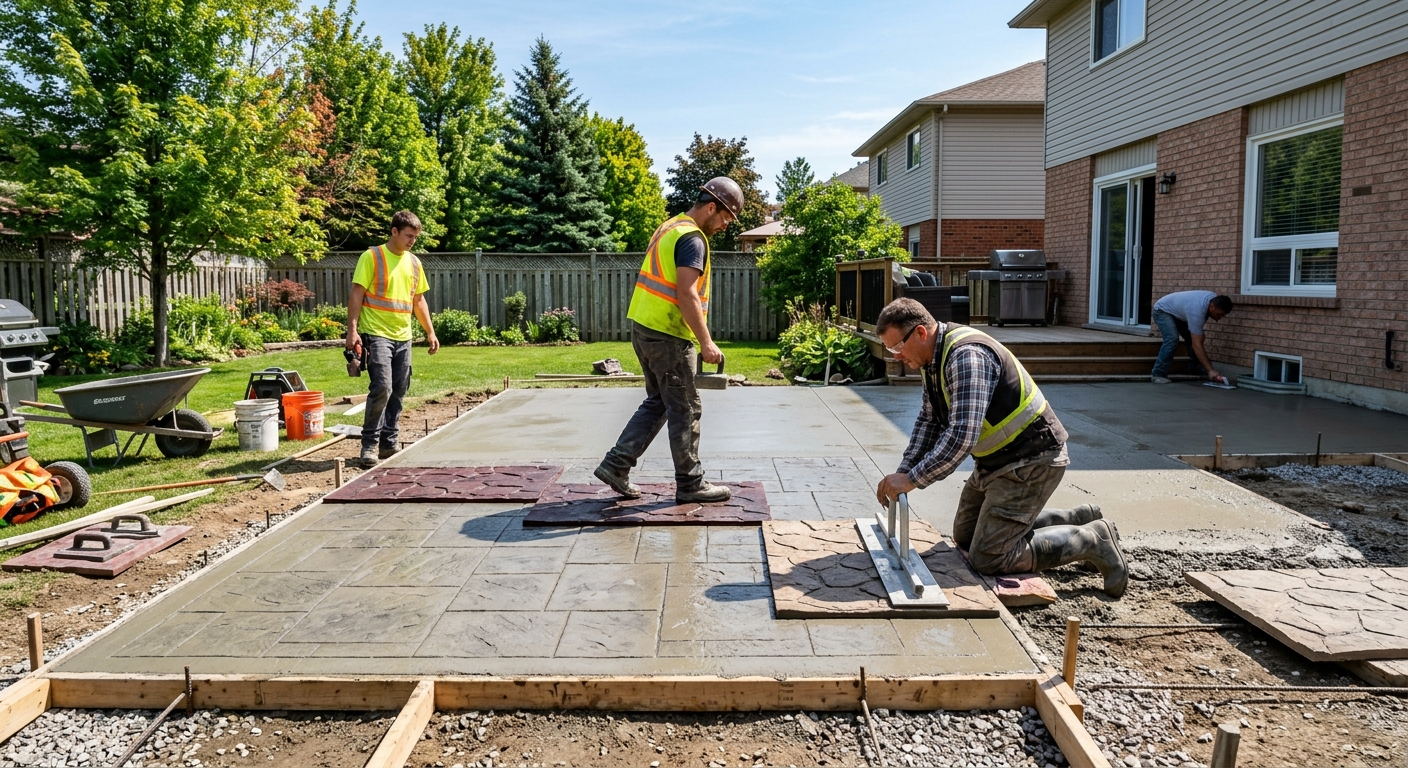
Stamped concrete costs more because it includes additional layers and labour: texture release, stamping tooling, and usually more careful finishing timing to maintain crisp edges in the pattern. In Crestwood, a standard broom-finish driveway typically aligns with $12,000–$18,000, while stamped concrete driveway or patio projects usually land around $15,000–$26,000 depending on area, colour method, and complexity (borders, steps, drainage transitions). You’re paying for the craft and the time spent at finishing—plus the extra preparation needed so the surface can hold the pattern without premature defects. If the quote doesn’t detail the finish process and curing approach, the price gap may not be justified—ask for specifics before signing.
When is the best time to pour concrete in Crestwood?
The best time is when temperatures allow proper placement and curing without excessive cold-weather measures. In the Crestwood area, exterior pours are usually planned during the warmer part of the season, because the practical window narrows as nights get colder and freeze–thaw cycles intensify. That said, quality contractors can still pour in shoulder seasons using winter-grade mixes, insulated blankets, and sometimes temporary heat to maintain curing conditions. The key is that the curing window is protected—not just that the concrete was “poured.” If a contractor proposes an outdoor pour late in the season without a defined heating/blanket plan and responsibilities, that’s a durability risk in Alberta’s freeze–thaw climate.
How long does concrete take to cure?
Concrete curing has two phases homeowners should understand. First, it develops strength during the early curing period—typical best practice is a minimum 7-day curing period under proper conditions (especially important in Alberta cold). Second, many protective steps rely on full or near-full cure timing. For example, penetrating sealers are commonly applied around 28 days post-pour so the concrete has dried enough to accept the sealer and benefit from better moisture/salt resistance. In Crestwood, cold weather can slow curing, so the contractor should explain how they’ll protect the slab during early strength gain. If you rush the schedule—like exposing the fresh surface to salt-heavy winter conditions—you increase the chance of scaling and early surface deterioration.