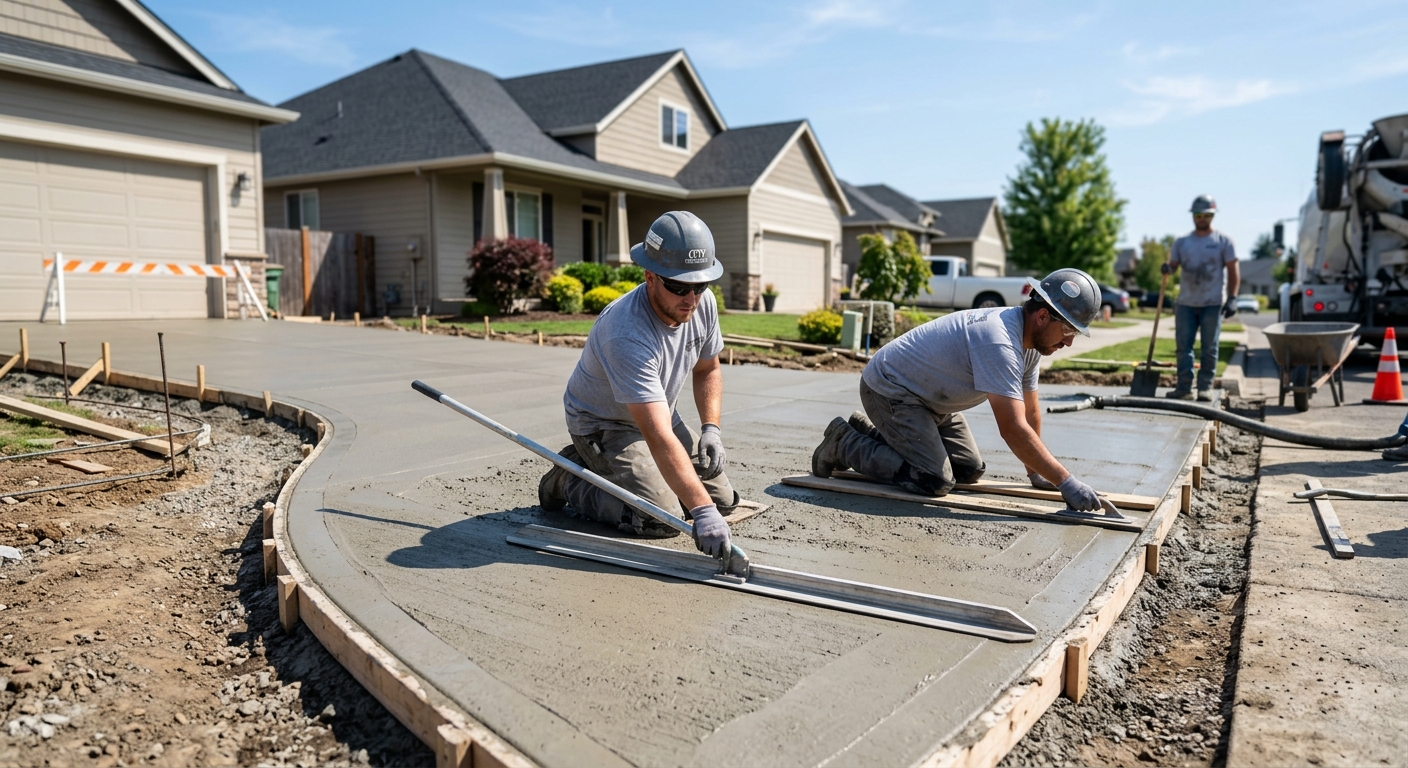
Concrete work options and costs in Canmore
Canmore is a great place for durable concrete—but it’s also a place where frost and freeze-thaw cycles can be brutal on driveways, patios and walkways. With Canmore’s homeowner base representing about 66.2% of households (Statistics Canada, 2021 Census), most concrete projects here are for residential flatwork: driveways, exterior slabs, garage floors and upgrades that improve curb appeal and access. The housing stock also leans toward single-detached homes—37.8% of dwellings—which is why standard broom-finished driveways and patios are steady work year-round.
In the Banff–Jasper–Rocky Mountain House region, concrete pricing is driven first by freeze-thaw exposure, frost depth and a shorter warm-weather pour season. That means contractors spend more time on excavation to proper frost depth, better base preparation, and tighter weather management. It also affects availability: in peak summer weeks, crews can be booked out, and rush scheduling can raise labour and mobilization costs.
In Canmore’s older areas, like parts of the downtown core and some residential pockets built before 1981 (11.6% of homes), homeowners often replace settlement-prone flatwork and improve drainage at the same time. Foundation and footing work is typically the highest-priced category because it’s structural, requires deeper excavation below frost depth, and involves more reinforcing and inspection coordination. From there, stamped and decorative work costs more than simple flatwork because it needs tighter finishing windows and additional materials like colour, release agents and sealers.
Use the table below as a realistic apples-to-apples comparison of typical project scopes before you request an itemised quote.
| Application |
Typical Size |
Key Spec |
Finish Option |
Price Range |
| Concrete driveway (standard broom finish) |
12 m x 3 m (about 36 m²) |
Air-entrained exterior mix, compacted granular base |
Broom finish + control joints |
$14,000–$26,000 |
| Exposed aggregate driveway |
12 m x 3 m (about 36 m²) |
Air-entrained mix, proper curing to protect surface |
Exposed aggregate + sealer |
$18,000–$32,000 |
| Stamped concrete driveway or patio |
10 m x 3 m (about 30 m²) |
Air-entrained mix, colour hardeners, release agent |
Stamping + colouring + sealing |
$22,000–$40,000 |
| Plain concrete patio or walkway |
8 m x 2 m (about 16 m²) |
Air-entrained mix, compacted base, control joints |
Smooth trowel or light broom + sealer |
$12,000–$22,000 |
| Garage floor (interior slab) |
6 m x 6 m (about 36 m²) |
Vapour barrier, reinforced slab (as required), proper curing |
Float/steel trowel + densifier or sealer (optional) |
$14,000–$28,000 |
| Foundation footings (structural, below frost) |
Typical detached home footing system |
Reinforced concrete, excavate to frost depth, engineering coordination |
Structural finish (not decorative) |
$35,000–$70,000 |
Prices are estimates only and vary by project scope, site access and material selection.
What affects the price of concrete work in Canmore
In Canmore and the wider Banff–Jasper–Rocky Mountain House region, two crews can price the “same” driveway very differently—typically by 30–50%—because the true drivers aren’t the concrete alone. They’re frost depth, freeze-thaw exposure, site preparation complexity, and how much risk management is built into the schedule and curing plan. Even labour hours can change dramatically based on access (tight driveways, limited truck access, and the need for small excavators) and how much granular base must be hauled and compacted.
Frost depth and freeze-thaw cycles dictate every exterior spec. Footings must extend below the design frost depth to reduce heave. In Alberta, that often pushes excavation deeper than homeowners expect, which increases formwork height, reinforcing quantity, and base prep. For slabs—driveways, patios and walkways—contractors typically require air-entrained concrete so the mix survives repeated freezing and thawing. Add a shorter pour season and colder overnight temperatures, and you also see higher costs from cold-weather curing precautions: insulating blankets, heated enclosures, and more careful planning so strength gain isn’t compromised.
De-icing salt is another local reality. If homeowners use road salt right away, it can accelerate surface spalling when the mix and curing aren’t right—so sealing (and correct timing) becomes part of the cost equation. For example, a broom-finished driveway may land near the lower end of the $14–$26 band, but choosing exposed aggregate or stamped work can move the budget toward the $22–$40 stamped/decorative band because you’re paying for extra labour, surface treatments and sealing. If you’re replacing older flatwork (like pre-1981 homes in parts of Canmore), expect potential add-ons for poor subgrade drainage and extra base rebuild—those issues can add thousands even before the concrete is placed.
| Price Factor |
Why It Matters |
Cost Impact |
| Frost line depth — determines footing depth and form height |
Deeper excavation prevents heave and shifting in freeze-thaw |
Raises structural project costs; can add significant labour and base material |
| Site preparation — excavation, grading, compacted granular base |
Concrete lasts only if the base is stable and drained |
Higher when access is tight or soil is unsuitable |
| Reinforcement — rebar or wire mesh requirement |
Controls cracking and improves load capacity (especially slabs) |
Increases material and labour; affects foundation and garage floors most |
| Mix design — air-entrainment and compressive strength spec |
Air entrainment helps resist freeze-thaw damage and spalling |
Costs more than basic mixes but reduces long-term failure |
| Finish type — broom vs. stamped vs. exposed aggregate |
Decorative work requires tighter finishing windows and more steps |
Stamped/exposed typically costs materially more than plain broom finish |
| Pour size and concrete truck access to site |
More truck trips and pump/hoist needs increase labour and scheduling risk |
Can add mobilization and labour hours, especially on sloped sites |
| Cold-weather curing precautions — heating and blankets |
Cold slows strength gain; early loading can cause defects |
Added costs during shoulder seasons and shaded installs |
| Control joint pattern and sealing cost |
Joints manage shrinkage cracking; sealing helps with de-icing salt exposure |
More work on layout and finishing; sealing adds a per-square-metre line item |
Permits & regulations in Alberta
In Alberta, structural concrete work—footings, foundation walls, grade beams and other load-bearing components—generally requires a building permit and often engineered drawings reviewed by the municipality. Concrete flatwork (patios, walkways and driveways) usually does not require a permit by itself, but it may become a permit issue if the work affects lot grading, drainage, increases impervious surface coverage beyond municipal limits, or changes something near a municipal right-of-way. Before you start, confirm the requirements with the municipality for the specific address.
For contractor compliance, always verify three things before signing in Canmore: (1) licensing/registration where applicable, (2) liability insurance, and (3) WSIB/WCB coverage. Step-by-step, you can do it like this: first, ask the contractor for their certificate of insurance showing liability coverage limits and confirm it includes work on residential properties in Alberta. Second, ask for WSIB/WCB clearance documentation (or proof of active coverage) and check that the dates are current—expired coverage is a common risk. Third, confirm the contractor’s registration status through the appropriate Alberta registry (and any trade-specific registration they claim). Finally, request references on similar-scale projects—especially exterior slabs done in freeze-thaw climates—so you can see finishing quality and crack/joint work.
If a contractor won’t provide insurance/coverage proof or refuses itemised scope details, that’s your cue to keep shopping.
Getting concrete right in Canmore's freeze-thaw climate
Concrete failures in Canmore usually come from the same chain: unstable base, wrong mix design, and insufficient curing—then freeze-thaw and de-icing salt finish the job. To get it right, spec the work around performance, not just appearance. Start with base preparation: a compacted granular sub-base built to the right depth for local soil and frost conditions reduces settlement and pumping. Next, the mix design: for exterior flatwork, air-entrainment is critical (typically 5–7% air content for exterior applications) and the concrete should meet a minimum 32 MPa compressive strength so the slab reaches reliable early and long-term performance.
Then control cracking. Concrete shrinks as it cures, and it moves through seasons. Well-placed control joints—spaced to limit random cracking—give the concrete a predictable weak point. After placement, curing matters more here than in warm-dry regions because cold slows strength gain. Plan for minimum 7-day curing under suitable conditions, and if temperatures drop, use heating and insulating blankets so the slab isn’t damaged before it gains adequate strength.
Finally, protect the surface. A penetrating sealer applied after the concrete has cured—commonly 28 days post-pour—helps repel moisture and reduce the impact of de-icing salts at the surface. When you’re shopping, ask technical questions about air-entrainment and curing time; the most common homeowner regret is spalling caused by inadequate air entrainment or rushed curing.
Price-wise, the difference between plain broom work and stamped can be justified. For example, a basic patio may fit near the $12–$22 band, while stamped concrete often moves toward the $22–$40 band because you’re paying for colouring, release agents, stamping labour and additional sealing steps. If the contractor cuts corners on mix or curing to “save money,” that premium is never worth it.
| Spec |
Why It Matters in Canmore |
What to Ask For |
Impact if Skipped |
| Compacted granular base (depth?) |
Stable base prevents settlement and frost-related movement in Canmore |
Confirm base depth, soil condition, and compaction testing expectations |
Uneven surfaces, cracking and early deterioration |
| Air-entrained concrete mix (target air %?) |
Air voids help concrete survive freeze-thaw cycles |
Ask for the target air content (typically 5–7% for exterior flatwork) |
Higher risk of spalling and scaling during Alberta winters |
| Compressive strength (MPa rating) |
Strength supports durability and reduces early damage risk |
Confirm minimum 32 MPa and what happens if conditions are cold |
Surface weakness, cracking and premature wear |
| Control joints (spacing per ACI guidelines) |
Limits random cracking from shrinkage and temperature change |
Ask for a joint layout and spacing plan |
Random cracks that spread and collect moisture |
| Minimum 7-day curing period |
Cold slows strength gain; curing protects early performance |
Confirm curing method and any heating/blankets during cold nights |
Damage from early loading and inadequate strength development |
| Penetrating sealer (when applied after cure) |
Reduces moisture penetration and helps with de-icing salt exposure |
Confirm timing—commonly 28 days post-pour—and product type |
Faster surface wear, scaling and staining |
How to choose a concrete work contractor in Canmore
Choosing the right concrete contractor in Canmore is about verifying compliance and workmanship up front. Start with Alberta coverage checks. First, ask for a current certificate of liability insurance showing the contractor’s coverage limit and expiry date. Second, confirm WSIB/WCB coverage for their workers (ask for clearance documentation or proof of active coverage—don’t accept promises without paperwork). Third, verify their Alberta trade registration/eligibility where applicable, then match that to the type of work you’re hiring for (structural footings versus decorative flatwork).
Next, get 2–3 itemised quotes. Don’t accept only a lump sum with no breakdown. Ask for labour vs materials, concrete mix type/air-entrainment details, base prep depth, reinforcement (if required), joint layout, curing/blanket approach, disposal costs, and whether the quote includes a permit pull for anything structural. For Canmore projects, it’s common for access challenges to change excavation and truck staging—itemisation makes it easier to compare real differences rather than marketing.
Warranty is another major filter. Ask for the workmanship warranty length and whether it’s backed by the installer contract (and how long they cover repairs). Clarify if the product manufacturer warranty applies to materials and whether it’s transferable with change of ownership.
On payment, never allow a schedule that asks for more than 10–15% upfront. Use a holdback until the work is complete and accepted (especially for finishing quality and joint sealing). Finally, demand a timeline: a start date and completion estimate in writing, with weather-cold contingency for shoulder seasons.
- Request proof of liability insurance and confirm it’s current
- Confirm WSIB/WCB clearance or active coverage for workers
- Get an Alberta registration/eligibility check for the contractor
- Use itemised quotes (labour, concrete mix spec, base prep, reinforcing, finishing, sealing)
- Ask for the air-entrainment spec for exterior slabs
- Confirm curing plan for cold nights (blankets/heating if needed)
- Require a written joint layout (spacing and pattern)
- Ask whether concrete pumping is included (and what triggers extra charges)
- Confirm excavation depth assumptions and disposal/haul-away costs
- Verify rebar/wire mesh details for the specific slab thickness and use
- Check workmanship warranty length and what “repair” includes
- Set payment schedule with a holdback until completion and cleanup
In Canmore, red flags include: quoting exterior flatwork without mentioning air-entrainment; skipping written joint layouts; promising “we’ll pour whenever” with no cold-weather curing plan; vague scopes that leave base depth or reinforcement undefined; and contractors who ask for large upfront deposits (more than 10–15%) or won’t provide insurance/coverage documentation.
Frequently asked questions — concrete work in Canmore
How do I compare concrete quotes?
When you compare quotes for concrete in Canmore, don’t just look at the total price. Ask each contractor to itemise the same scope: excavation and base prep depth, the concrete mix spec (especially air-entrainment for exterior slabs), reinforcement details, joint layout, curing plan, and whether sealing is included. If one quote is near the $14–$26 driveway band while another sits higher, you want to know whether the higher number includes a deeper base rebuild, better reinforcing, cold-weather precautions, or a higher-spec air-entrained mix. In the Banff–Jasper–Rocky Mountain House region, freeze-thaw risk is a spec issue, not a marketing issue. Finally, confirm disposal and access costs (truck staging or small equipment) so you’re not comparing different realities.
Can concrete be poured in cold weather in Canmore?
Yes, concrete can be poured in cold weather in Alberta, including Canmore, but it must be managed. The key is temperature control and curing protection so the concrete reaches safe strength before exposure causes damage. In practice, contractors should plan for blankets and/or temporary heating, protect against wind chill, and follow a curing approach that matches the forecast—cold nights can slow strength gain. Ask specifically what they do if daytime temperatures drop below workable ranges and how long they will keep the slab covered/insulated. If a contractor says they’ll “just pour and hope,” that’s a risk for early surface defects, scaling and cracking in freeze-thaw cycles.
How do I maintain concrete in Canmore's freeze-thaw climate?
Maintenance in Canmore is mostly about protecting the surface from moisture intrusion and salt. Keep de-icing chemical use reasonable: avoid rock salt blasting directly at the edges and joints, and use a manufacturer-recommended de-icer suitable for concrete when possible. If your slab is exterior, ask whether penetrating sealer was applied after proper curing—often around 28 days post-pour. Resealing schedules vary by product, but planning an inspection after the first winter helps you catch early scaling. Also check joint lines: if joints crack or become filled incorrectly, water can migrate and accelerate spalling. For older homes (including some pre-1981 properties in town), improving nearby drainage is often as important as the concrete itself.
What causes concrete to spall in Canmore winters?
Spalling in Canmore winters usually comes from freeze-thaw damage driven by either inadequate air-entrainment, insufficient curing, or moisture exposure that the surface can’t resist. If the concrete mix doesn’t contain the right air void structure (commonly 5–7% air for exterior flatwork), water enters and freezes, expanding inside the paste and breaking the surface. The risk increases if the slab was loaded too soon, if cold nights weren’t managed with insulation/blankets, or if the base was poorly prepared and the slab can “move.” De-icing salt then worsens the surface wear by increasing moisture and chemical attack. That’s why reputable contractors build spall resistance into the spec and curing, not just the finish.
What is rebar and when is it required in Alberta?
Rebar (reinforcing steel bars) is used to improve tensile capacity and control cracking in structural concrete. In Alberta, whether you need rebar depends on the design and the type of slab or foundation. For structural work like foundation footings and grade beams, reinforcing is typically part of engineered drawings and must be installed per spec. For exterior flatwork like driveways and garage slabs, reinforcement may be required based on thickness, subgrade stability, and design loads; some projects use rebar, others use wire mesh, fibres, or combinations. The best approach is to ask your contractor to show the reinforcement plan tied to your slab thickness and use—don’t accept “we’ll see as we go,” especially in freeze-thaw climates where crack control matters.
How long does a concrete project take in Canmore?
The duration depends on scope and weather. For a typical exterior flatwork project in Canmore, the active work (excavation, base prep, formwork, pour, finishing) is often completed within a few days, but the total timeline includes curing. Even with good conditions, plan for at least 7 days before normal loading, and you may need longer protection if temperatures are cold. Decorative work like stamping and colouring can take longer because the finishing window is tighter. Sealing is usually a separate step after curing—commonly around 28 days post-pour—so the full “done” milestone may extend beyond the initial pour. In the region’s shorter warm-weather season, crews sometimes book ahead, so scheduling early can help you avoid delays.