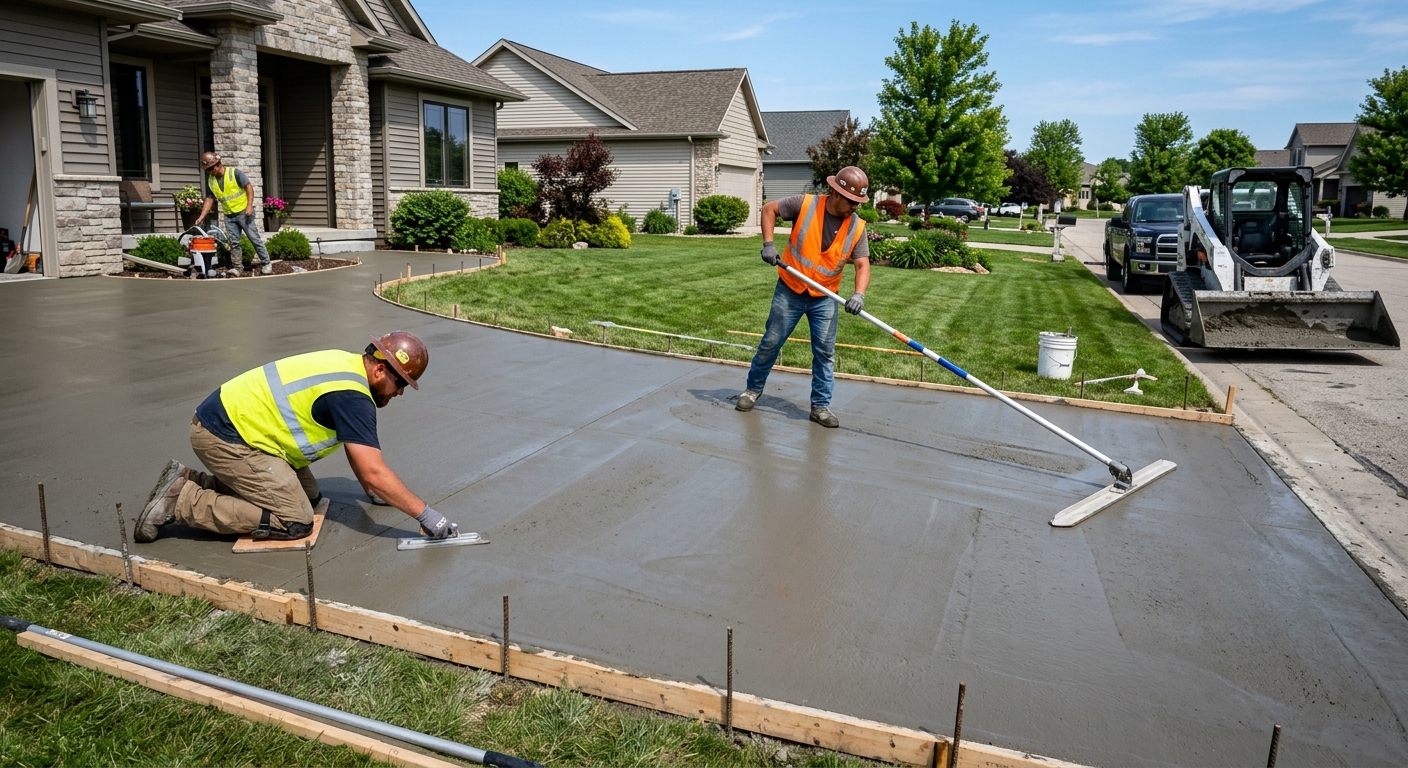
Concrete work options and costs in Kenilworth
Kenilworth homeowners typically choose concrete for driveways, patios and walkway surfaces because it’s durable and straightforward to maintain. In the wider Calgary region, the housing stock is largely built around single-detached homes, and in Kenilworth itself the population is 2,489 (Statistics Canada, 2021 Census). That mix of family properties and year-round exterior use creates steady demand—especially in older neighbourhood pockets where people are upgrading entries and rear-yard flatwork.
In Calgary’s cold continental climate, concrete pricing reflects more than just the slab surface. Cold weather placement, freeze–thaw cycles and a design frost depth around 1.2 m (roughly 4 ft) mean contractors must excavate deeper, build a proper compacted granular base and use air-entrained mixes for exterior work. The result is that a “simple” driveway often costs more here than in milder markets, and quotes can shift based on how much heating/insulation is needed to protect curing. Labour availability can also tighten when multiple crews are scheduling pours during the short practical season.
Many Kenilworth projects start around established residential corridors such as the areas near the downtown core and main access streets, where truck access and grading are predictable—good conditions that help keep pricing closer to the low end of the range. With that in mind, the table below compares common options so you can benchmark contractor estimates before you request itemised quotes.
| Application |
Typical Size |
Key Spec |
Finish Option |
Price Range |
| Concrete driveway (standard broom finish) |
400–600 sq. ft. |
Air-entrained exterior mix, compacted granular base |
Broom finish |
$12,000–$18,000 |
| Exposed aggregate driveway |
400–600 sq. ft. |
Air-entrained exterior mix, decorative stone reveal |
Exposed aggregate |
$16,000–$22,500 |
| Stamped concrete driveway or patio |
300–600 sq. ft. |
Admixtures for durability, control joints |
Stamped pattern + release |
$15,000–$26,000 |
| Plain concrete patio or walkway |
200–400 sq. ft. |
Exterior air-entrained mix, compacted base |
Plain broom/steel trowel edges |
$5,000–$9,000 |
| Garage floor (interior slab) |
400–500 sq. ft. |
Vapour/insulation options, fibre or mesh, proper thickness |
Standard smooth finish |
$9,500–$15,500 |
| Foundation footings (structural, below frost) |
House/garage size dependent |
Excavation to undisturbed soil, rebar, engineered dimensions |
Structural concrete + rebar |
$28,000–$45,000 |
Prices are estimates only and vary by project scope, site access and material selection.
What affects the price of concrete work in Kenilworth
In Kenilworth, you’ll often see quotes for the “same” concrete job come in 30–50% apart across the Calgary area. That gap usually comes down to what’s included in the base, whether the mix is engineered for freeze–thaw durability, and how a contractor plans the pour and curing window. In a cold-weather region, skipping details that protect concrete from frost can turn a mid-range bid into a low bid that costs more later.
The biggest driver is the frost depth requirement. Footings and structural elements must extend below the design frost depth—around 2.4 m in Alberta practice—so the ground doesn’t heave and move the foundation. For exterior slabs like driveways and patios, Calgary’s frequent freeze–thaw cycles also dictate air-entrained concrete, well-graded granular base prep, and correctly spaced control joints. When temps drop, contractors must use winter-grade mixes, insulate with curing blankets and sometimes add temporary heat to keep the curing process reliable. That’s why a driveway budgeted near $12,000–$18,000 can shift toward the top end when the pour date sits near the shoulder season.
Local conditions can raise or lower costs quickly. For example: (1) steep grades or poor drainage can require extra excavation and thicker base; (2) a small lot with tight truck access can add labour for wheelbarrowing and line setup; and (3) if your project needs decorative work, stamped or exposed finishes add labour and materials, moving you toward $15,000–$26,000 depending on area and pattern complexity. Housing age also matters—many older Kenilworth properties have mature landscaping to manage, which can add removal and reinstatement costs before concrete even gets poured.
| Price Factor |
Why It Matters |
Cost Impact |
| Frost line depth |
Determines how deep formwork and excavation go for footings and structural elements. |
Can add large excavation/form + rebar labour; often drives foundation pricing within $28,000–$45,000. |
| Site preparation |
Proper grading, topsoil removal and compacted granular base reduce settlement and cracking. |
Extra hauling/compaction can move a flatwork job toward the high end. |
| Reinforcement |
Rebar, wire mesh or fibres control cracking—especially where loads or moisture vary. |
Material + labour increases; omission can lead to early failure. |
| Mix design |
Air-entrainment and compressive strength specs are engineered for freeze–thaw durability. |
Winter-grade and engineered air can raise material costs but prevents spalling. |
| Finish type |
Broom finish is simpler; stamped/exposed require more labour steps and careful curing. |
Decorative finishes commonly add thousands (e.g., stamped budgets around $15,000–$26,000). |
| Pour size and concrete truck access to site |
Smaller pours with long carries increase labour time; access affects setup costs. |
Can change crew hours and equipment needs. |
| Cold-weather curing precautions |
Heating, insulation blankets and monitoring protect strength gain in low temperatures. |
Often the difference between bottom and top-end pricing in fall/spring. |
| Control joint pattern and sealing cost |
Joints manage shrinkage cracking; sealing improves resistance to de-icing salt damage. |
Lower bids may skip sealing or under-spec jointing; proper work costs more but extends service life. |
Permits & regulations in Alberta
In Alberta, many structural concrete scopes require a building permit and often engineered drawings before work starts. That typically includes footings, foundation walls, grade beams and other below-grade or load-bearing concrete. If your project touches the structural system or changes the foundation support conditions, expect permitting and engineering review as part of the process.
Concrete flatwork—such as patios, walkways and driveways—typically does not require a separate permit as a standalone item in Alberta. However, it can trigger review if it affects lot grading, stormwater drainage, impervious surface coverage requirements, or the municipal right-of-way (for example, work that ties into a curb, sidewalk approach, or changes drainage patterns). Because requirements can be site-specific, confirm with the local authority before breaking ground.
For contractor verification in Kenilworth: start by asking for proof of Alberta liability insurance and WSIB/WCB coverage (or the applicable exemption if the contractor is eligible and can document it). Then verify work status using the appropriate provincial licensing registry for the contractor’s trade/capabilities. Next, review the certificate of insurance for the coverage limits and effective dates, and request a clearance/coverage document where available. Finally, ask for references from comparable projects in the last 12–24 months—ideally in the Calgary area where freeze–thaw engineering practices match your climate risks. This simple checklist helps you avoid “uninspected” subcontractors and protects your project schedule.
Getting concrete right in Kenilworth's freeze-thaw climate
Concrete fails in Kenilworth mainly because water and salts get into the surface and freeze, then expand. In a cold continental climate with repeated freeze–thaw cycles, the most important spec is adequate air-entrainment—usually the difference between an exterior slab that lasts 20+ years and one that begins scaling or spalling in just a few seasons. The second big issue is a weak base: if the granular sub-base isn’t excavated to the proper depth and compacted correctly, the slab can settle and crack, letting more water enter.
To spec the job correctly, focus on five areas: (1) base preparation—remove topsoil/soft material, grade for drainage, and compact the granular sub-base to the design thickness for your site and frost conditions; (2) mix design—confirm air-entrainment and a minimum compressive strength (commonly 32 MPa) for exterior exposure; (3) control joints—place them to control where cracks form; (4) curing—plan for at least 7 days of curing under proper conditions, and don’t rush it in cold weather; and (5) sealing—apply a penetrating sealer after the concrete is fully cured (often around 28 days) to help resist de-icing salt damage.
When homeowners compare options, the best value isn’t always the cheapest. For instance, if a stamped patio quote comes in near $15,000–$26,000 while a plain patio is $5,000–$9,000, the price difference is justified when you truly want pattern and colour—and when the contractor still includes the same base prep, joints and proper air-entrainment to protect the slab. Skipping those essentials is never “savings” in Calgary-area freeze–thaw conditions.
| Spec |
Why It Matters in Kenilworth |
What to Ask For |
Impact if Skipped |
| Compacted granular base (depth?) |
Prevents settlement and reduces water movement that drives freeze–thaw damage. |
Confirm excavation depth, granular thickness and compaction requirements. |
Uneven settlement, cracking, and accelerated spalling. |
| Air-entrained concrete mix (target air %?) |
Air pockets provide space for freeze expansion, reducing surface scaling/spalling. |
Specify air content (typically 5–7% for exterior flatwork) and cold-weather admixture needs. |
Rapid scaling/spalling, especially where de-icing salts are used. |
| Compressive strength (MPa rating) |
Affects strength gain and durability in cold exposure. |
Confirm minimum 32 MPa for relevant exterior applications and engineered thickness. |
Surface weakness and long-term durability loss. |
| Control joints (spacing per ACI guidelines) |
Controls shrinkage cracking and limits random crack locations. |
Ask for joint spacing/layout plan and joint cutting timing. |
Random cracking pathways for water intrusion. |
| Minimum 7-day curing period |
Proper curing is crucial for strength development before freeze conditions intensify. |
Confirm curing method and what happens if temperatures drop (blankets/heat). |
Reduced strength, increased scaling risk and premature failure. |
| Penetrating sealer (when applied after cure) |
Helps repel salt and water, reducing freeze–thaw deterioration. |
Confirm product type and application timing (often about 28 days after pour). |
Faster deterioration from salts and moisture movement. |
How to choose a concrete work contractor in Kenilworth
Choosing the right concrete contractor in Kenilworth starts with verification. Ask for the contractor’s Alberta trade registration/licence information (appropriate to the work they’re performing), then request proof of liability insurance with coverage limits that match your project. Next, confirm WSIB/WCB coverage—either proof of coverage or documented exemption status where applicable. Don’t accept “we’re covered” verbally; get copies of certificates and clearance documents so you know you’re protected if there’s an injury or damage.
Then, get 2–3 itemised written quotes—not a single lump sum. A strong quote breaks down labour and materials (excavation, forms, granular base, reinforcement, concrete supply, finish labour, jointing, sealing and any winter protection). Carefully read what’s excluded: removal/disposal of topsoil, curb/sidewalk tie-ins, regrading, drainage corrections, and whether permit pulls or engineering requirements are included for foundation work. If your schedule pushes into colder weeks, ask how they handle cold-weather placement and curing (blankets/heat and curing monitoring), because that’s a cost and quality factor unique to Calgary’s freeze–thaw reality.
For warranty, look for a workmanship warranty length and confirm whether any product/manufacturer warranties apply to sealers/adhesives. Ask if the warranty is transferable. On payment, never pay more than 10–15% upfront; hold back a portion until the finish and sealing are complete and the site is cleaned. Also request a written start date and a completion estimate so your family can plan around deliveries and curing time.
- Ask for proof of Alberta liability insurance (certificate available on request).
- Confirm WSIB/WCB coverage and request documentation before work begins.
- Request an Alberta licensing/registration check for the contractor’s trade scope.
- Get 2–3 itemised quotes with line-by-line base, reinforcement, concrete supply and finish labour.
- Verify frost-related excavation and base preparation details are included.
- Confirm mix spec for exterior exposure (air-entrainment) and minimum compressive strength.
- Ask for control joint spacing and whether joints are installed/cut on schedule.
- Ask about curing plan and whether heating/blankets are included for cold pours.
- Confirm sealing is included, and specify the sealer type and timing (after full cure).
- Clarify disposal: is topsoil removal and concrete waste hauling included?
- Review warranty terms in writing (workmanship duration and what it covers).
- Set a payment schedule with a holdback until final completion and cleanup.
Red flags to watch for in Kenilworth: a quote that doesn’t mention air-entrainment for exterior slabs, “we can pour whenever” without cold-weather curing provisions, no clear jointing plan, refusing to provide insurance/WSIB/WCB documentation, or offering only a lump sum with vague exclusions (especially for excavation, regrading and sealing).
Frequently asked questions — concrete work in Kenilworth
Stamped vs broom-finish concrete — cost difference?
In Kenilworth and the Calgary region, stamped concrete generally costs more than a broom-finish driveway or slab because it requires extra set-up, release materials, labour-intensive stamping and more careful finishing around control joints. As a budgeting reference, standard concrete driveways often land around $12,000–$18,000, while stamped concrete driveway or patio projects commonly fall in the $15,000–$26,000 band depending on size, pattern complexity and colour options. The important part is that the base, air-entrained exterior mix, joint spacing and curing should be equally robust for both finishes—otherwise the decorative surface may fail early from freeze–thaw water and de-icing salts. Ask for itemised labour and materials so you can see exactly what you’re paying for.
When is the best time to pour concrete in Kenilworth?
The best time is when you can pour and cure without risking freezing while concrete is still gaining strength. In Kenilworth, that usually means avoiding late fall or early spring unless the contractor has a proven cold-weather plan (winter-grade mixes, insulated blankets, and sometimes temporary heat). Calgary’s freeze–thaw cycles are relentless, and rushing curing can increase surface scaling or weakness. If temperatures are borderline, your contractor should explain how they’ll monitor conditions and protect the slab for the required curing period. Scheduling also affects logistics—truck availability and crew coordination—so get your start date in writing. For exterior slabs, a dependable curing window is often more important than “the calendar date” alone.
How long does concrete take to cure?
Concrete cures by temperature and mix design, so timelines aren’t identical every job. For exterior work in Alberta, you should plan on at least a 7-day curing period under proper conditions for initial strength gain, with good protection from freezing during that time. Full durability benefits typically build over weeks as hydration continues; that’s why sealing is often delayed until the concrete is fully cured. If you’re applying a penetrating sealer to protect against de-icing salt exposure, plan on around 28 days post-pour for many systems. If a contractor is pressuring you to open forms, remove barriers or use the surface early, that’s a quality risk—especially in Kenilworth where freeze–thaw can start quickly after a cold snap.
Do I need a permit for concrete work in Alberta?
In Alberta, structural concrete typically requires a building permit—think footings, foundation walls and grade beams—because it affects the building’s structural system. Concrete flatwork such as patios, walkways and driveways usually doesn’t require a permit by itself, but it can require review if it impacts lot grading, stormwater drainage, or impervious surface/municipal right-of-way constraints. For a Kenilworth homeowner, the safest approach is to ask your contractor what they expect will be required for your specific site plan and then confirm with the local authority before excavation begins. Also verify the contractor is properly insured and covered (liability and WSIB/WCB where applicable) so you’re not stuck with uncovered risks if something goes wrong.
Concrete vs pavers for a patio in Kenilworth?
Concrete is usually the better choice when you want a consistent, low-maintenance surface with fewer joints exposed to water paths. Pavers can look great and can be easier to repair in small sections, but they rely on a well-built base and correct jointing/drainage to prevent shifting in freeze–thaw conditions. In Kenilworth, plain concrete patios often budget around $5,000–$9,000, and they can be engineered with air-entrainment, control joints and sealing to reduce salt and moisture damage. Pavers may cost more when you include base preparation to the same standard. The “right” option depends on your drainage plan, how tight the access is, and whether you want a monolithic surface or a more modular finish.
How long does a concrete driveway last?
With correct base prep, air-entrained exterior mix, proper jointing and sealing, a concrete driveway in Kenilworth can last many years—often decades. The main threats here are freeze–thaw cycling plus de-icing salts. If a contractor doesn’t include air-entrainment, doesn’t place control joints correctly, or skips sealing, the surface can scale and spall sooner, and cracks can widen as water enters. A well-executed driveway that’s built to the region’s frost depth and curing needs is more likely to reach the long end of expected service life. If your driveway is near the lower budget tier—around $12,000–$18,000—don’t assume it’s “cheap.” Instead, ask what’s included for base thickness, joints, curing protection and whether sealing is scheduled.