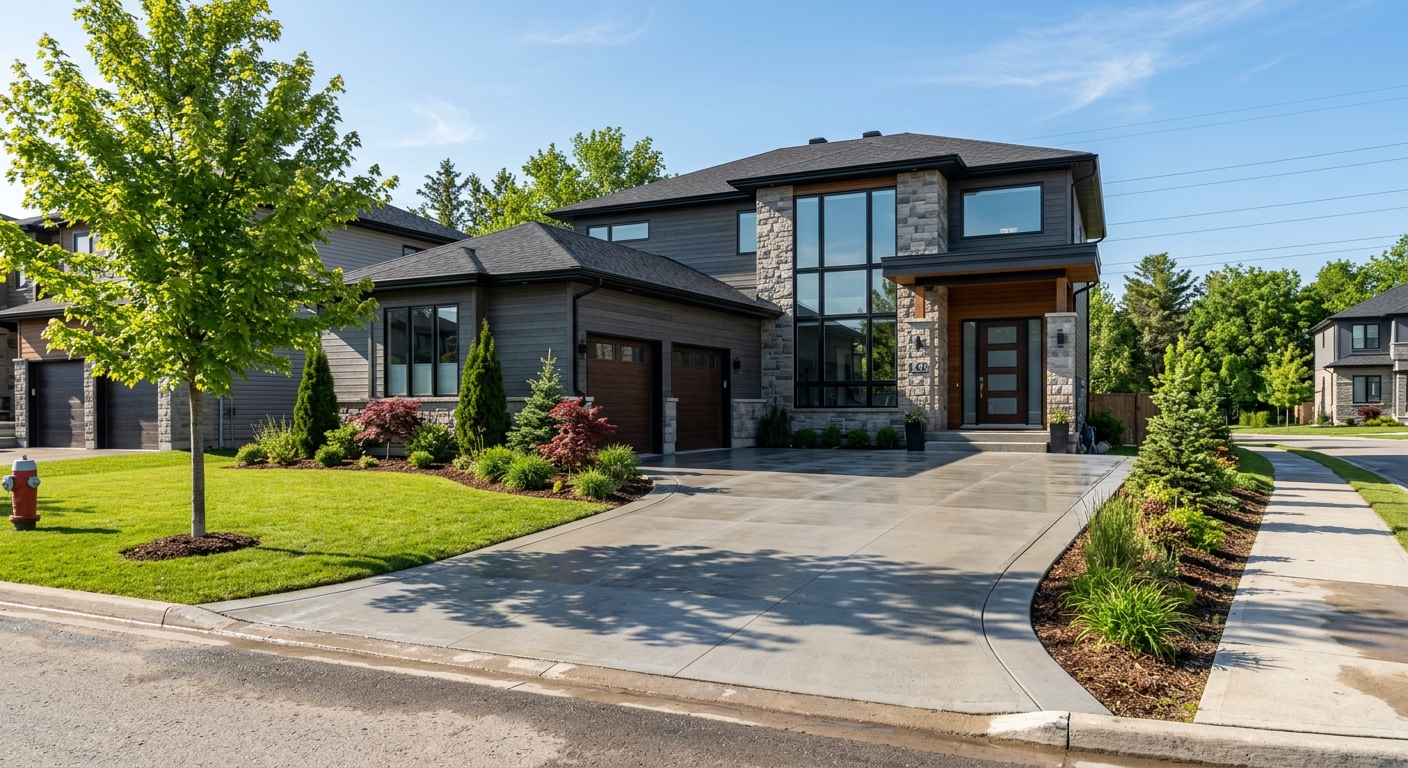
Concrete work options and costs in Morinville
Morinville is a strong demand market for concrete flatwork because most homes are single-detached and the region’s freeze–thaw cycle is hard on unprotected exterior slabs. In the 2021 Census, Morinville had 10,385 residents, and homeowner households made up 83.4% of all households (Statistics Canada, 2021 Census). With 73.2% of dwellings being single-detached, driveways, patios, walkways, and garage floors are among the most common concrete upgrades—especially in established areas like downtown and the surrounding residential core, where replacement and re-lifts often come up during renovations.
Pricing here is shaped by Edmonton’s cold continental climate. Footings for anything structural must be set below the designed frost depth to avoid frost heave, and exterior concrete needs air-entrained mixes to survive repeated freezing and thawing. The pour season is also shorter in winter and shoulder months, so contractors compress scheduling into late spring through early fall—labour and heated curing precautions can push budgets upward. As a result, you’ll often see quote differences that aren’t just about concrete; they reflect excavation depth, granular base build-up, reinforcement decisions, joint layout, and how the crew plans curing and protection.
If you’re comparing budget options, it helps to separate “what you want to look like” (broom vs exposed vs stamped) from “what keeps it from failing” (frost-aware base and air-entrained concrete). Use the table below as a realistic starting point for Morinville, then we can refine it based on soil, access, thickness, and finishes.
| Application |
Typical Size |
Key Spec |
Finish Option |
Price Range |
| Concrete driveway (standard broom finish) |
24 ft x 10 ft (240 sq. ft.) |
Exterior slab with compacted granular base and control joints |
Broom finish |
$9,000–$14,000 |
| Exposed aggregate driveway |
24 ft x 10 ft (240 sq. ft.) |
Exterior slab with air-entrained mix; exposed surface work |
Exposed aggregate (spray/acid wash finish) |
$13,000–$18,000 |
| Stamped concrete driveway or patio |
200–320 sq. ft. |
Exterior slab with proper jointing and curing protection |
Stamped pattern (limited colour range) |
$12,000–$26,000 |
| Plain concrete patio or walkway |
12 ft x 12 ft (144 sq. ft.) |
Exterior slab on compacted granular base |
Float/steel trowel with light broom or scored joints |
$3,500–$7,500 |
| Garage floor (interior slab) |
20 ft x 22 ft (440 sq. ft.) |
Interior slab with vapour control and proper base |
Standard broom or light trowel, power-broom finish |
$7,000–$13,000 |
| Foundation footings (structural, below frost) |
Typical detached home footing scope |
Excavation and concrete placed below design frost depth |
Reinforced concrete footings |
$25,000–$60,000 |
Prices are estimates only and vary by project scope, site access and material selection.
What affects the price of concrete work in Morinville
Even for the “same” concrete job, Morinville quotes can swing 30–50% across the Edmonton economic region because the expensive parts—excavation depth, base preparation, reinforcement, and winter protection—aren’t visible in marketing photos. Two contractors might both offer “a concrete driveway,” but one may be pricing a shallow, well-drained base with standard curing, while another prices deeper excavation and frost-aware subgrade treatment to reduce future heaving and cracking. In an area where frost depths in cold continental climates commonly run 1.5 m or more, those below-grade decisions directly affect labour hours, truck time, and material volume.
Freeze–thaw cycles also dictate mix and detailing. Exterior slabs should use air-entrained concrete so the paste has room to handle ice expansion; without it, you’re more likely to see scaling and spalling. Because Edmonton’s season is shorter, cold-weather scheduling often requires insulated blankets or heated enclosures to achieve proper curing—costing more in fuel, material, and time. De-icing salts used in Morinville accelerate surface wear when the slab isn’t properly sealed and detailed.
Local examples that commonly raise costs include: (1) a driveway replacement where the old base has poor drainage and needs full excavation before the new slab—pushing a standard broom driveway toward the upper end of the $9,000–$18,000 driveway band; (2) a stamped patio where labour to form, colour, and protect the surface justifies moving within the $12,000–$26,000 stamped range; and (3) structural footing work where the required frost depth and excavation in heavier soils can push foundation/footings toward the higher end of the $25,000–$60,000 band.
Housing age matters too. With 35.0% of homes built before 1981 (Statistics Canada, 2021 Census), some sites have older drainage patterns and settled edges that require more demo and regrading—so “removal and re-pour” work can be materially more expensive than starting fresh.
| Price Factor |
Why It Matters |
Cost Impact |
| Frost line depth |
Determines footing depth and form height |
More depth increases excavation, concrete volume, and labour |
| Site preparation |
Excavation, grading, compacted granular base |
Improper base means higher failure risk and likely rework |
| Reinforcement |
Rebar or wire mesh requirement |
Costs rise with steel quantity and placement labour |
| Mix design |
Air-entrainment and compressive strength spec |
Air-entrained exterior mixes and specs can add a premium |
| Finish type |
Broom vs. stamped vs. exposed aggregate |
Decorative finishes add material steps, labour, and curing protection |
| Pour size and concrete truck access to site |
Distance and staging affect production |
Limited access may require more crew time or smaller truck drops |
| Cold-weather curing precautions |
Heating and blankets |
Adds fuel, insulation material, and time; can increase schedule cost |
| Control joint pattern and sealing cost |
Joints manage cracking; sealing helps resist de-icing damage |
Proper jointing plus sealer is a cost add that reduces premature spalling |
Permits & regulations in Alberta
In Alberta, structural concrete work typically triggers permitting because it affects the building’s engineered stability. For Morinville homeowners, that usually includes foundation footings, foundation walls, and grade beams—and often engineered drawings submitted or reviewed as part of the permit process. Concrete flatwork (like driveways, patios, and walkways) usually does not require a permit by itself, unless it involves changes to lot grading, drainage, or impacts municipal requirements around impervious surfaces or the right-of-way. Always confirm with the municipality before you break ground or remove key drainage elements.
Before hiring, ask for proof your contractor is properly covered. Concrete crews should carry liability insurance (to protect you and the property during excavation and pours) and WSIB/WCB coverage (so workers are protected on site). Step-by-step in Alberta: (1) request their certificate of insurance and verify the policy is active and lists you/your address if your contract requires it; (2) ask for their WSIB/WCB account clearance letter or equivalent proof of coverage; (3) check that the company is properly registered/licensed for the trade and scope by using the relevant online contractor registry resources; and (4) confirm they can provide references for similar flatwork or footing scope in the Edmonton area.
If you’re planning structural work, request the permit/engineering checklist in writing so you know what’s included (drawings, inspections, and any rebar inspection steps) before signing.
Getting concrete right in Morinville's freeze-thaw climate
Concrete fails in Morinville when one of the “big five” details is missed: base, mix, joints, curing, or sealing. In our freeze–thaw climate, water is the real enemy—if the base isn’t compacted and well-drained, moisture migrates, freezes, and pushes the slab up (heave) or breaks it down (cracking and spalling). Start with base preparation: compacted granular sub-base to the correct depth for local soil conditions, with proper grading so water doesn’t pond. Next is mix design: specify air-entrainment for exterior flatwork (commonly 5–7% air) and a minimum 32 MPa compressive strength, especially for driveways and patios exposed to de-icing salts. Third, control joints: add joints early in the plan so shrinkage cracks happen where you want them, not randomly across the slab.
Curing is where winter schedules bite. Proper curing should target at least 7 days under suitable conditions; in cold periods, contractors should use insulated blankets or heated enclosures so concrete doesn’t freeze before it reaches adequate strength. Finally, sealing matters more here than many homeowners expect. Penetrating sealer applied after the concrete has cured (often around 28 days) helps repel salts and reduces surface scaling.
Ask technical questions like: “What is your air content target for exterior exposure?” and “How deep will you excavate and what granular base will you compact?” A realistic dollar example: upgrading from a plain broom finish patio to a sealed, well-jointed exterior patio can cost a few thousand dollars more up front, but it’s often less than replacing a spalled slab after one harsh winter—especially in older areas where drainage wasn’t designed for modern de-icing practices.
| Spec |
Why It Matters in Morinville |
What to Ask For |
Impact if Skipped |
| Compacted granular base (depth?) |
Prevents moisture build-up and frost-related movement |
Granular base depth and compaction method (plate/vibration) |
Heaving, settlement, and early cracking |
| Air-entrained concrete mix (target air %?) |
Helps concrete resist freeze–thaw cycles |
Air content target (commonly 5–7% for exterior flatwork) |
Spalling/scaling in winter and wet springs |
| Compressive strength (MPa rating) |
Strength affects durability under traffic and freeze–thaw |
Minimum 32 MPa rating for exterior slabs |
Surface wear, cracking, and reduced lifespan |
| Control joints (spacing per ACI guidelines) |
Limits random cracking patterns |
Joint layout plan and saw-cut timing |
Unsightly cracks and potential water pathways |
| Minimum 7-day curing period |
Proper strength gain before exposure to cold |
Cold-weather curing plan (blankets/heaters if needed) |
Weak surface and higher failure risk |
| Penetrating sealer (when applied after cure) |
Reduces de-icing salt and water penetration |
Sealer type and timing (often after cure, around 28 days) |
Faster surface deterioration and scaling |
How to choose a concrete work contractor in Morinville
Start with credentials and insurance—this is where you avoid expensive surprises. In Alberta, verify the contractor’s coverage and labour protection: ask for their liability insurance certificate and confirm it’s current and appropriate for your scope (excavation, concrete placement, and potential right-of-way work). Next, request proof of WSIB/WCB coverage—a clearance letter or account proof is usually provided. You can also check the company through the relevant Alberta online registry resources for registration status and business details.
Then get 2–3 quotes that are itemised—not just “lump sum.” You want a breakdown for: demo/removal (if any), excavation depth and disposal, granular base and compaction, formwork, reinforcement, concrete supply (including air-entrainment and strength spec), finishing labour, curing protection, joint cutting, and sealing. Confirm whether the contractor pulls permits for structural work and whether inspections are included where required.
For warranty, ask two things: what workmanship warranty length they provide, and whether it’s tied to specific steps (base prep, joint sealing, curing) rather than vague “material only” coverage. Also ask if the warranty is transferable if you sell your home.
Payment schedule matters in Morinville’s project timelines. Never pay more than 10–15% upfront. Hold back the remainder until the work passes your walkthrough and finishing/cleanup is complete. Get a written timeline with a start date, curing/protection steps in cold snaps, and an estimated completion date.
- Ask for references on driveways/patios with freeze–thaw performance in Edmonton-area conditions.
- Confirm the air-entrained mix requirement for any exterior slab.
- Get the planned excavation depth and granular base specification in writing.
- Verify joint layout (where joints will be saw-cut or tooled) and timing.
- Confirm reinforcement type and thickness where required.
- Request a pour schedule that includes curing blankets/heaters if temperatures drop.
- Ensure concrete truck access/staging is described, including how they avoid damaging landscaping.
- Ask whether disposal of old concrete is included.
- Confirm if sealing is included and whether it’s penetrating sealer after cure (often around 28 days).
- Check liability insurance and WSIB/WCB coverage before signing.
- Review the quote for exclusions (subgrade conditions, unexpected rock/soil changes, permit fees).
- Use a written contract with specs: thickness, strength, air content, and finishing method.
Concrete red flags I see in Morinville include: no written mix spec (especially air-entrainment for exterior work), vague “we’ll do the base” language without depth/compaction details, quotes that ignore cold-weather curing, skipping control joints or sealing/finishing timelines, and crews asking for large upfront payments before any formwork or base prep is complete.
Frequently asked questions — concrete work in Morinville
What is air-entrained concrete and why does it matter here?
Air-entrained concrete is mixed with tiny, evenly distributed air bubbles that give freezing water a place to expand. In Morinville’s Alberta climate, exterior slabs (driveways, patios, walkways) face repeated freeze–thaw cycles and de-icing salt exposure. Without sufficient air entrainment, the concrete’s surface can scale and spall during winter—often starting as small pits and roughness and progressing after a couple of harsh seasons. When you’re budgeting, this isn’t usually the biggest line item, but it’s one of the most important specs. It’s especially relevant if you’re paying for higher-finish work (for example, stamped concrete at the $12,000–$26,000 band), because decorative surfaces still fail if the base and mix aren’t freeze-thaw-ready. Ask your contractor for the air content target and confirm it’s specified for exterior exposure.
How do I prepare the base for a concrete slab?
Base preparation is the foundation of a durable slab in Morinville. A good contractor excavates to the correct depth, removes unsuitable material (like topsoil), then places compacted granular sub-base and grades it so water drains away. The granular base must be compacted in lifts, typically using appropriate compaction equipment, so it doesn’t settle after the pour. For exterior flatwork, the goal is to limit moisture movement—because moisture + freezing temperatures drives heave and cracking. In older neighbourhoods with older drainage patterns, you may need deeper excavation and more base replacement to reach stable soil. A clear quote should mention excavation depth, base thickness, compaction method, and whether they include disposal of unsuitable material. If those details are missing, your final slab may land in the “looks fine for a season” trap—even if the concrete price is within the usual $9,000–$18,000 driveway range.
How do I compare concrete quotes?
Comparing concrete quotes in Morinville is less about the total number and more about what’s inside the number. Ask for itemised pricing: demo/removal (if applicable), excavation and disposal, granular base and compaction, reinforcement (mesh or rebar), concrete supply with air-entrainment and strength spec, formwork, finishing method, curing protection, saw-cut control joints, and sealing. Make sure both quotes use the same slab thickness and finish timing (for example, broom vs stamped vs exposed aggregate requires different labour steps). Also confirm what’s excluded: unforeseen soil conditions, extra trucking distance, permit fees for structural work, or repairs to existing drainage. A “cheap” quote may omit key steps like proper base depth or cold-weather curing. For reference, decorative stamped jobs often fall in the $12,000–$26,000 band, while plain patios/waswo walkways are commonly in the $3,500–$7,500 range, depending on size and site access. Equalize the scope first—then compare.
Can concrete be poured in cold weather in Morinville?
Yes, concrete can be poured in cold weather in Morinville, but it should be done with a deliberate cold-weather plan. The risk is that concrete can freeze before it reaches adequate early strength, which weakens the surface and increases failure chances under freeze–thaw cycles. Reputable contractors use methods like insulated blankets, heated enclosures, wind protection, and temperature-controlled scheduling—plus they adjust the pour approach based on forecasts. Your contract should specify curing protection and who supplies the blankets/heaters. If the job includes exterior slabs, air-entrainment is non-negotiable, and the joints/finishing timing still matters. For interior slabs, requirements are often easier, but curing still matters. If a contractor says “we’ll just pour like summer” without discussing curing protection, treat it as a red flag—especially when timelines compress into late fall or early winter. Get the plan in writing before committing.
How do I maintain concrete in Morinville's freeze-thaw climate?
Maintenance in Morinville is mostly about reducing water and salt damage. For exterior concrete, use de-icing products carefully—avoid excessive salt piling in one spot and try to keep the surface clear so meltwater doesn’t pool. After the slab has cured (commonly around 28 days), a penetrating sealer helps repel water and slows down surface scaling from de-icing salts. Re-apply sealer on a schedule your contractor recommends based on product and exposure, often every few years. Keep an eye on drainage: if the grade around the slab allows water to collect, you can get early deterioration no matter how good the pour was. Also watch control joints—if joints are sealed incorrectly or water starts entering them, cracks can worsen. If your driveway or patio is older (Morinville has a meaningful share of older housing stock, with 35.0% built before 1981 (Statistics Canada, 2021 Census)), prioritize drainage corrections because older yards sometimes settle or slope toward the slab.
What causes concrete to spall in Morinville winters?
Spalling in Morinville winters is most often linked to freeze–thaw stress and surface weakening. The most common causes are inadequate air-entrainment (so the concrete can’t tolerate internal ice expansion), poor base drainage that lets water saturate the slab, and insufficient curing protection when the weather turns cold. De-icing salt then accelerates surface deterioration by pulling moisture through the surface pores and stressing the near-surface layer. Sometimes spalling is also connected to missed or poorly planned control joints—random cracking creates more pathways for water entry. If you used salt-heavy de-icing practices and the slab was sealed late (or not sealed), spalling can appear sooner. If you’re comparing options, remember that decorative finishes can make defects more visible, but the root cause is still performance specs. For exterior replacements, it’s smart to budget for correct freeze–thaw design within your driveway range (commonly $9,000–$18,000) and ensure the contractor specifies air content, jointing, curing, and sealing.