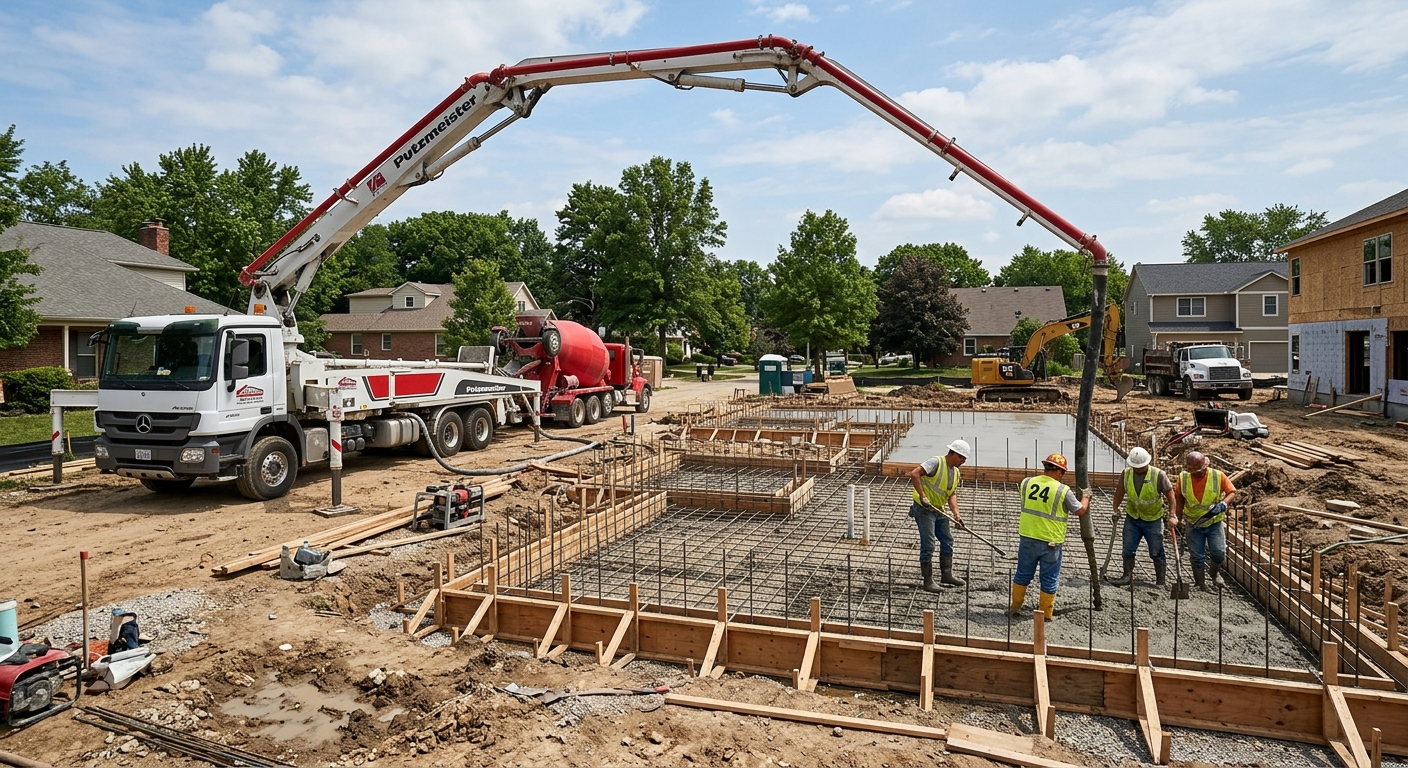
Concrete work options and costs in Penhold
Penhold homeowners typically choose concrete for driveways, patios, walkways, slabs and foundations because it’s durable in Alberta’s prairie freeze-thaw swings. In a market where single-detached houses make up 68.7% of dwellings and about 80.0% of households own their homes, there’s steady demand for long-life exterior flatwork. You’ll also notice a meaningful share of older housing stock—26.8% of homes were built before 1981—which often drives repair work, re-lifts, and new drainage/grade fixes before concrete is poured (especially around older sidewalks and driveways).
In the Red Deer economic region, concrete pricing isn’t just about square footage. Cold-weather exposure means deeper, more carefully prepped base work, air-entrained mixes, and extra attention to consolidation so the slab survives freeze-thaw cycling without scaling or spalling. The construction season is shorter, so scheduling pressure and mobilization can add cost, particularly when contractors have to bring in additional equipment for excavation, hauling, and weather protection.
In Penhold, areas such as the newer subdivisions along the eastern edge tend to see more driveway and walkway installs as lots finish landscaping and garages are built out. That mix of new builds and upgrades helps explain why quotes vary: excavation depth, access for the concrete truck, reinforcement needs, and finishing level often drive the budget more than the final footprint.
Below are typical cost ranges Penhold homeowners see for common concrete projects, so you can compare apples to apples before you book measurements.
| Application |
Typical Size |
Key Spec |
Finish Option |
Price Range |
| Concrete driveway (standard broom finish) |
24 ft x 20 ft (480 sq. ft.) |
Air-entrained exterior mix, compacted granular base |
Broom finish + control joints |
$10,800–$18,000 |
| Exposed aggregate driveway |
24 ft x 20 ft (480 sq. ft.) |
Air-entrained mix, base prep and curing protection |
Exposed aggregate finish |
$14,200–$22,500 |
| Stamped concrete driveway or patio |
20 ft x 18 ft (360 sq. ft.) |
Air-entrained mix, colour hardener and release |
Stamp pattern + seal coat |
$12,000–$20,000 |
| Plain concrete patio or walkway |
12 ft x 16 ft (192 sq. ft.) |
Exterior slab with proper base and edges |
Screed + light broom or steel trowel |
$1,900–$3,600 |
| Garage floor (interior slab) |
24 ft x 22 ft (528 sq. ft.) |
Vapour barrier (when needed), proper sub-base |
Light broom + control joints |
$7,500–$13,000 |
| Foundation footings (structural, below frost) |
Typical 1-storey house perimeter |
Engineered sizing, below-frost depth excavation |
Structural concrete |
$14,500–$29,000 |
Prices are estimates only and vary by project scope, site access and material selection.
What affects the price of concrete work in Penhold
In Penhold and across the Red Deer economic region, it’s common to see quotes for the “same” job come in 30–50% apart. The main reason is that the visible surface area doesn’t tell the whole story—concrete durability starts below grade. Your contractor’s pricing depends on excavation depth, base preparation, reinforcement, thickness, access for concrete trucks, and how much weather protection and curing supervision the team needs.
Freeze-thaw exposure is the big driver. Footings and foundations must extend below local frost depth (in Alberta, that’s typically in the ~2.4 m range for many design conditions), and exterior slabs need air-entrained concrete mixes to survive repeated expansion and contraction. That means more material handling and more labour than in milder climates. Also, the shorter pour season can force tighter scheduling, longer site supervision, and sometimes cold-weather curing precautions (like insulating blankets and controlled curing) even when the temperature is only “borderline.” Finally, de-icing salt accelerates surface wear, so sealing and proper mix/spec matter; skipping them can lead to scaling that costs more to fix later.
Here are a few Penhold examples of how conditions raise or lower cost. A driveway in a lot with poor drainage or high clay content may require extra granular base and re-grading before any concrete goes down. If your project needs reinforcement (for example, a longer driveway with heavier vehicle loads or a slab over problematic subgrade), labour and material increase. Conversely, a straightforward walkway on stable, already-prepared subgrade may price closer to the lower end of the $8–$16 per sq. ft. band for patios/walkways. Stamped work can be higher—closer to the $16–$28 per sq. ft. range—because it includes additional materials and more labour-intensive finishing and detailing.
| Price Factor |
Why It Matters |
Cost Impact |
| Frost line depth — determines footing depth and form height |
Footings must be below frost to limit heave and settlement |
Higher excavation and concrete volume when depth is greater |
| Site preparation — excavation, grading, compacted granular base |
Concrete failures often start with weak or poorly graded sub-base |
Adds labour if soils need removal/replacement or deeper base |
| Reinforcement — rebar or wire mesh requirement |
Helps control cracking and supports loads in exterior slabs |
Material + tie-in labour; can move price toward the higher band |
| Mix design — air-entrainment and compressive strength spec |
Air-entrainment improves freeze-thaw durability |
Often modest on material cost, but essential to meet performance |
| Finish type — broom vs. stamped vs. exposed aggregate |
Complex finishes require more steps and tighter timing |
Stamped/exposed typically add labour and product costs |
| Pour size and concrete truck access to site |
Access constraints can trigger additional labour or smaller loads |
Higher cost when pump, chute work, or extra handling is needed |
| Cold-weather curing precautions — heating and blankets |
Concrete gains strength slower; early freezing can weaken the slab |
Adds equipment and supervision during marginal weather |
| Control joint pattern and sealing cost |
Joints manage cracking; sealing helps with salt and surface durability |
Costs more upfront, but reduces premature scaling and repairs |
Permits & regulations in Alberta
In Alberta, structural concrete work usually requires permits and engineered involvement. That includes foundation components such as footings, foundation walls, and grade beams—these are part of the building structure and typically require a building permit, with engineered drawings reviewed by the municipality. For concrete flatwork like patios, walkways, and driveways, a permit is often not required by default; however, you may need approval if the work affects lot grading, stormwater drainage, impervious surface coverage limits, or the municipal right-of-way (for example, tying in near an approach/driveway apron).
Before you pour anything in Penhold, confirm with the local authority that your specific scope fits the “typical no-permit” category. Also verify your contractor carries liability insurance and WSIB/WCB coverage (these are practical homeowner safeguards, not just paperwork). Ask for references on similar-scale concrete builds in the Red Deer area because foundation and flatwork details can differ from job to job depending on soil conditions and access.
How to verify contractor credentials step-by-step:
- Check the contractor’s business registration and any Alberta trade licensing/registration details through the appropriate public registry/consumer pages.
- Request a certificate of insurance and ensure it lists current coverage, correct business name, and the work location.
- Ask for WSIB/WCB clearance or proof of coverage; don’t rely on a verbal “yes.”
- Confirm they carry enough liability limits for your project type (flatwork vs. excavation and structural concrete differs).
- Verify they can provide references with photos of comparable Penhold/Red Deer-region conditions.
Getting concrete right in Penhold's freeze-thaw climate
Concrete in Penhold has one job: survive freeze-thaw cycling without cracking, scaling, or heaving. Most failures come from poor base prep, inadequate air-entrainment, and missing or mis-spaced control joints—not from the top finish. To spec the job correctly, start with compacted base preparation. Use a compacted granular sub-base to the right depth for local soil and frost considerations so the slab doesn’t settle unevenly.
Next, specify an air-entrained mix for exterior flatwork. In Penhold projects, a common target is 5–7% air content for proper freeze-thaw resistance. Pair that with a minimum 32 MPa compressive strength spec and proper consolidation during placement so the mix performs as designed. Control joints are also crucial: they limit random cracking by giving concrete a planned place to crack, especially on driveways and long walks.
Curing is where many DIY attempts lose. Even if the temperature is “warm enough to pour,” concrete needs proper curing conditions. As a baseline, allow at least 7 days of curing under appropriate protection—blankets or other measures if the weather turns cold quickly. Finally, sealing matters in Alberta because de-icing salts can accelerate surface wear; a penetrating sealer is typically applied after full cure (often around 28 days) to help repel moisture and salts.
If you’re choosing between options, it helps to know what’s worth paying for. For example, moving from a broom-finish driveway toward exposed aggregate might add roughly $3,400–$6,000 for a typical 24 ft x 20 ft driveway in Penhold, but the upgraded surface texture can improve slip resistance and mask minor imperfections. If the base prep and air-entrained mix aren’t correct, though, paying for the “look” won’t stop spalling.
| Spec |
Why It Matters in Penhold |
What to Ask For |
Impact if Skipped |
| Compacted granular base (depth?) |
Base stiffness controls settlement and frost-related movement in Penhold’s winters |
Granular base depth and compaction requirements based on your soil conditions |
Uneven settlement, cracking, and early slab deterioration |
| Air-entrained concrete mix (target air %?) |
Freeze-thaw survival depends on entrained air spacing for exterior slabs |
5–7% air content for exterior flatwork |
Spalling/scaling during the first harsh seasons |
| Compressive strength (MPa rating) |
Strength development affects durability and resistance to surface wear |
Minimum 32 MPa compressive strength spec |
Weaker concrete, faster abrasion and edge break-off |
| Control joints (spacing per ACI guidelines) |
Joints manage where cracks occur under thermal cycling |
Joint spacing plan included in the proposal (with a joint layout drawing if possible) |
Random cracking and water infiltration under freeze-thaw cycles |
| Minimum 7-day curing period |
Cold snaps slow strength gain and can trap moisture before the slab matures |
Minimum 7 days curing under protection; cold-weather method described |
Reduced strength and higher risk of surface damage |
| Penetrating sealer (when applied after cure) |
Helps repel de-icing salts and moisture in Alberta winters |
Application after full cure—commonly about 28 days post-pour—per product instructions |
More salt damage and faster spalling/scaling |
How to choose a concrete work contractor in Penhold
Choosing the right concrete contractor in Penhold comes down to verification and clarity, not just price. In Alberta, make sure they can show proof of liability insurance and WSIB/WCB coverage for their workers. To check: (1) request a current certificate of insurance and confirm the coverage is active for the project period; (2) ask for WSIB/WCB clearance or proof of coverage before work starts; and (3) confirm they operate under the correct business name for the documents you receive. These steps protect you if something goes wrong on excavation, rebar installation, or during placement.
When you request quotes, insist on 2–3 itemised written estimates rather than a single lump sum. A good quote should list labour and materials breakdown (excavation/base prep, reinforcement, concrete supply, finishing/sealing, and disposal). Also read the fine print: what’s excluded (topsoil removal, backfilling, permit fees, snow/ice removal for forming, or regrading)? Is disposal included? Will they protect landscaping and handle excess material properly? For warranties, ask for both workmanship warranty length and any product/manufacturer warranty details, and whether the warranty is transferable if you sell the home.
Finally, manage cash flow. Never pay more than 10–15% upfront. Hold a balance until the job is complete and any curing/sealing steps are done. In Penhold’s freeze-thaw climate, timing matters—ask for a start date and completion estimate in writing, and ensure they’ll protect the slab during cold nights.
- Ask for past photos of Penhold/Red Deer-region driveways and patios, not just basement pours.
- Confirm air-entrained mix and exterior specification details in writing.
- Get the proposed slab thickness and base prep depth explicitly stated.
- Check that joint spacing and sealing are included where required.
- Ensure the quote specifies reinforcement type (none vs. mesh vs. rebar) and where it sits.
- Verify disposal of excavated material and any hauling is included or priced.
- Ask how they handle cold-weather protection and curing timing.
- Confirm who supplies and places concrete (and whether substitutions are allowed).
- Request a start date, weather-monitoring plan, and completion timeline.
- Review warranty terms in plain language—what’s covered and for how long.
- Use a clear payment schedule with a holdback until final acceptance.
- Meet the crew/project lead so you know who’s actually doing the work.
Concrete red flags in Penhold include: no discussion of air-entrainment or curing, vague thickness/base details, missing or inconsistent joint layout, refusal to provide insurance/WSIB/WCB proof, and “too-good-to-be-true” pricing that doesn’t match realistic excavation and weather-protection needs.
Frequently asked questions — concrete work in Penhold
Can concrete be poured in cold weather in Penhold?
In Penhold, Alberta, concrete can sometimes be poured in cold weather, but it depends on temperature trends, wind, ground conditions, and your contractor’s cold-weather plan. The key risk isn’t just “can it be placed”—it’s whether it’s protected so it gains strength properly without early freezing. A reputable crew will describe how they maintain curing conditions (insulating blankets, wind protection, and sometimes heating) and will follow concrete supplier guidance for cold-weather placements. For reference, homeowners commonly budget around $10,800–$18,000 for a standard broom-finish driveway; that price can rise in cold snaps when additional protection and supervision are needed. Because freeze-thaw cycling is tough on exterior slabs, don’t accept a pour plan that skips curing precautions.
How do I maintain concrete in Penhold's freeze-thaw climate?
Maintenance in Penhold is mostly about reducing moisture and salt exposure. After your slab cures, sealing (typically a penetrating sealer applied after full cure—often around 28 days) helps repel de-icing salts and slows surface wear. Use de-icer appropriately (avoid heavy salt dumps) and clear snow without aggressive scraping that damages edges. Keep an eye on drainage: if water pools near a driveway or walkway, the freeze-thaw cycle can worsen cracking even if the concrete was properly air-entrained. For joints, don’t let filler degrade completely—check annually and readdress if needed. If your job was a broom-finish driveway, maintenance is usually simpler than decorative finishes, but the climate rules are the same. With Penhold’s older home base—26.8% built before 1981—some homeowners also need grading fixes before concrete maintenance even works.
What causes concrete to spall in Penhold winters?
Concrete spalls in Penhold winters mainly due to freeze-thaw damage at the surface. The most common causes are inadequate air-entrainment, insufficient curing, or water getting into cracks and joints and then freezing. If the mix doesn’t have the right entrained air (commonly targeted at 5–7% for exterior flatwork), the freeze-thaw process can create internal pressure that breaks the concrete’s surface. Spalling can also happen when base prep is poor and the slab settles, creating gaps that allow water intrusion. In some cases, de-icing salts accelerate the problem by attacking the surface pores. That’s why sealing matters—especially in Alberta. If you’re choosing finishes, remember that decorative options don’t “fix” spalling risk; specs and curing do. For budgeting, even stamped work typically starts from a higher band like $12,000–$20,000 for a common driveway/patio size, but the real durability comes from the mix, joints, and cure.
What is rebar and when is it required in Alberta?
Rebar is steel reinforcing bar placed inside concrete to improve tensile strength and help control cracking. Alberta doesn’t rely on a single “one-size-fits-all” rule—reinforcement requirements depend on the design, slab thickness, soil support, and loads (like vehicle weight and how the driveway or garage slab is built). For many exterior flatwork applications, mesh or rebar may be recommended if there’s a heavier vehicle use case, longer unsupported spans, or if the design calls for it. For structural elements like foundation footings and foundation walls, reinforcement is typically required by engineered drawings and building permit requirements. In Penhold, because winter conditions and freeze-thaw cycling can punish weak support, reinforcement decisions often go hand-in-hand with base preparation. If your quote doesn’t clearly state whether reinforcement is included, ask the contractor to explain the spec and how it matches your project conditions.
How long does a concrete project take in Penhold?
Timing depends on the scope (excavation and base prep can be the longest part), weather conditions, and how much coordination is needed for reinforcement, finishing, and curing protection. For a typical driveway or patio, the actual concrete placement day is usually only one day, but the overall schedule often spans several days to a couple of weeks when you include excavation, regrading, forming, reinforcement, and cure-protection set-up. Cold conditions in Penhold can extend the timeline because crews may need to delay finishing steps, apply insulating blankets, and protect the pour until strength gain is adequate. While some homeowners only think in terms of “how fast can they pour,” durability requires patience—at least 7 days of curing under proper conditions. For example, a standard broom-finish driveway budget around $10,800–$18,000 may take longer in marginal weather than in ideal summer conditions due to curing and weather monitoring.
What is a concrete overlay and is it suited to Penhold?
A concrete overlay is a new concrete layer installed over an existing slab (after surface preparation), often used to improve appearance or extend life without removing the entire driveway. In Penhold, overlays can be suitable in some cases, but the existing slab condition matters. If the original concrete is severely cracked, badly settled, or has significant drainage problems, an overlay can fail early because the movement and water pathways continue. The surface must be properly prepared for bond, and you still need correct mix/curing and a plan for joints and sealing. Overlays are also sensitive to freeze-thaw cycling: moisture trapped beneath or cracks in the substrate can lead to debonding and scaling. A traditional full replacement might feel more expensive, but it can prevent hidden issues. If your existing driveway is still mostly sound, an overlay may be a cost-effective option; otherwise, pricing may shift closer to the driveway replacement range such as $10,800–$18,000, depending on thickness, reinforcement and base work.