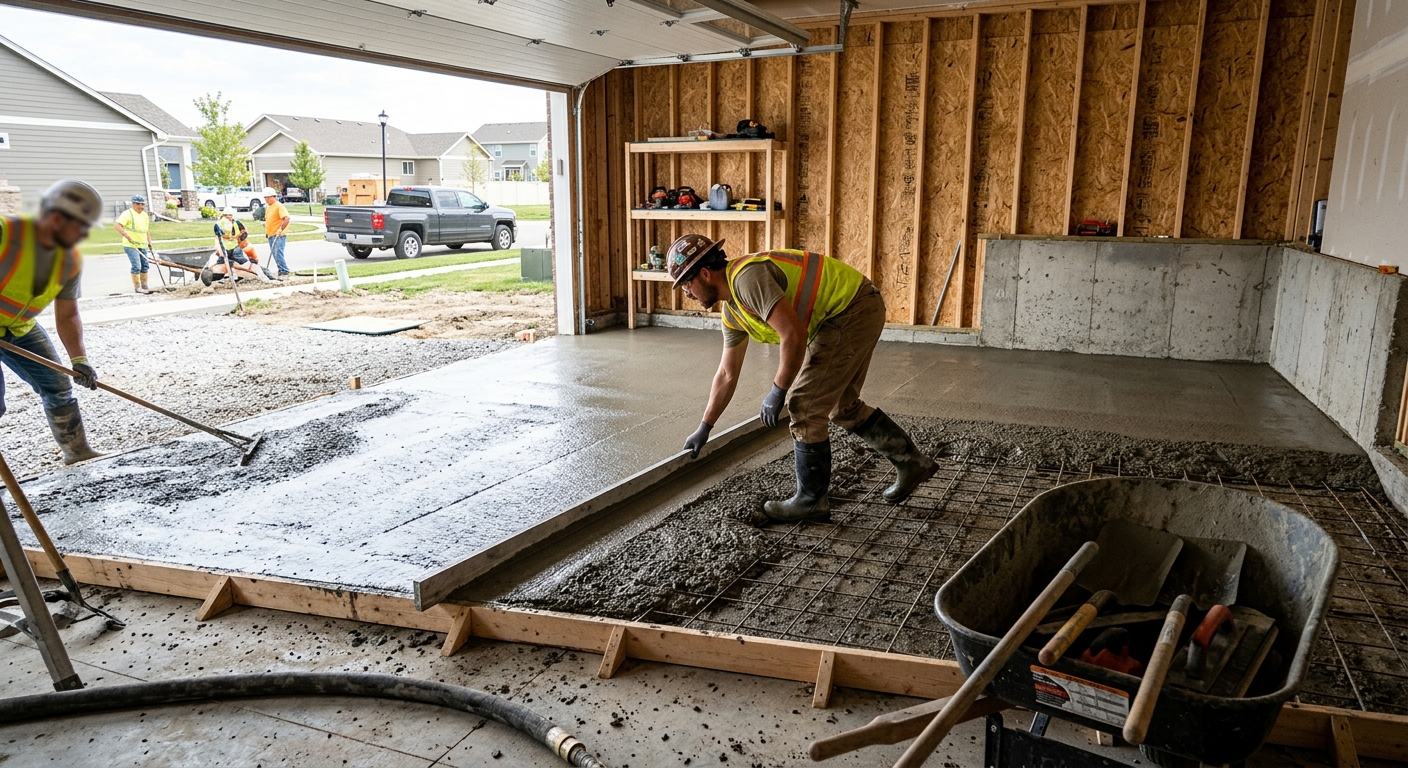
Concrete work options and costs in Twin Brooks
Twin Brooks is a compact community with a lot of practical, driveway-and-patio-focused concrete—especially around busy residential areas where families maintain gravel-free parking and clean walkways through winter. With a 2021 population of 6,435 (Statistics Canada, 2021 Census) and a housing pattern that’s heavily single-detached, concrete flatwork is one of the most common exterior improvement projects homeowners tackle. (Statistics Canada, 2021 Census also reports that Twin Brooks has a strong owner-occupied base, which typically means more long-term investment in durable slabs.)
In the Lethbridge–Medicine Hat economic region, concrete costs are shaped by a deep frost line and aggressive freeze–thaw cycles. For anything structural—like foundation footings—our spec requires excavation and forming down below frost to limit frost heave. That adds labour and excavation depth, which is why foundation/footing pricing sits above typical slab work. For exterior slabs (driveways, patios, walkways), we also design for freeze–thaw: air-entrained mixes, solid granular base prep, good drainage, and tight control joint layouts to manage cracking.
Local demand is especially strong along residential corridors where winter access is critical—areas near the main residential pockets around the town’s core see frequent driveway replacement and small patio additions. Because the pour season is shorter, crews also get scheduled tightly in warmer months, and cold-weather pours may require blankets/heaters or accelerators, which can increase costs.
Below is a realistic comparison of common concrete options and typical cost ranges you’ll see in Twin Brooks.
| Application |
Typical Size |
Key Spec |
Finish Option |
Price Range |
| Concrete driveway (standard broom finish) |
12 m x 6 m (about 72 sq. ft.) |
4 in. slab, 6x6 W2.9 x W2.9 mesh, air-entrained, control joints |
Broom finish |
$2,100 – $3,300 |
| Exposed aggregate driveway |
12 m x 6 m (about 72 sq. ft.) |
4 in. slab, air-entrained, retarder + proper curing |
Exposed aggregate |
$2,900 – $4,500 |
| Stamped concrete driveway or patio |
12 m x 6 m (about 72 sq. ft.) |
4 in. slab, air-entrained, integral color, seal coat |
Stamped pattern (ashlar/stone look) |
$3,000 – $5,200 |
| Plain concrete patio or walkway |
3 m x 3 m (about 324 sq. ft.) |
4 in. slab, granular base, air-entrained, control joints |
Float/smooth or lightly broomed |
$1,600 – $3,200 |
| Garage floor (interior slab) |
20 ft x 20 ft (400 sq. ft.) |
4 in. slab, wire mesh, vapour considerations at exterior doors |
Steel trowel finish |
$3,800 – $6,400 |
| Foundation footings (structural, below frost) |
Per project (typical crawl or basement system) |
Excavate below frost, rebar cage, engineered drawings, proper drainage |
Structural concrete formwork |
$9,500 – $18,000 |
Prices are estimates only and vary by project scope, site access and material selection.
What affects the price of concrete work in Twin Brooks
If you get two quotes for “the same” concrete job in Lethbridge–Medicine Hat, it’s common to see a 30–50% spread. The difference usually comes down to how far down the contractor excavates, what they’re including for base prep and drainage, and whether they’re specifying freeze–thaw durability details (air-entrained mix, joint pattern, sealing plan). Even when the finish looks similar at the surface, the strength, air content, and sub-base build-up under your slab control long-term performance here.
In Twin Brooks, the frost line depth and freeze–thaw cycles dictate every exterior spec. Footings must extend below the design frost depth (Alberta can be up to 2.4 m), which drives excavation and forming costs up compared with milder climates. For exterior slabs, air-entrained concrete is essential to relieve internal pressure when water freezes inside the matrix. Cold-weather pours also shorten the practical exterior season, so shoulder-season projects may need blankets, heaters, or accelerators—cost adders that some contractors underestimate when they quote early.
De-icing salt is another local reality: it can accelerate surface deterioration and spalling if the mix and finishing aren’t done right, so we often recommend sealing after cure. Two real examples from Twin Brooks: (1) a “standard” driveway may be quoted near the $14–$22 per sq. ft. backbone, but upgrading to an exposed aggregate surface and stronger drainage layers can push material-and-labour totals toward the upper range; (2) small patio pours can look cheaper at the $12–$20 band, yet if you need to re-grade or increase base depth due to soft soil, the total often climbs.
Local housing stock matters too. Older homes are frequently set on soils that shift or drain poorly, meaning added granular base depth and sub-drain work can add thousands. Those are the dollars that are hardest to see in the invoice—but most important to how long the slab stays serviceable.
| Price Factor |
Why It Matters |
Cost Impact |
| Frost line depth — determines footing depth and form height |
Below-frost excavation prevents frost heave and structural movement |
Higher excavation can add significant labour/material cost |
| Site preparation — excavation, grading, compacted granular base |
Correct base prevents settlement and keeps slabs supported in freeze–thaw |
Soft soils or deep prep can move total toward the high end |
| Reinforcement — rebar or wire mesh requirement |
Reduces crack widening; supports load transfer and durability |
Mesh is cheaper than rebar cages, but both affect labour time |
| Mix design — air-entrainment and compressive strength spec |
Air-entrainment improves freeze–thaw resistance and reduces spalling |
Proper spec costs more but protects against early failure |
| Finish type — broom vs. stamped vs. exposed aggregate |
Finishes add time, labour, and finishing materials/sequence |
Stamped/exposed typically increases price materially |
| Pour size and concrete truck access to site |
Access affects rigging, wheelbarrowing, and schedule efficiency |
Poor access can add labour and increase waiting time |
| Cold-weather curing precautions — heating and blankets |
Concrete gains strength slower in cold conditions; protection matters |
Heaters/blankets/accelerators can add noticeable cost |
| Control joint pattern and sealing cost |
Joints manage cracking; sealer helps repel salt-driven deterioration |
Sealing is a manageable add-on that reduces surface damage risk |
Permits & regulations in Alberta
In Alberta, structural concrete work—like foundation footings, foundation walls, and grade beams—typically requires a building permit and often engineered drawings that the municipality reviews. If your project changes structural loads, alters footing elevations, or involves a full basement/crawl foundation scope, treat it as permit-required work. Concrete flatwork (driveways, patios, and walkways) usually does not require a permit unless it affects lot grading, impervious surface coverage limits, or the municipal right-of-way (for example, work within a boulevard or right-of-way area).
For a Twin Brooks homeowner, verification should be step-by-step:
- Confirm the scope: footings/grade beams/foundation walls = permit/engineered review; typical patios/driveways = usually no permit unless grading impacts are involved.
- Ask for the contractor’s licence details: request proof of the legal entity that will perform the work and their trade coverage for the scope.
- Check liability insurance: request a current Certificate of Insurance and verify limits and that your address is included where appropriate.
- Verify WCB/WSIB coverage: request proof of workers’ compensation coverage (WCB/Alberta coverage depending on the contractor’s status).
- Get clearance/letters if applicable: some projects and permits require documentation showing coverage and good standing.
- Ask for references: similar footings or flatwork in southern Alberta conditions, not just a brochure portfolio.
Always confirm with the local authority before breaking ground, because what triggers a permit can hinge on lot drainage, right-of-way, and structural changes.
Getting concrete right in Twin Brooks's freeze-thaw climate
Concrete can fail fast in Twin Brooks when the slab isn’t built to survive freeze–thaw. The biggest culprits we see are inadequate base preparation (leading to voids and settlement), poor mix design (not enough air-entrainment), and weak curing or rushed finishing. When water migrates into the concrete and freezes, it expands; air-entrainment creates microscopic relief spaces to reduce internal pressure and helps prevent spalling. Joints also matter—without a proper control joint layout, cracking happens randomly, often along edges or near door openings.
To spec the job correctly in the Lethbridge–Medicine Hat market, we focus on five essentials. First, base preparation: compacted granular sub-base to an engineered depth based on local soils and frost considerations. Second, mix design: air-entrained concrete with target air content typically around 5–7% for exterior flatwork, and a minimum 32 MPa compressive strength. Third, control joints: spacing set to manage cracking patterns rather than leaving it to randomness. Fourth, curing: protect the slab for at least 7 days in proper conditions; in colder months, curing support like blankets and/or heaters can be necessary to achieve strength before loading/backfill. Fifth, sealing: apply a penetrating sealer after full cure (often around 28 days) to help repel de-icing salts.
When deciding between options, spending is justified when it prevents failure. For example, a standard driveway in the $14–$22 band might look similar on day one to a decorative stamped option, but the real value is in the underlying drainage and air-entrained mix—those details usually determine whether you’re resurfacing in 5–8 years or enjoying it long-term. A “cheap” shortcut on base depth can erase the savings quickly.
| Spec |
Why It Matters in Twin Brooks |
What to Ask For |
Impact if Skipped |
| Compacted granular base (depth?) |
Supports the slab and reduces settlement during freeze–thaw |
State compacted granular depth and compaction method; include drainage plan |
Voids and cracking; uneven slab and accelerated deterioration |
| Air-entrained concrete mix (target air %?) |
Prevents spalling from trapped water freezing |
Confirm air content target (typical exterior: 5–7%) and air-entraining cement admixture |
Surface scaling/spalling and early failure in salted winters |
| Compressive strength (MPa rating) |
Ensures durability and load capacity under temperature swings |
Confirm minimum 32 MPa mix (or higher if required by engineer/spec) |
Lower durability; increased risk of cracking and scaling |
| Control joints (spacing per ACI guidelines) |
Controls where cracks form as the slab moves |
Provide joint spacing plan and depth/saw-cut timing |
Random cracking, especially near edges and transitions |
| Minimum 7-day curing period |
Concrete gains strength; cold conditions slow strength development |
Ask how curing protection is handled if temperatures drop (blankets/heating if needed) |
Weak early strength and damage from premature traffic/backfill |
| Penetrating sealer (when applied after cure) |
Helps resist de-icing salt and reduces moisture ingress |
Schedule sealer application after cure (often around 28 days) and confirm product type |
More surface damage from salts and water migration |
How to choose a concrete work contractor in Twin Brooks
Choosing a concrete contractor in Twin Brooks is mostly about verifying they can build for Alberta conditions and then proving it in writing. Start with Alberta licensing: ask who is the contracting party and request proof of the licence/registration applicable to the scope. Next confirm liability insurance—request a current Certificate of Insurance with limits that match the project—and verify WCB/WSIB coverage (for Alberta, this is typically WCB Alberta coverage). A reputable contractor won’t hesitate to provide these documents before you sign.
Then get 2–3 itemised written quotes that break labour and materials out separately (excavation/granular/base, steel/mesh, concrete supply, forms, finishing, joints, curing protection, sealing). Avoid “lump sum only” quotes when the slab is exterior—details drive performance in freeze–thaw.
Read scope exclusions carefully: is permit work included (when required), is disposal included, and what’s the plan if you find soft soils or unexpected utilities during excavation? Clarify the warranty: ask for the workmanship warranty length, whether there’s a product/manufacturer warranty for coatings/sealers, and whether it’s transferable to future owners.
Finally, manage payment responsibly. Never pay more than 10–15% upfront; hold back part of the payment until completion and touch-ups are verified. Get a start date and completion timeline in writing so you can plan around the short pour season.
- Ask for COI (Certificate of Insurance) and confirm coverage dates are current.
- Verify WCB/worker coverage proof before work begins.
- Confirm who the actual permit-holder/contracting party is (when permit-required).
- Require itemised pricing (base prep, reinforcement, concrete supply, finishing, joints, curing protection).
- Ask about excavation depth and granular base spec (not just “we’ll prep properly”).
- Confirm air-entrainment and minimum compressive strength (exterior durability spec).
- Get joint layout details: spacing, saw-cut timing, and whether edges get control joints too.
- Clarify curing plan for shoulder/cold weather (blankets/heaters/accelerators if needed).
- Ask when and what type of sealer is included (and whether it’s included after cure).
- Confirm disposal/recycling of excavated material and concrete washout location.
- Set payment schedule: small deposit, then progress payments, holdback until final inspection.
- Require a written timeline with weather contingency notes (important in southern Alberta).
Concrete red flags in Twin Brooks include: a quote that ignores frost depth/base depth and only talks about the “surface finish,” no proof of WCB/liability coverage, vague curing commitments in cold/shoulder weather, missing details on control joint spacing, and warranties that exclude workmanship or crack control without specifying how joints are handled.
Frequently asked questions — concrete work in Twin Brooks
How long does a concrete driveway last?
In Twin Brooks and the Lethbridge–Medicine Hat region, a properly built concrete driveway often lasts 20+ years, but the real answer depends on how it was designed for freeze–thaw and salted winters. For exterior longevity, the essentials are air-entrained concrete, a properly compacted granular base, correct joint spacing, and appropriate curing. If a contractor uses non–air-entrained mix or skimping on base depth, you can see scaling/spalling and wider cracking much sooner. When you compare prices, a typical driveway in the $14–$22 per sq. ft. band usually aligns with proper exterior mix and joints—while cheaper “look-alike” bids may omit key specs. Local population is stable (6,435 in 2021) (Statistics Canada, 2021 Census), so contractor scheduling is tight in warm months, making rushed pours a risk unless cold-weather protection is planned.
What is air-entrained concrete and why does it matter here?
Air-entrained concrete is made to survive freeze–thaw by including tiny, evenly distributed air bubbles in the mix. In Alberta’s winters, water within concrete can freeze and expand; air bubbles give the frozen water somewhere to expand without breaking the concrete internally. That’s why exterior slabs in Twin Brooks—driveways, patios, and walkways—should use an air-entrained mix with a typical target around 5–7% air for exterior flatwork. If air-entrainment is missing or low, you’re more likely to see surface scaling and spalling after freeze–thaw cycles and de-icing salt exposure. Many homeowners notice this after a couple of seasons even if the slab “looks fine” at first. This is also why quotes can vary: one contractor may price a durable specification, while another may compete on lower mix cost.
How do I prepare the base for a concrete slab?
For a concrete slab in Twin Brooks, base preparation is where long-term durability is won or lost. The process typically includes removing topsoil/vegetation, excavating to the planned depth, and installing compacted granular sub-base to the correct thickness for your soil conditions and frost considerations. Compaction matters: it should be done in lifts with proof of compaction so the base doesn’t settle later during freeze–thaw. Good drainage is also crucial to keep water from pooling under the slab. When comparing quotes, don’t just ask for “a granular base”—ask for the compacted depth, how they will handle soft spots, and whether they will include edge drainage or doweling/tie-ins where required. A minor base upgrade can add cost, but it’s often cheaper than replacing a slab that cracks from settlement.
How do I compare concrete quotes?
To compare concrete quotes in Twin Brooks, insist on itemised pricing and matching specs. A fair comparison includes labour and materials breakdown (excavation/grading, granular base, reinforcement like mesh or rebar, concrete supply, forming, finishing, jointing, curing protection, and sealing if included). Ask each contractor to confirm air-entrainment and a minimum compressive strength (commonly at least 32 MPa for exterior durability). Also compare the finish details: broom vs. stamped vs. exposed aggregate can shift the finish cost and labour time—stamped and decorative work often lands higher within the $20–$32 stamped/decorative band. Lastly, check what’s excluded: disposal, permit pull (if required), and patching/repairs at transitions. If two quotes differ by 30–50%, it’s usually because one included deeper base prep and proper freeze–thaw specs, while the other didn’t.
Can concrete be poured in cold weather in Twin Brooks?
Yes, concrete can be poured in cold weather in Twin Brooks, but it requires planning. In southern Alberta, colder conditions slow strength gain and increase the risk of surface damage if protection isn’t used. A contractor may use heated enclosures, curing blankets, insulation, and sometimes accelerators to help the concrete reach safe strength before it freezes too early. The key is that the crew must monitor temperatures and follow a cold-weather curing plan—otherwise you can get weak concrete that later cracks or scales. This is also why the exterior pour season is shorter: work gets scheduled into warmer months, and cold-weather jobs may cost more even when the slab size is the same. As a rule of thumb, if you’re being offered a “same price” quote without any mention of heating/blankets and curing protection, ask pointed questions.
How do I maintain concrete in Twin Brooks's freeze-thaw climate?
Maintenance in Twin Brooks is about moisture control and salt management. Start with sealing: a penetrating sealer applied after the concrete has fully cured (often around 28 days) can help reduce moisture ingress from de-icing salt and slow surface deterioration. Use de-icers carefully—sand is often kinder than aggressive salt mixes for reducing slip risk. Keep an eye on drainage: ensure water doesn’t pond near the driveway edge or patio. If you notice hairline cracks, don’t ignore them—some crack sealing can prevent water migration, which fuels freeze–thaw expansion. Finally, manage snow clearing: avoid digging blades that chip edges. If you’re comparing maintenance vs. rebuild costs, sealing and basic care are relatively small costs compared with full replacement, especially when Twin Brooks sees freeze–thaw cycling and deep frost-related movement pressures.