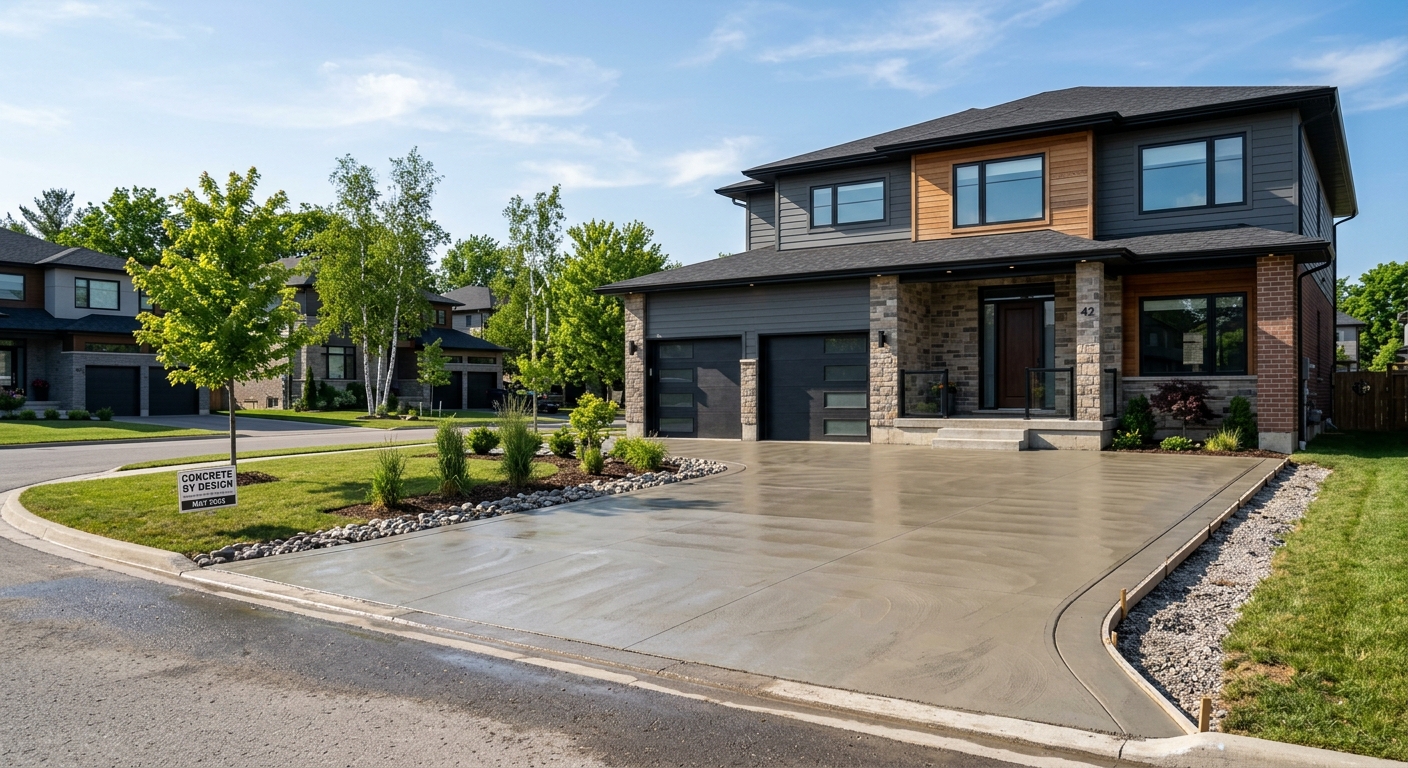
Concrete work options and costs in Bannerman
Bannerman is a small Alberta community (population 3,049 in 2021; Statistics Canada, 2021 Census) where homeowners typically invest in durable exterior surfaces—especially driveways, patios and walkways that need to handle Calgary-area freeze–thaw cycles. In this part of the Calgary economic region, the housing stock commonly includes single-detached homes, which drives steady demand for concrete flatwork: a well-built driveway and patio are often part of the “keep it maintenance-free” approach for aging lots and newly built houses.
Pricing in Bannerman generally tracks the broader Calgary market. The climate is the big reason: Alberta’s design frost depth is deep enough that footings and any frost-susceptible work must be engineered to bear on undisturbed soil below that depth to resist frost heave. Then, frequent freeze–thaw cycles push contractors to use air-entrained mixes, control joints, and correct curing. On top of that, the practical exterior pour season can be shorter than in milder provinces—so cold-weather placement (insulated blankets, sometimes heat) can add labour and material cost.
You’ll see stronger trade demand in newer residential pockets around the Bannerman area where lots are still being developed and service upgrades happen. If you’re comparing options, a standard broom-finished driveway is usually the most cost-predictable, while stamped or exposed aggregate surfaces cost more but can reduce the “upgrade itch” by adding curb appeal.
Below is a practical comparison of common concrete projects and what homeowners in Bannerman typically budget.
| Application |
Typical Size |
Key Spec |
Finish Option |
Price Range |
| Concrete driveway (standard broom finish) |
400–600 sq. ft. |
Air-entrained exterior mix, compacted granular base, control joints |
Broom finish |
$12,000–$18,000 |
| Exposed aggregate driveway |
400–600 sq. ft. |
Air-entrained mix, adequate paste removal, densified curing |
Exposed aggregate finish |
$15,000–$22,000 |
| Stamped concrete driveway or patio |
300–600 sq. ft. |
Air-entrained mix, integral colour, release agent, jointing plan |
Stamped pattern (e.g., ashlar/stone) |
$15,000–$26,000 |
| Plain concrete patio or walkway |
200–400 sq. ft. |
Air-entrained exterior mix, proper base and edging |
Plain finish (broom/steel trowel + light texture) |
$5,000–$9,000 |
| Garage floor (interior slab) |
400–700 sq. ft. |
Vapour barrier (where specified), thicker slab for vehicle loads |
Plain broom finish |
$6,000–$12,000 |
| Foundation footings (structural, below frost) |
Approx. 40–90 linear ft. (varies by design) |
Reinforced concrete footings designed for local frost depth |
Structural concrete (no decorative finish) |
$28,000–$45,000 |
Prices are estimates only and vary by project scope, site access and material selection.
What affects the price of concrete work in Bannerman
Homeowners in Bannerman can see concrete quotes swing by roughly 30–50% for the “same” job, and it usually comes down to engineering details and how much preparation is included. Two contractors may both quote a 20 x 24 patio, but one includes proper granular base prep to the correct frost-and-subgrade condition, the right air-entrainment spec, and a jointing/sealing plan—while the other assumes “we’ll pour and hope.” In a freeze–thaw climate like Calgary’s, those differences aren’t cosmetic; they directly affect how long the slab stays flat and how resistant it is to scaling and spalling.
Frost depth and freeze–thaw cycles dictate the spec in this region: exterior footings and frost-susceptible elements must extend below the design frost depth (about 1.2 m, roughly 4 ft, in this market) to prevent frost heave. Exterior slabs also need air-entrained concrete mixes to survive repeated cycles. Cold-weather placement further changes cost because the pour season can be tighter; cold-weather curing precautions (insulated blankets and sometimes supplemental heating) help concrete gain strength without surface scaling. Finally, de-icing salt accelerates surface deterioration—sealing is often the difference between “looks fine” and “starts shedding chips.”
In Bannerman, a driveway placed on saturated soil will cost more because excavation and granular replacement increase material and labour. Conversely, a straightforward replacement over prepared subgrade (minimal excavation, good truck access) can keep you closer to the lower end of local bands—like driveway budgets around $12,000–$18,000. For decorative work, stamped or exposed aggregate often lands higher (commonly $15,000–$26,000 for typical stamped projects) because labour-intensive finishing and materials (colour, stamps, release systems) add up.
| Price Factor |
Why It Matters |
Cost Impact |
| Frost line depth |
Determines footing depth and form height |
More excavation and concrete volume can push structural work toward the upper end of foundation/footings budgets |
| Site preparation |
Excavation, grading, compacted granular base |
Unfavourable soils or poor access increases labour and granular haul/placement time |
| Reinforcement |
Rebar or wire mesh requirement |
Upgrades for vehicle loads or larger spans add materials and tying time |
| Mix design |
Air-entrainment and compressive strength spec |
Correct freeze–thaw durability specs can add a modest material cost but prevents expensive failures later |
| Finish type |
Broom vs. stamped vs. exposed aggregate |
Stamped/exposed finishes add labour time, colour systems, and specialised crews |
| Pour size and concrete truck access to site |
Crane/pump needs and pour efficiency |
Pumping or extra deliveries raise cost quickly on larger or tight lots |
| Cold-weather curing precautions |
Heating and blankets |
Late-season pours often require additional day(s) of protection to meet curing targets |
| Control joint pattern and sealing cost |
Limits random cracking; sealer repels de-icing salt impacts |
Proper jointing and sealing can add line-item cost but typically reduces long-term patching |
Permits & regulations in Alberta
In Alberta, structural concrete work—think foundation footings, foundation walls, and grade beams—normally requires a building permit and often engineered drawings that get reviewed by the municipality. Concrete flatwork (patios, walkways, and driveways) usually does not require a permit on its own, but it can require municipal approval if it changes lot grading, impacts drainage, exceeds impervious surface coverage limits, or encroaches on municipal right-of-way. Because rules can vary by how your property drains and where the slab sits, it’s smart to confirm before excavation.
For homeowners in Bannerman, the best “step-by-step” verification is to ask for three things before signing: (1) the contractor’s proof of liability insurance, (2) proof of WSIB/WCB coverage (depending on how they operate), and (3) the right-to-do-the-work evidence for trades involved in the project scope. Then, check Alberta-facing information: use the online registry sources available for business and contractor status (if the contractor is registered under the correct trade/business), and always request a current certificate of insurance with your project name/insured details.
Before you break ground, request a written scope that clearly states who pulls permits (when needed), whether engineering is included for structural components, and whether disposal and hauling are part of the quote. With footings and foundations, you should also expect the contractor to follow the engineered plan dimensions and rebar detailing—because the cost difference between “good enough” and “engineered correctly” is exactly where frost protection matters most.
Getting concrete right in Bannerman's freeze-thaw climate
Bannerman sits in a climate where freeze–thaw cycles punish weak concrete specifications and shortcuts. The most common failure I see is spalling—surface scaling and chipping—usually linked to inadequate air-entrainment, poor base preparation, rushed curing, or missing control joints. To spec the job correctly, start with base prep: compacted granular sub-base to the right depth for your soil and local frost considerations, with proper drainage away from the slab. Then focus on mix design: exterior concrete should be air-entrained (typically 5–7% air content for exterior flatwork) and meet a minimum 32 MPa compressive strength so it can develop durability in winter conditions.
Control joints are next. You want a joint layout that limits random cracking by providing planned crack points, often at a spacing pattern that aligns with common ACI practices for slabs-on-grade. Curing follows: minimum 7-day curing under proper conditions, and in cold weather that may mean insulated blankets or temporary heating to keep the slab from freezing before it reaches adequate early strength. Lastly, add sealing: a penetrating sealer applied about 28 days post-pour helps repel de-icing salts and reduces surface deterioration during winter.
Here’s a cost reality: a basic broom-finished driveway might land around the $12,000–$18,000 range, but if you choose stamped concrete (often $15,000–$26,000), the extra dollars are justified only when the contractor still hits the same structural-quality basics—air-entrained mix, correct base, joints, and proper curing. Decorative top layers don’t fix a weak slab.
| Spec |
Why It Matters in Bannerman |
What to Ask For |
Impact if Skipped |
| Compacted granular base (depth?) |
Stable support reduces settlement and helps resist frost movement |
Documented granular depth and compaction method; confirm drainage and subgrade condition |
Uneven slab, premature cracking, and edge deterioration |
| Air-entrained concrete mix (target air %?) |
Improves freeze–thaw durability for exterior exposure |
Air content target typically 5–7% for exterior flatwork (per mix design) |
Spalling and scaling in winter, especially where salt is used |
| Compressive strength (MPa rating) |
Ensures the slab reaches adequate performance for cold conditions |
Minimum 32 MPa at specified curing age, stated in the contract |
Reduced strength gain and higher risk of surface and structural distress |
| Control joints (spacing per ACI guidelines) |
Controls where cracks form during shrinkage and temperature swings |
Joint spacing and saw-cut timing plan included in scope |
Random cracking and repairs sooner |
| Minimum 7-day curing period |
Strength development is critical before freeze risk |
Cold-weather curing plan; blankets/heating if temps require it |
Surface scaling, weaker bond, and long-term deterioration |
| Penetrating sealer (when applied after cure) |
Helps protect against de-icing salts and moisture ingress |
Sealer application after cure (about 28 days) with product details |
Faster salt-related spalling and more frequent patching |
How to choose a concrete work contractor in Bannerman
Choosing a concrete contractor in Bannerman is mostly about verifying quality systems—not just the final number. In Alberta, you should confirm the contractor carries liability insurance and has proper WSIB/WCB coverage (as applicable to their business structure and crew). To check, ask for a current certificate of insurance before work starts—ensure it matches the contractor’s legal name and that it indicates they have coverage relevant to general construction operations. For WSIB/WCB, request a clearance or proof document and keep it on file; if they can’t provide it, pause the decision.
Next, get 2–3 itemised written quotes. I recommend you require a line-by-line breakdown (labour, concrete supply, excavation/grading, rebar/mesh, forms, finishing labour, curing protection, sealing, and disposal). A good quote will list what’s excluded (for example: landscaping restoration, haul-away beyond a stated allowance, or permit fees when required). For foundation footings and other structural work, insist that engineered specs are included where needed and that the scope follows the plan dimensions.
Warranty matters: ask for workmanship warranty length and whether manufacturer warranties on concrete-related products (like sealers) apply to you and are transferable. For payment, never do a large upfront deposit—aim for no more than about 10–15% to start, then hold back a portion until the job is complete and cleaned up. Finally, demand a start date and completion estimate in writing, because late-season pours can require additional curing protection.
- Ask what mix design will be used (air entrainment and strength) and ensure it’s written in the quote.
- Confirm base preparation scope includes excavation, grading, and compacted granular base.
- Request reinforcement details (rebar vs. wire mesh, size, spacing, and where used).
- Verify jointing plan: saw-cut timing and control joint spacing approach.
- Ask how curing will be handled in cold weather (blankets/heating plan and expected temperature thresholds).
- Confirm whether sealing is included and when it will be applied (typically after cure).
- Check if disposal/hauling of excess material is included or excluded.
- Confirm concrete truck access plan (pump required or not; how placement is managed).
- Ask for past projects in cold-weather Edmonton/Calgary-area conditions, not just summer installs.
- Get warranty terms in writing and ask who you contact if there’s a defect.
- Use an itemised quote to compare like-for-like (same thickness, same finish, same reinforcement).
- Pay based on milestones, and keep a holdback until final walkthrough and surface protection are complete.
Red flags in Bannerman: crews who won’t specify air-entrainment and curing protection, quotes that are “lump sum” with no base depth or joint plan, contractors who require large upfront payments (well above 10–15%), vague timelines that ignore cold-weather curing needs, and “we always do it the same way” answers that don’t acknowledge frost and freeze–thaw performance.
Frequently asked questions — concrete work in Bannerman
Do I need a permit for concrete work in Alberta?
In Alberta, structural concrete work—like foundation footings, foundation walls, and grade beams—typically requires a building permit and often engineered drawings reviewed by the municipality. Plain concrete flatwork such as patios, walkways, and standard driveways often does not require a permit by default, but you can still need municipal approval if your project affects lot grading, drainage, or impervious surface limits, or if it encroaches on the municipal right-of-way. For Bannerman homeowners, the practical step is to call the local planning/building office before you excavate, especially if you’re changing slopes, adding swales, or extending paving closer to the street. Also verify the contractor’s liability insurance and WSIB/WCB coverage before work begins, so you’re protected if something goes wrong.
Concrete vs pavers for a patio in Bannerman?
Concrete and pavers both work in Bannerman, but they fail differently in freeze–thaw. Concrete patio slabs—when built with proper compacted granular base and air-entrained mix—can be very durable and easier to maintain, especially if the contractor includes control joints and a sealing plan. Pavers can perform well too, but they often require excellent base drainage and consistent bedding sand so the interlock stays solid as soils move. Cost-wise, a plain concrete patio commonly falls around $5,000–$9,000 for typical sizes, while pavers can vary widely based on stone type and labour for base and edge restraints. If you salt heavily in winter, a sealed concrete patio tends to tolerate salt exposure better over time. For either option, make sure the contractor explains the base build-up and joint/drainage approach—those details matter more than the surface material.
How long does a concrete driveway last?
A properly built concrete driveway in the Calgary region often lasts decades, but “how long” depends on specs and installation quality. In Bannerman’s freeze–thaw climate, the key durability drivers are air-entrainment for exterior exposure, correct base compaction, well-spaced control joints, and adequate curing (especially if pours happen in cool weather). Sealing can also help protect the surface from de-icing salts, reducing early scaling and spalling. If you’re comparing quotes, don’t choose based only on whether the driveway is broom-finished—choose based on whether the contractor states the air-entrained mix and curing method in writing. Typical driveway budgets often land around $12,000–$18,000 for standard broom finishes, and going decorative (stamped or exposed styles) often costs more, commonly $15,000–$26,000. The higher price is only “worth it” if the foundation quality is the same.
What is air-entrained concrete and why does it matter here?
Air-entrained concrete is designed with microscopic air bubbles that give freezing water places to expand without destroying the concrete. In Bannerman and the broader Calgary economic region, repeated freeze–thaw cycles are the reason this matters so much: if the mix isn’t air-entrained to the right target (commonly 5–7% air content for exterior flatwork), the slab can experience surface scaling and spalling. That often shows up in winter and early spring where de-icing salts are used. When you compare quotes, ask the contractor to specify the mix design including air-entrainment and minimum compressive strength. Also confirm curing protection in cold weather (blankets or heating when required), because early freezing can damage surface performance even if the mix is technically correct. In short: air-entrainment is a durability spec, not an optional upgrade.
How do I prepare the base for a concrete slab?
Base preparation is the part most homeowners can’t see after the pour, but it’s where long-term performance is decided. For a Bannerman slab, the contractor should excavate to the planned depth, remove unsuitable topsoil, grade to line and slope, and place a compacted granular sub-base. The granular base depth and thickness should be based on your soil and the project type, with compaction verified through accepted methods. In this region’s frost climate (design frost depth around 1.2 m), you can’t treat the slab as “just a thin layer on dirt.” Ask for the base spec in the written quote: granular type, approximate depth, compaction approach, and how drainage will be handled away from the slab. If the contractor won’t discuss base build-up, control joints, and curing—especially for exterior work—your slab is at higher risk of settlement cracks or frost-related movement.
How do I compare concrete quotes?
Start by comparing apples to apples. Ask each contractor for an itemised quote that breaks out labour and materials (excavation/grading, granular base, reinforcement, concrete supply, finishing, curing protection, disposal, and sealing if included). Make sure all quotes specify the same thickness, same finish (broom vs stamped/exposed), and—critically—air-entrained mix requirements for exterior exposure. Confirm control joint spacing and saw-cut timing, and ask how cold-weather curing is handled. Compare whether engineering/permits are included when the work is structural; structural footings and foundation elements generally require permits and often engineered drawings. Use price ranges as a sanity check: a standard driveway often budgets around $12,000–$18,000, while decorative stamped concrete frequently lands higher, commonly $15,000–$26,000. If one quote is dramatically lower, ask what they’re excluding—because the savings are usually in the base, the mix spec, or the curing plan.