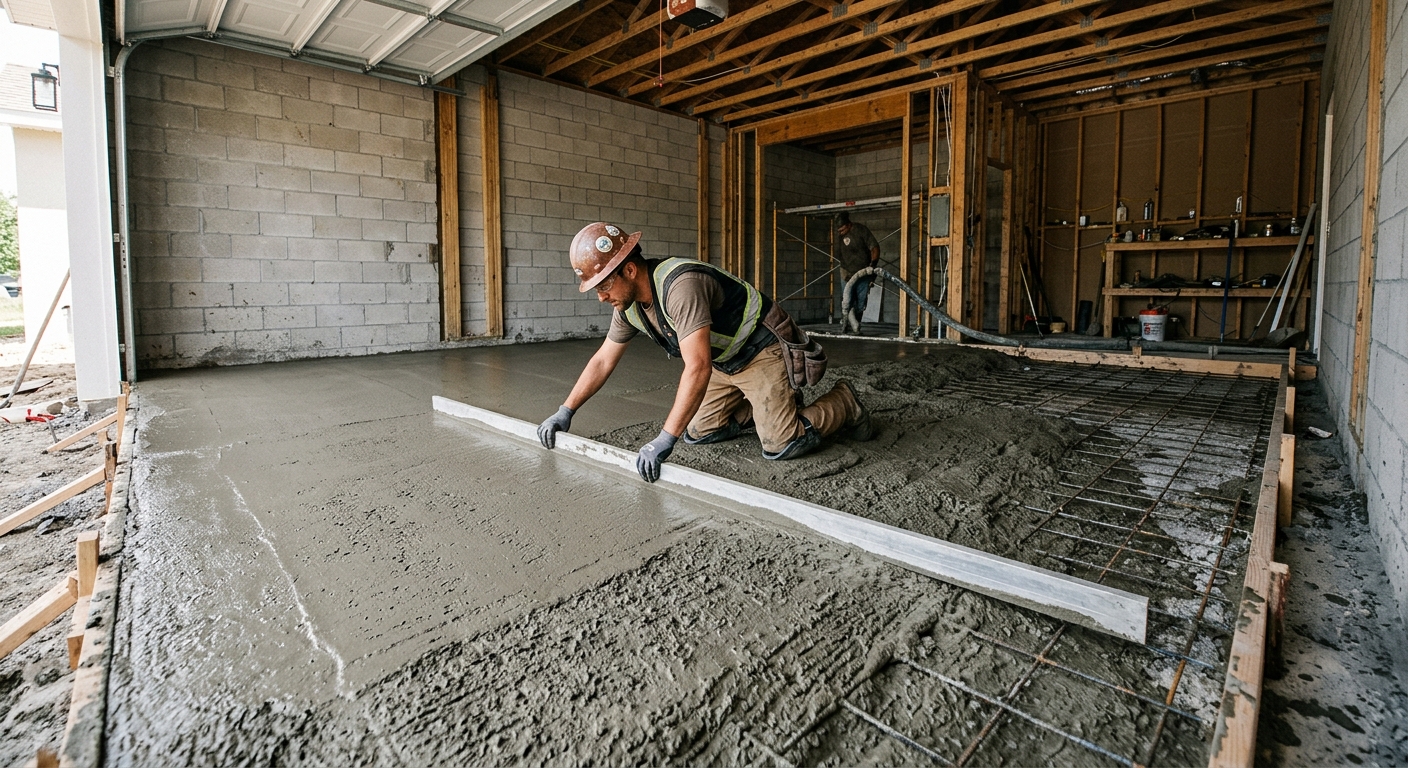
Concrete work options and costs in Tuxedo Park
Tuxedo Park, Alberta is a smaller community within Calgary, and that matters for concrete pricing because crews and concrete trucks often have to schedule around both local demand and citywide callouts. With a population of 5,165 (Statistics Canada, 2021 Census), you’ll see a steady flow of residential flatwork tied to the area’s ongoing home maintenance and upgrades. In Tuxedo Park, most concrete work is driven by typical owner needs—driveways, garage floors, patios, walkways, and structural foundation work—rather than large commercial builds.
Concrete in the Calgary region is costed differently than in milder climates because cold continental weather pushes frost depth and freeze–thaw durability requirements. Local engineering practice is based on a design frost depth of about 1.2 m (roughly 4 ft), so exterior footings for homes, garages, decks, and retaining structures must bear on undisturbed soil below that depth. Frequent freeze–thaw cycles also require air-entrained mixes, granular base prep, and better joint planning to limit cracking and spalling. Finally, the practical pour season for exterior slabs is shorter, and cold-weather curing precautions (insulated blankets and sometimes heated enclosures) can add labour and materials costs—especially for late-fall or early-spring schedules when cure conditions are tighter.
In Tuxedo Park, demand tends to be especially strong around older established streets where homeowners refresh driveways and front patios before winter. If you’re comparing options, the table below gives typical ranges to help you budget before site measurement and final design.
| Application |
Typical Size |
Key Spec |
Finish Option |
Price Range |
| Concrete driveway (standard broom finish) |
480 sq ft (24 ft x 20 ft) |
Air-entrained exterior mix, granular base, control joints |
Broom finish, light broom texture |
$12,000–$18,000 |
| Exposed aggregate driveway |
480 sq ft (24 ft x 20 ft) |
Engineered base, air-entrainment, proper curing and wash timing |
Exposed aggregate with broom texture blend |
$14,500–$21,500 |
| Stamped concrete driveway or patio |
320 sq ft (e.g., 16 ft x 20 ft) |
Air-entrained mix, release agent workflow, sealer system |
Stamped pattern + sealer |
$15,000–$26,000 |
| Plain concrete patio or walkway |
240 sq ft (e.g., 12 ft x 20 ft) |
Compact granular sub-base, air-entrained exterior mix |
Float/smooth or light broom finish |
$5,000–$9,000 |
| Garage floor (interior slab) |
480 sq ft (24 ft x 20 ft) |
Vapour barrier (as appropriate), fibre or mesh, proper base |
Steel trowel or light broom |
$10,500–$16,500 |
| Foundation footings (structural, below frost) |
Typical single-family home: 40–70 linear ft |
Excavate to frost depth; reinforcement per engineer; structural concrete |
Structural concrete only (no decorative finish) |
$28,000–$45,000 |
Prices are estimates only and vary by project scope, site access and material selection.
What affects the price of concrete work in Tuxedo Park
In Tuxedo Park and across the Calgary region, it’s common to see quotes for the “same” concrete project land 30–50% apart. That gap usually comes from differences in how contractors engineer the base, specify the mix, and manage curing—not just the concrete truck price. Labour rates and crew scheduling across the wider Calgary market also affect availability, and when weather windows tighten, the cost of meeting proper curing conditions rises quickly.
The biggest driver is frost and freeze–thaw performance. Footings must extend below the design frost depth to prevent frost heave and seasonal movement. In Alberta, that typically means deeper excavation and larger footing volumes than homeowners expect. Exterior slabs also require air-entrained concrete mixes to survive repeated freeze–thaw cycles, and we use well-spaced control joints to control where cracks happen. On top of that, the shorter exterior pour season means winter-grade placement practices—insulated blankets, temperature monitoring, and sometimes temporary heating—can add cost if you’re working near cold snaps.
De-icing practices matter, too. Calgary-area roads and sidewalks often see salt, and salt accelerates surface scaling if the concrete isn’t properly air-entrained and cured. Locally, that’s why a properly specified driveway built for the long term can cost closer to the higher end of the $12,000–$18,000 range. Likewise, stamped work in the $15,000–$26,000 range is usually justified by extra labour time, finishing workflow, and sealer/colour system needs—particularly where the finish area is larger or the site is tight.
For a practical example: if you upgrade from a plain patio to a stamped patio, you may pay roughly $3,000–$7,000 more depending on size and pattern detail. That difference is real—stamping, curing management, and edging/detail work take time and skill, and they’re what protect the surface through Alberta winters.
| Price Factor |
Why It Matters |
Cost Impact |
| Frost line depth |
Determines footing depth and form height |
Deeper excavation and more concrete/steel can increase foundation scope materially |
| Site preparation |
Excavation, grading, compacted granular base |
Hard digging, hauling, and higher base thickness drive labour and material costs |
| Reinforcement |
Rebar or wire mesh requirement |
Mesh vs engineered rebar patterns can change material and placement time |
| Mix design |
Air-entrainment and compressive strength spec |
Exterior-rated mixes and higher specs typically cost more but reduce spalling risk |
| Finish type |
Broom vs. stamped vs. exposed aggregate |
Decorative finishes add labour, consumables, and tighter curing workflow |
| Pour size and concrete truck access to site |
Impacts haul time, number of loads, and crew efficiency |
Limited access can force smaller pours or extra handling, increasing labour |
| Cold-weather curing precautions |
Heating and blankets |
Additional equipment and monitoring can add significant costs near shoulder seasons |
| Control joint pattern and sealing cost |
Controls cracking and protects against de-icing salt damage |
Better joint planning and quality sealing add budget but improve long-term surface durability |
Permits & regulations in Alberta
In Alberta, structural concrete work typically requires a building permit. That includes footings, foundation walls, grade beams, and any engineered structural elements tied to the building’s load path. In many cases, engineered drawings are reviewed as part of the permit process. For concrete flatwork—patios, walkways, driveways—the permit requirement is often not automatic, and many projects proceed without a permit. However, you may still need approval if the work affects lot grading, involves changes that impact drainage, or if you’re adjusting impervious surface coverage rules or working near municipal right-of-way conditions.
For your Tuxedo Park project, the best approach is simple: confirm with the local authority before excavation so you’re not caught mid-pour. Also verify your contractor is properly insured. A reputable crew will carry liability insurance and WSIB/WCB coverage (or the appropriate coverage for their business structure). Ask for proof and make sure the certificate is current and matches the legal company name on your contract.
Step-by-step contractor verification: (1) look up the contractor’s business and licensing details through the relevant provincial online sources that list active credentials; (2) request a certificate of insurance and confirm coverage limits, expiry date, and that you (or the property owner) are noted where required; (3) ask for WSIB/WCB clearance documents; and (4) verify they’ve completed similar-scale jobs in Calgary-area conditions—especially exterior flatwork designed for freeze–thaw durability. For structural work, insist on clarity about engineered design, inspection steps, and which drawings are included in the permit package.
Getting concrete right in Tuxedo Park's freeze-thaw climate
Concrete failure in Tuxedo Park is usually a freeze–thaw story. When moisture gets into the slab or underlying base and then freezes, it can expand and damage the paste, leading to surface scaling (spalling), rough texture, and premature cracking. The fix starts before the pour: base prep. A properly compacted granular sub-base helps control moisture movement and provides uniform support. Second is mix design. Exterior flatwork should use an air-entrained mix (commonly 5–7% air content for durable exterior performance) and meet at least a 32 MPa minimum compressive strength so the concrete resists repeated expansion and contraction cycles. Third is control joints. If joints aren’t planned and cut on the right schedule and spacing, cracking is more likely to occur randomly where it’s hardest to patch.
Curing is where many homeowners unknowingly lose long-term durability. In Calgary’s shorter exterior pour season, cold-weather placement requires minimum 7-day curing under proper conditions; when it’s near freezing, crews should use insulated blankets and temperature protection to help concrete reach the necessary early strength. Finally, sealing is critical for durability against de-icing salt: a penetrating sealer is typically applied after full cure (about 28 days post-pour) to help repel salts and water.
If you compare options: a broom-finished driveway is typically at the more affordable end of the $12,000–$18,000 range because it’s faster to finish. Stamped concrete can move toward $15,000–$26,000 because it needs a more controlled finishing workflow and careful curing management to preserve crisp edges and prevent premature wear. That price difference is justified when it’s tied to correct base, correct air-entrainment, and the right jointing plan—not just the stamp itself.
| Spec |
Why It Matters in Tuxedo Park |
What to Ask For |
Impact if Skipped |
| Compacted granular base (depth?) |
Supports the slab and limits moisture movement under freeze–thaw cycles |
Base depth and compaction method tied to site conditions |
Settlement and cracking; accelerated scaling in wet seasons |
| Air-entrained concrete mix (target air %?) |
Creates freeze–thaw resistance by managing ice expansion in the paste |
Specify exterior air content (commonly 5–7% for exterior flatwork) |
High risk of spalling and surface scaling in Alberta winters |
| Compressive strength (MPa rating) |
Ensures structural and surface durability under traffic and temperature swings |
Minimum 32 MPa requirement (or higher if engineer specifies) |
Lower durability, increased wear, and earlier surface breakdown |
| Control joints (spacing per ACI guidelines) |
Controls where shrinkage and movement cracks occur |
Joint spacing and cutting schedule for your slab dimensions |
Random cracking and more expensive cosmetic and repair work |
| Minimum 7-day curing period |
Develops early strength and protects against cold-weather damage |
How they protect curing when temperatures drop (blankets/heating) |
Surface scaling and weaker long-term performance |
| Penetrating sealer (when applied after cure) |
Repels de-icing salts and water to slow deterioration |
Sealer type and timing after cure (typically after 28 days) |
Faster salt damage and more frequent re-surfacing |
How to choose a concrete work contractor in Tuxedo Park
Start with proof, not promises. In Alberta, verify that the contractor has the correct credentials for the work they’re doing, carries liability insurance, and has WSIB/WCB coverage. How to check: (1) request a current certificate of insurance and confirm the policy is active through your scheduled pour date; (2) ask for WSIB/WCB clearance documents and confirm coverage matches the legal business name on the quote; and (3) confirm their registry/credential status using the appropriate provincial online lookup tools for contractor licensing. For concrete flatwork and foundations, you want a company that routinely works in Calgary-area freeze–thaw conditions.
Next, get 2–3 itemised written quotes. I recommend you ask for a breakdown that separates labour, excavation/site prep, formwork, reinforcement, concrete supply, and finishing/sealer. Avoid quotes that don’t specify what mix spec they’ll use or what the base depth/compaction will be. Also confirm whether permits are included where required, and whether disposal/haul-away is included if they’re removing excess material.
Warranty matters—ask for workmanship warranty length, plus how long the product/manufacturer warranty lasts and whether it’s transferable to you. Payment should be controlled: never pay more than 10–15% upfront, and hold back a portion until the final clean-up, joint sealing (where included), and final walkthrough are complete.
Finally, lock the timeline in writing: request a target start date and completion estimate, and ask how they handle weather delays in Calgary’s cold snaps.
- Ask what air content and concrete strength spec they will use for exterior work.
- Confirm base thickness and compaction targets before concrete is ordered.
- Require details on reinforcement (mesh vs rebar, and why) where applicable.
- Get the control joint plan: spacing, layout, and cutting schedule.
- Ask how they protect curing in cold weather (blankets/heating, temperature monitoring).
- Check whether de-icing salt resistance is addressed with proper mix + curing + sealing.
- Make sure equipment and access are reviewed (truck reach, staging area, protection of landscaping).
- Ensure the quote specifies disposal/haul-away if soil removal is required.
- Confirm permit responsibility for foundations/structural work (not just “we’ll handle it”).
- Request an itemised labour/material breakdown rather than a single lump sum.
- Verify warranty terms in writing and whether it covers cracking/spalling under normal conditions.
- Keep payment staged: small deposit, progress payments, and a holdback at substantial completion.
Concrete red flags in Tuxedo Park: crews who won’t discuss air-entrainment specs, no clear plan for base compaction depth, cutting corners on curing protection in cold weather, vague joint spacing that “depends,” and quotes that don’t include disposal/site prep details—then the bill grows after excavation.
Frequently asked questions — concrete work in Tuxedo Park
How much does concrete work cost in Tuxedo Park?
Concrete pricing in Tuxedo Park typically follows the Calgary-area bands we use for budgeting. For driveways and exterior slabs, many homeowners land around $12,000–$18,000 for a standard broom-finished driveway, depending on size, base depth, and access for concrete trucks. Plain patios and walkways often price around $5,000–$9,000 for typical residential footprints. Foundation/footings (structural, below frost) are usually in the $28,000–$45,000 range because Alberta’s frost requirements mean deeper excavation and higher engineered volumes. If you choose decorative finishes, stamped concrete commonly sits in $15,000–$26,000. The wide ranges reflect the reality that Calgary freeze–thaw and curing conditions influence how we build for durability, not just how it looks on day one. (Statistics Canada, 2021 Census)
How deep must footings be for Tuxedo Park's frost line?
For Tuxedo Park and the Calgary region, footings are designed around a frost depth of about 1.2 m (roughly 4 ft). Practically, that means excavating and building footings so the structural bearing is below the design frost depth to reduce frost heave and seasonal movement. The exact required depth on your property depends on geotechnical conditions, soil type, and the engineered foundation design, but you should expect excavation to reach below that frost level for typical residential structural work. This is one reason foundation costs often feel higher than in warmer parts of Canada—more excavation and concrete volume are involved. If you’re comparing quotes, ask each contractor what frost-depth assumption they’re using and whether it’s backed by engineering for your specific design.
Why does concrete crack in Tuxedo Park and how is it prevented?
Cracking in Tuxedo Park is usually a combination of shrinkage, temperature movement, and freeze–thaw exposure—not “bad luck.” Alberta winters repeatedly freeze and thaw moisture in and around slabs, which can widen minor defects if the concrete wasn’t engineered correctly. Prevention starts with a properly compacted granular base, because uniform support reduces movement. Second is specifying exterior air-entrained concrete and using correct curing so the paste develops strength before cold weather stresses it. Third is control joints: joints are engineered so cracking happens at planned locations rather than randomly across a driveway or walkway. Finally, sealing after proper cure helps repel water and de-icing salts, reducing surface deterioration. In practice, the best prevention is technical—air content, joints, and curing—not cosmetic patching after cracks appear.
Stamped vs broom-finish concrete — cost difference?
Stamped concrete usually costs more than broom-finished concrete because it takes extra labour, materials, and tighter finishing control. A standard broom-finished driveway often fits within $12,000–$18,000, while stamped decorative driveways or patios commonly fall around $15,000–$26,000, depending on size, pattern complexity, and detailing. The price jump isn’t just the stamp itself—decorative work requires disciplined curing timing, careful edge finishing, and a sealer system appropriate for Alberta de-icing conditions. If your site is also tight (limited truck access, steep slopes, landscaping to protect), decorative finishing time increases and so does labour. If a quote claims a stamped job is “only slightly more,” ask whether it includes the same base prep and air-entrained mix specs you’d get with plain work, because durability comes from those details.
When is the best time to pour concrete in Tuxedo Park?
The best time to pour concrete in Tuxedo Park is when temperatures support proper curing and finishing—typically in the warmer months and early fall—before cold snaps and freeze conditions become unpredictable. Calgary’s shorter exterior pour season means late-season pours require more safeguards, such as insulated blankets, temperature monitoring, and sometimes temporary heating to reach early strength safely. If you must pour near freezing conditions, the project cost can increase because those cold-weather curing precautions take labour, equipment, and planning. A contractor should outline their weather plan in the quote and explain how they’ll keep the slab curing correctly for at least 7 days. For foundations/structural elements, sequencing and inspection timelines also matter. In Alberta, rushing curing is one of the fastest ways to invite scaling and long-term surface damage.
How long does concrete take to cure?
Concrete curing happens in stages. You’ll often hear “28 days” for full cure, but you still need adequate early curing for durability. For exterior slabs in Tuxedo Park, plan for a minimum 7-day curing period under proper conditions so the concrete reaches early strength before it’s exposed to freeze–thaw stress. In cold weather, curing protection (insulation blankets and temperature control) is essential—without it, surface scaling and weakness can develop even if the slab “looks fine” at first. After that, sealing is typically scheduled around 28 days post-pour for penetrating sealers, since sealing too early can trap moisture and reduce performance. When discussing your project, ask your contractor to specify the curing steps and weather protection plan, not just the pour date.