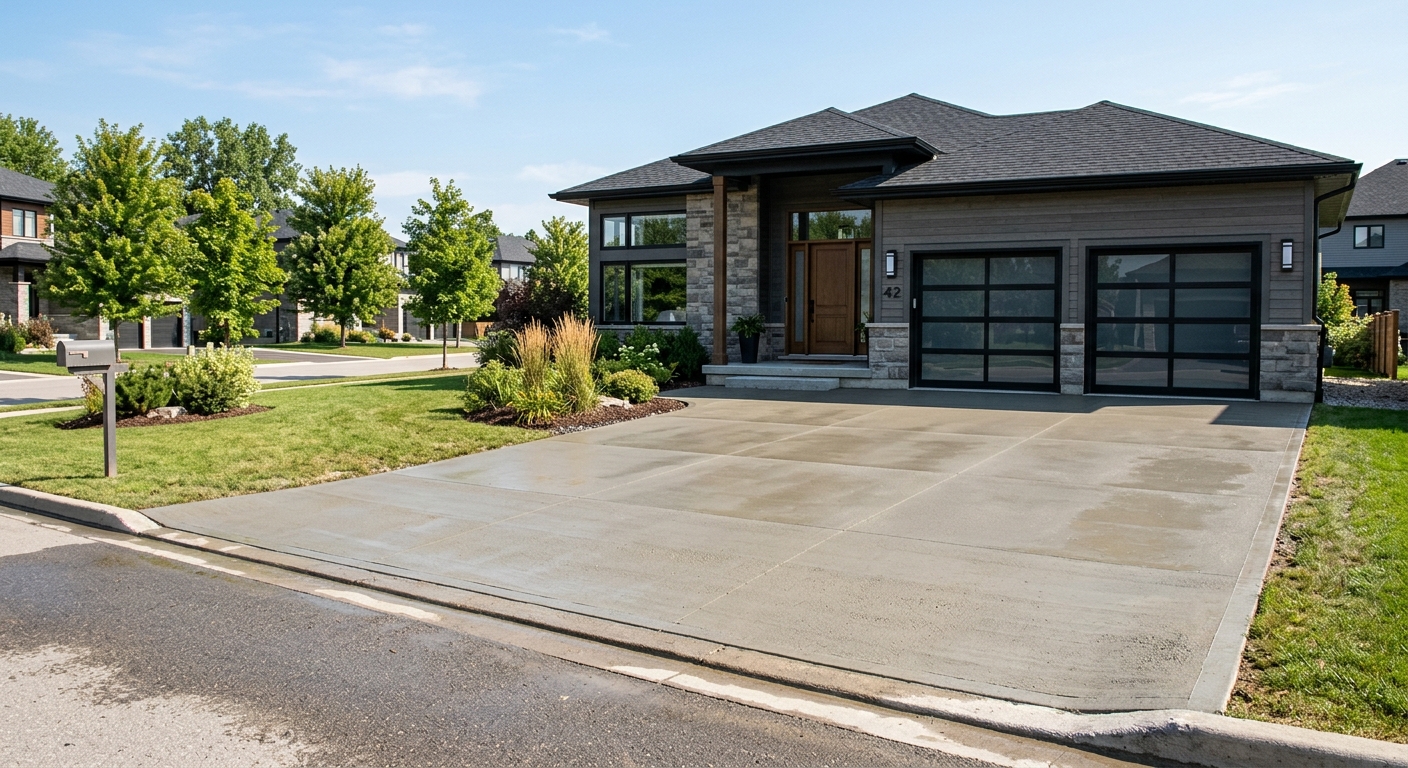
Concrete work options and costs in Prince Charles
Concrete work in Prince Charles, Alberta is mostly about building for real winter conditions—cold nights, repeated freeze–thaw cycles, and a frost depth that forces footings to go deep. Prince Charles has a small population (1,276 in 2021) (Statistics Canada, 2021 Census), and that matters for homeowner experience: crew availability can be tighter than in larger Calgary neighbourhoods, so scheduling earlier often helps protect pricing. The broader Calgary area also contains many single-detached homes that drive demand for driveways, patios, walkways, and garages—so competition for qualified crews is real when weather turns. In this region, concrete pricing tends to be higher than milder provinces because the engineered design frost depth (about 1.2 m in practice) means more excavation and higher footing volumes for foundations, garages, and retaining work.
On top of excavation, the Calgary market has to plan around a shorter practical exterior pour season. For exterior slabs, contractors typically rely on air-entrained mixes and stronger cold-weather curing controls (insulated blankets, temperature management) to avoid scaling and durability issues later. If your property in Prince Charles is near the busier residential pockets—often where homeowners are expanding driveways or adding backyard pads—work tends to move faster once grades and access are confirmed.
Below are common project types and realistic starting ranges you can use to compare quotes side-by-side.
| Application |
Typical Size |
Key Spec |
Finish Option |
Price Range |
| Concrete driveway (standard broom finish) |
24 ft x 10 ft (240 sq ft) |
4 in slab, air-entrained mix, compacted granular base, control joints |
Broom finish |
$12,000–$18,000 |
| Exposed aggregate driveway |
24 ft x 10 ft (240 sq ft) |
4 in slab, air-entrained mix, base prep, surface retarder and wash |
Exposed aggregate |
$14,000–$20,500 |
| Stamped concrete driveway or patio |
18 ft x 12 ft (216 sq ft) |
4 in slab, air-entrained mix, integral colour or hardener, release system |
Stamped pattern |
$15,000–$26,000 |
| Plain concrete patio or walkway |
12 ft x 12 ft (144 sq ft) |
4 in slab, air-entrained mix, compacted base, joints |
Float and broom edges |
$5,000–$9,000 |
| Garage floor (interior slab) |
22 ft x 20 ft (440 sq ft) |
4 in slab, vapour barrier (if included), trowel finish, jointing |
Industrial broom or light trowel |
$10,500–$16,500 |
| Foundation footings (structural, below frost) |
Typical single-detached house |
Engineered rebar layout, excavate to below design frost depth, proper base & concrete strength |
Structural concrete/formed footings |
$28,000–$45,000 |
Prices are estimates only and vary by project scope, site access and material selection.
What affects the price of concrete work in Prince Charles
In Prince Charles and the wider Calgary area, two contractors can quote the “same” concrete job and still land 30–50% apart. The big drivers are engineered specs (frost depth and reinforcement), the quality of base preparation, and how confidently the crew can place and cure concrete in cold snaps. Calgary’s freeze–thaw cycle affects everything: exterior slabs need air-entrained concrete mixes to survive repeated expansion and contraction, and footings must extend below the design frost depth (in Alberta this is commonly up to about 2.4 m depending on site conditions and engineering) to prevent frost heave and seasonal movement. Those requirements raise excavation and formwork quantities, which is a direct cost.
Another pricing lever is curing time and winter placement. Cold-weather curing often means insulated blankets and temperature monitoring to keep the concrete on track, and the practical exterior pour season is shorter here than in milder provinces. If your driveway or patio is scheduled late fall or early spring, winter-grade controls can add cost—and rushing curing increases the chance of scaling and long-term spalling, especially with de-icing salt.
Local site conditions in Prince Charles also matter. A yard with poor drainage or soft topsoil usually requires deeper or wider excavation and more granular base, pushing driveway costs toward the top end of the $12,000–$18,000 band. Conversely, a simple, flat access route with firm subgrade may keep a patio in the $5,000–$9,000 band. Finally, housing stock age plays a role: older lots sometimes have buried utilities, older grading patterns, and more tight excavation conditions—those can add labour even before the first truck arrives.
| Price Factor |
Why It Matters |
Cost Impact |
| Frost line depth — determines footing depth and form height |
Footings must bear below the design frost depth to prevent heave |
Higher excavation and concrete volume; can shift totals by thousands |
| Site preparation — excavation, grading, compacted granular base |
Base failure leads to settlement and cracking |
More granular and labour if soil is variable or drainage is poor |
| Reinforcement — rebar or wire mesh requirement |
Reinforcement reduces cracking and improves slab durability |
Material and placement time; often added for driveways and foundations |
| Mix design — air-entrainment and compressive strength spec |
Air-entrainment improves freeze–thaw resistance |
Winter-capable mixes may cost more but prevent costly failure |
| Finish type — broom vs. stamped vs. exposed aggregate |
Finishes require additional labour steps and materials |
Stamped and exposed surfaces typically increase price significantly |
| Pour size and concrete truck access to site |
Limited access increases time and may require pumps or tighter logistics |
Access issues can raise labour and equipment costs |
| Cold-weather curing precautions — heating and blankets |
Protects early-age strength in winter placement conditions |
Often increases costs in late fall/early spring |
| Control joint pattern and sealing cost |
Joints manage cracking; sealing reduces moisture and salt intrusion |
Proper jointing and sealer are low-cost insurance relative to repairs |
Permits & regulations in Alberta
In Alberta, structural concrete work generally needs a building permit, especially when you’re building the elements that hold up the house: footings, foundation walls, grade beams and similar load-bearing components. For many projects, you also need engineered drawings before municipal review proceeds. Concrete flatwork—patios, walkways, driveways—usually does not require a permit by itself, unless it changes lot grading, involves impervious surface/lot drainage constraints, or affects municipal right-of-way conditions (for example, work near a curb or boulevard). Because Prince Charles homeowners often deal with site grading and water runoff, it’s still smart to confirm requirements with the local authority before you break ground.
Before signing with any contractor in Prince Charles, verify three things: (1) they’re properly insured for the work, (2) they’re able to legally do the structural scopes when required, and (3) they can support their workmanship with references. Step-by-step:
- Ask for a certificate of liability insurance showing active coverage and the effective dates.
- Confirm workers’ compensation coverage (WSIB/WCB coverage as applicable) and request proof the company account is in good standing.
- For licensing or registration verification where required, look up the contractor through the Government of Alberta’s business/service registry listings (use the company’s legal name).
- For structural work, ask who stamps/handles engineering documents and ensure permits are pulled by the responsible party.
- Request 2–3 references from similar-scope concrete jobs completed nearby in similar weather conditions.
If they can’t provide insurance proof or won’t discuss permits and engineered requirements clearly, that’s a strong red flag in the Alberta concrete market.
Getting concrete right in Prince Charles's freeze-thaw climate
Concrete failures in Prince Charles usually come down to three things: poor base prep, inadequate freeze–thaw durability, and bad curing. In a cold continental climate with frequent freeze–thaw cycles, the common failure you’ll see is spalling—surface scaling and flaking—often worsened by de-icing salt. The way to prevent this is to spec the job around Alberta winter reality: (1) build a compacted granular sub-base to the right depth for local soils and frost considerations, (2) use air-entrained concrete with the correct air content for exterior exposure, (3) control where cracks are allowed to occur using a consistent joint pattern, (4) cure properly—especially in cold placement—with the right time and temperature protection, and (5) plan for sealing after the concrete has cured, so moisture and salts don’t keep penetrating.
To avoid spalling, ask specifically for air-entrainment (not “whatever the batch plant usually uses”) and confirm the mix includes the right performance target for exterior work. Control joints matter too: joints are cheaper than random cracking, and sealing complements joints by reducing water entry.
As a practical pricing example: upgrading a plain broom-finished driveway to a stamped finish is often not a “just because” change. In Prince Charles, a standard broom driveway may land around the lower-to-mid portion of $12,000–$18,000, while stamped concrete frequently moves into $15,000–$26,000. The extra cost is justified when the contractor also improves surface prep discipline, joint layout, and curing controls—because those are what protect both the appearance and the durability.
| Spec |
Why It Matters in Prince Charles |
What to Ask For |
Impact if Skipped |
| Compacted granular base (depth?) |
Supports the slab and resists frost-related movement |
Base depth plan based on soil and site conditions; compaction testing method if applicable |
Settlement, cracking and premature failure |
| Air-entrained concrete mix (target air %?) |
Protects against freeze–thaw spalling and scaling |
Exterior air content target (typically 5–7% air for many exterior flatwork specs) |
High risk of spalling in winter and rapid surface deterioration |
| Compressive strength (MPa rating) |
Ensures the slab develops enough early and long-term strength |
Minimum 32 MPa compressive strength spec and documented mix performance |
Weak concrete can crack and wear faster under traffic and salt |
| Control joints (spacing per ACI guidelines) |
Manages where cracks appear as temperatures change |
Joint spacing plan and saw-cut timing; alignment around edges |
Random cracking pattern and wider joint failure over time |
| Minimum 7-day curing period |
Builds durability before winter exposure escalates stress |
Concrete stays protected and cured for at least 7 days under proper conditions |
Reduced surface strength and higher scaling risk |
| Penetrating sealer (when applied after cure) |
Helps repel moisture and salt exposure |
Penetrating sealer applied after full cure, commonly around 28 days post-pour |
More salt/meltwater penetration, leading to spalling and rough surface wear |
How to choose a concrete work contractor in Prince Charles
Choosing the right concrete contractor in Prince Charles is mostly about verification and clarity. First, confirm they can legally and safely do the work: request proof of liability insurance (certificate of insurance), and ask for workers’ compensation coverage proof (WSIB/WCB coverage as applicable). For licensing/registration checks in Alberta, look up the company through the appropriate Government of Alberta business/service listings using the contractor’s legal name—don’t rely only on a website banner. Then, ask for references that match your project type (driveways, patios, footings) and similar weather timing so you can judge how they handle exterior curing in Calgary-area winters.
Next, get 2–3 itemised written quotes. You want labour and materials broken out so you can compare things like excavation depth, base prep scope, reinforcement type, and whether winter curing measures are included. Read the scope line by line: what’s excluded (old concrete removal, disposal, hauling, snow removal, temporary heating, landscape reinstatement)? Is the permit included where required? Finally, confirm warranty terms for workmanship and how product/manufacturer warranties are handled, including whether they’re transferable if you sell the home.
For payment, use a sensible schedule: never pay more than 10–15% upfront, and hold back part of the balance until the final inspection is complete. Also, insist on a written start date and an estimated completion timeline—weather can shift it in Alberta, but reputable contractors plan contingencies.
- Proof of liability insurance (active certificate, correct address).
- Proof of workers’ compensation coverage (WSIB/WCB as applicable).
- Clear written scope: excavation, base depth, reinforcement, and concrete thickness.
- Specified concrete mix (air-entrainment and strength targets for exterior work).
- Joint plan: spacing, saw-cut timing, and sealing expectations.
- Winter curing plan if pouring near cold weather (blankets/heating).
- Disposal included? Confirm what happens to removed spoil and old concrete.
- Site access plan: how trucks reach the work area safely.
- Settlement/grade requirements: who verifies slopes for drainage.
- Warranty length for workmanship in writing.
- Payment schedule with a holdback for completion.
- Schedule with start and finish dates stated in the contract.
In Prince Charles, watch for red flags like quotes with vague “standard concrete” wording, no mention of air-entrainment for exterior slabs, no plan for joints, skipping documented base prep, and contractors who pressure you to pay most of the job upfront.
Frequently asked questions — concrete work in Prince Charles
What causes concrete to spall in Prince Charles winters?
In Prince Charles and across Alberta, spalling is usually a freeze–thaw durability problem. When water gets into concrete pores or micro-cracks and then freezes, it expands and breaks down the surface. De-icing salt can accelerate this process by increasing the chemical attack on the surface layer. The biggest preventable cause is inadequate air-entrained concrete for exterior exposure—air bubbles give freeze–thaw stress a place to go. A second common cause is weak or poorly cured concrete placed late in the season without proper heating/blankets. Poor base prep can also contribute by letting the slab move slightly, which opens cracks and gives water a pathway. If your driveway is in the $12,000–$18,000 range, ensure your contractor specifically commits to exterior air-entrainment and curing protection rather than assuming “regular” concrete will last.
What is rebar and when is it required in Alberta?
Rebar (reinforcing steel) is steel bars embedded in concrete to carry tensile forces and control cracking in slabs and foundations. In Alberta, whether rebar is “required” depends on the structural design and engineered drawings for your specific foundation or slab, the loads (like a garage floor), and the exposure conditions. For most typical concrete flatwork—especially driveways—many specs call for reinforcement or alternative engineered solutions (like wire mesh) to improve crack control and durability over freeze–thaw cycles. For footings and foundation elements, reinforcement is almost always part of the engineered requirement because those components must resist soil movement and structural loads. In Prince Charles, where frost penetration is deeper than in milder areas, the engineering and reinforcement detailing matter because frost heave and seasonal movement can be more severe. Always ask for the reinforcement layout and confirm it matches the drawings or approved design.
How long does a concrete project take in Prince Charles?
Project duration in Prince Charles depends mainly on prep, access, and curing conditions. The actual pour and finishing can be fast, but the schedule usually includes excavation, formwork, base grading/compaction, reinforcement placement, and then concrete placement. For many exterior slabs, you may see one to several days of on-site work, followed by curing time. The practical reality is that you shouldn’t rush cure in Calgary-area conditions: Alberta work often targets at least a 7-day curing period under proper conditions before you apply full load or heavy traffic. In cold weather, contractors may need to add time for heating or insulated blankets to reach the needed early-age strength. If you’re comparing quotes around the $5,000–$9,000 band for a patio, expect a quicker turnaround than structural footings, which often require more coordination and inspection steps. Ask your contractor for a written timeline that includes curing protection, not just the day of the pour.
What is a concrete overlay and is it suited to Prince Charles?
A concrete overlay is a new surface layer built on top of an existing concrete slab. It can be a way to refresh appearance and add thickness without removing everything, but it only works when the existing slab is still structurally sound and well-bonded. In Prince Charles winters, overlay success depends on moisture management, surface preparation, and whether the underlying slab has active cracking or major spalling. If the old concrete is already failing due to freeze–thaw deterioration, a thin overlay can end up trapping water and accelerating failure underneath. If the slab is in decent condition and the prep is thorough—proper cleaning, profiling, and the right bonding system—an overlay can be a cost-effective option compared with full removal. Pricing varies widely by prep and thickness, so use itemised quotes and ask what bonding method and curing plan they use, particularly for exterior exposure and de-icing salt.
How do I seal concrete to protect it in Prince Charles?
Sealing helps reduce moisture and salt penetration, which is important in Prince Charles because freeze–thaw cycles and de-icing chemicals increase the risk of spalling and surface deterioration. The key is timing and product choice. Typically, use a penetrating sealer that’s applied after the concrete has cured—commonly around 28 days post-pour—so you’re not sealing in excess moisture. Before sealing, the surface should be clean and dry; any dust, curing compounds, or residual contaminants can prevent proper penetration. Sealing isn’t a cure-all: it works best when the concrete mix was correctly air-entrained for exterior exposure, the base was compacted properly, and joints were installed so cracks have a controlled path. When you’re budgeting, sealing is usually cheaper than repairs, so ask whether sealing is included and confirm the application date in your contract, especially if your pour happens late in the season.
What is the difference between concrete and cement?
Concrete and cement get mixed up a lot. Cement is one ingredient—typically Portland cement—that acts as the binder. Concrete is the full engineered mix: cement plus water, sand (fine aggregate), gravel or crushed stone (coarse aggregate), and sometimes admixtures. In Prince Charles exterior projects, the “concrete” part is what you should be specifying: air-entrainment (often targeted around 5–7% air for many exterior flatwork specs), minimum compressive strength (commonly 32 MPa in many residential specifications), and the curing plan to handle Alberta’s freeze–thaw cycle. Cement content alone doesn’t guarantee durability; you need the right overall mix design and placement/cure discipline. That’s why a quote that lists “good quality cement” without stating air-entrainment, strength targets, and curing steps isn’t as helpful as it sounds. If you’re comparing driveway quotes around $12,000–$18,000, insist on the actual concrete mix performance, not just brand names.