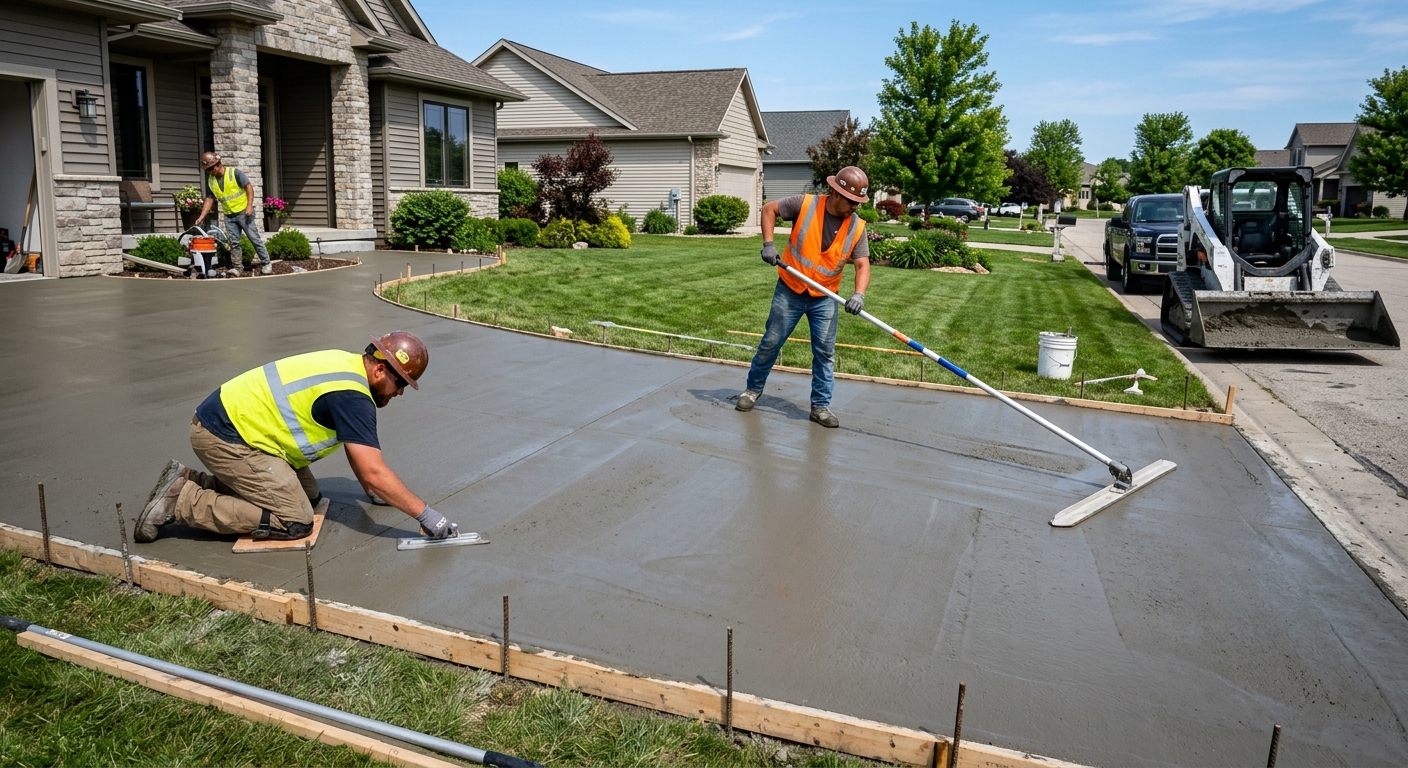
Concrete work options and costs in Shawnee Slopes
In Shawnee Slopes, Alberta, concrete choices usually come down to how much performance you want from your flatwork—and what the freeze–thaw cycle will do to it over the years. The community’s housing stock skews toward single-family, owner-occupied homes, which is why driveways, patios and walkways are among the most requested concrete projects. With a population of 2,020 (Statistics Canada, 2021 Census), the local contractor schedule can tighten quickly when several neighbours are planning pours in the same window. Calgary’s cold continental climate also affects cost: engineered specs typically assume a design frost depth of about 1.2 m (roughly 4 ft), so excavation and footing/formwork volume increase compared with milder regions. That shows up in both foundation pricing and slab/flatwork budgets. Frequent freeze–thaw cycles mean exterior pours rely on air-entrained mixes, good granular base preparation, and control joints placed with intention to reduce cracking and surface deterioration. If you’re scheduling exterior concrete late in the season, contractors often recommend winter-grade protection (insulated blankets and, in some cases, temporary heat) to protect curing—pushing labour and materials upward but improving long-term durability. For many homeowners, that’s the difference between a driveway that looks good for a few years and one that holds up for a decade. In Shawnee Slopes near established arterial connections and busy access routes, concrete flatwork demand is especially strong in periods when new builds and landscaping are being staged together. With that context, here’s a practical way to compare common options and budgets before you request site measurements.
| Application |
Typical Size |
Key Spec |
Finish Option |
Price Range |
| Concrete driveway (standard broom finish) |
24 ft x 10 ft (240 sq ft) |
Air-entrained exterior mix, fibre optional, control joints |
Broom finish |
$12,000–$18,000 |
| Exposed aggregate driveway |
24 ft x 10 ft (240 sq ft) |
Air-entrained mix, higher labour for surface exposure |
Exposed aggregate |
$14,500–$21,500 |
| Stamped concrete driveway or patio |
24 ft x 10 ft driveway (240 sq ft) |
Air-entrained mix, colour hardener, release agent and sealer |
Stamped pattern |
$15,000–$26,000 |
| Plain concrete patio or walkway |
12 ft x 12 ft (144 sq ft) |
Air-entrained exterior mix, compacted base and edging |
Light broom or smooth-finish trowel (as applicable) |
$5,000–$9,000 |
| Garage floor (interior slab) |
22 ft x 20 ft (440 sq ft) |
16–20 MPa interior concrete, vapour barrier typically included |
Steel trowel + broom finish top or standard finish |
$10,000–$15,500 |
| Foundation footings (structural, below frost) |
Typical single-detached footprint |
Excavation to design frost depth, rebar cages, engineered formwork |
Structural concrete |
$28,000–$45,000 |
Prices are estimates only and vary by project scope, site access and material selection.
What affects the price of concrete work in Shawnee Slopes
It’s common to see quotes for the “same” concrete job vary by 30–50% across Calgary and surrounding Alberta communities, even when the finished square footage looks similar. The main driver is usually what happens below the surface. In Shawnee Slopes, the design frost depth for engineering and permitting practices is about 1.2 m (roughly 4 ft), which means footings must be built on undisturbed soil below that depth to prevent frost heave and seasonal movement. Exterior slabs and flatwork also need air-entrained concrete mixes to resist freeze–thaw damage; a mix that’s too low in air can lead to scaling and spalling even if the slab “looks fine” early on. Then there’s the pour season: in late fall or early spring, contractors may need winter-grade precautions like insulated blankets and short-term heating to achieve proper curing. Those measures add cost, but they protect structural performance. Add in de-icing salt use, and sealing becomes more than cosmetics—it’s a durability step. For example, a standard broom driveway might land in the $12,000–$18,000 range, while upgrading to stamped concrete commonly pushes you into the $15,000–$26,000 band because of colour systems, labour intensity, and added sealing requirements. Local conditions swing the other way too: good access and stable soil reduce excavation and site labour; steep slopes, poor drainage, or oversized excavation for utilities increase the bill. Shawnee Slopes’ climate also affects how quickly crews can safely place and cure concrete, which can reduce “available” labour hours in a given week during colder snaps—so schedule matters, not just demand.
| Price Factor |
Why It Matters |
Cost Impact |
| Frost line depth — determines footing depth and form height |
Deeper frost exposure requires more excavation and concrete volume |
Higher excavation/formwork can raise foundation costs noticeably |
| Site preparation — excavation, grading, compacted granular base |
Proper base reduces settlement and keeps exterior slabs flat |
Poor access or wet/unstable soil increases labour and granular material |
| Reinforcement — rebar or wire mesh requirement |
Reinforcement controls cracking under load and freeze–thaw stresses |
More steel, chairs, and proper placement add direct material and labour cost |
| Mix design — air-entrainment and compressive strength spec |
Exterior durability depends on correct air content and strength |
Specialty mix and tighter QA increase material cost |
| Finish type — broom vs. stamped vs. exposed aggregate |
Finishes drive labour time, surface prep and material systems |
Decorative finishes typically add cost per square foot |
| Pour size and concrete truck access to site |
Large pours may need multiple loads; access affects placement efficiency |
Limited access can require pumps/extra crew time, raising labour |
| Cold-weather curing precautions — heating and blankets |
Cold placement must still reach required early strength and cure conditions |
Winter materials and setup can add a noticeable upswing late in the season |
| Control joint pattern and sealing cost |
Joints guide cracking; sealing helps resist salt scaling |
More joints, saw cutting and sealer line items increase the “small details” cost |
Permits & regulations in Alberta
In Alberta, structural concrete work—typically including footings, foundation walls, and grade beams—generally requires a building permit, and it’s commonly tied to engineered drawings reviewed as part of the municipal permit process. That’s especially important in Shawnee Slopes where frost depth and drainage detailing directly affect structural performance. For concrete flatwork like patios, walkways and driveways, permits often are not required unless the work affects lot grading, drainage, impervious surface coverage limits, or the municipal right-of-way (for example, certain tie-ins at the curb). Because rules and triggers can vary by situation, confirm with your local authority before breaking ground. Also make sure your contractor carries liability insurance and has the required worker coverage for jobsite work (WSIB/WCB coverage, depending on their status). A reputable contractor should provide references for similar-scale Alberta projects and be comfortable discussing how they’re meeting frost-related requirements through excavation depth and base build-up.
To verify a contractor in Shawnee Slopes step-by-step: first, ask for their proof of liability insurance and check that the certificate lists your contractor and includes the correct coverage limits; second, request documentation showing their WSIB/WCB coverage; third, look up licensing/registration details through the appropriate Alberta registry pathway for contractors (if applicable to their scope), and confirm the info matches the company on your quote. Finally, get copies of jobsite insurance documents before scheduling, not after. Clear documentation protects you if something changes mid-project.
Getting concrete right in Shawnee Slopes's freeze-thaw climate
Concrete failure in Shawnee Slopes usually comes back to freeze–thaw stress, moisture movement and surface vulnerability—not just “bad concrete.” The most common homeowner-visible issue is spalling (chipping/flaking), which often traces to inadequate air-entrainment or poor finishing that traps water near the surface. To spec the job correctly, start with base preparation: use a compacted granular sub-base built to the required depth for your soil conditions and frost considerations. Calgary-area practice aims to keep exterior elements stable through the year; because the design frost depth is about 1.2 m (roughly 4 ft), excavation and base build are not optional details. Next, use an exterior mix with air-entrainment (typical target is about 5–7% air content for exterior flatwork) and specify a minimum compressive strength of 32 MPa for the structural expectation of the slab where relevant. Control joints matter in this climate: spacing should limit random cracking so joints become the “sacrifice” areas instead of uncontrolled cracks. Curing is the quiet make-or-break step: plan for at least 7 days of proper curing conditions, and in cold snaps you may need insulated blankets or approved temporary heat to protect early strength development. Finally, sealing should be done after cure (commonly at 28 days) with a penetrating sealer designed to repel de-icing salts. When you ask questions, focus on durability first: “What air content are you targeting?” “How are you protecting curing temperatures?” and “What’s your joint spacing plan?” Those answers prevent spalling from an under-air mix.
Dollar-wise, the upgrade can be justified. If a broom-finished driveway at $12,000–$18,000 is showing signs of surface scaling after a couple of winters, paying for correct mix design, jointing and a penetrating sealer can cost less than replacing a slab early. Decorative upgrades—like moving into the $15,000–$26,000 stamped range—are worth it when the underlying frost and curing specs are already solid, but they shouldn’t substitute for them.
| Spec |
Why It Matters in Shawnee Slopes |
What to Ask For |
Impact if Skipped |
| Compacted granular base (depth?) |
Proper thickness and compaction prevent settlement and reduce cracking under freeze–thaw movement |
Confirm base thickness and compaction testing/standard practice for your soil and design |
Uneven slab, early cracking, and drainage issues that feed freeze–thaw damage |
| Air-entrained concrete mix (target air %?) |
Air bubbles provide room for freeze expansion and reduce spalling risk |
Ask the contractor for target air content (typically 5–7% for exterior flatwork) and mix design sheet |
Higher likelihood of scaling/spalling during Calgary cold snaps |
| Compressive strength (MPa rating) |
Strength supports durability and load performance |
Minimum 32 MPa (where specified for the slab/application) and confirm mix meets the requirement |
Surface wear, reduced long-term durability, and potential structural underperformance |
| Control joints (spacing per ACI guidelines) |
Joints control where cracks form as concrete shrinks and moves |
Request joint spacing details and timing for saw cutting |
Random cracking that can widen and allow moisture intrusion |
| Minimum 7-day curing period |
Early strength gain is essential before freeze–thaw stresses begin |
Ask how they protect curing conditions, especially during cold weather |
Scaling, lower strength, and increased long-term cracking risk |
| Penetrating sealer (when applied after cure) |
Sealers help repel salt and water, reducing freeze-driven deterioration at the surface |
Confirm penetrating sealer type and application timing (commonly after full cure, e.g., 28 days) |
Faster surface degradation from salt and moisture, leading to patchy spalling |
How to choose a concrete work contractor in Shawnee Slopes
Choosing the right contractor in Shawnee Slopes comes down to proof, not promises. Start by verifying Alberta coverage requirements: ask for a current certificate of liability insurance (and confirm it matches the legal company name on the contract) and ask how they handle WSIB/WCB coverage for workers on your site. Next, request itemised quotes—labour and materials broken out—so you can compare apples to apples. A lump sum with vague inclusions makes it easy for change orders to appear late, especially on excavation depth, base build thickness, and finishing complexity. Read the scope carefully: what’s included for demolition (if needed), removal/disposal, grading/soil haul, bonding adhesive (if an overlay is involved), saw-cut joints, and sealing? Also confirm whether permits (when required for structural work) are pulled by the contractor or by you, and what the timeline assumptions are. Warranty matters too: ask for the workmanship warranty length and whether product/manufacturer warranties apply to admixtures, sealer systems, or decorative materials—and whether those warranties are transferable if you sell.
For payment scheduling, keep it conservative: never pay more than 10–15% upfront, and use a holdback until key steps are complete (base approval, final finishing, and curing/sealing where included). Finally, insist on a start date and completion estimate in writing, because cold snaps in Calgary can change the feasible pour window.
- Request proof of liability insurance with matching legal name and valid coverage dates.
- Ask for WSIB/WCB clearance/documentation for workers assigned to your project.
- Get 2–3 itemised quotes (labour, concrete, reinforcement, base/gravel, equipment, finishing, sealing).
- Confirm if excavation depth matches design frost requirements for your scope.
- Verify air-entrainment specification for exterior flatwork in the quote.
- Ask for reinforcement details (rebar size/spacing or mesh type) and placement plan.
- Request control joint spacing and saw-cut timing.
- Clarify cold-weather curing approach (blankets/heating) if pours occur late in the season.
- Ask who handles disposal and what’s included in haul/fees for removed material.
- Confirm whether sealing is included (and when it will be applied relative to cure time).
- Check the warranty is written, with timelines and what constitutes “defect” versus normal cracking.
- Use a payment schedule with a holdback until final acceptance and documentation are provided.
Concrete contractor red flags in Shawnee Slopes include: refusing to provide insurance/WSIB documentation, quoting without describing base depth/compaction, promising a fast late-season pour with no curing plan, leaving out air-entrainment and joint details in writing, or providing only a single lump-sum number with no breakdown for excavation, reinforcement, and sealing.
Frequently asked questions — concrete work in Shawnee Slopes
Can concrete be poured in cold weather in Shawnee Slopes?
Yes, concrete can be poured in Alberta cold weather in Shawnee Slopes, but only with the right temperature control and curing plan. In the Calgary region’s freeze–thaw climate, contractors typically protect the pour so the concrete reaches early strength before cold conditions lock in moisture stress. That often means using winter-grade mixes, insulated curing blankets, and sometimes temporary heat around the work area—especially for exterior slabs, patios, and driveways. If you’re scheduling late fall or early spring, ask your contractor what minimum curing temperatures they maintain for at least 7 days and how they’ll manage windchill on the finish. For comparison, exterior flatwork often aligns with the $12,000–$18,000 driveway band when the job is planned for durability, not just speed.
How do I maintain concrete in Shawnee Slopes's freeze-thaw climate?
Maintenance is mostly about reducing moisture and salt-driven surface breakdown. In Shawnee Slopes, keep de-icing practices reasonable: use appropriate ice melt (and avoid over-salting) because salt can accelerate spalling when the concrete surface isn’t protected. If your driveway or walkway is sealed, you’ll usually get better resistance to water and salts—penetrating sealer is commonly applied after cure (often around 28 days). Sweep debris so small stones don’t abrade the surface during ploughing. If you see hairline cracking, don’t ignore it—monitor first, then consider targeted crack sealing to stop water from migrating into the slab. The big maintenance win is ensuring the original specs were correct: air-entrainment (typically 5–7% for exterior flatwork), control joints, and proper curing during the first week.
What causes concrete to spall in Shawnee Slopes winters?
Spalling in Alberta winters is usually tied to freeze–thaw damage at the surface, most often from inadequate air-entrainment, poor curing, or water getting into vulnerable areas. In Shawnee Slopes, temperature cycling expands and contracts moisture inside the concrete. If the mix doesn’t have the correct air content (commonly about 5–7% for exterior flatwork), there’s less room for expansion, so surface scaling and flaking can occur. Uneven base prep or missing control joints can also worsen the problem by creating pathways for water. Another contributor is salt: de-icing chemicals can intensify surface deterioration if sealing wasn’t done after cure. If you’re selecting between options, remember that “decorative” finishing doesn’t replace durability specs—whether you’re at the $12,000–$18,000 driveway level or higher, the freeze-thaw engineering needs to be right.
What is rebar and when is it required in Alberta?
Rebar is steel reinforcement placed inside concrete to control cracking and improve performance under load and seasonal movement. In Alberta—including Shawnee Slopes—when rebar is required depends on the structure being built and the engineered design, not just the homeowner preference. For structural work like foundation footings and foundation walls, rebar is commonly specified by the engineer and is part of the permitted structural system. For exterior flatwork such as driveways, rebar or mesh may be required based on slab thickness, sub-base conditions, and anticipated loads (like heavier vehicle use). The contractor should outline reinforcement type (rebar size/spacing or mesh style), placement method (on chairs/distance supports), and how it ties into control joints. Ask for the reinforcement plan in writing so you can compare quotes fairly, especially when budgets sit anywhere within the typical foundation range of $28,000–$45,000 or when upgrading driveway durability.
How long does a concrete project take in Shawnee Slopes?
Project duration depends on scope, weather, and curing requirements—more than most people expect. In Shawnee Slopes, a simple interior slab might be faster because there’s no exterior cure exposure risk, while exterior flatwork is constrained by temperature and wind conditions. For typical driveway or patio work, the day(s) for excavation, base prep, formwork, placing, and finishing can be relatively short, but the overall timeline should include curing protection and, if included, sealing timing. Even if finishing is done in a day, you should plan around a minimum 7-day curing period for early strength, and if sealing is part of your plan, sealer is commonly applied after full cure (often around 28 days). In colder weeks, winter blankets/heating may add setup time. Ask your contractor for an actual start date and completion estimate in writing, not just “weather permitting,” so you can plan around Calgary-area scheduling.
What is a concrete overlay and is it suited to Shawnee Slopes?
A concrete overlay is a new concrete layer placed on top of an existing slab or surface after preparation. It can be suited to Shawnee Slopes when the existing concrete is structurally sound (not extensively undermined, badly heaved, or severely cracked through). Overlays can improve appearance and provide a fresh finish, but they only perform well if the surface prep is correct, drainage is addressed, and the overlay mix and bonding method are appropriate for freeze–thaw conditions. If your existing driveway has widespread spalling or repeating frost movement, an overlay may fail sooner than expected because moisture continues to work under and within the system. If you’re considering options, ask for a surface assessment and bond prep method, and confirm the overlay mix includes proper air-entrainment and a curing plan. Depending on condition, it may be more cost-effective to rebuild within the typical driveway/flatwork budgets (such as the $12,000–$18,000 band) rather than repeatedly patch.