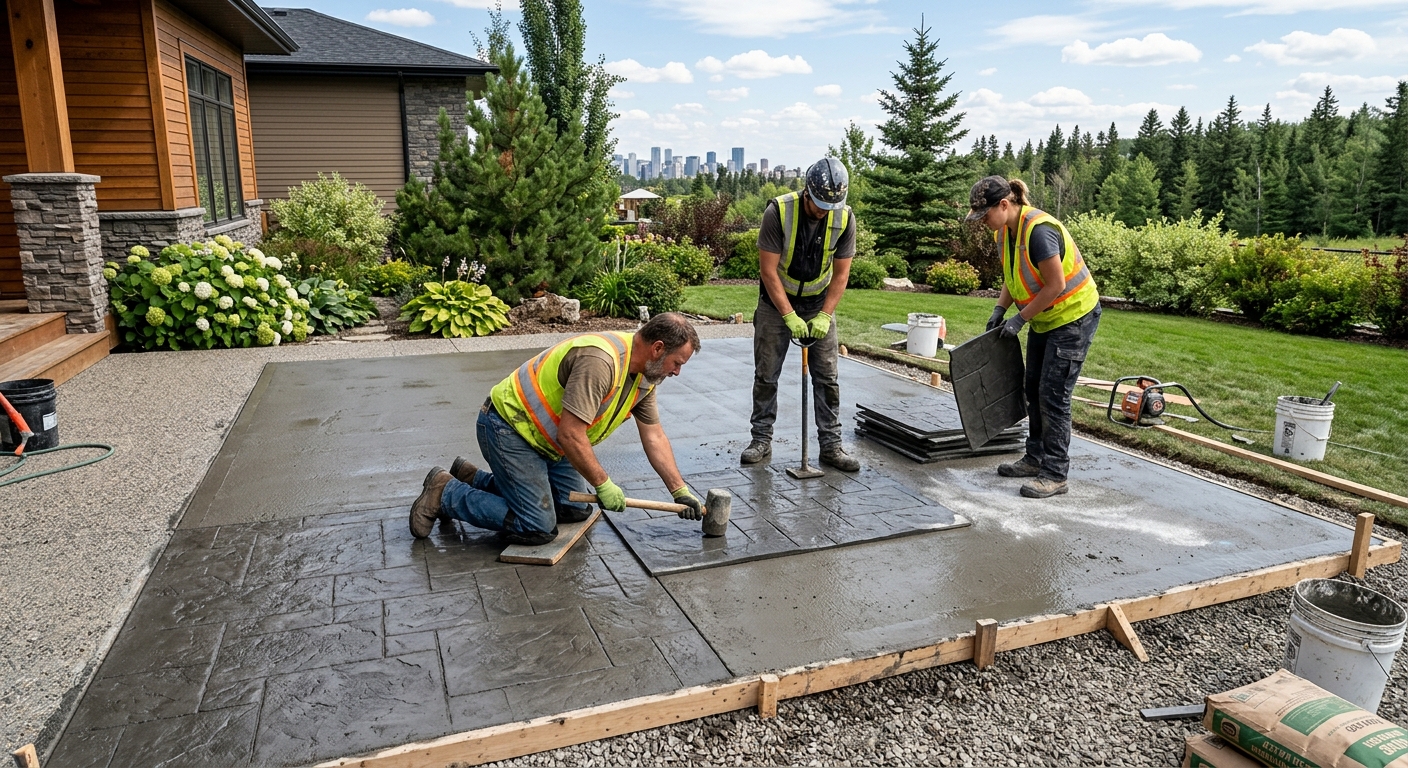
Concrete work options and costs in Cambrian Heights
Cambrian Heights, Alberta is a small community where concrete flatwork is a regular part of home life—especially for driveways, patios, and walkways. With a population of about 2,000 residents (Statistics Canada, 2021 Census), contractors tend to book solidly when weather windows open, so timing affects both availability and pricing. The housing stock here is similar to other Calgary-area neighbourhoods: many properties rely on concrete for low-maintenance exterior surfaces, and that demand is steady for standard broom-finished driveway replacements and repairs.
In the Calgary region’s cold continental climate, concrete costs reflect engineering choices made for frost and freeze–thaw. Footings for houses, garages, decks, and retaining structures must be founded below the design frost depth (about 1.2 m or roughly 4 ft) to reduce frost heave and seasonal movement. Exterior slabs also require air-entrained mixes, granular base prep, and well-spaced control joints to manage cracking and spalling over multiple freeze–thaw cycles. Because the exterior pour season is shorter, crews often use winter-grade practices—insulated blankets and, when needed, temporary heat—to protect curing. Those cold-weather precautions are part of why a “cheap” quote can look good on paper but fail later if the curing plan is rushed.
In Cambrian Heights, work is especially in demand along active residential streets where access for a concrete truck is straightforward—better access usually means tighter scheduling and lower placement costs. With that in mind, the comparison table below shows realistic price ranges for common concrete options you’ll see around Calgary-area neighbourhoods.
| Application |
Typical Size |
Key Spec |
Finish Option |
Price Range |
| Concrete driveway (standard broom finish) |
400–600 sq. ft. |
4 in. air-entrained slab, granular base, control joints |
Broom finish |
$12,000–$18,000 |
| Exposed aggregate driveway |
400–600 sq. ft. |
Special aggregate mix, proper curing, base and joints |
Exposed aggregate |
$15,000–$22,000 |
| Stamped concrete driveway or patio |
300–600 sq. ft. |
Air-entrained mix, stamped mats, release agent, sealed finish |
Stamped |
$15,000–$26,000 |
| Plain concrete patio or walkway |
200–450 sq. ft. |
4 in. slab on compacted base, joints as required |
Float + broom/steel trowel edges |
$5,000–$9,000 |
| Garage floor (interior slab) |
400–600 sq. ft. |
Vapour control consideration, reinforcement as specified |
Float/steel trowel, light broom edges |
$10,000–$16,000 |
| Foundation footings (structural, below frost) |
Varies by design |
Excavation to undisturbed soil, reinforced concrete, below frost depth |
Structural finish (formed) |
$28,000–$45,000 |
Prices are estimates only and vary by project scope, site access and material selection.
What affects the price of concrete work in Cambrian Heights
In Cambrian Heights and across the Calgary region, two homeowners can receive quotes for the “same” concrete project that differ by roughly 30–50% once you look at the details. The biggest reason is that Calgary-area concrete is engineered around deeper frost exposure and repeated freeze–thaw. When contractors price correctly, they include more excavation, a thicker or better-compacted granular base, air-entrained concrete, and the right curing approach. When they don’t, the slab may look fine for a short time, but cracking, scaling, or spalling can show up sooner—especially where de-icing salt is used.
Frost line depth matters because footings must extend below the design frost depth (about 1.2 m in this region) so the foundation and supporting soils don’t heave. Freeze–thaw cycles also dictate exterior slab specs: air-entrainment, control joint patterns, and surface protection. Calgary’s shorter pour season adds cost too; late fall and early spring pours may require winter-grade mixes, insulated blankets, and sometimes temporary heating to keep curing on track. That curing window is where “cheap” quotes often get derailed.
In day-to-day Cambrian Heights pricing, I commonly see these cost swings: (1) if a site needs haul-off due to poor subgrade or saturated soil, the project can drift upward; (2) if a driveway replacement includes major regrading and new base, you’ll feel it in the final number; (3) if truck access is tight, placement labour and time increase. As a reference point, a broom-finished driveway typically lands around the $12,000–$18,000 band, while stamped concrete often prices higher in the $15,000–$26,000 range because it’s labour-intensive and includes extra materials like colour and release systems.
| Price Factor |
Why It Matters |
Cost Impact |
| Frost line depth — determines footing depth and form height |
Footings must be founded below the design frost depth to prevent frost heave. |
Higher excavation and concrete volume; can materially change foundation costs. |
| Site preparation — excavation, grading, compacted granular base |
Proper base prevents pumping, uneven settlement, and premature cracking. |
Unsuitable soils or required haul-off increases labour and disposal. |
| Reinforcement — rebar or wire mesh requirement |
Reduces crack width and improves slab durability under loads. |
Material and labour add cost; skipping can raise risk of failure. |
| Mix design — air-entrainment and compressive strength spec |
Air-entrainment protects against freeze–thaw scaling and spalling. |
Higher performance mix can add cost but improves longevity. |
| Finish type — broom vs. stamped vs. exposed aggregate |
Decorative finishes require more labour, materials, and curing/sealing coordination. |
Stamped and exposed work typically costs more than broom-finish flatwork. |
| Pour size and concrete truck access to site |
Access affects pump/placement time, crew size, and scheduling. |
Limited access or long distance hose/pump requirements can add labour. |
| Cold-weather curing precautions — heating and blankets |
Concrete must cure properly to reach strength; cold slows hydration. |
Winter gear and labour can increase cost during shoulder months. |
| Control joint pattern and sealing cost |
Joints manage cracking location; sealing helps resist de-icing salt damage. |
More precise joint layout and sealing plan can increase line-item cost. |
Permits & regulations in Alberta
In Alberta, structural concrete work typically triggers permitting and engineering review. For a homeowner in Cambrian Heights, that usually means footings, foundation walls, and grade beams require a building permit, and you’ll often see engineered drawings reviewed through the municipal process. If your project involves changing load paths, supporting a structure, or altering foundation elements, assume you’ll need permits and plans—not just a “concrete quote.”
Concrete flatwork—such as driveways, patios, walkways, and garage slabs—often does not require a permit unless it affects lot grading, drainage, or municipal rules around impervious surface coverage, or it touches right-of-way boundaries. Even when a permit isn’t required for the slab itself, you should confirm with the local authority before breaking ground, especially if the work involves regrading, major drainage changes, or work near municipal boundaries.
Before you sign a contract, verify three basics: liability insurance, WSIB/WCB coverage (as required for workers), and a contractor’s ability to manage structural scope where applicable. Step-by-step: (1) ask the contractor for a certificate of insurance showing current general liability limits that name you as applicable; (2) request proof of coverage/clearance for WSIB/WCB; (3) confirm the contractor’s details through the appropriate online registry presence for their business; and (4) ask for references on similar projects in Calgary-area conditions (freeze–thaw, air-entrained mixes, and cold-weather curing).
Getting concrete right in Cambrian Heights's freeze-thaw climate
Concrete fails in Cambrian Heights when the slab can’t handle deep seasonal freezing and repeated freeze–thaw. The two biggest issues I see are (1) weak or poorly prepared base leading to settlement and cracking, and (2) inadequate durability spec—especially air-entrainment—leading to surface scaling and spalling after salt exposure. In this Calgary region, that shows up quickly on driveways and exterior walks because de-icing chemicals and moisture get into micro-cracks.
To spec the job correctly, insist on five fundamentals. First, base preparation: excavate and build a compacted granular sub-base to the proper depth for local soil and frost conditions—this supports the slab and reduces movement. Second, mix design: exterior flatwork should use air-entrained concrete with typical target air content around 5–7% air and a minimum 32 MPa compressive strength spec (project-dependent). Third, control joints: plan joint spacing to limit random cracking; joints are where the concrete is allowed to crack, not where homeowners see a failure. Fourth, curing: plan for a minimum 7-day curing period under proper conditions, and don’t skip winter curing measures when temperatures are near or below typical placement thresholds. Fifth, sealing: apply a penetrating sealer after cure (commonly at 28 days post-pour) to help repel de-icing salts and moisture.
When homeowners compare options, the cost difference is usually justified when it improves durability. For example, moving from a basic broom-finish driveway to a stamped concrete driveway often pushes you toward the $15,000–$26,000 band instead of the $12,000–$18,000 broom band—but the extra labour, release system, and finish coordination can be worth it if you also keep the durability specs (air, base, joints, curing) consistent.
Ask contractors directly: “What air content are you targeting, what’s your minimum strength, what’s the joint spacing plan, what’s your curing method for the dates we pour, and what sealer product will you use?” Those questions are how you prevent the most common Cambrian Heights failure: spalling from inadequate air-entrainment and rushed curing.
| Spec |
Why It Matters in Cambrian Heights |
What to Ask For |
Impact if Skipped |
| Compacted granular base (depth?) |
Supports the slab and controls movement through freeze–thaw seasons. |
Granular type, compaction method, and base depth to the frost-appropriate design. |
Settlement, pumping, uneven cracking, and shorter service life. |
| Air-entrained concrete mix (target air %?) |
Air-entrainment provides freeze–thaw resistance in Alberta conditions. |
Target air content (typically 5–7% for exterior flatwork) and confirmation of air-entrained mix. |
Scaling and spalling after freeze–thaw and de-icer exposure. |
| Compressive strength (MPa rating) |
Strength affects durability, abrasion resistance, and long-term performance. |
Minimum 32 MPa (or higher if required by design/load conditions). |
Higher cracking risk and accelerated surface deterioration. |
| Control joints (spacing per ACI guidelines) |
Controls where cracks occur, helping keep cracks predictable and narrow. |
Planned joint spacing and pattern before the pour. |
Random cracking across the slab and possible water infiltration. |
| Minimum 7-day curing period |
Concrete needs time and the right conditions to reach strength. |
Curing method and protection plan during the first week. |
Weak surface, reduced strength gain, and premature wear. |
| Penetrating sealer (when applied after cure) |
Helps repel moisture and de-icing salt so the surface stays more resilient. |
Sealer type and timing (commonly 28 days post-pour after cure). |
Faster deterioration and more frequent scaling in salted traffic areas. |
How to choose a concrete work contractor in Cambrian Heights
Choosing the right concrete contractor in Cambrian Heights comes down to verifying coverage, asking for itemized pricing, and protecting yourself against shortcuts that show up months later. Start by confirming Alberta licensing/business legitimacy and that the contractor carries current liability insurance and WSIB/WCB coverage for workers (or equivalent coverage where applicable). How to check: request a current certificate of insurance and read the effective date and coverage limits; ask for proof of WSIB/WCB clearance; and verify the business details through the appropriate provincial registry presence. A contractor who can’t produce paperwork quickly is a risk.
Next, get 2–3 written, itemised quotes—not just a lump sum. You want a breakdown that separates concrete supply, reinforcement, forms, excavation/grading, base prep and compaction, disposal/haul-off, finish labour, and sealing (if included). Read the exclusions: “demo only,” “materials only,” “no permit included,” or “sealer not included” are common exclusions that change the real cost. Also confirm whether disposal is included and how they handle any unsuitable soil.
Warranty matters in Alberta’s freeze–thaw world. Ask for a workmanship warranty length and what it actually covers (settlement vs. surface cracking vs. finish defects). Clarify whether the product/manufacturer warranties are transferable to you. For payment, keep it conservative: never pay more than about 10–15% upfront, and hold back a final amount until completion and clean handover. Demand a written start date and completion estimate tied to weather constraints—because a winter pour plan is part of the job, not an afterthought.
- Ask for proof of liability insurance (current certificate) before scheduling.
- Verify WSIB/WCB coverage/clearance for workers handling the work site.
- Request at least two site references for similar Cambrian Heights-style freeze–thaw exterior slabs.
- Use itemised quotes: labour, concrete supply, reinforcement, excavation/base, disposal, finishing, sealing.
- Confirm if permits are required and whether the contractor will pull them (where applicable).
- Get their curing plan in writing for your pour date (blankets/heating if temperatures drop).
- Ask for target air-entrainment and minimum strength specs for exterior slabs.
- Require the control joint spacing plan before the pour, not after cracking.
- Confirm base prep thickness and compaction method (not just “proper base”).
- Make sure sealing is included where promised, with timing after cure.
- Keep payment tied to milestones; avoid large upfront payments.
- Require a written schedule and weather contingency plan.
Concrete red flags I see in Cambrian Heights include: quotes that don’t mention air-entrainment for exterior work, crews who won’t discuss curing/blankets for cold weather, missing joint plans (or joints added after the fact), “we’ll figure it out” promises about base depth, and vague warranties that exclude workmanship issues like settlement or spalling.
Frequently asked questions — concrete work in Cambrian Heights
How do I seal concrete to protect it in Cambrian Heights?
In Cambrian Heights, sealing matters because freeze–thaw plus de-icing salt can drive moisture into the surface and accelerate scaling or spalling. For most exterior flatwork, you typically seal with a penetrating sealer after the concrete has cured—commonly around 28 days post-pour—so the sealer can bond into a mature surface. Before sealing, the concrete should be clean and fully cured; any trapped dust, curing compounds, or leftover construction residues can limit performance. Ask your contractor which product they use and whether it’s designed for winter salt exposure. If you’re budgeting, sealing is often a line item; paired with a broom-finish driveway in the $12,000–$18,000 range, proper sealing helps protect that investment through Calgary-area freeze–thaw cycles.
What is the difference between concrete and cement?
In plain terms, cement is an ingredient, while concrete is the finished engineered product. Cement is the binding material (it reacts with water to build strength). Concrete is cement plus water, sand, gravel (or crushed stone), and any required admixtures—like air-entrainment for exterior slabs in Alberta. When contractors talk about specs, they’re usually referring to the full concrete mix design: target air content, compressive strength (for example, minimum 32 MPa for many exterior slabs), and durability-related additives. In Cambrian Heights’ climate, the difference isn’t academic: air-entrainment is what helps concrete resist freeze–thaw damage.
How much does concrete work cost in Cambrian Heights?
Cost in Cambrian Heights typically follows Calgary-region reality: deeper frost considerations, heavier excavation for exterior supports, and tougher durability specs. For an exterior driveway on a typical residential footprint, you’ll commonly see pricing around the $12,000–$18,000 band for a standard broom-finish replacement. Patios and walkways often fall in the $5,000–$9,000 range depending on size and site conditions. If you choose decorative work like stamped concrete, expect higher labour and materials—often landing in the $15,000–$26,000 band. Foundation footings are a different category due to structural scope and excavation to undisturbed soil below frost; those are commonly in the $28,000–$45,000 band for many typical residential scenarios.
How deep must footings be for Cambrian Heights's frost line?
For Cambrian Heights, the key practical reference is the regional design frost depth of about 1.2 m (roughly 4 ft). Footings for houses, garages, decks, retaining structures, and similar supported elements must be founded below that depth on undisturbed soil to reduce frost heave and seasonal movement. The exact depth can vary based on soil conditions, drainage, and engineered design, but you should not accept “near frost line” guesses. When you talk to contractors, ask what depth they’ll excavate to, what they’re bearing on (undisturbed soil), and how they’ll document base conditions. This is one place where a difference in quote can be real: under-excavation can look cheaper initially but creates long-term risk in Alberta’s freeze–thaw environment.
Why does concrete crack in Cambrian Heights and how is it prevented?
Concrete cracks in Cambrian Heights mainly because concrete shrinks as it cures, the slab moves slightly as temperatures swing, and moisture/freezing cycles stress surfaces over time. Cracking isn’t automatically a failure—random cracking is the issue. The prevention approach is to design for controlled cracking: proper compaction and granular base prep, air-entrained exterior concrete for freeze–thaw durability, and a smart control joint layout so cracks happen where you expect them. Joints must be spaced appropriately and properly executed. Curing also plays a role; rushing curing in colder periods can weaken the surface. De-icing salt exposure increases the need for sealing and durable surface performance. If your contractor mentions joint spacing, air-entrainment, and curing steps, that’s a good sign they understand Alberta’s climate-driven stresses.
Stamped vs broom-finish concrete — cost difference?
Stamped concrete usually costs more than broom-finish because it requires extra labour and materials: stamping mats, release agents, colour options, and more careful placement and finishing coordination. In the Calgary region, a broom-finish driveway replacement commonly lands around the $12,000–$18,000 band for typical sizes and scope. Stamped driveway or patio projects are commonly priced higher—around the $15,000–$26,000 range—depending on size, pattern complexity, and preparation. The important part for homeowners in Cambrian Heights: make sure the durability specs are not downgraded just because the finish is decorative. A stamped driveway should still include air-entrainment, correct base prep, proper control joints, and cold-weather curing precautions when needed.