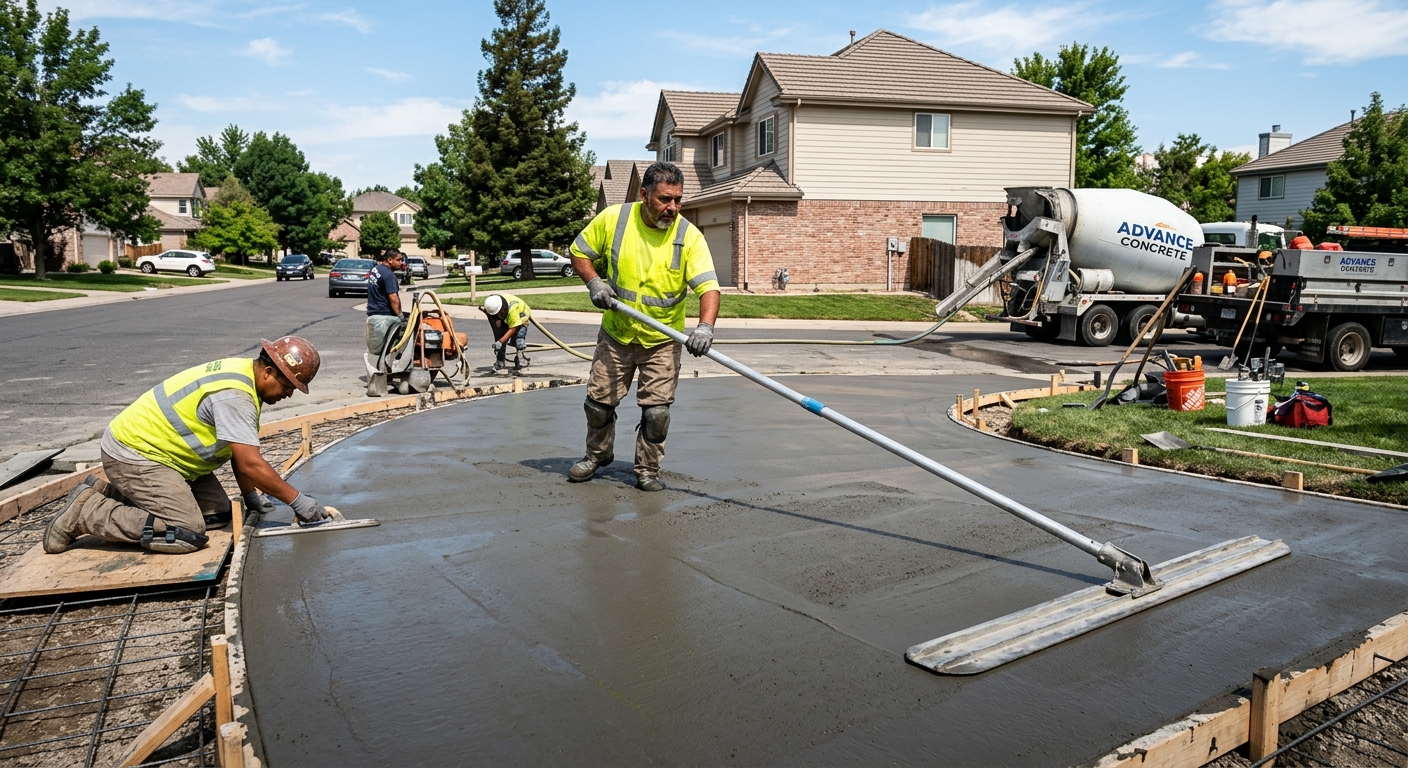
Concrete work options and costs in Royal Oak
Royal Oak, Alberta is a great place for durable concrete flatwork, but the pricing reflects what Calgary-area homeowners deal with every year: deep frost, frequent freeze–thaw cycles, and a shorter practical exterior pour season. With a population of 11,580 (Statistics Canada, 2021 Census), the local housing market has enough volume to keep trades busy, particularly around the newer residential pockets in and near the Royal Oak/Sunridge area where driveways, patios, and garage slabs get upgraded as homes settle.
Most concrete scope in Royal Oak is tied to single-detached homeowners building and improving driveways, walkways, and backyards—projects where base prep, drainage, and jointing matter as much as the finish. In this climate, contractors plan concrete thickness and mix design around a design frost depth of about 1.2 m (roughly 4 ft). That means deeper excavation and larger footing volumes than in milder regions, and it also means exterior flatwork needs air-entrained concrete plus proper curing (often with insulated blankets in cooler periods). The result is that even “similar” driveways can land far apart on price once the contractor accounts for excavation depth, granular base quantities, reinforcement, and winter-ready placement.
Below is a practical comparison of common options so you can see typical ranges before you request itemised quotes for your lot, access, and finish selection.
| Application |
Typical Size |
Key Spec |
Finish Option |
Price Range |
| Concrete driveway (standard broom finish) |
24 ft x 20 ft (480 sq ft) |
Air-entrained, 4 in slab, light rebar/wire mesh (as required) |
Broomed trowel + control joints |
$12,000–$18,000 |
| Exposed aggregate driveway |
24 ft x 20 ft (480 sq ft) |
Air-entrained, 4 in slab, sealed aggregate exposure |
Exposed aggregate (surface retarder or wash system) |
$15,000–$21,000 |
| Stamped concrete driveway or patio |
20 ft x 20 ft (400 sq ft) |
Air-entrained, 4 in slab, integral color (or approved system) |
Stamp texture + release + sealed finish |
$15,000–$26,000 |
| Plain concrete patio or walkway |
12 ft x 16 ft (192 sq ft) |
Air-entrained, 4 in slab, compacted granular base |
Floating/trowel + broom or light edging + joints |
$5,000–$9,000 |
| Garage floor (interior slab) |
24 ft x 22 ft (528 sq ft) |
4 in slab, vapour barrier & proper reinforcement (as designed) |
Smooth or broomed finish |
$10,500–$16,000 |
| Foundation footings (structural, below frost) |
Typical house footprint; depth based on frost/soil |
Engineered concrete, rebar, excavation to undisturbed bearing |
Structural grade concrete |
$28,000–$45,000 |
Prices are estimates only and vary by project scope, site access and material selection.
What affects the price of concrete work in Royal Oak
In Royal Oak and the wider Calgary region, it’s common to see quotes for the “same” concrete job swing by 30–50%. That’s because contractors price the realities of getting it built correctly here: excavating to the right depths, producing a stable granular base, delivering air-entrained concrete, and curing it properly through changing shoulder-season temperatures. Even when finish looks similar from the curb, the hidden work—sub-base depth, reinforcement, and jointing—changes the concrete and labour totals.
Three regional factors drive most of the cost spread. First, the frost depth requirement: footings and structural elements must bear below the design frost depth (about 1.2 m in Calgary-area engineering practice). That usually means more excavation and higher footing volumes than many homeowners expect, which pushes foundation/footings pricing into the $28,000–$45,000 band for many typical scopes. Second, freeze–thaw cycles require air-entrainment and disciplined curing so exterior slabs survive surface scaling and spalling risk; this is why an exterior patio or walkway often trends toward the $5,000–$9,000 band when base and curing are properly planned. Third, the colder pour window affects labour scheduling and sometimes adds winter-grade concrete handling, insulated blankets, and temporary heat on slabs poured late in fall or early spring.
In Royal Oak, costs can be higher when access is tight (long pump distances or multiple small truckings), when drainage isn’t corrected before the pour, or when soil conditions require additional granular replacement. Conversely, costs can be lower when your driveway location is already cleared, the lot grades are straightforward, and the contractor can place concrete quickly with clean truck access. Age of the housing stock also matters: older yards often have more regrading and buried obstacles, which increases excavation time and disposal fees in dollars.
| Price Factor |
Why It Matters |
Cost Impact |
| Frost line depth |
Determines footing depth and form height needed for frost stability |
Can add significant excavation and concrete volume—major driver of foundation/footings pricing |
| Site preparation |
Excavation, grading, and compacted granular base prevent settlement |
Higher when soil is poor, there’s slope correction, or there’s extra granular replacement |
| Reinforcement |
Controls cracking and supports slab performance in freeze–thaw |
Wire mesh vs rebar grid, and rebar placement/removal costs vary by design |
| Mix design |
Air-entrainment and strength requirements protect against spalling |
Cold-weather or higher-spec mixes can raise material cost and logistics |
| Finish type |
Broom vs stamped vs exposed aggregate changes labour time and materials |
Stamped/exposed systems typically add surface prep and finishing steps |
| Pour size and concrete truck access to site |
Placement speed and reach affect labour and equipment |
Poor access can mean extra labour, smaller batches, or pump/telebelt charges |
| Cold-weather curing precautions |
Heating and insulating blankets help achieve proper cure |
Adds equipment and time—more common in late fall/early spring pours |
| Control joint pattern and sealing cost |
Joints reduce random cracking; sealing helps repel de-icing salts |
Sealing timing (after cure) and joint layout affect both labour and product cost |
Permits & regulations in Alberta
In Alberta, structural concrete work generally needs a building permit—especially when you’re changing the structure of a home or adding engineered elements. That typically includes footings, foundation walls, grade beams, and any structural slab that ties into the load-bearing system. For these items, municipalities often require engineered drawings or design documentation reviewed through the permit process. Concrete flatwork like patios, walkways, and most driveways usually does not require a permit, unless it impacts lot grading, drainage, or impervious surface coverage rules, or encroaches on municipal right-of-way or frontage requirements. Your municipality may also require approvals if you’re doing significant regrading, building a retaining structure, or altering egress paths.
For a Royal Oak homeowner, the practical way to verify compliance is step-by-step before work starts. First, ask the contractor which permits they’re pulling (and confirm whether any engineering letters are included). Next, confirm the contractor carries liability insurance—request a current certificate of insurance and ensure it matches the company name on the quote. Then verify workers are covered under WSIB (workplace safety coverage) in Alberta; you can ask for proof of coverage or a clearance-style confirmation letter. You should also review references on similar-scale projects, ideally with photos in freeze–thaw conditions, because cured performance is the real test here.
Finally, don’t rely on verbal “it’s covered.” Get everything in writing: permit responsibility, engineered scope, and site restoration/disposal requirements.
Getting concrete right in Royal Oak's freeze-thaw climate
Concrete failure in Royal Oak is usually not “bad concrete” in the plant—it’s a placement and detailing issue interacting with Calgary-area freeze–thaw. The biggest enemy is freeze–thaw-driven spalling and scaling when exterior slabs lack proper air-entrainment or when the base isn’t built to drain and compact correctly. When water gets into the slab surface and freezes, it expands; over multiple cycles it can pop off the surface and eventually compromise performance.
To spec the job correctly, focus on five items. (1) Base preparation: compacted granular sub-base to the design depth for your soil and required frost stability, with drainage handled before the pour. (2) Mix design: exterior flatwork should use air-entrained concrete targeting about 5–7% air content and a minimum compressive strength commonly around 32 MPa (per design/spec). (3) Control joints: spacing that limits random cracking; joints should be installed at the correct depth and timing. (4) Curing: minimum 7 days of proper curing conditions. In cold weather, curing may require insulated blankets and/or temporary heat so the concrete achieves strength gain and resists surface damage. (5) Sealing: a penetrating sealer applied after the cure (commonly around 28 days post-pour) to repel de-icing salts and reduce water ingress.
For Royal Oak, ask how they’ll prevent the “cheap” version of a driveway from scaling. If one quote is significantly lower—say a driveway near the $12,000–$18,000 band versus another closer to $18,000–$22,000 due to better base depth, reinforcement placement, and cold-weather curing—those higher costs are often justified by reduced rework risk over the winter cycles.
Use the technical questions below to keep your project tied to performance, not just appearance.
| Spec |
Why It Matters in Royal Oak |
What to Ask For |
Impact if Skipped |
| Compacted granular base (depth?) |
Stable, drained support prevents settlement and cracking under freeze–thaw movement |
Exact excavation depth and granular type/compaction method; drainage plan if needed |
Uneven settling, early cracking, and accelerated deterioration |
| Air-entrained concrete mix (target air %?) |
Air voids provide freeze–thaw protection so water expansion doesn’t break the surface |
Target air content (commonly 5–7% for exterior flatwork) and documented mix design |
Spalling and scaling, especially where salt or meltwater hits |
| Compressive strength (MPa rating) |
Adequate strength supports slab durability through seasonal loading |
Minimum 32 MPa (or project-specific spec) confirmed in writing |
Lower long-term performance and reduced resistance to wear |
| Control joints (spacing per ACI guidelines) |
Directs cracking to predictable locations, limiting random surface cracks |
Joint spacing, joint depth, and cut timing after finishing |
Random cracking and wider crack openings over winters |
| Minimum 7-day curing period |
Strength gain and surface durability depend on curing conditions in cold weather |
Confirm curing method; ask what they do if temps drop during/after placement |
Surface weakness, scaling risk, and long-term durability loss |
| Penetrating sealer (when applied after cure) |
Helps reduce water and salt migration that fuels spalling |
Sealer type and timing (commonly after cure—around 28 days post-pour) |
Faster surface damage and more frequent maintenance |
How to choose a concrete work contractor in Royal Oak
Choosing a contractor in Royal Oak isn’t just about the lowest number—it’s about proving they build to spec in Calgary-area conditions. Start by verifying Alberta coverage and responsibility. Ask for a current certificate of liability insurance and confirm the coverage limits are appropriate for your project scope. Next, verify WSIB/WCB coverage (Alberta workers’ coverage). You can request a clearance-style confirmation or documentation showing the contractor is in good standing. For licensing, ask which permits are needed for your specific scope and confirm they’re familiar with the municipal process for structural work like footings and foundation walls.
Then get 2–3 itemised written quotes—not lump sums. You want a breakdown that separates excavation/site prep, concrete supply, reinforcement, finishing, joints, sealing, and any cold-weather curing equipment. Check what’s excluded: permit fees, disposal, regrading, temporary heat, saw-cutting, and whether they include protection/curing supplies. For warranties, ask for the workmanship warranty length in writing, whether it covers labour for repairs (not just materials), and if any manufacturer warranty is transferable. Confirm the payment schedule: never pay more than 10–15% upfront, and use a holdback until completion and cleanup are done. Finally, get a clear timeline—start date and estimated completion—so you can plan around truck access and weather swings typical in the Calgary market.
- Confirm liability insurance with a current certificate and the correct legal company name.
- Verify WSIB/WCB coverage and request proof/confirmation before work begins.
- Request itemised quotes showing excavation, base, reinforcement, concrete, finish, joints, and sealing.
- Ask whether the quote includes disposal and disposal site fees for removed material.
- Ask about permit responsibility and confirm which permits (if any) are required for your scope.
- Confirm the mix spec: air-entrainment target and minimum compressive strength.
- Ask for the planned control joint layout and cutting schedule.
- Confirm curing plan for cold nights (blankets/heat if needed) and who provides it.
- Ask how they protect finished concrete from early freezing, traffic, and freeze–thaw before strength gain.
- Check references for similar projects in the Calgary freeze–thaw climate, not only warmer regions.
- Review warranty terms in writing: labour coverage, exclusions, and duration.
- Use a payment schedule with 10–15% max deposit and a holdback until completion.
Concrete red flags in Royal Oak: (1) a quote that doesn’t specify air-entrainment, (2) unclear joint spacing/cut timing, (3) skipping granular base depth and compaction details, (4) no cold-weather curing plan when temperatures are dropping, and (5) pressure to pay the majority upfront or to waive written warranty coverage.
Frequently asked questions — concrete work in Royal Oak
How much does concrete work cost in Royal Oak?
In Royal Oak, pricing typically tracks the Calgary-area bands because excavation depth, base prep, and freeze–thaw protection are built into the spec. For driveways and similar exterior flatwork, homeowners often fall within $12,000–$18,000 for a standard broom-finish driveway, while more decorative systems (like exposed aggregate or stamped work) commonly climb toward $15,000–$26,000. Patios and walkways often land in the $5,000–$9,000 range depending on thickness, size, and whether reinforcement and sealing are included. Quotes can still differ by 30–50% when one contractor includes deeper granular base, reinforcement placement, and winter-ready curing. Always compare itemised scopes, not only the finish name.
How deep must footings be for Royal Oak's frost line?
For Royal Oak (Calgary-area engineering practice), the design frost depth is commonly around 1.2 m (roughly 4 ft). That means structural footings typically need to bear on undisturbed soil below that depth, and the exact depth can vary with your geotechnical recommendations and soil conditions. Because frost stability is critical in freeze–thaw cycles, contractors usually plan excavation and footing sizes around frost requirements, not just typical “rule of thumb” depths. If a quote is vague about footing depth or says it will “match the old foundation,” ask for the engineered footing plan and confirmation that bearing is below the frost line. Structural concrete work also generally requires the right permitting and engineered documentation before excavation.
Why does concrete crack in Royal Oak and how is it prevented?
Concrete cracks in Royal Oak mainly because seasonal movement and temperature changes create contraction/expansion stresses, and the freeze–thaw cycle can intensify surface deterioration if water gets into the slab. The most preventable cracking is handled through proper base prep (compacted granular support), correct thickness, and a control joint pattern that limits random cracking. Air-entrainment also protects the concrete from spalling/scaling; spalling can make surface cracks look worse over time even if the slab isn’t structurally failing. Prevention is also about curing—minimum 7-day curing under suitable conditions—and sealing after cure to reduce water and de-icing salt ingress. Ask your contractor for joint spacing and the timing of saw-cutting, not just a general “we’ll put joints in.”
Stamped vs broom-finish concrete — cost difference?
Stamped concrete generally costs more because it requires a coloured system (integral colour or approved colouring), additional surface preparation, stamping tools, and careful timing for pattern placement. Decorative work is labour-heavy and can be more sensitive to curing conditions—especially in Calgary’s cooler shoulder seasons. In Royal Oak, a broom-finished driveway often fits around $12,000–$18,000, while stamped concrete driveway or patio work commonly trends toward $15,000–$26,000. That difference is usually justified when the quote includes proper base prep, reinforcement, and sealing. If the cheaper option cuts corners on air-entrainment, curing blankets, or jointing, it may fail faster in freeze–thaw.
When is the best time to pour concrete in Royal Oak?
The best time is typically when daytime temperatures are consistently above the contractor’s cold-weather thresholds and you can protect the pour through the critical early curing window. In the Calgary area (including Royal Oak), that often means late spring through summer for exterior slabs, because cold nights in fall and early spring can raise the risk of inadequate curing and surface scaling. If you must pour in cooler weather, reputable contractors plan for insulated blankets and/or temporary heat to maintain curing conditions and achieve strength gain. Ask what they’ll do if temperatures drop after placement and whether the quote includes winter curing precautions. Getting the curing right matters as much as the finish you choose.
How long does concrete take to cure?
Concrete strength gain happens over time, but for most exterior and interior slabs, you should plan on a minimum curing period of about 7 days under proper conditions before treating the slab as fully serviceable. Proper curing is especially important in Royal Oak’s freeze–thaw climate, where early damage can show up later as scaling or cracking. Even after the initial cure, many contractors schedule sealing after the concrete has cured sufficiently—commonly around 28 days post-pour for penetrating sealers—so the surface is ready to repel water and de-icing salts. Always confirm curing methods in writing: how they control temperature overnight, what protection they use, and when you’ll be allowed to load or drive on the finished concrete.