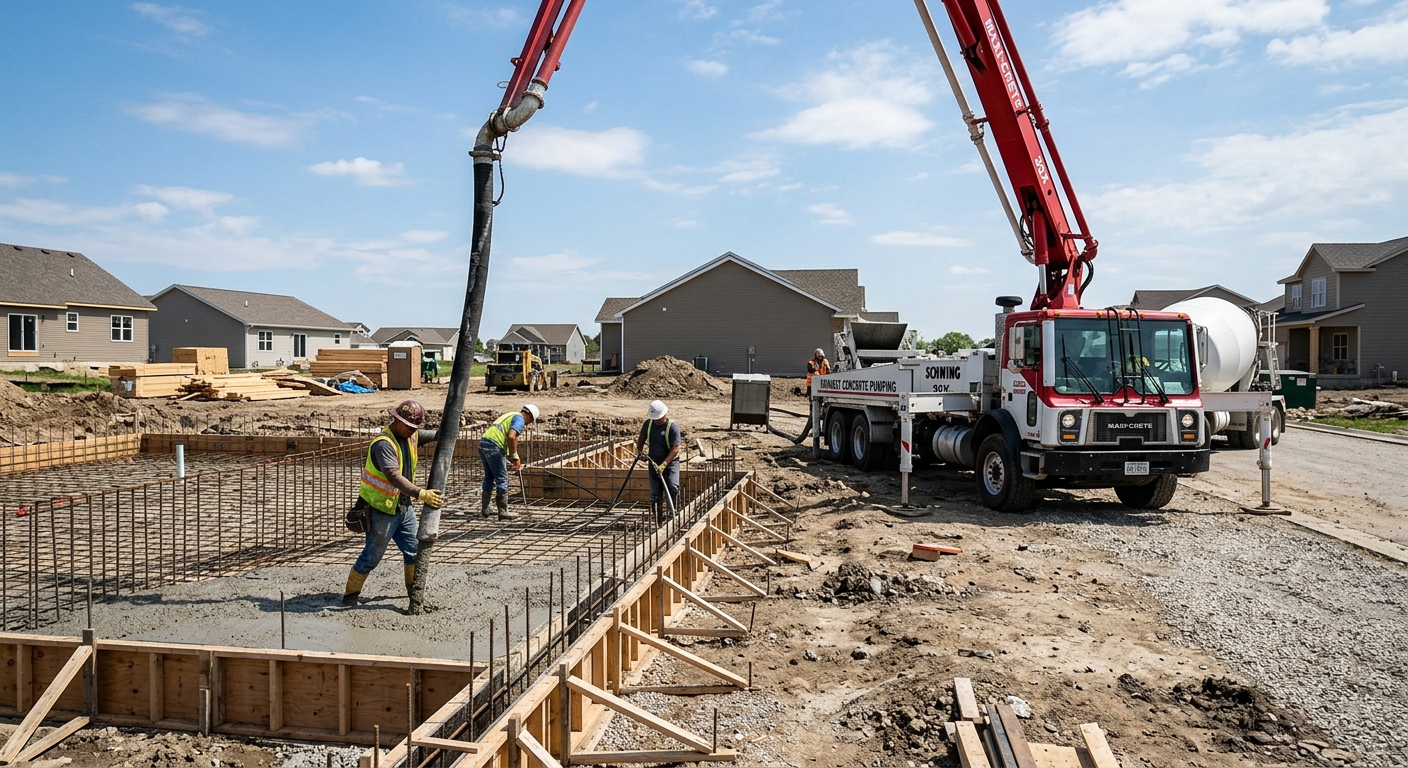
Concrete work options and costs in Jasper Park
Jasper Park, Alberta is a small community (population 1,832 as of the 2021 Census) where homeowners tend to prioritize durable concrete flatwork—especially around driveways, patios and walkways that have to survive Calgary-area freeze–thaw swings. In this market, concrete is often planned alongside the most common housing types in the region; as a benchmark, single-detached homes dominate the owner-occupant landscape, which typically means more exterior slab work tied to garages, rear yards and entryways. Because Calgary’s climate uses a design frost depth of about 1.2 m (roughly 4 ft), foundation and footing excavations and concrete volumes are engineered to bear on undisturbed soil below that level. That’s a major reason concrete foundation pricing in Alberta often tracks higher than milder regions: there’s simply more digging, more formwork, and more structural concrete.
Concrete pricing here also reflects winter reality. Exterior flatwork has a shorter practical pour season, and colder-weather placement needs winter-grade mixes, insulated blankets and sometimes temporary heat to get proper curing. When de-icing salts get used on sidewalks and driveways, sealing becomes less optional—surface scaling and early spalling show up faster if specs are rushed. Contractors who are set up for cold-weather curing and who build consistent granular base prep tend to be in the busiest demand pockets of Jasper Park, particularly near the more developed residential edges where access and staging are tighter. With those realities in mind, here are common options and realistic price ranges to help you compare quotes before you ask for an itemized breakdown.
| Application |
Typical Size |
Key Spec |
Finish Option |
Price Range |
| Concrete driveway (standard broom finish) |
400–600 sq. ft. |
Air-entrained exterior mix, compacted granular base, control joints |
Broom finish |
$12,000–$18,000 |
| Exposed aggregate driveway |
400–600 sq. ft. |
Air-entrained exterior mix, base prep, proper curing to reduce spalling risk |
Exposed aggregate (wash) |
$15,000–$22,000 |
| Stamped concrete driveway or patio |
250–450 sq. ft. |
Air-entrained exterior mix, reinforced slab where needed, integral colour |
Stamp + release + colour |
$15,000–$26,000 |
| Plain concrete patio or walkway |
150–300 sq. ft. |
Air-entrained mix, compacted sub-base, joint layout |
Float + light broom edge |
$5,000–$9,000 |
| Garage floor (interior slab) |
300–500 sq. ft. |
Vapour barrier where needed, reinforced slab, proper curing schedule |
Standard broom or smooth trowel |
$10,000–$16,000 |
| Foundation footings (structural, below frost) |
Typical house/garage perimeter |
Excavation to undisturbed soil below frost depth, rebar, structural concrete |
Structural finish (not cosmetic) |
$28,000–$45,000 |
Prices are estimates only and vary by project scope, site access and material selection.
What affects the price of concrete work in Jasper Park
In Jasper Park, you can see the same concrete scope price apart by 30–50% across contractors because the “hidden” line items aren’t hidden for long: excavation depth, granular base thickness, rebar detailing, concrete mix design, cold-weather curing, and finishing labour all swing the final number. In a Calgary-region market with heavy freeze–thaw cycles, engineering practice isn’t optional—footings must extend below the design frost depth (Alberta often lands in the deeper range, up to about 2.4 m depending on site conditions and design), and exterior slabs must use air-entrained concrete to survive repeated freezing and thawing without scaling or spalling. Cold-weather curing precautions—insulated blankets, tenting, and sometimes auxiliary heat—add cost when you pour in late fall or early spring, and they also limit contractor availability during the short safe placement window.
De-icing salt accelerates surface wear, so we usually plan for joint spacing and sealing on exterior work. That’s why two “driveways” can differ: a standard broom-finish driveway might land in the $12,000–$18,000 band when base prep and curing are straightforward, while a decorative or exposed-aggregate driveway typically costs more because materials and finish labour increase—often pushing into the $15,000–$26,000 range depending on area and complexity. Here are local examples of what raises or lowers cost: longer driveway approaches with poor access require more manpower and may increase truck waiting time; a slab on poor subgrade (wet spots, frost-susceptible soils) may need deeper granular replacement; and garage floors or patios tied to existing drainage can require extra demolition and regrading, which doesn’t show up in the square-foot price unless the quote is truly itemized.
| Price Factor |
Why It Matters |
Cost Impact |
| Frost line depth — determines footing depth and form height |
Footings must bear below design frost depth to prevent frost heave and seasonal movement |
Higher excavation and concrete volume; can move foundation pricing significantly |
| Site preparation — excavation, grading, compacted granular base |
Strong base reduces settlement and keeps joints/cracking patterns predictable |
More truckloads and labour when soils are unsuitable or grades are steep |
| Reinforcement — rebar or wire mesh requirement |
Controls cracking and improves load capacity for slabs and structural elements |
Material + tying labour; can be a major delta between “cheap” and “durable” specs |
| Mix design — air-entrainment and compressive strength spec |
Air-entrainment helps concrete resist freeze–thaw damage |
Winter-grade and spec’d mixes cost more, especially when cold-weather placement is needed |
| Finish type — broom vs. stamped vs. exposed aggregate |
Labour intensity, finishing tools, and curing/cure-time management differ |
Decorative finishes typically add cost vs plain broom-finish concrete |
| Pour size and concrete truck access to site |
Longer pours or limited access increase time, staging and potential waiting |
Extra labour hours and possible pump/extended reach requirements |
| Cold-weather curing precautions — heating and blankets |
Proper curing reduces surface scaling and structural issues over time |
Can add noticeable line-item cost in shoulder seasons |
| Control joint pattern and sealing cost |
Joints guide cracking and sealing helps repel de-icing salt damage |
More layout time and materials, but fewer premature failures |
Permits & regulations in Alberta
In Alberta, structural concrete work typically requires more oversight than decorative flatwork. In Jasper Park, a building permit is generally needed for structural elements such as foundation footings, foundation walls, grade beams, and other load-bearing concrete work. Many projects also require engineered drawings that the municipality reviews as part of permit processing. By contrast, concrete flatwork—like driveways, patios and walkways—usually does not require a permit unless it affects lot grading, alters drainage in a way that impacts municipal requirements, or changes impervious surface coverage/right-of-way conditions. Always confirm with the local authority before breaking ground, because the “permit/no permit” decision can hinge on drainage and grading.
For contractor accountability, verify insurance and coverage before you sign. Step-by-step: (1) ask the contractor for their certificate of liability insurance naming you as additional insured when applicable; confirm limits and expiry date. (2) confirm they have WSIB/WCB clearance (the clearance letter is the cleanest proof). (3) request proof of coverage for the crew doing the work, not just the corporate office. If you’re hiring structural trades tied to concrete foundations, expect additional documentation through the permit process.
Finally, get references on similar-scale Alberta projects and keep your quote tied to specific specs—like air-entrainment and cold-weather curing—so compliance isn’t just paperwork, it’s built into the mix and workmanship.
Getting concrete right in Jasper Park's freeze-thaw climate
Concrete failures in Jasper Park are rarely “mystery problems.” In a Calgary-area cold continental climate, the usual causes are inadequate base prep, incorrect mix design, weak curing, and skipping the joint/sealing approach. If water sits in the slab or subgrade, freeze–thaw expansion pushes against weak surfaces and lifts them—spalling is the common outcome. The way we spec concrete here is tuned to engineering practice: (1) base preparation with a compacted granular sub-base to the right depth for local soil and frost conditions; (2) an air-entrained exterior mix—typically 5–7% air content for exterior flatwork—with at least 32 MPa compressive strength; (3) control joints placed to limit random cracking; (4) curing for a minimum of 7 days under proper conditions, with cold-weather precautions (insulation blankets and temperature management) when placement happens near freezing; and (5) penetrating sealer applied after cure, usually 28 days post-pour, to help repel de-icing salts and reduce surface deterioration.
Ask the contractor to explain how they’ll manage the cold-weather curing window. That conversation is often where price differences make sense. For example, a plain patio/walkway in the $5,000–$9,000 band might look similar at first glance to a decorative job, but adding proper winter curing and correct base/thickness decisions can narrow the “cheaper option” gap—because the extra cost is buying durability, not just appearance. In contrast, if someone promises a low price but won’t commit to air-entrainment, joint layout, and cure protection, you’re likely paying later in repairs and resurfacing.
| Spec |
Why It Matters in Jasper Park |
What to Ask For |
Impact if Skipped |
| Compacted granular base (depth?) |
Reduces settlement and keeps water away from the slab through freeze–thaw cycles |
“Confirm granular base depth and compaction method for my soil condition; include haul and grading.” |
Uneven settlement, accelerated cracking, premature joint failure |
| Air-entrained concrete mix (target air %?) |
Helps concrete resist freeze–thaw damage on exterior surfaces exposed to water and salt |
“What is the air content target (typically 5–7% for exterior flatwork) and how will it be verified?” |
Scaling/spalling, surface deterioration within a few winters |
| Compressive strength (MPa rating) |
Improves durability and structural performance in a cold climate |
“Confirm minimum 32 MPa (or higher if required) and test/inspection approach.” |
Lower durability and higher risk of cracking under freeze–thaw stress |
| Control joints (spacing per ACI guidelines) |
Directs cracking to predictable lines and reduces random cracking |
“Provide joint layout drawings or spacing plan and timing of cutting.” |
Random cracking, water infiltration, and later spalling |
| Minimum 7-day curing period |
Curing strength gain is critical to resist early freeze damage |
“How will you protect and cure the slab for at least 7 days, including blankets/heat if needed?” |
Surface weakness, increased scaling, reduced service life |
| Penetrating sealer (when applied after cure) |
Repels de-icing salts and reduces surface moisture penetration |
“What penetrating sealer is specified and confirm application after cure (commonly ~28 days)?” |
Faster surface wear and salt-related scaling |
How to choose a concrete work contractor in Jasper Park
Choosing the right contractor in Jasper Park is mostly about proof: proof they can build to Alberta expectations, and proof they’ll stand behind workmanship. First, verify licensing/registration where applicable for the trade. Next, check liability insurance: request the certificate of insurance, confirm it’s current, and make sure it covers the scope you’re hiring for. For coverage, ask for WSIB/WCB clearance—this is usually a straightforward clearance letter the contractor can provide. Don’t accept “we’re covered” as a claim; look for the document and confirm dates.
Then get 2–3 itemised written quotes, not lump sums. You want separate line items for excavation and disposal (if applicable), granular base, reinforcement, concrete supply, forming, finishing, curing methods, and sealing. Also ensure you understand exclusions: is cold-weather heating included if temperatures drop? Is permit paperwork included for structural work? Is sawcutting and joint sealing included or priced as an add-on? Warranty terms matter too: ask for workmanship warranty length, what it covers (cracking, spalling, joint failure), and whether it’s backed by the manufacturer when applicable.
Payment schedule should stay sensible. A good rule is never paying more than 10–15% upfront. Hold back a portion until the job is complete and surfaces are cured and finished as specified. Finally, get a timeline in writing with a start date, pour day plan, and completion estimate—especially important in Alberta’s shorter exterior placement season.
- Request an itemised quote with labour and materials separated (no “one price covers all” only).
- Confirm air-entrainment and exterior curing plan in writing for freeze–thaw durability.
- Ask for granular base depth and compaction specs, not just “proper base.”
- Verify rebar/wire mesh placement and slab thickness for your specific application.
- Confirm control joint spacing and cutting timeline (when sawcutting happens).
- Ask who supplies the concrete and whether winter-grade curing measures are included if needed.
- Get proof of liability insurance (certificate) and WSIB/WCB clearance letter.
- Check disposal and haul-away—mud and excess soil can be a hidden cost.
- Confirm sealing product type and application timing (commonly after cure).
- Make sure cleanup/removal of forms and debris is included in scope.
- Warranty in writing: workmanship duration, coverage, exclusions and claim process.
- Never pay more than 10–15% upfront; keep a holdback until completion.
Concrete red flags in Jasper Park include: “standard mix” promised for exterior work without confirming air content, refusal to discuss curing/blankets when weather is cold, quotes that omit control joints or sealing details, vague scopes that don’t list base depth and reinforcement, and contractors who rush decision-making without providing itemized breakdowns.
Frequently asked questions — concrete work in Jasper Park
How long does a concrete project take in Jasper Park?
In Jasper Park, timelines depend on weather, thickness, and whether the work is structural or flatwork. For a typical exterior patio or walkway, you’ll often see scheduling in phases: excavation/base prep, forms, pour, then curing protection. Even if the pour day is quick, you should plan for at least a week of controlled curing before you expect normal use. A driveway can take longer because prep and finishing are more extensive, and cure protection matters more during cold snaps. If decorative work is involved, finishing and curing procedures are more demanding. In Alberta’s freeze–thaw season, contractors also coordinate around temperature and wind chill; that can add days to your overall calendar plan even if actual labour hours are similar (Statistics Canada, 2021 Census for the community size context).
What is a concrete overlay and is it suited to Jasper Park?
A concrete overlay is a new concrete layer placed over an existing concrete slab, usually after surface preparation (scarifying, bonding agent, and repair of weak areas). It can be suited to Jasper Park when the original slab is structurally sound and the problems are mainly surface wear—not major settlement or widespread cracking. However, overlays still have to handle Alberta freeze–thaw cycles and de-icing salt exposure, so the mix design, bonding method, and thickness matter. If the existing slab is failing due to water intrusion and poor base drainage, an overlay can trap moisture and accelerate the next cycle of scaling. For many homeowners comparing options, it’s often easier to budget for full replacement when the slab is badly deteriorated, versus an overlay that may only address surface issues. Either way, ask about air-entrainment and curing protection—those specs drive long-term performance in Calgary’s climate.
How do I seal concrete to protect it in Jasper Park?
Sealing in Jasper Park is mainly about repelling water and de-icing salts so the surface doesn’t degrade quickly through freeze–thaw cycles. After a new pour, wait until the concrete has cured sufficiently—typically about 28 days—before applying a penetrating sealer. Skipping cure time is a common mistake that can reduce penetration and long-term performance. Choose a penetrating sealer (not just a coating film) designed for exterior exposure, and ensure the slab is clean and dry before application. For driveways and walkways, make sure joints are cut and properly treated so the sealer supports water management rather than sealing in cracks. If you use salt in winter, sealing becomes more important; it helps slow surface scaling, which is a frequent early failure mode in colder Alberta applications. Your contractor should specify product type and application timing in writing.
What is the difference between concrete and cement?
Cement is one ingredient inside concrete. Concrete is the full engineered material: cement plus water plus sand/gravel (and sometimes admixtures like air-entrainment for exterior freeze–thaw durability). In Alberta, the practical difference you’ll feel is in how concrete is specified for the job. For example, exterior driveways and patios in Jasper Park need air-entrained concrete mixes so the freeze–thaw cycle doesn’t break down the surface. That means the “cement mix” isn’t the whole story—contractors need to specify the total concrete performance (air content and strength, plus curing steps). When you request a quote, ask what concrete mix is being used for your exposure (salt, wetting, winter temps) and whether cold-weather curing measures are included if placement happens near freezing. That’s how you ensure you’re paying for the right engineered concrete, not just “cement delivered.”
How much does concrete work cost in Jasper Park?
Pricing varies with scope, thickness, site access, reinforcement, and finish level, but you can use local Alberta price bands to sanity-check quotes. For concrete driveway work, budgets often land in the $12,000 – $18,000 range for standard broom finish, while decorative options like stamped concrete or exposed aggregate can climb into $15,000 – $26,000 depending on area and complexity. Plain patios and walkways are commonly budgeted around $5,000 – $9,000, while foundation footings (below frost) typically sit in $28,000 – $45,000 depending on perimeter length, excavation conditions, and engineering requirements. In Jasper Park, cold-weather curing and deeper excavation to suit frost-protection needs can affect the final number, so always ask if winter-grade measures are included. If two quotes for the same slab size differ by 30–50%, it’s usually base depth, reinforcement, cure protection, or finish details.
How deep must footings be for Jasper Park's frost line?
For Jasper Park concrete foundations, footing depth is designed around frost protection so the concrete bears on undisturbed soil below the design frost depth. In the Calgary region, local practice commonly uses a design frost depth of about 1.2 m (roughly 4 ft) as a baseline for engineered foundation design, but your actual required depth can vary with soil conditions, drainage, and the specific building/structural design. That’s why quotes for foundation footings shouldn’t be purely “typical”—a good contractor confirms excavation depth on a per-site basis and coordinates with engineering/permit drawings for structural elements like footings and grade beams. Because freeze–thaw cycles are frequent here, relying on shallow assumptions increases frost-heave and seasonal movement risk. If you’re unsure, ask your contractor to reference the engineered drawings and explain how they achieved the required bearing depth and compaction below the frost line.